
Scientists are not the most social people on the planet. Many of them would rather be holed up in their labs trying to make the next big discovery than hanging out on Facebook throwing virtual pies at each other (although there are exceptions). But what if they could organize their all their scientific papers online and share them easily with other members of their lab?
Mark Kaganovich figures that will get them online. After graduating from Harvard with undergraduate degrees in biochemistry and computer science two years ago, he set out to create Labmeeting. In May, 2008 he closed a $500,000 seed round from Peter Thiel, Kinsey Hills, and other angel investors. And since last week, Labmeeting has been open to anyone with a college e-mail account.
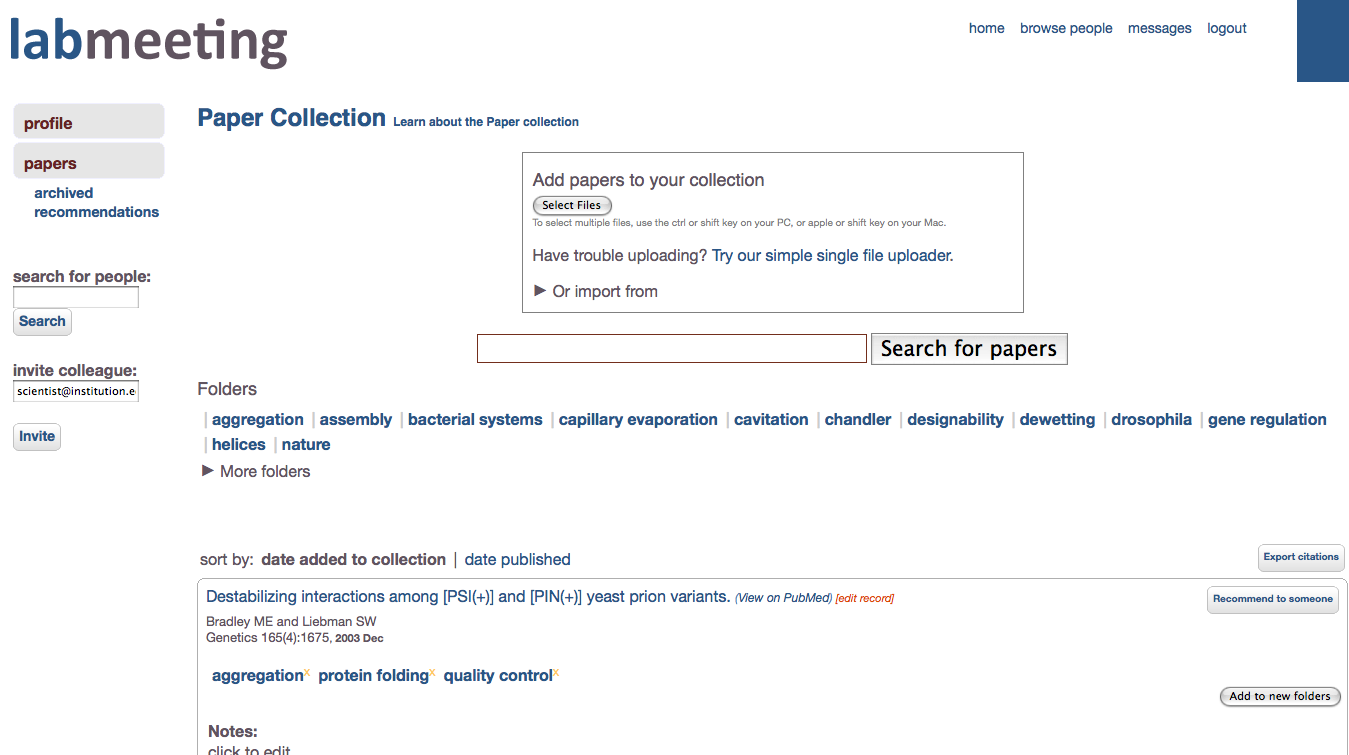
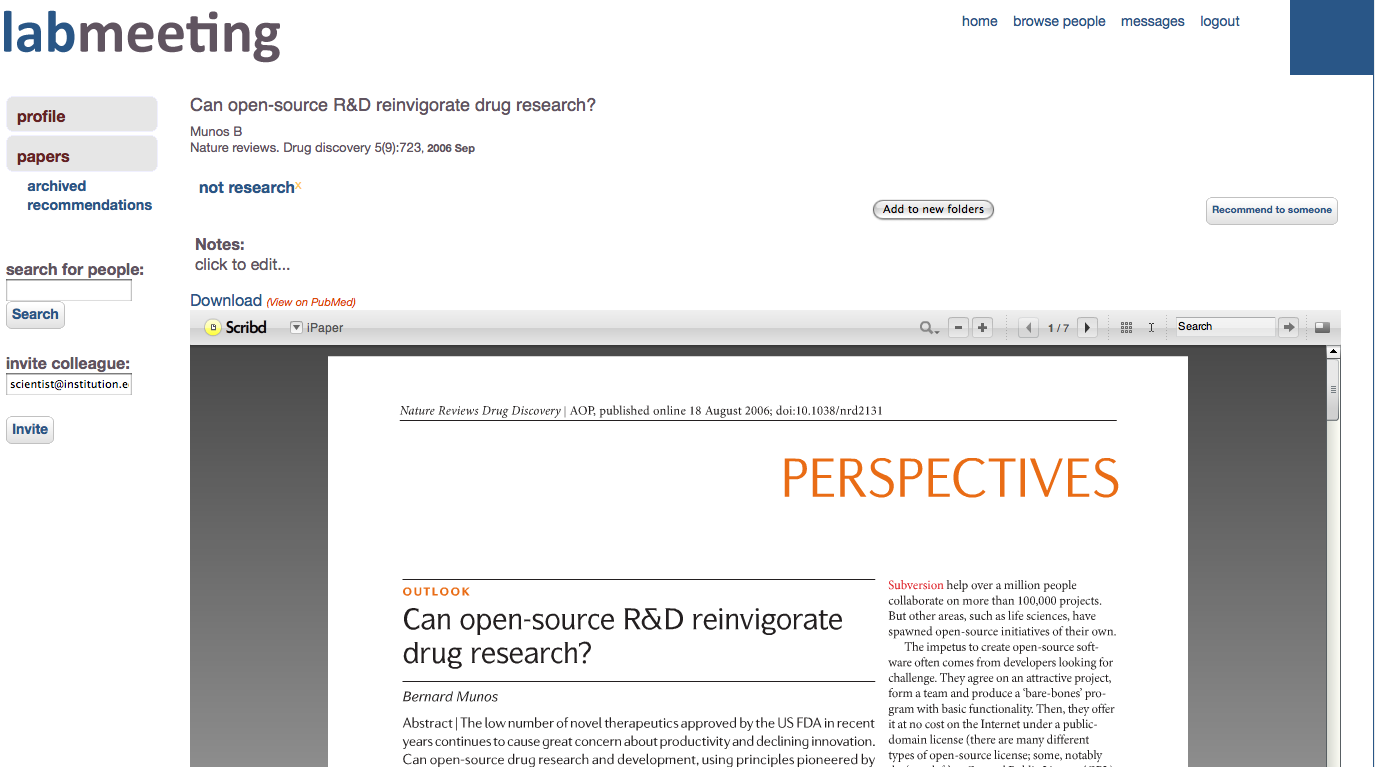
Typically, scientists have stacks of papers, protocols, and notes in their offices that they pass around as PDFs. Labmeeting is designed first and foremost as a document management site that allows scientists and students to easily upload all of those PDFs, organize them, search them, and share them. Scientsist can create groups, and invite other members of their labs to create a common repository of papers that can be accessed from anywhere. The PDFs appear inside an embedded Scribd window (Kinsey Hills is also an investor in Scribd).
Says Kaganovich:
What we are trying to do is change the way information in biomedical research and the medical community is distributed and retrieved.
Scientists can recommend papers to colleagues, mark them up, create collections, and follow what other scientists are collecting. Each scientist gets a profile page. By interacting through their research, they are more likely to interact with each other. Labmeeting could also form of basis a community ranking system for scientific papers, based on who is reading, writing, and sharing them.
Labmeeting is free for individual scientists and students. Eventually, Kaganovich plans to charge subscription fees to corporate users such as drug and biotech companies.


sounds like its gonna be a really fun site to pick up new friends. If you think the library is the most social place to pick up women.
http://www.nodatetonigh.com
Yeah, obviously… can’t spell the address right. Fail!
thankx for da hiads nup Jon
http://www.nodatetonight.com
doesn’t that raise security issues? i mean, obviously the staff of this website has access to their database, therefore to each uploaded documents.
if i was a scientist up to discover the secret of artificial nuclear fusion, or the vaccin for AIDS, do you really think i would leave my notes up to some website owners you don’t even know if they’re trustworthy and won’t sell your invention or whatever.
Hi all,
I went into the site as the Idea of it was interesting. BUT the I could not finish first step of signing up. I dont have and .edu or .org email that I can use as I am working as a Professor in a collage and dont have any one of those suffix to my email. So it scored couple of bad points for that. As I said the idea is nice and this reminds me something like an electronic lab book.
For a scoentific network one can find couple of them on the web. A very good one would be http://www.scie...stsolutions.com I use it frequently and got all of the answers to my scientific problems on top of shortening the answer time to the scientific questions one can also develope a scientific network all around the world and not just in the US.
No problem in registration and one could also see everything without registration.
Guy
I was actually engaged with a couple of scientists who were looking to put something very similar together. We got started and then they lost their major piece of funding due to the discovery of a competitor that was further along in the process. Looks like I found out who that was!
Personally I don’t think this is not a very promising project … Typical PI, postdoc or PhD students have their own familiar ways to find information, papers, or collaborators. The research domains are usually very specific and we know that there are only a few guys or labs doing the similar kind of things. And sharing ideas would be a very tricky thing …
Another major issue is that when a paper is published the journal owns the rights to it. You can’t just release it all over the web. That’s the biggest problem with these social sites.
Increasingly scholarly journals are permitting authors to release their papers into the public domain. Most of the journals have rules about going public domain. At times there is a time limit — 6 months after publication by the journal, etc. But the flow of ideas is not going to be stopped on paper.
Got the following error/feature:
”
The email address must be from an academic institution and hence must end with “.edu”
”
So, all researchers outside the US are out, by default? Why should I have to contact labmeeting for them to add my University’s domain to the approved list?
FAIL.
no, it doesn’t literally need an edu. any academic adress will do. i was able to sign up with my “.ac.il” academic address from israel.
Just to add to this, for those readers without academic email addresses who are curious what the “profile” aspect of the site looks like, here’s a link to the public profile of one of the co-founders, Jeremy England:
http://www.labm.../Jeremy_England
Love to see how this is doing 365 days from now…
LabMeeting: Thrive or Fail[VOTE]? http://snurl.com/37rpb [www_thriveorfail_com]
Well, it would be interesting having social scientists inside. Let’s build it!
Oooops. Right website now.
Well, it would be interesting having social scientists inside. Let’s build it!
How is this different than the Thomson Reuter’s ResearcherID site (http://www.researcherid.com/)?
looks like it would be useful for science to take place while easily connection people at the same time.
http://blabtech.blogspot.com
We run the largest professional network of scientists in the world at http://www.scilink.com. Try us out!
Interesting idea but if you were in the Research arena, you’d know that it’s cutt throat competitive.
We don’t share. There’s a reason why we keep all doors in the lab LOCKED.
Sharing = Helping a Competitor = Possibly losing years of hard work
To add to my comment: Think of Pepsi and Coke sharing the secrets to their formula or what they’re looking at…
Not gonna happen. It’s war in the research arena.
As a Ph.D.-level scientist who has spent over a decade in the lab, I can immediately see that this site is designed by people who really have no research experience. It just doesn’t cater to true lab scientists because it is lacking too many features. The amount of work required to set myself up on the site would not be worth it. I like the PDF storage and searching, but that is done by Scribd, not labmeeting.com There are other issues:
1.) Researchers do not want to post valuable, secret research in a place that could be compromised.
2.) Scientists are already aware of the labs doing the most relevant research, and if they want to find a scientist in another discipline, the best way to do it is a Pubmed search for high impact papers, because this method is guaranteed to return the most relevant results, not just the names of people who happened to register on labmeeting.com
“As a Ph.D.-level scientist who has spent over a decade in the lab, I can immediately see that this site is designed by people who really have no research experience”
Then have a look at http://www.scilife.net and you will discover that this site was developed by and for researchers.
Does anyone still use Connotea ttp://www.connotea.org ? – this has been around for a few years now and has evolved from a del.icio.us type bookmarking/article sharing space to a more robust interaction environment (I’m avoiding the word “social” since that seems to get everyones’ hackles up whether they’re inside or out of the scientific community)
It has the added benefit of being a product of the Nature Publishing Group and a nice API.
2collab.com from Elservior seem a more viable approach. It let people share note, comments, and rate the published article. Sharing on-going research project won’t work at least on the cutting edge research.
I am convinced that there is a need for such a website. Probably the introduction to the post is a little misleading, since it is not meant to be a social network, rather a research sharing site.
Twidox.com has taken a more ‘open’ approach; focusing on ‘quality documents’ such as research, data, statistics, articles and so forth. Check out http://www.twidox.com
Disclaimer: I work for twidox
If scientists are that party animals, then a lot of things won’t get done.
sorry w/o “that”. Grammar.
Just to clarify a few things from previous comments: Labmeeting was created by Ph. D. students and postdocs in biomedical research science (two of us from Stanford) with a combined 30 years of experience in a dozen different labs. We agree completely that scientists prize security and privacy, and that’s why our features emphasize individual utility and sharing within the lab. Our goal is to help scientists more rapidly discover published information that’s relevant to them, and coordinate better with the people they work with every day.
This post really lacks a lot of background on web tools for scientists. Labmeeting is just one of many websites and by no means the most used or interesting. Check out the social networks: Nature Network, Epernicus, Scilink; reference managers: Zotero, Connotea, CiteUlike; Science videos : JoVe, SciVee … among many others.
Scientists have been slow to pick up these things but Labmeeting faces some though competition.
I am a PhD student and have been experimenting with lab meeting for the last month. There is real value for me in sharing and viewing what papers people in different networks (my lab, my department, a course I teach etc) are reading, and I like the feed-style for paper alerts. I encourage people to check it out.
Actually, scientists are very social people and the first sentence in your article shows that you subscribe to some idiotic stereotype about educated people. Scientists love to socialized with other people like them. They just have better things to do than waste their time on Twitter or Facebook.
Cheers!
I agree with the statements above along the lines of ” Researchers do not want to post valuable, secret research in a place that could be compromised.” Scribd’s terms of service (http://www.scribd.com/terms) state: “By distributing or disseminating User Content through the Scribd Platform, you hereby grant to Scribd a worldwide, non-exclusive, transferable, assignable, fully paid-up, royalty-free, license to host, transfer, display, perform, reproduce, distribute, compress or convert for distribution, and otherwise exploit your User Content, in any media formats and through any media channels, solely in order to publish and promote such User Content in connection with services offered or to be offered by Scribd. Such license will apply to any form, media, or technology now known or hereafter developed.”
I can’t see scientists agreeing to grand Scribd such a broad license for their top-secret research. In addition, this will severely compromise publication with any journal that requires an exclusive license to publish.
The important thing here is to keep track of the distinction between the terms of use for scribd.com, where people post documents out on the open internet for free distribution, and the Scribd API, which is what we use for flash document viewing (iPaper) inside each individual Labmeeting user’s private paper/document collection.
http://www.scri...platform/apitos
Is the API not part of the “Scribd Platform”?
Interesting ideas, especially the “community ranking system for scientific papers, based on who is reading, writing, and sharing them.”
That is one of the things we have in mind with Mendeley (http://www.mendeley.com), a free Windows/Linux/Mac software for managing & sharing research papers. Mendeley then generates statistics about the most popular papers, authors and topics in the network.
Based on a user’s research paper collection, we’ll then be able to recommend papers he may not know yet, or introduce him to people with similar research interests. Of course, privacy is protected and users can select with whom to share their data. Sort of like a “Last.fm for research”, if you will!
“Scientists are not the most social people on the planet. Many of them would rather be holed up in their labs trying to make the next big discovery than hanging out on Facebook throwing virtual pies at each other (although there are exceptions).”
As far as my experience is concerned, the exception is definitely the rule! all the phds and postdocs procrastinate on Facebook, and they are very sociable to make up for lab time :p… Even lab time can be social, since the lab is pretty open plan.
Goooood Luck Labmeeting. I guess you have never heard of academic institutions beyond the borders of the United States!. No university in CANADA ..hello we do have universities… has an .edu extension.. Sorry ..no Canadians allowed in the club. Bye bye
Can anyone confirm if Peter Thiel is looking to make a run for the presidency in 2012? I found this site: http://www.peterthiel2012.com
As a Ph.D holder with 2 masters myself, i guess i somewhat qualify as a researcher. Regardless of the merits of such a site, the comments above by robotics rather stunned me.
“…. first sentence in your article shows that you subscribe to some idiotic stereotype about educated people….love to socialized with other people like them.” blah blah blah…
the only idea ‘robotics’ makes me subscribe to is that despite having all that education one can still be an ass. Educated? Other people like them? what, researchers are some rarefied breed, and others are the unwashed uneducated mass, is that it? You really need to cut down on your arrogance if you want to amount to something that actually matters in life.
There are two similar startups creating soc nets for academics. Both London based:
- http://www.mendeley.com
- http://www.kappaprime.com
I think it is an interesting concept and I sure would have liked to use a platform like that in university.
Sounds like http://www.academia.edu/ which tries to do this for all academics.
If I was an academic, I’d use it!
Sounds like http://www.academiaconnect.org may have a better approach
The Scribd API Terms of Use states “These API Terms are incorporated into and are subject to the Scribd Terms of Use”
Vadlo is a cool search engine for scientists, with great cartoons!
There is much more powerful Web 2.0 Tools for Research and scientific collaboration. You may give it a Review: http://sciencestage.com
Labmeeting and scribd are only focusing on Documents.
Why limiting the world of science and research and not using also streaming media to increase knowledge transfer.
Hey guys,
I use researchgate and I think it is fantastic.
Here some texts from their blog:
“To make them even more useful, we upgraded our database to include the content of several major scientific databases, namely PubMed, Citeseer, RePEc, ArXiv, IEEE, NASA. Currently, more than 30.000.000 scientific articles from a broad range of scientific fields are included. Searching for keywords is one thing – relating research output based on content is another. We developed semantic tools that are able to do that.”
researchgate offers a powerful search, a new semantic search with the possibility to paste whole abstracts, which will be analysed semantically and closely related papers will be shown.
The group functions are pretty nice. Filesharing tool, voting tool, etc.
here is their video in youtube:
http://www.yout...h?v=E-CIyenkZ8A
http://www.researchgate.net
http://blog.researchgate.net
hi friends,
i also used researchgate and its wonderful.
researchgate – i use it as well! they have just launched a new version!
really good idea
i use researchgate too it is welldone
Dear all,
Since all the people reading this post are interested in social networks for scientists (weither they like it or not) I thought you may be interested in PRESANS: yet another social network for scientists: http://www.presans.com.
I allow myself to post a comment the post related to LabMeeting as we are not competitors at all: in our case, the social network is actually “just” a tool: PRESANS is a new open innovation intermediary in France for scientists around the world. We are launching the private beta period mid-september 2009. Registration is already open on http://www.presans.com.
Basically, PRESANS is a social network for Experts (researchers, scientists, engineers etc.). We provide Experts with a range of free services through our internet platform and Experts are paid significant rewards to solve R&D challenges (from tens to hundreds of K euros). So the social network is really a tool to help us to manage and keep the contact with the Experts.
This means that, even if PRESANS is another social network for scientist, this one is also for you!
Thank you very much for reading this post and I am really looking forward to reading your comments and to seeing you PRESANS (http://www.presans.com/). And REMEMBER: registration has already opened for the beta and the actual launching is mid-september 2009.
Cheers,
Albert Meige, founder of PRESANS (and researcher in Plasma Physics!)