
Many life science students and researchers couldn’t live without PubMed, a free comprehensive research database that includes articles related to health and a number of biological sciences. Unfortunately, navigating the intimidatingly massive database can be difficult for novices - the interface looks like it hasn’t seen an update in about a decade.
Ologeez!, a new Stanford startup that recently launched in public beta, is looking to help. The site offers an intuitive portal for searching through science articles that integrates social features that it hopes will help scientists find relevant material and colleagues more quickly. For now the site is limited to users at universities, but founder Jason Hoyt says that it will eventually expand to the general public.
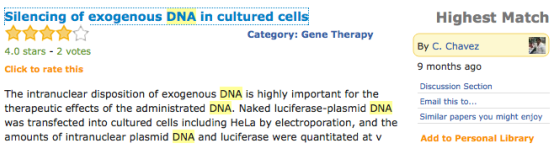
Ologeez accesses PubMed articles through the database’s API, but it goes beyond just improving the interface. Users can rate and discuss each article on the site, which will eventually help the most credible articles rise to the top of search results. Users can also upload articles to Ologeez that aren’t included in the PubMed database. Each article can be categorized, which allows the site to offer Netflix-like recommendations for “other items you might be interested in”.
The site’s social networking features aren’t targeted at individuals (this isn’t a Facebook for scientists). Instead, it’s aimed at groups of scientists who collaborate together. For example, members of a lab could share calendars, safety guides, and lab protocols on the site, as if it were a virtual bulletin board. Hoyt says that the site also allows users to search through the database by keyword and field, potentially connecting researchers who may be interested in working together.
Ologeez’s real flaw is that it has very few article ratings and discussions at this point (there simply isn’t a sizable user base). But it can’t just open the floodgates to the masses. To succeed, it will need to establish itself as not just a popular resource for article ratings, but a credible one as well - something that will be hard to do.


i disagree with this assemsment. It doesn’t have a large user base now but since pubmed is the google of lifescientists, any improvement over the UI is a welcome one and will undoutedly attract the masses.
Sounds like what Zotero is doing.
Wasn’t this one of the original uses of the internet (i.e. ARPA)?
Hey TechCrunch. Congrats for your acquisition by AOL. I heard it’s a $20M acquisition so Michael welcome to the Milionaires club
Sounds like what Zotero is doing.
TechCrunch got purchased by aol for 20 Million?????? Congrats guys. I hope AOL doesn’t destroy the site. Go to http://www.gothamtechminute.blogspot.com
There already is a very good UI alternative to Pubmed called Hubmed, made by Alf Eaton : http://www.hubmed.org/
@ Derick : Zotero is a Firefox extension that is a bibliography manager, to store references, not an article search engine.
Seems like this space is hotter than I expected. Ologeez is doing a very similar thing to KappaPrime.com, a London-based startup. Key difference is that we (at Kappa Prime) rely more on user submissions and less on getting articles from other DBs or from the web as Ologeez does.
Pubmed works fine for me. Setting up an RSS feed is simple and gets straight to the point.
Thanks for the writeup Jason. And nice name btw. I’m up late, 4:30AM, and actually using PubMed, and my site ;-), trying to finish up my dissertation due in two weeks.
Commenters are totally correct that PubMed alternatives are popping up all over now. One of the originals is CiteUlike, though that is just user submitted abstracts. Dissatisfied with PubMed and Google Scholar, I started development of Ologeez a year and half ago in my spare grad school time before these alternatives existed.
My goal with Ologeez was not only a user driven database, PubMed interface (other databases to follow soon), and an online EndNote/BibTex library, but to create a central database for lab groups to find each other and hopefully collaborate (read: what social networks are supposed to be used for).
I also wanted to create new memes and structure for peer-reviewed literature based on user dictated categories. Getting users involved, instead of just an algorithm based spider crawl, means a recommendation engine could start taking effect as well.
Ologeez also isn’t exclusive to the life sciences. Engineering, business, and social sciences in an academic sense are all included.
Anyway, like most of my research, Ologeez is an experiment, but hopefully a successful one.
Regards,
Jason
Hi
I’m glad that many alternative to PubMed are coming up.
Some of them are just alternative interface with additional functionality as HubMed others perform analysis to the data to give better performance and save time like e-lise or novoseek.
Anyway, based on what has been said i see Ologeez more like biomedexperts, scilink or authoratory.
When writing my thesis, I usually just used Google academic search. It was connected with the library system automatically, so I had instant access to most all of the articles.
I do like this idea in some ways, but we do have to discuss the implications for academic credibility in terms of the philosophy of science. What is ratest best is not always the best–Consider controversial articles that focus on the anomalies that a theory cannot explain. It may be considered less scientific, but it is also the way we see paradigm shifts in science. There are a million ideas for how to accomplish (or ruin) objective science–And this is one such approach, user voting.
Not a big deal perhaps, as it is one of many tools. Perhaps it is important that we do have many different search sources for this very reason.
Another alternative to PubMed. I use Biowizard.com for my PubMed search, they offer significantly more features.
Sam, you beat me to it. BioWizard quickly replaced PubMed as my research destination 2 years ago. They just added a proceedings database too.
Clayton, I think you’re making an interesting point about the implications of public rating mechanisms for research papers.
However, I don’t quite share your pessimism that this might “ruin objective science”, despite the danger of positive/negative rating manipulations, because neither public rating nor anonymous peer review will ever be free of hidden agendas. I believe that every researcher who has gone through the peer review process a few times (as I have) will be inclined to acknowledge this.
A possible alternative to peer reviews and citations as measures of academic credibility could be “implicit reviews” of papers - by measuring the actual “usage” of papers. For example: If a great number of researchers spent a lot of time reading a recently published paper, as opposed to quickly scanning through a paper and then discarding it, this might be interpreted as a sign that this paper has something important to say - long before citations start to appear.
In short, a “Last.fm for research”, if you will. That’s the idea behind Mendeley (http://www.mendeley.com), a project I’m currently working on (together with the former chairman of Last.fm, actually)!
they should also consider using a visualization tool such as Sightix’s DataStorm or any other contextual graphing tool.
these tools can really help someone to explore and find related things which share the same context or strength of relations.
Hi John - where can i find such a tool to visualize the links between objects?
go to Sightix’s site (http://www.sightix.com/bi).
they also installed it on D&B and many others places.
there are more tools like this but what i liked about their product was that you can actually find things through the graph because it has a really good contextual algorithm which helps you to find stuff
It is not true that the Pubmed serach interface have been updated for ages. The whole site is constantly improved but LOOKS oldfashioned for not distracting. And Pubmed is NOT Google for health!