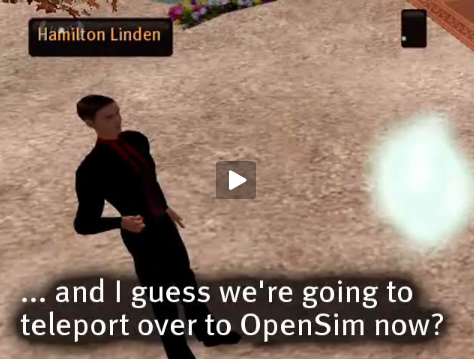
Virtual worlds like Second Life have a silo issue—they are virtual worlds unto themselves. Today, Linden Lab (which operates Second Life) and IBM announced that they have successfully bridged two virtual worlds, with avatars from Second Life successfully “teleporting” to an entirely different metaverse based on an OpenSim server.
The two companies have been working together on the Open Grid Protocol to allow for interoperability between virtual worlds. In a post on the Second Life blog, Hamilton Linden explains:
An open standard for interoperability based on the Open Grid Protocol would allow users to cross freely from one world to another, just as they can go from one Web site to another on the Internet today.
Here’s a video showing the avatars “teleporting” from one world (i.e. set of computer servers) to another:
Interoperability between virtual worlds is fine, and is definitely a step towards breaking down the walled gardens they are increasingly finding themselves in. But ultimately it is the wrong answer. What we really need is interoperability between virtual worlds and the Web.
Otherwise, virtual worlds will remain isolated in their alternate universe. If you can’t link to it from the regular Web (and vice versa), it doesn’t exist. That is why virtual 3D worlds are going to come to the browser. One startup, Vivaty (which launched in public beta earlier today), is already creating these browser-based virtual environments, where each place and object is a regular URL.
These still pale in comparison to what you can do in Second Life, but they will get better. And being connected to the rest of the Web will ensure that they never have any interoperability issues. The Web will just become more 3D over time. Will Second Life join the Web, or will its legacy architecture (built when there was no other choice) prevent it from doing so?


That NASA-style audio beep betrays how full of themselves these people are… pleeze, you’re just moving from one application instance to another.
This sound like one of those deals whose sole purpose is to generate press for both parties. Second Life will need a second life sometime soon. The system requirements block out the masses and even some earlier adopters. Would somebody take them behind the barn and shoot them already please?
Play games at harryballs.com
Haha, I agree with tabitha
Teleporting avatars between virtual worlds? A journey no avatar has made before? Mark Cuban was right… the internet has officially “Jumped the Shark”
http://en.wikipedia.org/wiki/Jump_the_shark
I seem to remember a system of “Virtual Worlds” that promised to revolutionise the web, and everyone/everything in it.
VRML, I believe it was called, and it was developed back in 1995.
Guys, as one of the guys documenting how this thing works, I can assure you that it was 1) tough to do adn 2) isn’t just moving from one application isntance to another.
You see, Second LIfe servers run proprietary software and while OpenSimulator is an open source server system, it was written entirely without help by Second Life programmers.
SO… THis was the case where two different bits of virtual world software, managed to transfer data using only open protocols implemented on both systems.
That is the basis of the virtual world internet.
And, there will certainly be web interfaces to it, just as their are web-browsers embedded in the Second Life viewer, you can expect 3D world viewer plug-ins to appear inside web-browsers. Some wil be Java based, some C# based, some scripted. SOme will be dedicated to only one kind of virtual world. Some will be dedicated to as many kinds as the programmers can devise.
This is the equivalent of Tim Berners-Lee demoing his first webpage at CERN decades ago, NOT the equivalent of shwing off the latest Flash webbrowser plugin.
But its a start.
I take your point on this and would love to see a Second Life client authored in something like Flash and thus embeddable on the web.
However, your argument pre-supposes that the WWW will remain the dominant internet interface. I think it more likely that what we currently call the “metaverse” will be the next step in internet navigation and will probably in time extend the metaphor to our actual desktops. With the advent of the grid and cloud computing there should be no eventual barrier to this.
I am an early adopter, but even now I access the web from “within” the likes of Second Life - the same with various media and web objects. The metaverse is about “presence” and the future of communications - still part of the internet but a platform far beyond the static web as we know it.
It will take time of course, but I imagine we will all ultimately live and work in a simulated 3D environment when online (never replacing real-life of course) and that access to the present web, and indeed our other applications, will be part of that experience.
We certainly need browser embedded worlds too - if only to accelerate take-up of the medium, but I don’t feel it is an either/or situation. The Linden/IBM achievement is to be welcomed.
Well, Second Life is linkable from the web via a “slurl” which will launch the Second Life client and teleport you to the place indicated. I believe you can have links in text that will send you to web pages too. So I guess what you might really be thinking of is an embeddable client so it is actually part of your web browser. Actually, this is pretty straightforward to do and I wonder why they haven’t tackled it yet.
There is another signficant problem with SL though, and that is that a server will melt down with only a few dozen people visiting an area. Until they find a way around this issue it’ll never be mainstream. Imagine a post on Digg (or even a blog with a few hundred readers) linking to a Second Life location. Instant death.
You assume that text will eventually fall behind in how people communicate. I strongly disagree with that.
First, it’s simple and fast. You can focus on what you’re writing without the distraction of a virtual anything around you. Text dominates, and will continue to do so. Flashy graphics and avatars won’t be a substitute for the written word.
Also, there have been virtual worlds with at least a minimal web interface. MMORPGs such as Everquest 2 have had chat->game web clients built into them for years. I’m just at a loss for what web interface you expect. Warcraftzilla? Using what’s now considered a 2D web interface to connect to a 3D world really doesn’t work. It’s going to take something brand new to come around and be accepted before you can connect virtual worlds to them.
I looked at Vivaty and thought “this would be a serious distraction as a web interface”.
Now if they could only achieve this with my social networking accounts!
@ Erick.
We (Exitreality) enable “browser-based virtual environments, where each place and object is a regular URL.”
Our platform can take any and every 2D URL and build out in real time a basic virtual environment that you can then decorate using the platforms in built capabilities… or build out a more compelling 3D space (or objects) using various open standards.
Duncan featured us here a little over a month ago…
http://www.techcrunch.com/2008.....s-jr-deal/
I think SL better fix their own little universe before they start beaming Avatars to other worlds. Their systems crash, lag is terrible. They just don’t have enough server power to run their world right (did anyone say GCloud??).
What would happen if they have a system crash right at the moment I TP to another world? Could you imagine Scottie beaming up captain kirk using servers that crash moire often than Twitter??
Erick and Saijanai , both SL and OpenSim run the same protocols, do they not? And those protocols are not web-standard, last I checked. Not that VRML/X3D have taken the world by storm either.
At the risk of dissing someone’s year of hard work, this seems to me like celebrating the first time someone took a proprietary Word document and opened it in Open Office. It’s non-trivial to accomplish. It gives us more choices of word processor. But it didn’t create or significantly change the web itself, did it?
I also don’t quite understand the significance of “no inventory got transfered.” That would seem to be a bad thing, no? I’d want to safely take my designs, my money, my reputation with me from world to world, or at least have a trusted repository where I can always get to them.
Vivaty is embedded in a browser, you can get there from Facebook and AIM (and go between them), is built on VRML/X3D. Exit Reality does something similar, also VRML/X3D. And Bitmanagement is working on something similar, last I heard, also VRML/X3D. Perhaps the storm took a while to build.
I applaud the technical achievment of translating one set of meshes to another, etc. I wonder that this would be much simpler going between VRML/X3D networks, assuming they all use the same ’spec’.
As the interoperability goes what is needed to make it more connected to the web? Probably web services. And this is what will be easier to add with the new Open Grid Protocol. Moreover the Open Grid Protocol is based on HTTP and tries to use standards found in the web developer scenes as much as possible.
The thing accomplished is of course just a small step but an important one. In the end it has the potential to drive a lot of things or even just make them possible, such as a more stable system, better, smaller, embeddable clients, new 3d formats, more integration options and so on. It will open up competition and this can drive many things. Also region scalability might be solved by somebody (but also remember: on a region with 1000 avatars there will be a lot of people saying “Hi!”).
It has the potential to become very big and be the HTTP of virtual worlds.
cheeziest voice over ever! they dont seem to take themselves serious. that bit about ‘no inventory’ sounded sarcastic. call me when you got something.
Eric … write about what you understand.
Interop between Virtual Worlds and the web is just virtual worlds minus the 3d.
What’s the challenge? It’s been done a 100 times before for Second life. Nobody cares because, well, nobody cares about interop.
I thought I saw this before: http://youtube.com/watch?v=jCiZQudyzdo around 4:20 into it.
Open social of 3d MMORPGs. I guess that’s cool
This comment is mainly for Eric, but is targeted at everyone else too.
I’m an oldie by SL standards, having been an active member of the community for 2.5 years.
From the technical aspect:
1) There are 2 servers being used here. The Linden Lab-developed Second Life server that is proprietary, and the OpenSim server which has been developed independently over the last year or so with no official linden Lab support.
2) The ability to “teleport” between sims is itself not very important. This is simply a very visible and symbolic way of demonstrating the amount of work that has gone on in the OpenSim community to catch up to the protocol standards that Linden Lab has developed.
Since OpenSim is open source, eventually developers will be able to plug in other 3rd party virtual world servers as well. Conceivably you would be able to move from Second Life to World of Warcraft to There to a Vivaty web room and back, all withing the same application. The visual representation for each of these places would likely be different in a unified client than in the individual application clients dedicated to each virtual environment, but you would be able to move around, communicate with people, and interact in each environment. Eventually we start being able to transfer virtual items between worlds as well.
3) As for the inventory which Avi brought up, I’ll explain. Linden Lab runs a cluster of asset servers which maintain the list of items that you own or have in your possession while in Second Life. Its the same concept as any MMO game where you have an inventory. The OpenSim servers do not currently have a connection to these Linden-owned and controlled servers, though there is talk that they are working on opening them up for external access in the future.
What the narrator was simply demonstrating to the viewers was that yes indeed, they were no longer *in* Second Life.
4) Second Life has been increasingly integrating itself into the web over time. Yes, it is still a silo in many respects, but the entire point of this video is about the fact *that* is changing.
Second Life has featured SL->web->SL communications via its internal LSL scripting language for years. You initiate a standard http request from an object or script in Second Life that communicates to a remote web server, then delivers the response back to your in-world object.
SL has also had support for XML-RPC communications for years. This has made it possible for external servers to communicate to objects and scripts within SL without the need for human initiation.
In the last 6 months, SL now features “html on a prim”, which lets you render web pages onto 3D objects in Second Life itself. This is still a new feature and will change over time, but its already being used heavily to let users import visual data into SL without having to upload it directly into Linden Labs asset servers.
Finally, the Second Life client features a fully-integrated web browser based on Mozilla/Firefox. You can do all of your web surfing right from within the Second Life client, effectively merging both the web and the 3D experience into a single application. It still does not support Firefox extensions, but that is only a matter of time. Imagine being able to write extensions for FF that interact with Second Life and other virtual worlds that interoperate with SL as well.
To speak about the video itself, lets clear a few things up. The narrator is Torley Torgeson, or Torley Linden as the SL community knows him. He is an incredibly outgoing and caring employee of Linden Lab who goes out of his way to help the SL community. He is a widely respected and loved member who often makes these kinds of interesting videos for all of us.
This video was made especially for the members of the SL community. For those of us who are deeply involved with SL, this was a rather remarkable feat that those on the outside (like most pundit bloggers) are likely to dismiss out of hand. We’re used to it. We’ll keep plugging away at what we love and eventually people come on board or they don’t. That doesn’t have much effect on us either way.
The concept that most people still miss is that the browser is not the *only* way to interact with people and data on the internet. Way too many people forget that people were using IRC to chat and gopher to access information on the internet before the Web got started.
Think about it like tools. I am a web developer here in San Francisco. I don’t use a text editor to make pictures. I don’t use Photoshop to write xhtml and css. Second Life is more open than *any* other “virtual world” in terms of the ability to create content and import/export data to and from the web.
Second Life does not need to replace the browser, and it doesn’t necessarily need to be used in the browser either. As I said previously, you can *do* that in SL anyway, even though I argue that its not necessarily needed. The browser is a tool for some kinds of jobs. Second Life is a type of tool for another.
I’m with Mike (#16). No offense Erik but asking for interop between browsers and SL makes no sense at all. (am assuming you’re not talking about slurls and web links in SL, both of which exist today).
Its like asking “when am I going to be able to swim on a football field?”
Won’t this allow criminal avatars to jump from world to world, easily evading justice? Someone needs to think through the consequences of this technology. It may unleash all kinds of problems.
With the growth of virtual worlds, marketeers have tried to jump in the bandwagon. It’s a more effective way to pursue users (as the spend more time there) and the metrics are more measurable.
Uh, check this out: http://www.lively.com
Did you not know about Lively when you wrote this?
Don’t forget Blink3D(big big potential, uses open standards with lowest barrier to entry), Vastpark, Multiverse, Activeworlds, Twinity, and now Vivaty and Lively.
I don’t know what happened with virtual worlds… did they have a “buy-one-get-one-free” offer?
I haven’t tried the new ones, but I would be amazed if they don’t introduce some sort of virtual marketing.
Its of course about both - you need an interoperability between different virtual world platforms and the web. I have written a pretty extensive post about data portability and virtual worlds here:
http://pixelsebi.com/2008-07-0.....al-worlds/
It’s ok to be a silo and a walled garden. Really. SL is one hell of a big walled garden spanning more than 20 simulators now, 1.5 billion square meters of land.
You are so used to doing this horrible knee-jerk spasm based on the original Internet, where Compuserve and AOL and Geocities and all the walled gardens are shot at dawn, that you forget that the next iteration may not really care about this distinction as much as you Web 1.0 geeks do. Who really cares about walking between worlds? That’s a total geek affectation. Nobody in an SL McMansion wants to walk into a WoW raid, or go and sit Ruthed in opensimulator with no economy (there’s no buy/sell interface or permissions for content creation).
Only people selling the connector widgets (IBM, Cisco, whatever) or the big grid hook-up (Linden Lab) care about interop — the masses do not, and the top content creator class do not because it horribly threatens their intellectual property rights when anyone can save their sim offline and suck copies out even more easily than they can now — and into worlds with no economy/permissions.
There is in fact a big debate now about how IP might be protected with a flags system or some form of obfuscation and of course the usual goofs are demanding CC licenses be welded into the viewer. Sigh.
Walled gardens keep the integrity of communities and content. Why the rush to destroy them? To what end? When there is no overall architecture of a 3-D web really conceived as a platform that can be monetarized as the earlier web is.
And…the Internet? Like…I need to hook up to that better when it is just…in the other window? I mean, seriously. You’re too close to this stuff. Worlds are good. Stop interop. Save the economy.
>Don’t forget Blink3D(big big potential, uses open standards with lowest barrier to entry), Vastpark, Multiverse, Activeworlds, Twinity, and now Vivaty and Lively.
Not a single one of these entities — some of them still in alpha or beta — have economies. Buy/sell interfaces connected to real currency in real life. Nor do some of them have user-generated content. Those that do, like Activeworlds or There lost a lot of their users to Second Life for various reasons.
The walled garden of SL looks far better to you after two hours fooling around in Lively where you cannot sell anything or buy land or do anything but goof around in a constricting “room”.
Let’s say there are 269 million people registered for Lively now. So, Google will sell them ads? Will they let people put AdSense up in their rooms? What is it but a mere freebie ad on that maybe helps Google get paid but not the user?
Contrast SL with only 380,000 people in a month who spent more than a dollar — but there is a long tail of people who made money — real cash — from real services and content, not merely from being data-scraped or being doormats for ads. That is of inestimable worth.
For the time being the Internet remains text based. Google is king because they recognized this early. I agree that unless these new virtual worlds develop real economies they are destined for the trash bin.
You have to love how people comment negatively about a topic they do not fully understand. And that 3D virtual worlds wont -replace- text.. just enhance the over all experience. After being in Second Life for over two years now I can already say the system demands are small compared to most 3D applications out there. And I for one don’t believe that there needs to be a serious concern about embeddable clients for web sites. Personally I think the web as we know it will go through a paradigm shift where we as Internet users start moving over to the new tchnology because that will be increasingly where most of the content is going…
And people also do not realise that Second Life is a ground breaking technology. Sure, as far as MMO’s go it isnt that grand but thats the point, its MORE than an MMMO… its a platform, its an environment its not just another virtual world….
And I am going to add .. Bravo Charles .. really .. very nicely put .. you really out into text what I was thinking all along…
Why do so many people think is it so important for virtual worlds to be accessible from a browser?
Most of us still use email clients rather than webmail because we recognise that the capabilities of email applications for the most part far surpass that of webmail.
Why do people think virtual world clients are somehow any different?
Why on earth would you want to shoehorn a fully immersive 3D environment into a 2D browser with all of it’s limitations?
The only people that really benefit from web based virtual spaces are marketing people and corporations. I suppose for that reason, we won’t see the format disappearing anytime soon even if it brings little (if any) benefit to the user.
Sure, maybe a ‘lite’ web based client for IM’s and chat might be handy at a push but to get that full immersion you need a real client.
And Profoky is completely right about Second Lifes ‘walled garden’. SL is still here after so many other virtual world have faltered is because of it’s user generated content, its economy and its IP rights. All of these would be extremely hard to manage without its ‘garden wall’.
In an open system, who polices intellectual property? How will micro-payments work between sims? Will I need a dozen different currencies to get around or will they need something like a micro-Paypal?
To be honest though, I like Second Life BECAUSE it’s separated from the Real World. The more they try to integrate it into the rest of webdom, the less appealing it will become.