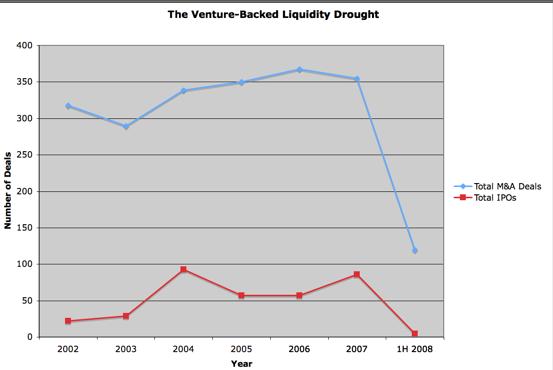
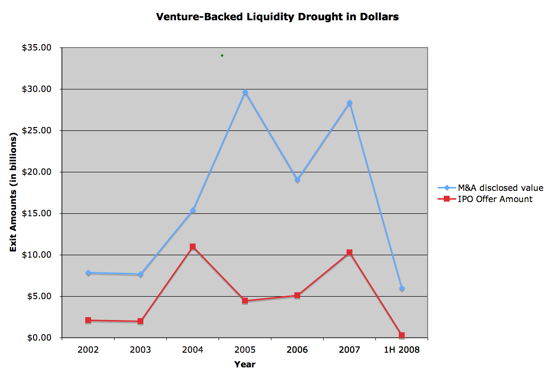
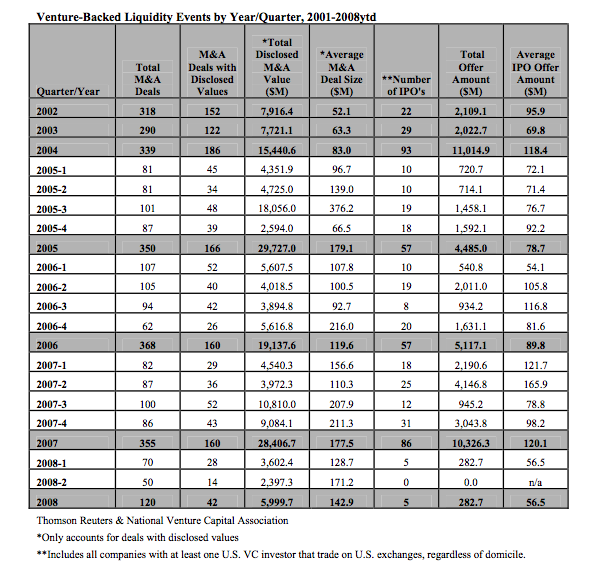
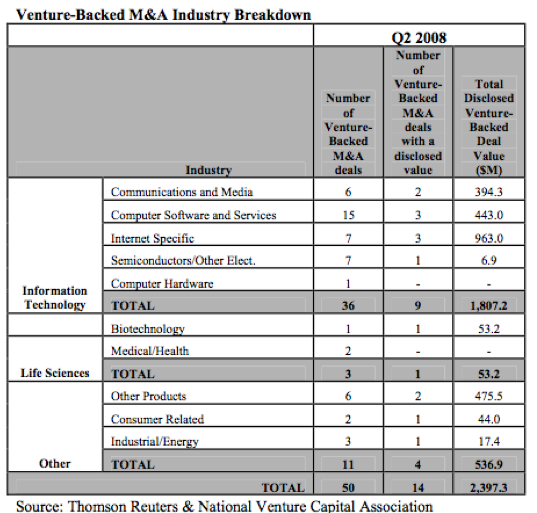
There were no venture-backed IPOs in the second quarter, and M&A deals are down. The last time there were no VC-backed IPOs in a quarter was in 1978. The liquidity drought for venture-backed startups is so bleak that the National Venture Capital Association is calling it a “crisis.” Last quarter there were only 5 IPOs that brought in a piddling $283 million. That compares to 43 IPOs during the first half of 2007 that brought in $6.3 billion.
(During the first half of 2008, 42 companies were in registration for an IPO, but they never pulled the trigger—versus 70 for the same period in 2007).
The other exit avenue for startups, getting acquired, is also getting narrower. During the first half of 2008, there were 120 VC-backed M&A deals, compared to 169 during the first half of 2007. Those deals whose amounts were disclosed brought in $6 billion, compared to $8.5 billion in 2007. That is 42 percent less cash for venture investors.
Before you cry yourself a river, consider that if VCs cannot get their money out of startups they may start to put less money into them. Much of this drought, however, seems to be tied to the weakness of the overall economy. It is a crisis that likely will pass. According to a survey of 660 venture capitalists conducted by the NVCA, the “three largest factors to which venture capitalists attribute the current IPO drought are:”
—Skittish investors: 77 percent
—Credit crunch/mortgage crisis: 64 percent
—Sarbanes Oxley regulation: 57 percent
Here are some of the other responses:
—Venture capitalists who do not see the IPO window opening in 2008: 81 percent
—Number of venture capitalists who believe that venture-backed companies are less
likely to want to go public today than they were 3 years ago: Two thirds—Venture capitalists who characterize the current IPO drought as “not critical” to the future health of the venture capital and entrepreneurial communities: 8 percent
Credit crunch aside, it might be time to amend Sarbanes Oxley at least for smaller companies. If the drought continues through 2008, startups that seek VC funding will start to feel the pinch, if they are not already. Yet one more reason to bootstrap your startup until you absolutely need that VC cash.


That wouldn’t have anything to do with them investing lotto style in all these web 2.0 businesses with fake revenue forecasts right?
The plan for all these VC backed businesses is to amass freeloading customers, then to sell out. I know because I interviewed with a number of them. Their only milestones are to get 1, 2, 50 million users. They have revenue as 2nd, 3rd, 10th on the todo list.
The figure that once they get there, they can do anything, and that is wrong.
One of the large VC backed startups which I interviewed with at length laid out their entire plan in detail and there was nothing in it about generating revenue at all. It was European.
Just my 2 cents.
It occurs to me that there may be a temporary gap in the investment cycle. Cleantech investments may reflect the development cycle of a medical device company (so 5-7 years before an exit). Internet companies may not have any meaningful exits as there aren’t a whole lot of interesting players at the moment that are worth acquiring for any meaningful valuation (say > $250 Million). So I think we’re seeing a lull between the shift of investment into a heavier-load of long-cycle investments.
And I wouldn’t see M&A deals while the credit markets are tight.
This must be the “nuclear winter” that caused many SV companies to raise so much $ recently.
“Internet companies may not have any meaningful exits”
That’s a lot of bankruptcy right there.
way to bogart every comment thread chris
hang on people. it’s going to get UGLY. that giant sucking sound you hear is the liquidity rushing out of the bay area!
@5, You’re right. I’m sorry. Being in California for dotCOM bust 2.0 is pretty exciting though.
The global liquidity crunch is very real. Look at the market caps of our largest banks: In the past year, Citibank has fallen from $52/share to $17/share today, Bank of America has fallen from $54/share to $24/share.
It is inevitable that the crunch impact valley firms.
There is no crisis. Keep making useless profitless companies. Don’t listen to these people.
There’s typically a flight to quality in this type of scenario. If your startup is top 5-10% for whatever reason, the competition to invest in you will likely continue to be extremely fierce - maybe even more so. For everyone else however, I wouldn’t be surprised to hear that “the books are closed right now”.
July 1st folks — mark it as the last official day of TC. It will soon be FC #2
Are there any companies looking for debt financing seeing as how startups don’t have that much access to capital?
FC? TC?
“Are there any companies looking for debt financing seeing as how startups don’t have that much access to capital?”
Unsecured financing for a company that’s starting up with next to no assets and a good business strategy on paper???
Show me where, and I’ll sign up. Software generates real revenue. Banks won’t do it.
Why go back only 5 years ? How does this compare to 2001 ? or 1999 ? it’s not that far back or does the graph not look as impressive once we put it in context with the .com bust.
FC = Fucked Company
TC = TechCrunch
Who didn’t see this coming?
Erick,
I understand from your article that lack of venture capital is a “reason” to bootstrap a company. You don’t argue this point directly, however it is implied based on your closing rationale. Your argument is as fundamentally flawed as the investing strategy deployed by most VCs which has led to the lack of “exits”.
Let me first disclose that I attended business school in the 80’s, and have worked in tech for nearly 20 years. If that makes me a “dinosaur”, so be it.
That said, there are several fundamentals to building a business that VC’s should seek in their investments, but don’t value much anymore. Particularly:
1. A clear business model
2. A scalable plan for growth with defensible intellectual property
3. Preexisting “sweat equity” by founders
These fundamentals are severely lacking in most VC investments today, but they are the ones which result in business liquidity over the long term. Loose credit markets result in liquidity events that are often irrational, yielding a poor return on investment. The combination of poor investment decisions by VCs combined with easy credit has resulted in limited liquidity events or “exits”.
Bootstrapping is not, and should not be considered a desperate option if no venture capital is available. Bootstrapping is fundamentally sound for building a business startup with solid long term growth potential.
My $.02.
Best,
Curtis
I’d really like to see a more detailed investigation on Sarbanes-Oxley: Is it likely to be repealed? Is it likely to be relaxed? What do the two presidential candidates think about? What’s the consensus on SOX in the senate / congress?
The negative effects of Sarbanes-Oxley on the economy are hard to overstate. I’d like to understand the chances of an improvement.
@12, the reason banks won’t invest risk capital into startups is because some people start LLCs or corps to shield themselves, then they get lots of capital and lose it.
Here is an example since we are on the subject of TC being pushed into the deadpool. I dunno whether it will or not, but here is some history.
crunchbase.com/company/edgeio
“Edgeio recieved $1.5 million in angel funds from the likes of Louis Monier, Frank Caufield, the RSS Investors Fund, Jeff Clavier, Ron Conway, Michael Tanne, and others. $5 million in Series A financing followed in October of 2006. ”
So 6.5 Million, then the total of their assets gets sold at an undignified auction for $280,000
http://valleywag.com/336901/wi.....-web-loser
The bank knows this, and they’re like “where did the 6.22 million go?”
There is no answer. It disappears into the abyss of web 2.0. An accounting mess of weird and flashy expenses.
Definitely experiencing a lull here, namely, I think, because of these external factors related to the economy, and growth of foreign industries. The question becomes, when are we going to see a boom in VC activity? More competition internationally means less investment in the states. Couple this with current economic conditions and you make a stagnant soup. Whether this is the web 2.0 bust period, we’ll have to see. My opinion is that innovations in internet technologies, primarily focussed on the concept of “discovery” either replacing or complementing search will spark another internet boom. The difference between search and discovery is that in search you are seeking a particular concept, and you may click around its periphery material from a search engine. You are still fairly limited in terms of results, specific matches to whatever your query was. Discovery involves more sophisticated technologies that can refer hyper relevant material that you may have never thought connected or was related to the material you originally searched for. The result of this is “discovery” of new valuable, directly or indirectly related material. This is where the industry is heading - in ecommerce, travel, search engines, you name it. http://www.readtheanswer.com/index.php?RTA=web2
Well, if the VC’s are drying their powder, maybe they should invest in another round of YASN’s and Facebook applications, or maybe another video sharing, how-to, or uploading site!
How about a social network for your apartment building! Or a Socnet for elderlywith out computers. Or…….another recommendation engine. Or a mobile social network to…wait for it - help you find your friends at the bar.
Above all, do not invest in mobile data ventures where the end-users have agreed to pay 20-30 / mo. for subscription dispatch services for independent automotive services trades. No…..that would make money.
Likewise, don’t invest in technical vertical and specialty markets. They pay cash up front, and high recurring subscription fees. That would make money. Don’t invest in that, either.
Lets assume this “crisis” signals some fundamental shift. To most TC readers this is all a “no sh..” scenario, but let me spin some optimism here:
1) VC investment has funded a zillion horrible and wonderful businesses (though mostly horrible).
2) Very few ever made or even planned to make a penny. The old we’ll monetize later was yelled while running into battle. Google’s arrogance helped perpetuate this.
3) Without monetization, nobody can hope to compete. Entire segments have been subsidized by this nonsense, and only the VC funded elite can push their ideas. Entrepreneurs everywhere threw their hands in the air the moment a competitor got VC dollars and gave away the farm in return for users.
The optimism: Now the nonsense will fade away, and bootstrapping actually CAN work. And I don’t mean TC-defined bootstrapping where you “launch” and get TC to post on it so you can get real funding a month later. Bootstrapping should get you PROFITABLE, not just investable. Chicken and egg.
So yes, I now hope for some new real businesses. Of course, all that is assuming this is in fact a real change, but more likely it is a temporary distraction and all will return to normal soon.
All you have to do is look at the stupid crap companies (like Twitter) that are getting attention and the solution is clear.
Anybody who thinks that the “crisis” in venture capital is due primarily to the credit crunch doesn’t know what he’s talking about.
The credit crunch and SOX aren’t helping VCs but the “crisis” is due to the fact that far too much VC money has been invested in startups that don’t interest anyone on Wall Street anyway because they aren’t real businesses. Apparently VCs didn’t get the memo: the .com boom was an anomaly in the IPO market and it isn’t likely to happen again anytime soon (we’ve moved on to creating other bubbles).
VCs hoping that cleantech is the answer are in for more disappointment. I work for a hedge fund and over 25% of our investments are in the energy sector. We looked at several investments in cleantech startups that had raised VC money in earlier rounds and the VCs I talked with were clueless. They had no understanding of the energy business and looked dumbfounded when we told them that they had probably invested in a startup with an interesting technology that probably isn’t going to be commercially scalable.
Bottom line: VCs are in “crisis” because most of them are clueless tools who couldn’t even run a dry cleaners.
Did anyone else notice that this chart is extraordinarily misleading?
If I chart annual data for the last 5 years and then chart only half year data for the final year, you will always see a big drop.
It may be down, but it’s not down anywhere near what this chart suggests it is.
“If I chart annual data for the last 5 years and then chart only half year data for the final year, you will always see a big drop.”
There are half year markers along the bottom half of the chart.
Who ever produced these charts did not create the data nodes on half year markers, so you are right.
These charts were poorly made.
For instance the data point for the first half of 2007 should be 169 but it’s at 350.
I agree with you, #26. The first thing I thought when I saw the charts is that the author completely undermined his credibility (in a potentially very persuasive message) with his choice in skewing the data visualization. Unfortunate.
Does this mean my “sporkr.com” mobile food microblogging project might not become an internet sensation? But baby needs a new pair of shoes!
The chart is misleading. Please remove from post.
I guess that means no more bad web 2.0 startups monetized exclusively by CPM advertising! What a tragedy!
I started building my own company almost 2 years ago, self-funded. Launch in May of this year.
I considered seeking funding, but decided against it. After all, I started my own company so I wouldn’t have to answer to anyone (except my users). Getting funding seemed like replacing one boss with another. I’m stubborn, maybe foolish, but it felt right for me. I was inspired by the Plentyoffish model.
The Recession is going to be one hell of a mess. I view it as an opportunity. Loose money creates waste and inefficiency and encourages stupidity. When money is dear, innovation really blossoms. The Depression was a fruitful time to start a company. High gas prices are going to launch the next GM, I guarantee it.
http://lookcube.com
I think its SOX et al.
http://abovethecrowd.com/2008/.....arter-why/
Hopefully this will generate a flight to quality among entrepreneurs. I’m sick of conferences where slick haired guys in t-shirts sit on a stage and talk about how the way of the future is their app that lets you throw a facebook fish at a myspace user. The world may be desperate for an app that lets you view a twitter feed on an android phone, but its not so desperate that it will pay for it.
I hope people start looking for real problems to solve, rather than sitting in starbucks saying “wouldn’t it be cool if . . .” Maybe if the VCs stop funding cool, and start funding useful, that will happen.
the best time to invest is during economic downturns… not during the upswing. it is amazing how few investors get that given that this trend has played out over and over again over the past century. this is especially true for vcs who need to wait 4-6 years before the companies they invest in have a chance to exit.
people in the valley are all lemmings. as long as vcs invest in companies that can make money (no social networking startups here… sorry) they will do well
This is a result of the continuing fallout from the extreme dot com boom/bust cycle of 1999 - 2003. The investment world (and regulatory system) has never really recovered from its skepticism about new, “IPO-ready” technology companies as a whole, regardless of individual success stories, so when other factors (credit crisis, economic uncertainty) increase the risk premium, the memory of being burned and scarred by tech companies is still vivid, and investors flee to quality, or sit on their hands.
good news, actually, mayb we will get some new busiesses with much smaller, but real, income possibilites
the home run mind set is no good, the build it and they will come mindset is no good
address a problem. provide a solution. charge for it.
and additionally, advertising as revenue source is laughable long term
Collapsing US dollar. VC’s should look at funding companies that are going to help the upcoming police state. That’s where the money is!
“Credit crunch aside, it might be time to amend Sarbanes Oxley”
This is the point when TC starts being laughable. Are you guys living on Mars? I think the deeper we are into this ooil crisis, the more laughable TC will become, and then it will simply close.
Not only internet businesses, just the peak oil is here
I agree with Wall Streeter. I think it’s obvious to everyone that energy is the hot ticket. I also think Wall Streeter draws an accurate characterization of the overwhelming majority of VCs.
@22 Alan -
How about a new “social video discovery” site that pulls videos from YouTube and lets users rate them? With a mobile component?
Once we get all the college kids using it, we’ll make billions!!!
Possible names:
Woopta
Qizmoo
Xoof
Anything with “oo” is cool because it is reminiscent of Yahoo… and you know those kids made billions out of nothing. JUST LIKE WE ALL WANT TO DO!!!
Even 8 years after DotBomb 1.0, everyone wants to be Jerry Wang!!!
Venture Capitalists and the Internet is just a bad mix
there are no meat and potato startups that are ready for ipo. the bubble bar has raised so high that its hard to jump over.
VentureLocator.com
How long will such a mess last? If the VCs don’t invest, where the money will go?
This is just another product of the “housing/mortgage meltdown.” The economy is going nowhere but down over the next 3 years minimum. This is a time to cherry pick companies.
Lenderpolice.com seems to have taken care of the mortgage lender loan fraud problem for Borrowers, Closing Agents, Mortgage Lenders, and Real Estate Agents.
Always use Lender Police after you apply for a mortgage loan. They’ll tell you if your lender is giving you a good deal or not in one of two ways. You can purchase a good faith estimate review for $99 that will tell you if the interest rate, points, fees, and rebates you’re being charged is appropriate for your situation. The loan document review for $199 verifies that the loan documents that you’re signing are for the same loan that you were quoted and your lender didn’t slip in any extra points, fees, pre-payment penalties, or is receiving a lender rebate for selling you a higher interest rate than you qualify for.
A mortgage loan evaluation from Lender Police is the only way to guarantee your lender isn’t trying to rip you off.
“The plan for all these VC backed businesses is to amass freeloading customers, then to sell out. I know because I interviewed with a number of them.”
Of course, while it’s a sin to invest in such companies, it’s perfectly fine to work there….
So US Vcs should start think global, think urban development, think politics, think urban development, think impossible, think out of the box;
US Vcs should start looking abroad:
Sell your stake to a foreign investment fund: The dollar is cheap. European and Asian investment funds are desperately looking for US opportunities
Lobby for Greentech/Cleantech
Think Impossible is possible.
http://leetchee.blogspot.com/2.....guise.html