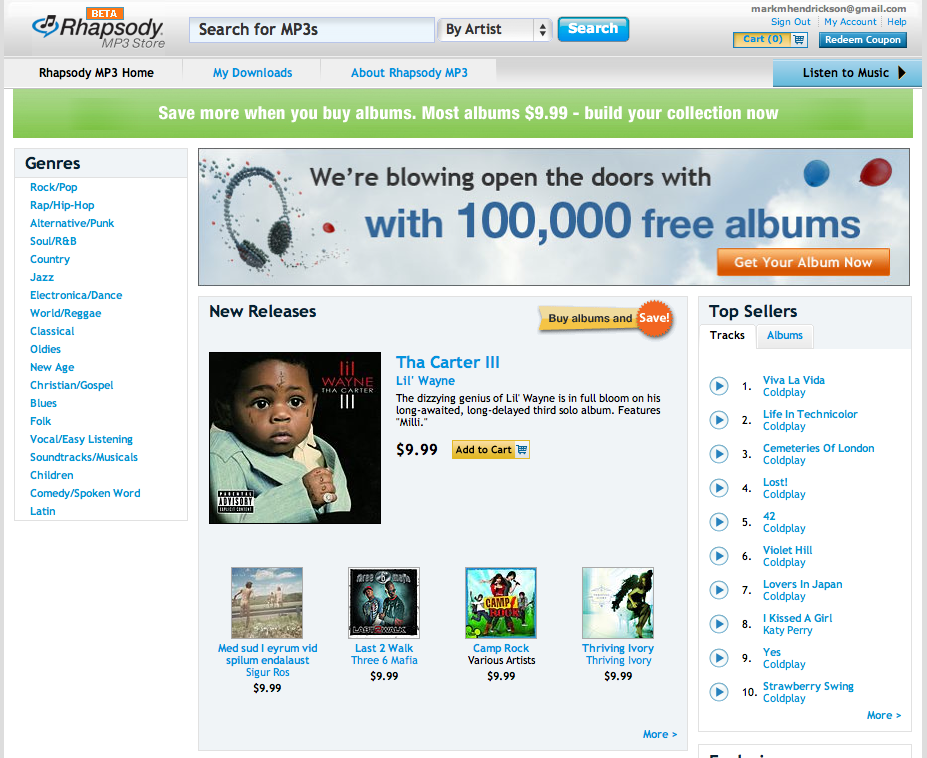
Streaming music service Rhapsody has joined the likes of Wal-Mart, Amazon, and Napster by launching an MP3 store.
Its move to offer unprotected music downloads has been anticipated since last Fall when Real Networks joined forces with MTV and Verizon. The Rhapsody MP3 Store offers music from all four major labels (Universal Music Group, Sony BMG, Warner Music Group, and EMI) at 99 cents per single and mostly $9.99 per single disc album.
While Rhapsody specializes in streaming music to paying subscribers ($13 per month gives you on-demand access to its entire music collection), this is not the first time Rhapsody has offered downloads. Most of its downloads have been protected by RAX-formatted DRM, although lately MP3 files have been mixed into its collection as well.
But with the launch of its MP3 store, Rhapsody fully endorses the idea that DRM is dead. And it goes toe-to-toe with the aforementioned DRM-free music stores, as well as iTunes Plus (whose files are actually in AAC format, not MP3), by providing over 5 million tracks that can play on virtually any music player without any restrictions. All songs will be provided with a 256 bit rate.
The Rhapsody MP3 Store sits to the side of the regular Rhapsody streaming music service on its own subdomain, but the two are also integrated with one another. Shoppers on the MP3 store site who are also paying subscribers can play full-length samples (non-subscribers can also play up to 25 full length samples per month). And subscribers have the option of buying and downloading the files they’ve enjoyed streaming but want to play when not at their computers (or connected to the internet).
The purchase experience is mostly browser-based; however, Rhapsody also provides a download manager that can automatically load songs into iTunes. Only Windows is supported at launch, with Mac support coming later.
Rhapsody is also working over the next couple of months to integrate its streaming and downloading functionality into Viacom’s network of music sites, including MTV, VH1, and CMT. It has teamed up with iLike as well to power music across all of that startup’s social networking apps and on its main website. Expect the same level of integration that we’ve already seen on MOG.
On related notes, Rhapsody is putting the finishing touches on its powering of Yahoo Music, which should go live soon so that Yahoo users aren’t simply redirected off-site. And it has just helped launch a new Verizon VCAST music service for getting its songs onto mobile handsets. With all of these partnerships, Rhapsody is working to become not only a destination but a platform for music distribution as well.
Streaming music may be the way of the future – especially when reliable and fast wireless technology becomes ubiquitous – but the launch of Rhapsody’s MP3 store goes to show that consumers still want to own their music – and control when and where they can use it.
Also see our round up of DRM-free music providers from last fall, which includes some of the more indie-focused services like Amie Street.


AAC is the audio component of MPEG4 and is superior to MP3.
http://en.wikip...ed_Audio_Coding
How come you guys (the media) always makes iTunes look like the bad guys for going with a superior format?
“Only Windows is supported at launch, with Mac support coming later.”
This is not true. There is a Windows download manager, however you can download ziped MP3 files on any platform.
Will it let you convert existing purchases?
@Eric – thanks for pointing that out; I’ve clarified what it means to be “Windows-only”.
Whatever superiority AAC has is minimal.
Especially when viewed as part of Apple’s plan to tie you to the iPod forever.
Sell a MP3. Anyone can use.
Sell a AAC and you’re in iTunes hell for life.
AAC is only superior to MP3 at lower bitrates because it uses a better compression algorithm. At 256kbps, MP3 and AAC are roughly equivalent in terms of sound quality.
And, sound quality also depends on how much CPU power you throw at the encoding process. iTunes uses a quicker algorithm to encode to AAC (so that your CD rips will be faster) and, actually a good MP3 encoder like MAME will actually produce better results if encoding at its highest quality settings. That is, at higher bitrates, with MAME you can produce better sounding MP3s than iTunes-ripped AACs. (Of course, if you use a better-quality AAC encoder like QuickTime Pro on its highest quality setting, it’ll be a wash.)
And, along those lines… the 256kbps MP3s and AACs that you get from these online stores are better quality than the ones you can produce yourself by ripping CDs with iTunes at the same bitrate. You need to use MAME or QuickTime Pro at their highest quality settings to match what these stores are giving you.
Sorry… it’s getting late….
Meant… the * LAME * encoder for MP3.
# 6 George,
Were you talking about lame encoder or is there something called mame?
“Sell a MP3. Anyone can use.”
“Sell a AAC and you’re in iTunes hell for life.”
Uh, wrong. The Microsoft Zune plays AACs fine, including iTunes AAC Plus format.
Winamp plays AACs fine, including iTunes AAC Plus format.
Windows Media Player plays AACs fine, including iTunes AAC Plus format.
What you mean is PROTECTED AACs bought at the iTunes Store. I know its difficult to post with all that Apple hatred pent up inside, but a few seconds of Googling would save you some embarrassment.
And so it begins……
Our indie artists will be offering their songs DRM-free as well at Apricado Music – http://www.apricado.com/ – Launching soon.
the ilike/rhapsody offering will *not* offer the same functionality as the mog/rhapsody combination.
it’s limited to streaming just 25 songs per month, vs. unlimited full-length streaming of anything on mog that’s also available via rhapsody.
people are glossing over the fact that you only get full-length previews if you’re already paying $13 a month for a Rhapsody subscription. Otherwise, it’s just 25 songs a month — hardly “unlimited” and definitely not groundbreaking.
from the LA Times:
http://www.lati...0,5307252.story
“Now, Rhapsody subscribers will be able to preview as much music as they want before buying directly from the Rhapsody store. Music shoppers who aren’t subscribers can listen to 25 full songs a month.”
When will they realize nationalism is dead? US only. Useless.
Unfortunately, nationalism is not dead, it’s just really annoying.
Rhapsody’s subscription service is dependent on DRM, so the post title is in error. For anyone who hasn’t experienced the joy of being able to download (almost) every new song to their MP3 player for a fixed monthly price, should give it a try. It’s the closest thing to music nirvana.
I’ve been a member of Rhapsody’s streaming service for about three years now. They’ve offered MP3s for over a year now – interesting to see they’ve actually started a store just for it.
# Adam Kmiec
Will it let you convert existing purchases?
Adam – I believe that Rhapsody’s MP3s cost more than RAX, their other “buy-it-you-own-it” DRM-protected format, so I don’t know if they’ll let you convert them.
I love the people bitching about the bitrates from ACC and LAME mp3 encoding it’s so funny because the human ear can’t hear the differences and if your bitching about compression, get over it and buy a bigger HD for your damn music.
Hey, the good thing is that companies are finally seeing that DRM is useless, music is meant to be shared. As for the whole AAC MP3 argument, AAC is pretty much compatible with everything, as stated before, and as always people need to stop acting like apple is the devil or something, why is it people keep reacting this way?
I don’t think Apple have too much to worry about at the moment, when I click on “Create Account” I get taken to a page that says “Sorry, we can’t find the page you were looking for.”
Maybe it’s because I don’t reside in the US, …don’t know, but that’s a pretty terrible start if you ask me!
Andy
Boo…not available in Canada.
For CANADA:
…try Spiralfrog.com. Free (legal) downloads, big catalogue and growing. They want you to sign up, and then all you have to do is renew membership every 30 days. (By ‘free’, I mean free. No money changes hands.)( I found Windows mediaplayer 11 is necessary to handle the DRM. V 10 doesn’t do it. ) You can also download to a number of supported devices.
I was a big fan of iTunes simple interface until I lost my iPod and realized the trance I had been under. I now use Amazon’s MP3s which automatically load in iTunes, are cheaper, and completely DRM-free. I am glad that Rhapsody is coming to its senses and look forward to continued improvement in their services.
As to whether you can hear the difference between AAC, MP3, WAV and with regard to various bit rates… It depends largely on your brain, i.e. ear training and intrinsic ability, plus the audio chain. I can hear that WAV beats them all (no compression) and that AAC is clearly the winner over MP3, even when bit rates are pushed to the limit; however… I am listening on relatively hi fi gear. The most obvious difference to my ears, between MP3, AAC & WAV, have to to with high frequency resolution and how it can render (or fail to render) phase information, which is really important for stereo ambient fields. In mono summed playback, you probably wouldn’t notice much difference, even with hi fi gear and great ears. If stereo ambience or reverberant field is something you listen for and enjoy, then steer away from MP3. If you’re playing back through less than hi fi equipment or less than ideal acoustics (e.g. not using headphones or near field monitors), then you probably don’t need to worry about it at higher sampling rates. You’ll still enjoy the music just fine! The bottom line is that you enjoy the music.
Basically, I’m still going with iTunes or CDs (often used ones) from Amazon for music that I enjoy allot, so I can hear the best rendering of stereo ambience / space. I believe iTunes files are worth a buck, at least for your favorite songs. I can see how DRM could get expensive for music fanatics though…
By the way, with good gear CDs almost always sound better than WAVs, unless the files were recorded directly to your own hard disk and then burned to a CD. CD burners are not capable of the same level of fidelity as manufactured CDs (I don’t know why, but I can hear it! You’ll have to ask a higher level geek for that one). When I do blind comparisons between CDs and WAVs, I can in some recordings, hear difference in the stereo field, but usually it’s quite subtle.
Think about it though… People used to sit around a camp fire and howl or pound out music on animal skins. There were scratchy wax cylinders, bakalite records, and narrow band AM radio. Even with CDs and media players, if you’re in a car, there’s a heck of a lotta ambient noise. Don’t know about you, but I still enjoy music that’s fading in an out on AM late at night when I’m driving. There’s always that chance of discovering something new or interesting & making that mind connection (with present or past).
mp3 downloads – rules, cd – it’s last ceuntry))