The State of Open Mobile OSes
by John Biggs on June 25, 2008

Open operating systems, for most folks, means that the operating system is essentially free. The average computer user knows that Linux is free, as in beer, while Windows costs money. The case is the same for mobile OSes although, until very recently, the idea of purposely using an open OS has been a fairly nebulous concept.

To be clear open mobile OSes have been around for years, starting most prominently with the QTopia project that ran on ARM hardware found in many PDAs and phones. The Linux kernel plays well with almost any platform, making it ideal for small installations.

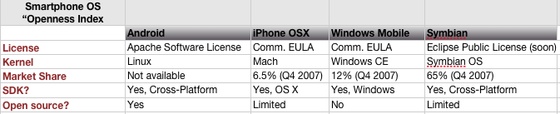
With the announcement of an “open” version of Symbian coming soon, let’s take a look at what open means to the average consumer.

Android – Google’s smartphone OS is probably about as open as you can get. It’s designed to run on almost any hardware and includes a fully open and free UI complete with source code. It costs nothing for carriers to use and if, if used in its official form, simply brings Google apps and content to the fore at opportune times. To the average consumer Android should be able to add smartphone functionality to a number of odd devices, including phones that once depended on proprietary, no-name operating systems like the Motorola RAZR.

iPhone OSX – iPhone’s OSX uses a Mach kernel which, like Linux, is fairly open and well-documented. Unlike Linux, however, the price of the iPhone’s kernel is bundled into the cost of the actual phone and cannot be sold to third parties. The SDK or programming tools for the OS, however, are quite popular and are free. This ensures that programmers can harness the full power of the OS without having to dig too deeply into the core. As a whole, OS X is as close to being open as you can get without really being “open” and fully cross-platform.

Windows Mobile – Windows Mobile is a closed operating system. The common user interface remains unchanged across devices, however, third-party applications can be developed by writing programs using software like Visual C++. Windows Mobile also makes use of the .NET Compact Framework, which is similar to the .NET Framework found on Windows-based PCs.

Symbian – Currently, the Symbian operating system is not classified as open source, although with Nokia’s recent announcement, it will soon be available under the royalty-free Eclipse Public License. As it stands now, though, handset manufacturers that make use of the Symbian operating system are only provided with certain parts of the source code. It is expected to be fully opened up within the next two years. Symbian is the most widely used mobile operating system in the world today.

One interesting aside: there is an excellent chance that Symbian will not make it through its conversion to openness alive. The OS is old and crotchety, unable to handle data intensive applications with the same aplomb RIM or even the iPhone OS have. Once the platform is open, Nokia will most likely put it out to pasture, watch as the developers branch it off, and then build something entirely new. As popular as it is, I doubt many of us would miss Symbian’s various foibles and flaws.

Advertisement

Comments rss icon

  • But surely Android and iPhone are showing that the SmartPhone of the future is a consumer phone. Consumers want music and web on their phone. Or do with sensible data plan prices. So suggestions that paying millions for the rest of Symbian with a strategy to ditch it just doesn’t ring true to me.

  • I think Android and the iphone OSX will be the most succesful of the bunch and eventually they will partner for a single standard OS. This is one of hte reasons I chose to invest in Google and Apple. See more details at my blog.

  • What good is an OS if you can only get apps from one location? End users care about putting what they want on their device when they want. Developers care about being able to distribute their software when they want to and where they want to.

    Call it what you want, but iPhone OSX is closed. Only certain devs can distribute apps. End users can only get the apps from iTunes.

    The other operating systems allow anyone to create apps and distribute them anywhere they like (Source Forge, personal websites, forums, etc.).

    iPhone OSX is really about Apple controlling what goes on your phone and who the code author is.

  • Please try and get your technical details right. You’re talking utter tripe about the current abilities of Symbian OS to handle data intensive applications. Symbian OS is technically far more capable than anything else (though you might argue that the UI doesn’t show this). It also capable of running on more restricted hardware (more so than anything else).

  • @James – I’m talking about real-world experience working with the OS. I know it’s technically capable of lots of things but for the basics – email, messaging, and contacts handling – it still chokes under load.

    @Andy – See what you’re saying, but Nokia still has the low-end handset market to pump Symbian into. It needs a more compelling sucessor, however, if it wants to keep the high-end. I saw first-hand how popular Nokia smartphones are in Europe but the industry is changing and Android and OSX are creating a huge shadow.

  • You left out Blackberry.

  • Matthew Kanwisher - June 25th, 2008 at 6:31 am PDT

    Microsoft Offers the source code to windows ce under the shared source license, so while not totally open. You can browse all the source.

  • You have neglected to mention the Linux-based LiMo Foundation’s open platform solution that was launched in January 2007 by NTT DoCoMo, the world’s largest telecommunications company, Motorola, Samsung Electronics, NEC, Panasonic, Vodafone and others.

    In February 2008, 18 different models were launched from 7 vendors.

    During 2008 there has been numerous new members join the LiMo Foundation.

    Hence, with a number of LiMo Foundation based systems already in volume production, you’ve neglected a major player in the open mobile OSes.

  • You mention RIM in the article, but don’t include Blackberry’s OS in the list???? There’s just no excuse for that kind of sloppiness!

  • OpenOs for mobiles weren’t implemented because of the service provider’s need to control everything. We, the users, have made them change their policies by opening up and leveling the playing field. Here’s another analysis about why we desperately need a new mobile phone.

  • Any reason why Palm OS was left out! It is good to have different OS as each has its own strengths and weakness (Dont know much about Android!). It would give the consumer more options based on their needs.

  • How will Android fair with the whole new Nokia-Symbian deal? Symbian is widely available, and Nokia is a strong company throughout the world, but maybe not the US. My personal belief is that Symbian might Android run, over give it severe competition if both are going to be open-source. Then again, I continue to believe Android is kinda over-rated, like most other things that come out of Google, but that’s just me.

  • The Symbian kernel is probably pretty solid given its years; I wouldn’t chuck the kernel but perhaps other layers could use improvement. I think Nokia stands to gain by opening this up. When people create improvements for the phone experience, and share this through the open source model, Nokia will (if they honor the open-source license of course) be able to make some of those same improvements to the phones that they ship. Personally, I’d like to see it go so far as allowing people to re-flash the firmware in their existing phones – with a backup of course, so we could add small improvements to handsets we already like.

  • OS X uses XNU kernel not mach. Mach is just a part of the whole kernel. XNU consist of Mach microkernel + FreeBSD kernel.

  • http://www.adob...eaver/features/

    Click on “Menu” then “Adobe Device Central CS3″

    I purchased a DW CS3 license last night. I haven’t used Dreamweaver in YEARS. This feature alone sold it for me. I now have Flex CS3 and DW CS3.

    The vast mobile device emulators are pretty awesome.

  • This announcement is according to Kai Oistamo, EVP Nokia, “…an opportunity for us to streamline the software process for Nokia.”

    It will take time to sanitize the Symbian code for release to the open source community. It will take time to unify the components of UIQ, S60, and MOAP(s). It will take time to realign the organizations behind Symbian, S60, UIQ, etc. out into the Symbian Foundation.

    Step one: complete the acquisition
    Step two: Symbian employees become Nokia employees
    Step three: Nokia streamlines their software process
    Step four: Symbian Foundation org is formed including consolidation of development and dev support orgs for Symbian, S60, UIQ, MOAP(s) by Nokia.
    And so on.

    Nokia is creating a system of advantage before they release the open one. If, as you point out, that ever happens. The Symbian deal is more about end-to-end software a.k.a. Apple’s model for the immediate future.

    Apple = iPhone
    Nokia = NSeries, ESeries

    Apple = OSX
    Nokia = Symbian

    Apple = Safari
    Nokia = Nokia Browser

    Apple = iPhone SDK, iPhone fund
    Nokia = Symbian, S60 SDKs, existing devs

    Apple = mobileME
    Nokia = Ovi

    Later….

    Google = Android
    Nokia = Symbia Foundation or ?

    I’m just saying….

  • As a whole, OS X is as close to being open as you can get without really being “open” and fully cross-platform.
    ——————————–

    Surely this is very far from true. You cant even execute code on the iPhone without Apple’s permission, and the license of the SDK is as closed as they come, even forbidding open source software I believe.

    e.g.

    With the release of Apple’s SDK, the development community has come to the rude awakening that it’s not all it’s cracked up to be with its restricted features, hidden methods, and heavy distribution scrutiny. Nobody had imagined that a development platform would be so heavily DRMed, but it looks like the linker even includes DRM from crt.o. Where does this leave developers? Well, it looks like it’s impossible (without hacks at least) to build anything with the Apple SDK that is DRM-free, possibly requiring approval from Apple just to run once the production builds hit iPhones.
    http://www.zdzi...ers/iphone.html

  • Since when is android open? See the current license :

    “1.3 This version of the Android SDK is being offered to the developer community on an “Early Look” basis. With the help and input of the developer community, Google will continue to add new functionality and features to continually improve the SDK. Once the SDK reaches a more finished form, Google intends to release most of the components under the Apache v2.0 open source license. ”

    And with regard to Symbian, yeah sure it ain’t as pretty as some of the other offerings out there, but some nice apps have been developed on it – check out the latest version of Nokia Maps on an N95.

  • Are you insane? Why on earth would a company invest millions in buying out an operating system, then invest years of developer time in building a common, open source platform for phone development only with plans to ditch it later?

    Symbian OS is certainly not “old and crotchety” as you put it. You simply have no idea what Symbian OS is, let alone its capabilities. But at least you could write with some basic grounding in the responsibilities of publicly traded companies to their shareholders.

  • What about the blackberry?

    I’m pretty sure Java is used to develop apps for the BB, and Java is open sourced. Not sure if the BB OS is open source or not.

  • 1, you left out Blackberry, 2, seems like the installed base of Symbian is all on nokia and those devices ARE NOT SMART PHONES. “An OS does not a smart phone make”. Iphone and BB, those are smart phones, not a rehashed free phone with a alleged smart OS.

  • I second this, iPhone OS X uses XNU (http://en.wikip...ia.org/wiki/XNU) kernel, not Mach.

  • How many of you think Nokia bought the remaining stake in symbian to kill symbian and migrate the symbian footprint to linux/maaemo? Thoughts?

  • How man google-created apps will be available originally for android? When it launches later this year, what type of applications will have been created? I know they had a developer competition where about 50 awesome apps were created. Are android users going to have to sort through a bunch of crappy apps to find the ones that are any good. How will people be able to access a library of apps (similar how iTunes let’s you access music?)…. on another note i’d suggest entrepreneurs look at this http://www.read...ex.php?RTA=web2. Thanks.

  • You really need to do more research and actually use some of the systems you are describing. I think you are confusing Symbian with the S40 version of the OS. S60 manages to do a lot more things with a rather inferior piece of hardware than the iPhone OS and RIM who are deployed on phones that run processors three times quicker and with twice the memory. Have you tried to run multiple programs at the same time on the iPhone? Oh wait, you can’t. Well, S60 has been doing that for years, at about 100MHz with 64MB of memory.

  • it’s really strange to tell the iphone os “open”. even windows mobile is more open.

  • You have a really strange definition of open, if you call the iPhone open. To start off the Windows Mobile portion by opening with “is a closed operating system” while calling the iPhone close to open is absurd.

    Developers can use any number of free tools, emulators etc. to develop applications for Windows. These applications can be distributed anywhere by anyone and installed in any way they choose. The iPhone is no where near as open with this regard. Having to use jailbreak techniques or go through an Apple store, or get approved by Apple is not open in any sense.

    Stop drinking the iPhone coolaid and at least be honest. The iPhone is, imo, a superior product to Windows Mobile, but to say it is more open is a joke and takes away all credibility you might be trying to have.

  • @3,5,6,7,8 and all the rest – you’re absolutely right. At least TC’s readers know a bit more about mobile than the articles.

    Arrington
    Please could you do us all a favour and have Biggs write about anything but mobile? I mean I like the guy and all, even his LinkedIn photo is kinda cute but he clearly know nothing about mobile. At least nothing on his bio or this sloppy piece (@8) to show that he should be covering mobile. Shame b/c this could actually have been an interesting piece.

    prdo

  • This article started out interesting because this is a topic I’ve been reading more and more about, but the comments are what made it more interesting!

    thanks for the comments everyone :-)

  • Voyager Offers Android, .NET CF, Java Runtime Support

    http://www.tmcn.../25/3516643.htm

    Wonder if RSI will ever open up too….

  • Open Source : OS X Limited and Windowd Mobile No ?

    To install an application on my Windows Mobile device, I don’t have to get it from a mandatory shop of MS. I can install it from a cab file or a setup on the PC. Some operators restrict it but most of WinMo devices are able to get any application without “jailbreak” it.

  • The whole Mach vs. XNU kernel thing is trivial. Get over it.

    When you talk about smartphones and quote market share, you should include market share only from other smartphones, not overall marketshare. Don’t compare apples and oranges here.

    I’ve used Nokia phones with Symbian, and while Symbian is better than WindowsCE/Mobile, it can’t really compare to Linux and OS X/Darwin. IBM had virtual machines running back in the 1960s with the “VM” operating system on their mainframes which had just the tiniest fraction of the RAM and CPU capacity of current machines, but you wouldn’t compare that with a modern VMware application.

    The iPhone does qualify as being relatively open from the perspective of being well documented and easy to develop for, and mostly open source (based on OS X and Darwin). This is a real-deal full-blown multi-tasking/multi-user OS that has been tailored for use on a mobile platform. The DRM and other issues are a separate problem which do need to be considered, but they need to be considered separately. And the so-called cross-platform development tools are useless if they don’t give you actual useful applications on anything other than WindowsCE/Mobile.

    You also need to ask yourself what “smartphone” means. If it means a business-oriented device with a full-blown miniature QWERTY keyboard and current connections to Exchange, then you’d have to be looking at the Nokia E61 and relatives, and you’d have to compare their market share separate from all other Nokia devices using Symbian, but then you’d also have to consider certain RIM devices (but not the ones without QWERTY keyboards), and the Palm Treos.

    Personally, I’m not convinced that you need the miniature QWERTY keyboard, so you could open up to other RIM and Nokia devices as well as the iPhone, but then you have to ask about things like the camera and other consumer-friendly features like having a full-featured web browser, etc…. In that case, you might have to exclude a lot of RIM hardware from consideration, because they don’t have cameras. Same for certain versions of the Palm Treo, Nokia hardware, etc….

  • The iPhone does qualify as being relatively open from the perspective of being well documented and easy to develop for, and mostly open source
    ————————————————————-

    Is this really true? Doesn’t Apple have a private framework which they have not documented and which they do not give developers access to? Aspects left out would be things like access to the dock and bluetooth radio.

    Also I don’t believe any of the code besides the kernel is open source – Apple is very proprietary.

  • Blackberry OS is so inferior comparing to iPhone OS X and Android. It cannot even stand up straight for a fight. Same for ancient Palm OS. The OS architecture is not designed for modern mobile usage. So funny than Android does not even have a real device out yet on the market, yet Nokia is scrambling to put their crap together…

  • Yes, Surur, you are correct. The iphone doesn’t qualify as open, even if OSX is the underlying platform. All you can do as a developer is provide a bookmark to a mobile-optimized website and hope that someone at Apple approves it as worthy for distribution through the only existing and also closed channel – itunes.

    People are quite busy trying to trash Symbian for some reason. It’s old and stable and though Android might be better in the long run, it does a pretty good job now, and you can self-sign.

  • How can you include Android which isn’t even on the market and not include the BlackBerry OS with 15 million+ users and thousands of third party apps and its OWN SDK developed for it.

  • Hahahah… now i know why the TC network has so many page views per uniques…

    this article was also posted on crunchgear and there is another “post” that links to the same article.

    http://www.crun...le-os-openness/
    http://mobilecr...le-os-openness/

    If the post had some real content, i wouldn’t have complained. Is this a sign that TC is spreading its butter too thin with these “verticals”? Yawn

  • No OS costs the *carriers* anything, as they pass the cost of subsidizing handsets through to the customer with an expensive long-term contract. Also, an open-source or free OS is not necessary for innovation. A Windows PC, for all its shortcomings, is and has been the leading prototyping platform for two decades.

    What is helpful is when anyone can afford developer tools and doesn’t have to get permission or pay fees to create new software and distribute it to anyone at any price they see fit. The Apple model is nothing like that regardless of the $0 price of the SDK.

    Carriers do have a problem where their networks are not ready to handle exponential growth in data usage. So they must choke innovation in the handset that assumes bandwidth is free, until they figure out how to manage constantly upgrading their network capacity without sinking profitability. Data has been nearly an afterthought for carriers until the iPhone, so despite a decade of growth in consumer use of the Internet, they are just getting started on learning to deal with this problem.

    > Android…It costs nothing for carriers to use…

  • I would like to state that Microsoft is way more open than the iPhone especially when you consider it as a programming platform. In terms of source code openness, if you are going to classify iPhone as “limited,” I would argue WinMo should be “limited” as well based off the plethora of shared source licensing opportunities as well as Academic open-source licensing which pretty much give’s all the code for the kernal away with the exception of Plug&Play bits.

    You should correct the tabel and make WinMo, limited. If you really want to get technical, iphone should also be reclassified as “closed.”

    http://www.micr...ng/default.mspx
    please see Academic and CE licensing.

  • I see that lots of people are attacking the idea of iPhone’s App Store. However, the reality is the opposite of what most people would expect. Sure, with other Mobile OSes, you can create and distribute your apps anywhere you want. But how are the users supposed to find them on the web, if they don’t know what it’s called, or even if such thing could exist. App Store provides an easy way for users to find applications built for iPhone. For users, there’s no goolging around looking for apps only to find a bunch of news articles. For developers, you are guaranteed that if you write an app, it will be seen be all the iPhone users around the world and used by many. You can argue whatever you want to argue, but App Store is what really separates iPhone from other mobile programming platform.

  • err.. you can develop in Windows Mobile with C++, .Net. but it don`t ends there. you can develop in Java and now in Silverlight…i don`t know why java and Silverlight was left out of the write up.

  • good summary but you left out the Palm OS. Care to comment on that? Any learnings we can get from the Palm OS back when it was hugely popular for developers (2000-2002).

  • “As it stands now, though, handset manufacturers that make use of the Symbian operating system are only provided with certain parts of the source code.”

    FYI, manufacturers are already provided with all of the Symbian source. It’s ISVs who aren’t.

    I won’t bother pointing out the other inaccuracies in the above article. :)

  • This article is terrible. I can’t believe it got printed in the Washington Post. One only needs to glance through the comments above to get a sense of the numerous numerous inaccuracies and shortcomings of this article. Sigh.

  • Really terrible article indeed.
    It got printed in WP??? Well I could get the Pulitzer price then.

    Anyway, we are going forward (forward?) to a much stricter world only hidden behind the curtains of supposed “open source”. This goes for all aforementioned OSes and platforms. Do realize this fact.

  • By the way, Nokia sells more handsets in a week than the total number of iPhones sold to date.

  • Alexander Matthus - June 26th, 2008 at 9:29 am PDT

    The level of misinformation in this article is surprising, to say the least.

    To sum up, Apple and Google = good guys, MS and Nokia = bad guys. Lift your pompoms for the good guys, cheerleaders! Oh gee, we don’t nearly have enough of that kind of mindless fanboism already, do we.

    Seriously though, Android might or might not be the next coming of Christ, we’re just not there yet and I’d wager it was useless to include that platform for a “real world” comparison. The iPhone isn’t open at all, being able to make little widgets for it doesn’t qualify for the “open platform” title.

    And to echo others, why were Blackberry and Palm left out?

  • Are you kidding?

    iPhone and openness? They are the opposite poles of earth.

    We can’t even develop and deploy programs for iPhone without getting into the tightly bolted jail called app store. Even Windows Mobile is a lot more open than that.

    Anyway future Symbian, Android and LiMo are what can be called real open-source mobile OSes. iPhone and its Mac OS X are nowhere in vicinity to these when it comes to openness.

  • There is also a mobile OS that is truly open: OpenMoko (http://wiki.ope.../wiki/Main_Page). I think it’s worth mentioning since they will begin shipping the Neo Freerunner soon.

  • From a development standpoint, there are a lot more than four mobile OS’s (and other options)–and some come in various flavors. Openness isn’t the only factor to consider when you are a developer, especially a microISV. I started a conversation on the subject in a recent blog post: http://creative...tware-platforms

Leave Comment

Commenting Options

Enter your personal information to the left, or sign in with your Facebook account by clicking the button below.

Alternatively, you can create an avatar that will appear whenever you leave a comment on a Gravatar-enabled blog.

Trackback URL
bugbugbugbug
Techcrunch on Facebook