Yapta Graduates From Browser Add-On to Flight-Tracking Website
by Erick Schonfeld on June 22, 2008

Browser add-ons are a great, but not everybody uses them. If you want to build a serious Web business, it is probably still a good idea to have a Website as well. Last year, when Tom Romary launched Yapta he didn’t want to compete with all the other established travel Websites out there. So he created Yapta as a browser add-on that allowed travelers to track flight fares at the exact time when they were searching other travel sites for airfares. (See our initial review here).

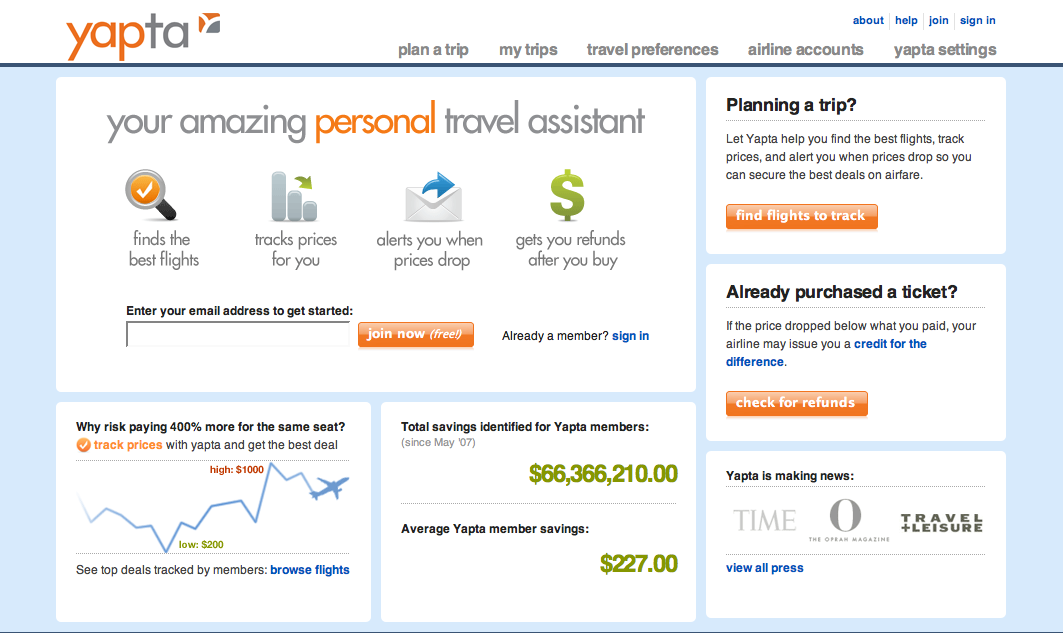
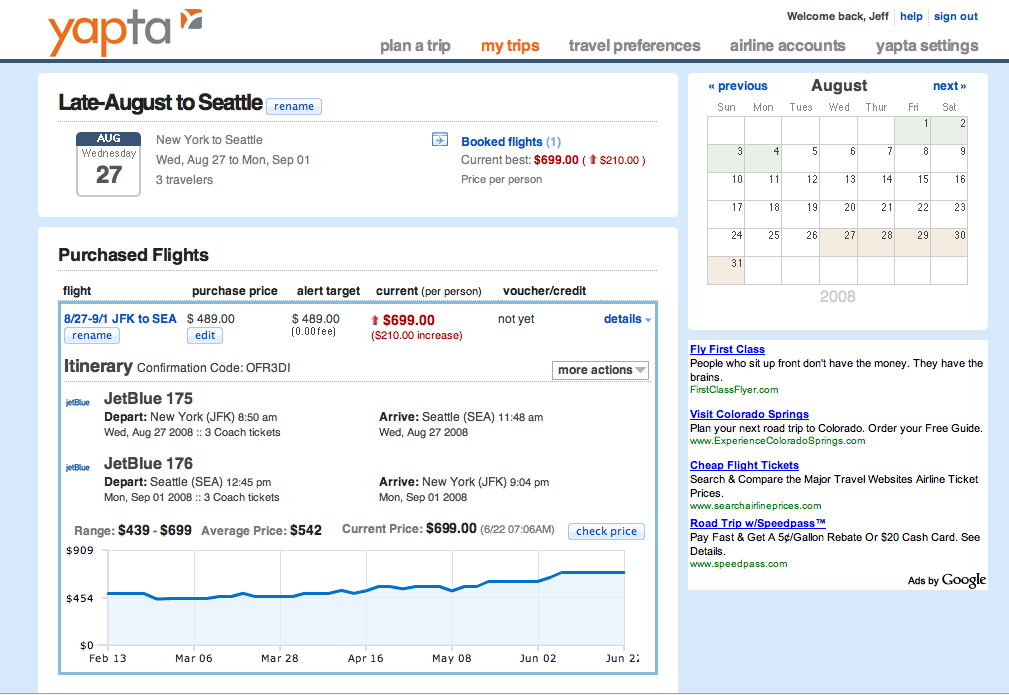
Now, 350,000 registered users later, Yapta has finally launched as a full-fledged Website, where you can track fares from 23 different airlines, including American, Delta, United, Jet Blue, Virgin America, and many newly added international carriers (Air France, British Airways, Cathay Pacific, Lufthansa). Once you find a flight you like, you can track it, and Yapta will alert you when the price drops. If the price declines after you purchase it, Yapta will help you get a refund or credit from airlines that have lowest guaranteed fare policies (most of them do if you buy directly from the airline, which Yapta helps you do by linking directly to the airline sites).

Unlike Farecast (now owned by Microsoft), Yapta does not make fare predictions. It tracks actual prices and sends you an email alert when the price changes. Says Romary:

Prices are very volatile. What we’ve learned is that the answer to whether it is going up or down is. ‘Yes.’ It is going up and down. People want to know when it happens.

So far, with just its browser add-on, Yapta users have tracked more than one million flights and identified over $60 million in savings. Nearly $50 million of that was identified before purchase, and the rest came in the form of vouchers from the airlines after the fact. Of all the flights tracked, about half (46 percent) saw price drops.

Now that Yapta is a Website, maybe it will be able to grow beyond the niche that it has carved out for itself. If you have time to plan a trip a few weeks out in advance, Yapta can be really handy, especially in conjunction with Farecast which gives you an idea of how low prices on a particular flight might go. Too bad there isn’t an API for Farecast that lets Yapta integrate the prediction feature into its own site, or vice versa.
Advertisement

Comments rss icon

  • ah,today first one say…happy

  • That’s a pretty cool idea.

    TC missed this. Google put codesearch snippet results into it’s regular search
    http://www.goog...q=selectedIndex
    That means the end of krugle.

  • For those who want to jogsearch more information about Yapta, simply click on the blue arrow to jog from one site to the next:

    And by the way the “Explore page” button simply means you can jog through all the links of the current page… (try it out its fun!)

    http://www.jogt...chEngine=google

  • Although not as pretty, but more useful is

    http://history....advPurchase=180

    That’s a graph of 2 years worth of airfare data.

  • Signed up, cool site – I also like Mobissimo.com, which I believe was mentioned on TechCrunch before.

  • the travel booking is getting congested or it becomes confusing with too much travel booking site and competition hopefully they can monetize their site.

    Nat
    http://www.workersinc.com

  • myspace.com/clintp

    @6, Your Celica is pretty nice Clint, my old roomate Ken had a Celica Supra, and it was so much cooler. I tried Toyota and bought a brand new 2007 Corolla. It was lame. I sold it on ebay 3 months ago and got a recent model Dodge.

    http://images.g...sa=N&tab=wi

    Supra was so much better.

  • Tried it out, yapta isn’t too good with european flights, they give me 0 results, while a quick search on a few airlines’ sites gave me like 20. Still a cool idea.

  • Yeah Chris,

    I bought that car in 06 It was a 05 model when I got it, and was actually looking for a supra but couldn’t find a newer one.
    The car did what i wanted it to do and that’s help find the chicks :} I was 19 then.Hopefully next year I will be able to buy a 09 Dodge Challenger I want that big 6.1 V8

  • Sorry, a somewhat pedantic comment, but for TC to say “So far, with just its browser add-on, Yapta users have tracked more than one million flights and identified over $60 million in savings.” is shitty journalism, regurgitating as if it were fact a probably-lying press release. $60m? Yeah, right.

  • Dennis sounds like tech crunch made you mad also.. I got so mad at mike for trying to sue everyone especially facebook. People use others images all the time the paparazzi for example profit off a picture,you don’t see every celebrity suing them.

    Here is the article on my thoughts.

    http://www.crun...g-facebook.html

  • “Hopefully next year I will be able to buy a 09 Dodge Challenger I want that big 6.1 V8″

    Gas is getting up near $5 a gallon here in SoCal. You must be making crazy money my friend. Good luck with the Challenger. That’s a fscking sweet vehicle.

    If I was insanely rich I would buy my favorite car in Gran Turismo 5 Prologue.
    http://www.gtrb...tsukuba-001.jpg

    I actually want most of the cars in Gran Turismo 5.

  • http://www.alex.../scobleizer.com

    Another story not reported by TC, Robert Scoble, self proclaimed, the first ever blogger, is rapidly and largely losing his audience. I noticed this progression start earlier this year, and it hasn’t stopped yet. When I saw this I shed a tear.

  • @Dennis – This is not true with all of TC with regards to shitty journalism, just Erick’s posts in my opinion, not really bad journalism I guess but just lazy, a lot of what what is posted is simply regurgitation, especially regarding technical information and a lot of time the results are innaccurate, when a little bit of research into a topic would reveal quite a bit more information and would be better help to TC readers. Just my opinion.

  • This is a very interesting service and can be used for a variety of ventures that are related to tourism as well as health.

  • I just tried booking a flight from Sydney to NZ and the best price they have is three times the normal airfare!

    They must not cover some reasonable size airlines yet – qantas, emirates, air nz.

  • @ Chris

    … and TechCrunch (aka “All Things Y!”) traffic has fallen off the table in the past week.

  • The flight prices did seem very expensive. I do like all the information. Good for photographer flying around the country.

    rosh
    http://www.newm...hotographer.com

  • To Yapta owners/developers or anyone who is developing similar application to Yapta, might find the following paper useful. I cut & paste the abstract below, but the full paper (PDF) with title, (”To Buy or Not to Buy: Mining Airfare Data to Minimize Ticket Purchase Price“) can be downloaded from the link shown (end of message).

    Abstract:
    As product prices become increasingly available on the World Wide Web, consumers attempt to understand how corporations vary these prices over time. However, corporations change prices based on proprietary algorithms and hidden variables (e.g., the number of unsold seats on a flight). Is it possible to develop data mining techniques that will enable consumers to predict price changes under these conditions?

    This paper reports on a pilot study in the domain of airline ticket prices where we recorded over 12,000 price observations over a 41 day period. When trained on this data, Hamlet — our multi-strategy data mining algorithm — generated a predictive model that saved 341 simulated passengers $198,074 by advising them when to buy and when to postpone ticket purchases. Remarkably, a clairvoyant algorithm with complete knowledge of future prices could save at most $320,572 in our simulation, thus Hamlet’s savings were 61.8% of optimal. The algorithm’s savings of $198,074 represents an average savings of 23.8% for the 341 passengers for whom savings are possible. Overall, Hamlet saved 4.4% of the ticket price averaged over the entire set of 4,488 simulated passengers. Our pilot study suggests that mining of price data available over the web has the potential to save consumers substantial sums of money per annum.

    And also , the various algorithms covered in this paper : To Buy or Not to Buy: Mining Airfare Data to Minimize Ticket Purchase Price are available in the most popular Java open source data-mining project from here in New Zealand called WEKA , from the University of Waikato. I can’t provide the link for WEKA , since any post with more than one HTML link, the TechCrunch spamfilter blocks it, but just Google for it using search terms as “WEKA Java”, you can’t missed it.

  • To Yapta owner & developers or anyone who is developing similar application to Yapta, might find the following paper useful. I cut & paste the abstract below, but the full paper (PDF) with title, (”To Buy or Not to Buy: Mining Airfare Data to Minimize Ticket Purchase Price”) can be downloaded from the link shown (end of message).

    Abstract:
    As product prices become increasingly available on the World Wide Web, consumers attempt to understand how corporations vary these prices over time. However, corporations change prices based on proprietary algorithms and hidden variables (e.g., the number of unsold seats on a flight). Is it possible to develop data mining techniques that will enable consumers to predict price changes under these conditions?

    This paper reports on a pilot study in the domain of airline ticket prices where we recorded over 12,000 price observations over a 41 day period. When trained on this data, Hamlet — our multi-strategy data mining algorithm — generated a predictive model that saved 341 simulated passengers $198,074 by advising them when to buy and when to postpone ticket purchases. Remarkably, a clairvoyant algorithm with complete knowledge of future prices could save at most $320,572 in our simulation, thus Hamlet’s savings were 61.8% of optimal. The algorithm’s savings of $198,074 represents an average savings of 23.8% for the 341 passengers for whom savings are possible. Overall, Hamlet saved 4.4% of the ticket price averaged over the entire set of 4,488 simulated passengers. Our pilot study suggests that mining of price data available over the web has the potential to save consumers substantial sums of money per annum.

    And also , the various algorithms covered in this paper : To Buy or Not to Buy: Mining Airfare Data to Minimize Ticket Purchase Price are available in the most popular Java open source data-mining project from here in New Zealand called WEKA , from the University of Waikato. I can’t provide the link for WEKA , since any post with more than one HTML link here, the TechCrunch spamfilter blocks it, but just Google for it using search terms as “WEKA Java” or “WEKA data mining”, you can’t missed it.

  • To Yapta owner & developers or anyone who is developing similar application to Yapta, might find the following paper useful. I cut & paste the abstract below, but the full paper (PDF) with title, (”To Buy or Not to Buy: Mining Airfare Data to Minimize Ticket Purchase Price”) can be downloaded from the link shown (end of message).

    Abstract:
    As product prices become increasingly available on the World Wide Web, consumers attempt to understand how corporations vary these prices over time. However, corporations change prices based on proprietary algorithms and hidden variables (e.g., the number of unsold seats on a flight). Is it possible to develop data mining techniques that will enable consumers to predict price changes under these conditions?

    This paper reports on a pilot study in the domain of airline ticket prices where we recorded over 12,000 price observations over a 41 day period. When trained on this data, Hamlet — our multi-strategy data mining algorithm — generated a predictive model that saved 341 simulated passengers $198,074 by advising them when to buy and when to postpone ticket purchases. Remarkably, a clairvoyant algorithm with complete knowledge of future prices could save at most $320,572 in our simulation, thus Hamlet’s savings were 61.8% of optimal. The algorithm’s savings of $198,074 represents an average savings of 23.8% for the 341 passengers for whom savings are possible. Overall, Hamlet saved 4.4% of the ticket price averaged over the entire set of 4,488 simulated passengers. Our pilot study suggests that mining of price data available over the web has the potential to save consumers substantial sums of money per annum.

    And also , the various algorithms covered in this paper :

    “To Buy or Not to Buy: Mining Airfare Data to Minimize Ticket Purchase Price”
    http://knight.c...amlet-kdd03.pdf

    are available in the most popular Java open source data-mining project from here in New Zealand called WEKA , from the University of Waikato. I can’t provide the link for WEKA , since any post with more than one HTML link here, the TechCrunch spamfilter blocks it, but just Google for it using search terms as “WEKA Java” or “WEKA data mining”, you can’t missed it.

  • To Yapta owner & developers or anyone who is developing similar application to Yapta, might find the following paper useful. I cut & paste the abstract below, but the full paper (PDF) with title, (”To Buy or Not to Buy: Mining Airfare Data to Minimize Ticket Purchase Price”) can be downloaded by Googling for it since posting links in a message at TechCrunch will go directly to spamfolder or being deleted.

    Abstract:
    As product prices become increasingly available on the World Wide Web, consumers attempt to understand how corporations vary these prices over time. However, corporations change prices based on proprietary algorithms and hidden variables (e.g., the number of unsold seats on a flight). Is it possible to develop data mining techniques that will enable consumers to predict price changes under these conditions?

    This paper reports on a pilot study in the domain of airline ticket prices where we recorded over 12,000 price observations over a 41 day period. When trained on this data, Hamlet — our multi-strategy data mining algorithm — generated a predictive model that saved 341 simulated passengers $198,074 by advising them when to buy and when to postpone ticket purchases. Remarkably, a clairvoyant algorithm with complete knowledge of future prices could save at most $320,572 in our simulation, thus Hamlet’s savings were 61.8% of optimal. The algorithm’s savings of $198,074 represents an average savings of 23.8% for the 341 passengers for whom savings are possible. Overall, Hamlet saved 4.4% of the ticket price averaged over the entire set of 4,488 simulated passengers. Our pilot study suggests that mining of price data available over the web has the potential to save consumers substantial sums of money per annum.

  • And also , the various algorithms covered in this paper (mentioned in my previous post) :

    To Buy or Not to Buy: Mining Airfare Data to Minimize Ticket Purchase Price

    are available in the most popular Java open source data-mining project from here in New Zealand called WEKA , from the University of Waikato. I can’t provide the link for WEKA , since any post with more than one HTML link here, the TechCrunch spamfilter blocks it, but just Google for it using search terms as “WEKA Java” or “WEKA data mining”, you can’t missed it.

  • And also , the various algorithms covered in this paper (mentioned in my previous post) :

    “To Buy or Not to Buy: Mining Airfare Data to Minimize Ticket Purchase Price”

    are available in the most popular Java open source data-mining project from here in New Zealand called WEKA , from the University of Waikato. I can’t provide the link for WEKA , since any post with more than one HTML link here, the TechCrunch spamfilter blocks it, but just Google for it using search terms as “WEKA Java” or “WEKA data mining”, you can’t missed it.

  • Erick Schonfeld, sorry, I pressed the submit button once and my comment didn’t appear. So, I chopped part of the text form the first post since it contained HTML URL, and then re-submitted for the second time, the cut-down version and it finally appeared. Since the I chopped half of the text from my first post that finally appeared in my second message, I thought that I posted the second part since it contains the important info about the open source WEKA project. This part didn’t appear after I pressed the submit button. I thought that because it contains an HTML tag for the URL, the TechCrunch spamfilter blocked it. The last post in @25 was done without the HTML url and it finally appeared.

    So, this explains the consecutive posts with almost the same message. Just curious, how many HTML links can you post in one message without being blocked by the TechCrunch spam filter? Perhaps if you can give us a hint, then I will avoid posting HTML links in the future. The info that I like to share with readers here at TechCrunch is quite informative related to state-of-the-art technology that some might find interesting perhaps for technology implementation, but lots of my posts in the past where I have included HTML links are just being blocked by the TechCrunch spam filter.

  • nice site, thanks for the find

  • Yikes. The idea is great, but their airline selection is dismal. There are so many missing airlines that it isn’t even funny, unless you happen to only fly in the US and never use low cost airlines. I made a few test runs, and it consistently failed to find the best deals. It also lacks some features already found on similar services such as date shift tolerance. Nice idea as I said, but please make it useful.

  • I’ve used it and it’s saved me money. United airlines has a policy where you can get a refund of a fare drop within 24 hours no questions asked. I think you hav eto buy the fare from united.com. in any case, i tracked it after I bought it and then got an email from yapta and then called United and it was true. Although i hate united’s customer service or lack thereof, this was a bright spot. i think its the yield mgmt software companies that have the most to fear if this gets widely adopted.

  • I’ve tried the site multiple times already and it just doesn’t work. Is there something I’m doing wrong? Maybe they haven’t optimized it for Firefox or something, because the “Plan a Trip” feature just freezes up when I input my choices and nothing happens.

    Is this just a non-functioning pre-beta presentation, or is this supposed to be a working model?

  • @Falafulu Fisi

    I did a little research on the paper you mentioned. As it turns out, Hamlet eventually turned into Farecast. This is from Professor Oren Etzioni’s website: “Etzioni is the founder of Farecast—a company that utilizes data mining techniques to anticipate airfare fluctuations. The company was formerly known as Hamlet (”to buy or not to buy…that is the question”). Farecast was acquired by Microsoft in 2008.”

Leave Comment

Commenting Options

Enter your personal information to the left, or sign in with your Facebook account by clicking the button below.

Alternatively, you can create an avatar that will appear whenever you leave a comment on a Gravatar-enabled blog.

Trackback URL
bugbugbugbug
Techcrunch on Facebook