Can Google Trends Predict The Election?
by Erick Schonfeld on June 7, 2008

obamamccain.png

If more people are searching on Google for “Obama” than “McCain” does that mean he is more likely to win the election?

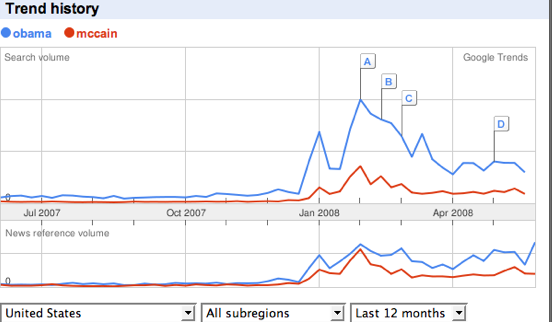
Not every voter in the U.S. uses Google, or even uses the Internet, for that matter. But enough of the population does use Google that its search patterns cannot be ignored by either candidate, the press, or anyone interested in the outcome of the election. Fortunately, Google lets anyone see the relative popularity of different search terms on Google Trends. The screen shot above is from a comparison I just did between “Obama” and “McCain” in the U.S. over the past 12 months. If search volume is predictive of election results and the elections were held today, Obama would win.

More traditional polls come to the same conclusion. A CNN-Opinion Research Corp. poll conducted June 4 and 5, shows Obama ahead by 47 percent to McCain’s 43 percent (Ralph Nader has 6 percent). And a Gallup poll shows a tighter race, with Obama at 46 percent verses McCain at 45 percent. Obviously, it is a close race and sentiment can go either way between now and November. And there is a likely correlation between search volume and news mentions, which are also compared in the graph above (by pulling in data from Google News).

What is great about Google Trends, though, is that you can drill down by state. An in-depth analysis of how predictive Google Trends was during the primaries (by Michael Giuffrida, a student in Virginia) shows that in at least half the cases for the Democratic primaries, Google Trends did a good job predicting the outcome. Update: Just to clarify, the analysis looks at both Democratic and Republican primaries. For the Democratic primaries 37 states were analyzed, and five of those had to be thrown out because of insufficient data. Of the remaining 32, Google Trends correctly predicted 27 of the primary elections, or an 84 percent success rate. For the Republican primaries, 29 elections were analyzed and Google Trends correctly predicted only about half (the data wasn’t as good for a variety of reasons).

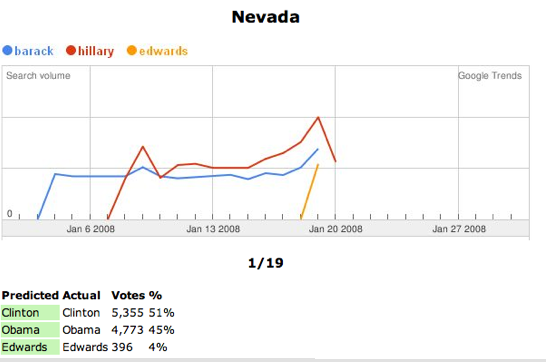
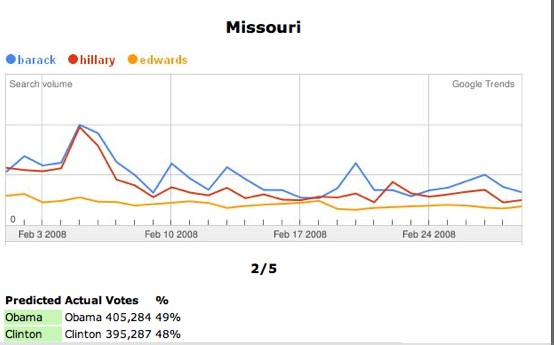
Below are two of his comparisons of Google Trends and actual election results in Missouri (where Obama won) and Florida Nevada (where Clinton won). Google Trends appears to be more predictive the higher the search volume (i.e., the more data points). Some states had more searching than others, but you’d expect election-related searches to spike across the board as the general election nears. At the very least, both campaigns would be wise to use it as a sanity check on their own polling on a state-by-state basis, if they are not doing so already.

(via Slashdot).
obamahillary-missouri.png
obamahilary-nev.png

Advertisement

Comments rss icon

  • Well, actually Google CAN predict the elections :)
    At least they did in Croatia just before the Parlamentary Elections :)

    Go, go Obama!

  • Intersting, I suppose. But I’d be more interested in seeing these trends in 3 months. Keep in mind that mccain clinched the nomination long ago and has since not said much.

    You’ll notice Obama’s highest spikes were at times when he was facing off against hilary. Notice how he has trended down as of late, espcially now that his nomination has been secured.

    Again, interesting, but perhaps a bit misleading…

  • It may be able to predict current sentiment, but it will never be able to predict the “October Surprise”.

  • I am not saying this is predictive of what will happen in November. I am saying that Google Trends might be as accurate or more accurate than traditional tracking polls, and that the candidates can use it to see which states they need to focus on.

  • The answer is “no.” Seriously? Search engine volume as an indicator of whether or not someone will win the election? How’s that myopia working out for you?

  • “An in-depth analysis of how predictive Google Trends was during the primaries … shows that in at least half the cases Google Trends predicted the outcome.”

    You realize that a fair coin flip has about the same chances too, right?

    This is a pretty terrible post. Google’s audience is clearly not a fair sample for a politics survey. McCain has a lead with blue collar workers and less educated folk, the exact people who don’t even own a computer let alone google for a candidate.

  • I’m sorry, but:

    “shows that in at least half the cases Google Trends predicted the outcome.”

    Doesn’t that mean that in the other half, Google Trends did NOT predict the outcome?

    Did I misunderstand Erick?

    Anyway, no, I don’t think it’s an accurate predictor of the election, but more a reflection that more people know McCain than people know Obama (many are just beginning to learn about Obama), and that the general Google-using crowd is skewed more towards Obama than the general population (still many who don’t use the internet, and many more who like their Yahoo!).

  • Hell, who needs election? Let’s just let Google decide!

  • Taken as a raw indicator, I’d use the Google trends numbers with caution. First of all, it seems likely that McCain supporters are older and less likely to be using the Internet in general. This would introduce a potentially large bias into these results. Also, more searches does not always mean more searchers. You’d also need to exclude the possibility that Obama supporters do more searches than McCain supporters. Finally, I simply note that a search does not mean a vote. I’ve done plenty of searches for the candidate I’m not going to vote for.

  • It would be interesting to look at it from another angle. for instance one could combine words like Obama / health care or McCain / War … by going through some pattern a smart person could figure out which Googlelers are concerned with which topics in conjunction with which candidate…. makes sense? I’d like to do that but since we’re sweating through the weekend to get ready for soft-launch our apps on Monday I am afraid I won’t get to that ;-(

  • Facebook Lexicon seems to agree with Google…

    http://www.face...=mccain%2Cobama

    In the case of Faceook Lexicon, it’s measuring how much people are talking socially about those things, rather than searching for info about them. Could it be argued this is a more accurate measure?

  • “Two girls, one cup” for president!

    http://www.goog...7-11&sort=0

  • Not likely. McCain supporters already know who they are supporting. Dems and even long-time Obama supporters don’t know what it is they support, so they have to search it. I’m sure a lot of dems did search for both Obama and Clinton to decide where they’d cast their primary votes.

    I think this is just wishful thinking on your part Erick. Here’s my advice: stick to real tech news. This post would have been more impressive AFTER November, should it turn out to be true.

    Excuse me while I write a script to Google “McCain” repeatedly…

  • So…. is someone writing the code to automatically search for whichever candidate in order to manipulate the conception of “front-runner,” now that we’re going to assume web hits provide a more accurate set of voter intention data than pollling?

  • Is there any state that McCain has more searches than Obama?
    Checked Texas and Florida… Both are states where Obama is currently trailing McCain [-9 in TX and -10 in FL].
    http://www.electoral-vote.com/

    If Obama has more searches in every state does that mean he will carry all the electoral votes?

    In the 60 days before the election it will be interesting to see state by state analysis in the swing states. The searches done during this time frame will have more weight than those done in the 12 months prior to today when many voters were just getting to know Senator Obama.

    What are your thoughts?

  • Dejavu, Can the UNIVAC predict the election?

  • I thought the same thing in May using Compete trend data instead.
    http://blog.sea...any-indication/

  • did no one notice that part of the supporting evidence was that Hillary won Florida… Where obama was not even on the dem ticket due to the party acting improperly in that state. Poor choice for evidence. Obama didn’t even run in that state…

  • Good points, but make it more generally

  • Ron Paul was the number one searched query for all candidates (Dem. and Rep.) for many months in a row. We see how well that turned out.

  • can Google Trends Predict the Election? {seesmic_video:{”url_thumbnail”:{”value”:”http://t.seesmic.com/thumbnail/s73ikRasp2_th1.jpg”}”title”:{”value”:”can Google Trends Predict the Election? ”}”videoUri”:{”value”:”http://www.seesmic.com/video/wY0l5IjcRm”}}}

  • Does that mean everyone who Googles “9/11″ is thinking of become a terrorist?

    Maybe we can only predict that half of the time ;)

  • I know it has been said, but here is the graph. 2007 Ron Paul trounced any candidate in terms of search queries. I think that serves as a strong enough proxy to say that google search trends is not a reliable data point. Now the political market stuff CNN is doing – that is a whole different story.

    http://www.goog...2007&sort=0

  • I don’t think it means anything. Well it’s good for keeping track of what events spike what kind of activity, but as a comparison tool its seemingly worthless. There are way too many differing factors between the two candidates. For example, there has been more news out about Obama because of Hillary. Also considering that Obama has much more content with his name on social networks, like Obama girl. And considering he is pretty much a new face in politics, I’m sure people are still trying to get to know him.

    So I’m with Dangrsmind, a search doesn’t mean a voter. I’m a McCain supporter, and I never search for him. I go to his website or GOP.com. There is way too much bad media out about every candidate, I’d prefer to follow each campaign individually.

    It’s an interesting theory but I don’t think it carries much weight.

  • It’s a good discussion thread though! Good job Erick!

  • I would like to point out that not only did Google Trends correctly predict the ‘04 election results, it also predicted the closeness of the results.

    http://www.goog...eo=usa&sa=N

    I do strongly believe there is a correlation between Google Searches and public opinion.

  • Based on the blogs I visit regularly, liberals are MUCH more active on the Internet. (and overly vocal, I might add).

    Heck, I can’t even visit seobook.com to read up on SEO without having to read a rant against conservatives between link building and duplicate content articles. And forget Digg.com – it’s like hanging out at Sean Penn’s house.

    I would handicap Barack’s numbers – his user base on the Internet is probably 3x higher than McCain’s.

  • Interesting observation Erick…and mostly good comments from the gallery, thus far.

    Considering that Obama’s past history and his philosophy is the least known of any candidate in modern times, I’d guess the searches may be more from his Republican detractors or curious Independents, than from the Democrats (most of whom seem to have been converted by his talk and have no need to check his walk.)

    #12 (MAtt) has an opposing view, citing a need for Democrats to know about their candidate. I’m wondering how he comes to that conclusion? The battle between Clinton and Obama was indeed epic, but very unusual. Now that the standard-bearer has been anointed, the party faithful will dutifully get in line.

    My bet is that by now, the red and blue lines are drawn and few will switch from their choice, barring a major candidate mis-step or some new national calamity. Barr and Nader may pull a few votes, but those should cancel each other. Independents will be the biggest determinant, along with the relative success that the big-two parties have in getting out the vote. In that, I think Obama has the advantage.

    Its good to see TC continue to keep a finger on the political pulse, in this most important election.

  • Works for the Superbowl too: http://google.c...2008&sort=0

  • If Google Trends only quantifies how many times their name was entered into a search bar, I’m not sure how you connect the logic dots and say that it translates into a vote for them. In fact, I have recently Googled both of them, does that mean I am voting for both? Of course not.

    Searching a name can only mean they want info about them.

    Google is a serach engine not a polling machine.

  • @15: Hey, The UNIVAC was actually right with predicting Eisenhower. CBS just didn’t publish the results due to fear of being wrong. It was 1952 afterall. I guess they just didn’t trust computers back then.

  • Of course not.

    Google Trends are a reflection of query volume, which in this case can be traced to a number of things e.g. people still getting to know Obama, the fascination over the Obama/Clinton dynamic, and especially temporal events that might temporarily heighten a candidate’s media presence (think Dean’s “yee-hah”, Clinton’s “under sniper fire”, Reverend Wright quotes) causing a spike in search activity etc… Heightened online campaigning specifically can help spur search activity too (e.g. various trends available on Ron Paul from the past year).

    That’s not to say that companies haven’t dabbled in making predictions about contest outcomes using search-based analysis, looking at not just query volume but also keyword analysis, to try to gauge respective voter preferences. Even then though, that has its limitations.

    Queries and votes, or even potential votes, are totally different things. Moreover, as usage ranges go and contrary to how the leading domestic search engine has build so much power up that it’s brand is increasingly being used as if it were a verb (barf), it’s silly to presume that there aren’t powerful blocks of voters who are not heavy users / consumers of Google, the Web and/or digital media in general.

  • I updated the post with some more data from the state-by-state analysis. For the states studies where there was enough data, Google Trends predicted 84% of the Democratic primary elections, and half of the Republican ones (I had misread it earlier and thought it was half of all the primaries studied).

    That is a pretty impressive success rate for the Democratic primaries, and suggests that at least in cases where the choice is limited to two or three leading candidates, there could be a correlation between Google Trends and actual results.

    @29, of course each search doesn’t translate into a vote. What we are talking about here is a correlation. If search = intent for enough people, then it is predictive.

    @17, while Obama chose not to run in Florida, his name was still on the ballot. But you are right, Florida is not the best example. I swapped in Nevada instead, another state Clinton won.

  • I happen to know a fair amount in this space… and search volume is ONE way to look at it. But there are significant problems with it.

    The main problem is that search volume is uni-dimensional. That is, you may search for someone if you LOVE them, or HATE them. The search looks just the same.

    I happen to have plenty of access to search data and you should see the charts for Howard Dean as he was making his run couple elections back. If you saw that you would be CONVINCED he would win. Unfortunately, people were searching for him because he was a lunatic and had a crazy video.

    There is another problem. You have to really dig deep to understand the demographics of the people searching, and what their propensity to actually vote is. Searching does not equal voting.

    I will say that search can be used to help tri-angulate studies. On its own, too many flaws to be a single source of reliable data.

  • “it’s silly to presume that there aren’t powerful blocks of voters who are not heavy users / consumers of Google, the Web and/or digital media in general.”

    @31, it doesn’t matter as long as the people who do use Google are a broad enough swath of society that they are a statistically valid sample (for each state, in this case).

  • I agree with Brett @2 . Obama and Hillary have been in the news for months as they continued hashing out their primaries while McCain was rarely a headline. I would like to add though, that first if McCain was in the news the liberal media always finds Obama and Hillary more interesting.

    Really though, searching for a phrase doesn’t always mean you are “for” something. I’d agree that more people read news sources where they agree with the content and probably seek it out more often, but this is the internet. You can type anything into a search box…remember those AOL search records released?

  • I came to a similar analysis a few weeks ago:

    http://myeyesgl...-of-crowds.html

  • moot though …

    mccain wont last the three months to the convention, and the party will decide they need someone else

  • Like stocks, volume alone is not a valuable method of prediction.

  • @34, that sounds like an assumption added atop an assumption to me. That said, even if we were to take it as a given that the swaths are broad enough, the underlying problem remains:

    The notion of (@32) search being sufficiently representative of not just mass interest but beyond that predictive of mass intent lacks evidence in my opinion. To me, evidence means demonstrate the correlation across multiple scenarios over time, with major variable types such at the examples I’ve given eliminated and/or explained in each case.

    In other words, until a compelling general case is made for such a correlation happening more often than not, the notion is fundamentally presumptuous at best (and as for this specific scenario, it’s not like Obama winning would change that).

  • @Aaronontheweb – no fucking shit!!! Eric, you’re a MORON. Try doing some research ehh? Good fucking god you blog guys are self absorbed idiots…

    Hear’s a hint – HITS does not equal Intelligence

  • First of all, why would you search for “barrack” and “hillary”, why not “obama” and “clinton” as you used “edwards.” This looks like a contrived story…

    When using “obama” and “clinton” obama wins every state by search.

  • lol man techcrunch readers ripped you a new one Eric.

  • David Rockefeller can predict who will win the elections. That will be Obama.

  • “Hot Trends aren’t the search terms people look for most often — those are pretty predictable, like [weather] or [games] or perhaps [myspace]. Yes, [sex] too. Instead, the Hot Trends algorithm analyzes millions of searches to find those that are deviating the most relative to their past traffic. And the outcome is the Hot Trends list.”

    http://googlebl...-hot-today.html

  • This post is a DIRECT rip-off of 2 of my posts from my blog from EARLIER in the year!

    March 20: http://adwordse...ial-battle.html

    May 20:

    http://adwordse...t-searches.html

    no credit to me on this?

  • Dan (#46), hopefully you’re not seriously thinking someone ripped you off. Your blog has to been seen to be ripped off.

  • Too bad this didn’t work for Snakes on a Plane.

  • Google Trends is an amazing tool. With 60% or more of online users searching Google for information, it certainly stands to reason that the trends we are seeing are representative of a large segment of our population. The question is — how many of the people who actually get out and vote use Google?

  • Unfortunately I don’t think so. This reminded me of a little experiment I did with Summize during the mayoral elections in London: http://2gether0...-is-the-medium/ – it displays perception not prediction.

Leave Comment

Commenting Options

Enter your personal information to the left, or sign in with your Facebook account by clicking the button below.

Alternatively, you can create an avatar that will appear whenever you leave a comment on a Gravatar-enabled blog.

Trackback URL
bugbugbug