
I want to love the search apps in Yahoo’s newly opened Search Gallery. I really do. Opening up its search engine to outside developers is an idea worth applauding (although it could still do more). That’s why I was excited when Yahoo announced its SearchMonkey platform, which essentially allows outside developers to create their own search “applications” that changes the display of search results.
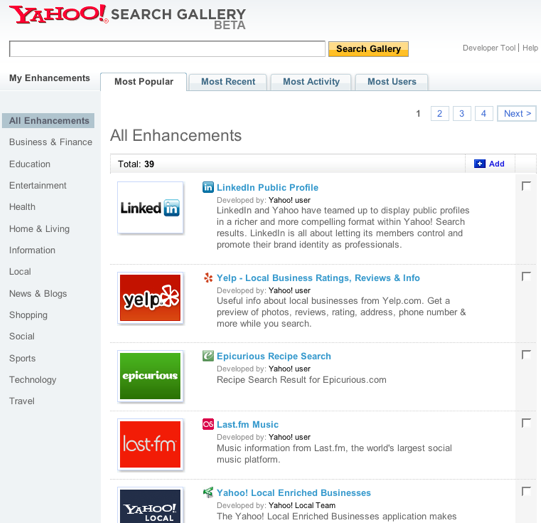
Today, Yahoo publicly launched a gallery of these apps, which Yahoo members can add as customizations to Yahoo search. Some of these include apps that are supposed to highlight public LinkedIn profiles, Yelp reviews, Epicurious recipes, Digg stats, and music info from Last.fm. When you perform a related search, a little icon and customized detail information is supposed to appear within the search results. Think of these as Firefox search add-ons, but all in one place.
Well, that’s the idea. But after putting some of these enhancements through a quick test drive this morning, I am completely underwhelmed. The following searches failed to produce any enhanced results: “fried snapper,” “baked ziti,” “U2″ (got the regular Yahoo Music shortcut, but not any Last.fm results), “Rolling Stones” (same). “White Stripes” (same), several current headlines on Digg (nothing).
The LinkedIn app seemed to work okay for famous tech CEOS like “Reid Hoffman” and “Max Levchin,” but it didn’t prioritize the LinkedIn results in any way. For Levchin it was No. 6, even though I told Yahoo by adding the LinkedIn enhancement that I want to see those results. But SearchMonkey only lets developers change the display, not the order of the results.
Then I put in a very specific search for something I know is listed on Yelp: “bar tabac brooklyn restaurant.” Nothing. Or, rather, too specific. When I tried just “bar tabac,” I finally got this enhanced result:

So it kind of works, but you shouldn’t have to hunt and peck to find these enhanced results. And you’d think that the more specific your search query, the more likely you are to find one. But the reverse is true.
I’m not sure if this is Yahoo’s fault or the fault of the developers. What I do know is that SearchMonkey apps have along way to go before they create a better search experience.


It’s clutter. What would really be useful is just a separate link that would highlight the search terms once you click on the link like Google’s cache links do.
but in real time. The link to hide the highlighting would take you to the real page, and the highlighted page would be a JIT cache.
I guess it was a desperate move to get an edge in search. I think the idea is very powerful but then there is implementation…
The deeper yahoo! let’s developers reach into their search technology the more powerful becomes the concept.
hi, eric, searchmonkey does not affect the ranking of the results, so your argument “but it didn’t prioritize the LinkedIn results in any way” is totally wrong. If it changes the rankings, then it opens a huge door for spam.
I second the point from Folks. This article seems to be based on discussion of search ranking/position for providers implementing SearchMonkey, rather than the benefits of enhanced listings.
It would make sense for Yahoo to somehow place relavant results that would be displayed with a SM app at that top since you told Yahoo you want results displayed with this app.
The deeper yahoo! let’s developers reach into their search technology the more powerful becomes the concept.
Is there a filter in tech crunch, i simply hate read Erick’s post. I doubt his aptitude.
bar tabac brooklyn restaurant probably dint show yelp short cut because none of the search results were from yelp. If there is was a search result from yelp it would have automatically been shown that way i guess.
@andy: exactly, the enhanced results will surely standout from the rest of plain results, so it is like the site get free advertising on yahoo search result page, that’s the motivation for them to develop monkeys.
i am disappointed that Eric did not spend a minute to understand what searchmonkey really is and write nonsense things like “it didn’t prioritize the LinkedIn results in any way”. He has been my favorite writer on TC, but i guess he also makes mistakes too.
Agree with Folks. This is a post that definitely has to be corrected at several places. Somehow Erick seems to have misunderstood or did not even care to find out the purpose of search monkey.
Why is this post confusing Yahoo search with SearchMonkey? When you say “bar tabac brooklyn restaurant” didn’t display result from yelp, it’s because it displays it on the 2nd page. And when I go to Yelp page, it turns out that the first time the word “Restaurant” is used it’s in a comment far down the page. Though, Google catches it and the Yelp result is 4th. What you mean here is that google search is better than yelp (depends on your point of view). So far, this has nothing to do with SearchMonkey.
Searchmonkey simply allows the developer to catch the result from Yelp and enhance it. In my test drive today, I like the way the search results are enhanced. Though as others mention, it wouldn’t be bad if the results for which I added enhancement come out on top. There is one potential problem with this though: you might search for something that returns results from several of your enhancements and they all turn up at the top of the page, and you have to scroll far down to find a more useful link that was not in your enhancement list. So it’s kind of a double edged sword.
Folks and Andy are spot on about the ranking issue. SearchMonkey has never been about manipulating ranking — at least not yet.
Also note that the Gallery is very plainly marked “beta.” There are some issues, which should obviously be fixed, but at least yahoo is trying to innovate in search — and as we all know, sometimes innovation can be a little messy. I’m sure it will be cleaned up and become a stronger platform with time.
@Folks @andy - Agreed on the spam points and the underlying motivation so far, but being able to skew the results might be useful for say, a health search engine or one targeted at children’s literature for example…there is a case to be made for not just customizing the UI, but also being able to filter based on what you know your audience wants.
This is just getting started - I know for a fact there is broad vision and big ideas driving this at Yahoo! and I believe that in the market this idea will definitely mature as both utility and product.
I agree with Eric that the LinkedIn one is not quite right because I came up second on a vanity search for Ben Watson, and not at all on Benjamin Watson, even though I own the LinkedIn URL for benjaminwatson. I will try again with a more important example
Search monkey is for monkeys who want to do the work for Yahoo! It’s do dumb the way it’s implemented now. I am not sure what yahoo people were thinking. They want your users to leave your site to go back to yahoo and install the app, so when they search for you again you show up inside the yahoo for those users.
This sounds like some lame compromise that must of have come out of some internal fight within different factions at yahoo. As a result it’s neither here or there. It would only benefit the major sites like yelp who might get automatically installed for all searchers but useless for the rest.
It will not survive in it’s current implementation.
You can do what Erick is talking about. You just add the site:example.com tag
http://search.yahoo.com/search.....%3Alast.fm
Here is one I did for Last.fm
The metadata results on site: searches is pre-expanded also, which isn’t mentioned at all in the article. The thing is it’s still clutter.
The same people that are geeky enough to want to do go through with the extra steps to do this are the same people who don’t want/need it.
Eric,
yes, the platform has still ways to go. Long tail searches in general aren’t that well served by search engines and you seem to be disappointed more by the search ranking than the enhanced result itself. Understandable. You may want to check out or app: http://gallery.search.yahoo.co.....n?smid=wKB which reacts very differently to long tail queries.
With the app added, try looking for “best calamari palo alto”. clicking on the enhanced search result’s link (the title) takes you to the actual list of restaurants that have most +ve mentions for calamari in Palo Alto. The enhanced result shows you the top 3 restaurants.
I do believe, like some of the previous commenters, that Yahoo’s search ranking and relevancy needs to seriously take into account the trust-factor that comes into play when a user has opted-in to a searchmonkey application; without this, there won’t be too much innovation on the platform. Also, they need to figure out clever ways of previewing enhanced results to encourage adoption.
Erick, sorry I left out the K in your first name. Oops.
Nice add by Yahoo. I’m looking forward to further development of this platform.
hi
i have some wii fit for sell
http://cgi.ebay.com/ws/eBayISA.....0255429754
@19, I can see why you don’t want it.
Erm… Erick?? This is a presentation enhancement thing that they’ve done - so it will only pimp a result if it’s there to be pimped. The other comments are spot on. If yahoo went off and stuck all the results from lastfm at the top just because you added that monkey wouldn’t that kinda suck?
Besides when you add one of these things there is a link so you can see the applications.
My dad won a real monkey in a poker game. He said it bit him several times and crapped on everything he owned. Thats all the insight I can offer on this one.
”The other comments are spot on. If yahoo went off and stuck all the results from lastfm at the top just because you added that monkey wouldn’t that kinda suck?”
http://search.yahoo.com/search.....%3Alast.fm
As I stated in my other post, perhaps Yahoo should just add the site:example.com tag automatically to the searches after you customize results for 1 site.
That would be less confusing for people that really want to do site search.
Then they could have a radio button that is auto-checked on lastfm. site search but with another radio that says “search the web” next to it.
It’s going to be interesting to see the take up of this and whether this does indeed allow spamming techniques to improve ranking.
Seems like a good first step. Yes, some aren’t loading properly and some aren’t designed well. And Yahoo probably isn’t mining its index properly to connect results with created add-ons. All of that seems easy enough to fix and quickly improve. For example, Amazon should show ratings more than anything else — but I suspect that’s Amazon’s fault and could be remedied in a few minutes. I like it. And, yes, as already noted several times, this shouldn’t alter results. On the other hand, if you want just add-on type results, I would image they could be built into a my.yahoo type page, and it could work without being considered SEO. This is good stuff. Screw Microsoft. Let’s see what an independent Yahoo can do now that they know Microsoft will pounce if they falter any time over the next year or two.
The enhancements are pointless if the search results that use them aren’t easily accessible.
Adding an application is basically implicit consent — you add the application because you want to see the enhanced information. Erick’s search for “U2″ should have put the Last.fm result somewhere near the top, regardless of its actual ranking.
It’s just not that useful if application-enhanced results aren’t given priority over normal results.
That, or Yahoo! can break their search results into a two-three column layout, with application-enhanced relevant search results being displayed in a column to the right somewhere.
At Trulia, we built our app to cover parts of both our head and tail queries. If you search for “miami homes for sale” you’ll see our treatment for the head real estate city search queries. We also have a treatment for individual properties in Yahoo’s index, but those are obviously tail and hard to find unless you know what you’re looking for.
I with agree with part of Erick’s assessment - it’s really hard to find results for some apps unless you know how the app works. But the SearchMonkey platform itself is pretty powerful and gives developers a lot of flexibility to treat their results differently if they want.
Here’s the link to our app - http://gallery.search.yahoo.co.....n?smid=gBV
Erick,
Thanks for your comments on the SearchMonkey Gallery. Very useful feedback. The Gallery is in Beta right now, so we’re incorporating suggestions as we build out the final version.
One clarification, however - SearchMonkey is a useful overlay of structured data on top of the organic search results - so if a certain site doesn’t show up for a certain search query, their app won’t show up. Put another way, SearchMonkey doesn’t effect the ranking of results. That said, a user adding an application for a site is a clear expression of preference, so as we roll out SearchMonkey and it becomes a rich source of user data we will evaluate factoring it into our relevance model.
Amit
I guess it was a desperate move to get an edge in search. I think the idea is very powerful but then there is implementation…
@Amit Kumar I think it’s a great start. The use of four (maybe more?) different button styles, tabs, interface elements, old-style buttons and AJAX is disconcerting from a simple UX standpoint. But that’s not my major concern… Is there an outlet to provide particular feedback, not only to Yahoo but more importantly the individual developers of an add-on? I’d be happy to provide some observations but would prefer to take it off TechCrunch and over the next few days.
Folks, and everyone else, I am very aware that SearchMonkey only effects the display and not the ordering of results. Maybe this sentence was not clear enough:
“SearchMonkey only lets developers change the display, not the order of the results.”
What I am arguing, as I have in the past (see second link) is that Yahoo should allow the re-ordering of results so that others can actually help them make a better search engine. My frustrations as a user with these Search Gallery apps is a case in point.
@Harsh, really, what I was looking for is on page 2 of results? Fail.
Good search is about figuring out my intent. By selecting and adding these apps, I am explicitly telling Yahoo that I am interested in seeing Yelp results or LinkedIn results or Epicurious results or whatever. But it doesn’t seem to do me much good.
@ Tim F: Thanks. We’re definitely interested in feedback. Best place to submit suggestions is:
http://suggestions.yahoo.com/?prop=searchmonkey
Thanks,
Amit
Erick: Even after trying out, reviewing AND writing an article about it, I still don’t think you get what SearchMonkey is about. Your last paragraph in your last comment contradicts itself. You are interested in seeing Yelp results, go to yelp.com. You are interested in better formatting of Yelp results on Yahoo! search, use SearchMonkey.
Your argument is “i see they made a car that travels on the road, but it’s so bad that it can’t even fly to the moon?”. Well, if you want to fly to the moon, use a friggin spaceship.
I like the concept of being able to influence the way search results are presented from our site - especially if we can bring in data from other sources or surface relevant related info from the site.
Right now though I’m finding the set-up app too flaky and unreliable to get it to do what I’m after. Maybe it’s my poor brain, and i know it’s Beta, but needs more work IMHO.
I have a feeling this is the start to something huge! Google should be shaking in their boots…
Erick, what if you say: I want to see x,y,z types of results as a,b,c but you do a search for w and the query bring backs x,x,x,x,x,x,x,x,x,y,y,y,y,y,y,y,y,y,z,z,z,z,z,z,w. w gets bounced to the bottom because you don’t have a plug-in for w even though it’s actually the most relevant result and the desired result. By selecting x,y,z plugins, you are not saying that all search should always be only x,y,z.
We hear you saying you want that, but that’s not how it’s designed (now) and that’s not what it does (now). We hear what you’re saying, but you are acting as if it’s broken when it’s doing what it’s designed to do. “By selecting and adding these apps, I am explicitly telling Yahoo that I am interested in seeing Yelp results or LinkedIn results or Epicurious results or whatever.” (No, you aren’t. You are wanting that, that’s it.)
I asked my toilet to come into the room and position itself under my ass, but it didn’t do it — my toilet must be broken or maybe it’s not even a toilet.
Erick - You need to learn to communicate. Written English definitely isn’t your forte? You say you get it; and, yet, you contradict yourself all over the place. Please, learn to write before attempting to cover any more ‘news’. I just wasted 15 mins of my lovely evening reading this crap and responding to your blighted thoughts.
Wow, SearchMonkey seriously rocks!
Wow…is Erik not a popular guy then?
Anyway, I think some of the comments that say that Erik misses the point, are themselves missing the point.
Erik pointed out–and Amit concurred–that if you allow a particular plug-in into your world, then that is a pretty clear statement of your preferences. The argument about spam doesn’t stand up, since if I chose the LinkedIn extensions, then I obviously want them, and if I don’t want them, I can turn them off again.
Of course that doesn’t mean that this is there today, but as Amit said, Yahoo! will be looking into it.
(It’s no different to putting the weather forecast as the first result, if I search for “London, UK”; why not put LinkedIn above any other occurrences of a person’s name, if I chose LinkedIn, or last.fm at the top if I searched for a band, if I have enabled the last.fm plug-in?)
But the reason I’m responding to this point, rather than just letting it fly by, is that there is an important underlying principle here, which is that semantic information is not just ‘tagged data’, but also user behaviour. For example, if in GMail I say “always allow images for this email address”, I’ve given a pretty good steer about the relationship I have with that email address. That information is legitimate ’semantic’ information, just as much as any structured data is.
The same goes here; it’s true that Erik is asking for SearchMonkey to do slightly more than it currently does. But that extra functionality he suggests is exactly the kind of thing that is needed if we are to make the semantic aspect of the web usable.
Anyway…interesting post…interesting service…interesting times…but now I better get back to building tools for the semantic web.
Mark
webBackplane
http://webBackplane.com/mark-birbeck