Facebook certainly chose a peculiar time to announce the imminent death of a platform (and dare I say, operating system) staple: the installation screen.
In the late afternoon of last Friday, Pete Bratach penned a post called “Streamlining Application Authorization” that went virtually unnoticed by the press at the time, even by Facebook-focused blogs. And when they did finally cover Bratach’s post, they chose to focus on less important matters concerning user metrics.
Was Facebook trying to pull a fast one on us? That wouldn’t be surprising, given the potential of fundamental platform changes to upset a large number of developers. And what it did announce consisted of quite a fundamental change.
Starting July 15 (and perhaps coinciding with the rollout of Facebook’s new site design), users will no longer see an installation screen (see below) when they access an application for the first time. Rather, they will see a new “login” screen that simply asks them whether they want to permit the application access to their information. This simply grants the application temporary access to your data so it can operate, without establishing any real footprint on your Facebook experience.
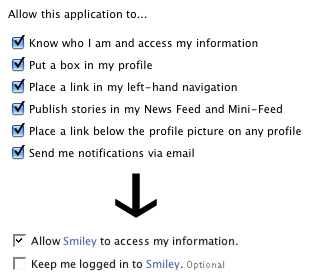
The new screen has been designed to make application adoption less intimidating for users. They will no longer have to worry about installing (and later uninstalling) applications – and their associated profile boxes, left-hand nav buttons, profile links, and email lists – just to try them out.
But the change should also slow viral growth patterns – especially for newer, smaller apps. Gone is the ability to put profile boxes (which give apps considerable visibility) on users’ pages upon first access. To add a box (on a special apps tab no less), users must later decide that they like it well enough to click on a special canvas page button.
The same goes for email notifications and news feed items larger than one line; users must opt into these through the canvas page as an afterthought. The new design will also forgo app links in the left-hand column (the column is going away in its present form), as well as app links under profile pictures. All in all, these changes mean that applications will struggle to obtain the same visibility and user access that they can instantly achieve now upon installation.
The move to get rid of installations is the latest in a line of decisions meant to clamp down on spammy apps by implementing sweeping changes to the platform, rather than coming down hard on particular wrongdoers. We first covered this trend in August when Facebook moved to stop developers from generating deceptive profile boxes and messages, and then changed the way all applications are measured.
Later, Facebook outed misleading notifications and mini-feed stories, reined in cross-application notifications, and put restrictions on feed stories. More importantly, Facebook began regulating the number of notifications, requests, and emails that apps could send to new users, based on response rates. And this year the company also released a formal platform policy that implemented rule-based limitations in addition to technical ones.
Platform changes meant to reduce spam are great for users but not so great for developers, even the non-spammy ones. After all, platforms by definition are meant to be stable; shake them up and things start to fall apart. Furthermore, just how Facebook has chosen to evolve its platform should give innocent developers pause. As Michael remarked in August, Facebook tends to avoid punishing mischievous developers in any meaningful way. This policy leads to further bad behavior since developers know they won’t be held individually accountable; Facebook will just change the entire platform on them.
And these pending changes only serve to continue that tradition. When installation screens go away mid-July, existing applications will see their access to users grandfathered in. Their profile boxes will be moved over to the new tab, their email lists will retain members, and they will still be able to generate news feed items just as before. Thus, the popular apps that achieved success through spammy means won’t suffer nearly as much as nascent apps that have yet to gain a foothold.
The question going forward, therefore, is this: will Facebook continue perfecting the platform with the goal of preventing all bad behavior with technological measures but no meaningful deterrents? Or will it concede that overly selfish behavior on the part of developers is unstoppable to some extent, and that it’s important to implement a reliable and effective system of punishment?


spammy apps ruined the platform for those of us who have apps that don’t send notifications or require users to spam their friends. I’m a lot more interested in the other social networks with opensocial now
I, for one, think this is a positive change. I don’t know how many time’s I’ve wanted to try an app had to install it, and then find out they want to force invites upon me, then I have to go into a seperate page to uninstall it.
People still use this platform? The whole vampires, superpoke spam, and sheer abundance of crappy apps killed it. I don’t even know anyone who uses facebook apps anymore. Everyone I know is looking towards iphone/android dev. Nice knowing ya facebook!
This is a bit like bate and switch for all the people who spend thousands of dollars and endless hours building the facebook app.
We were shown one type of experience and now we are getting a different one. This is going to favor status quo and kill all the incentive for creating new apps. This is a mistake by facebook as it makes them dependent on the major app builder like rockyou, slide and others.
Again we were lured into the app based on the current app experience and now facebook is doing a switch on us.
How about a class action law suit. Anyone?
Hey Mark,
I did write about this on my post if you look. I reference Bratach’s post and state:
“Facebook has also suggested that developers adjust the way applications require users to login. Rather than adding the application, Facebook prefers that developers let users login first to view the application before they permanently add it.”
As far as I can tell this is not a requirement but instead a recommendation. In Bratach’s post he states:
“We’re doing this by recommending that you use require_login instead of require_add when the user first interacts with your application.”
I interpreted that as a suggestion not a requirement. Let me know if you think I’m wrong in my interpretation.
I’m glad you covered this. Certainly deserved more attention than it got prior to this blog post.
@Nick – I didn’t mean to suggest you overlooked the change entirely, just didn’t dive into it much.
For now, it will be optional for developers to switch over (the suggestion). But on July 15th and onwards, it’ll be a requirement. Per Bratach:
“You should start using require_login in place of require_add now. When the new profile design goes live to all users, we’re going to redirect require_add calls to require_login.”
Nick – It looks to me like they are suggesting that app developers start using “require_login” now, but it will be required when the new profiles go live. From the post:
“You should start using require_login in place of require_add now. When the new profile design goes live to all users, we’re going to redirect require_add calls to require_login.”
It is certainly suicide attempt by facebook platform. Facebook has 18% traffic from apps.facebook.com as per alexa, which is only canvas page views of apps, and does not include user interaction with apps within facebook profile page.
All they had to do was some easy method to cleanup unused added apps, which would have been enough to deal with “crappy” apps.
This might make apps more interesting as developers will now focus on functionality. The use of applications will become a highly personal, albeit lonesome experience. The app will actually have to do something.
I suspect the gaming category will obviously continue to do well as will review style applications (thinkin iRead, Visual Bookshelf). What I’d love to see is productivity apps begin to infiltrate Facebook (and MySpace).
Another side effect might be a drastic reduction in page views within the application realm as users stop interacting with apps which should drive up CPM/CPI fees. That will be a big bonus for established apps with large audiences.
@Mark ah great catch … I’ll get something else up about this
This is all done by Google’s Trojan horse execs who became CXOs in facebook, who are trying to ruin facebook.
mark, what an insightful and well-written article – but unfortunately, facebook just doesn’t merit this kind of attention or analysis..hope to see you give the same kind of intensity and thought to more pressing and interesting tech news
@12 : hehehehh funny, never thought of it that way.
However, if you ask me, Zuckerberg was doing a good enough job destroying FB himself before the Google crew showed up.
Mark, thanks for catching this. Most developers opposing this change hopelessly, give a look: http://forum.de...k.com/index.php
Google was talking about no application installs months ago..
http://opensoci...-container.html
@Dave – thanks, duly noted.
@Dave; good point
Seriously though, I’m doubtful that changing the copy surrounding application access will do much. For most users the issue is one of “your account information will be accessed”…how that access happens is largely irrelevant.
One of the dangers for Facebook is that changing their policies not only affects developers but it also affects the marketers paying the developers. In other words, if I am Disney and Facebook keeps changing its app policies and slowing down potential adoption of apps I want to build, I’m not nearly as likely to spend marketing dollars on Facebook.
LeveragingIdeas.com
Overall, I agree with these changes. I personally found the application install screen to be very intimidating. I was never sure whether adding the application would send messages to my friends, spam my newsfeed, or become a genuine pest to uninstall, and I held Facebook accountable for not making the experience better and the consequences clearer in creating the platform. I think that Facebook has suffered a TON of damage from the spam apps, damage that might not be reversed for the next year as users essentially “forget” the painful experience of Zombie Bite and “Questions.”
To be honest, I’m actually expecting the Apple “me.com” service to be a legitimate competitor to Facebook, because it seems that Apple, too, has access to a vast majority of data in iPhoto, iTunes, and Address Book that can easily streamline the “personal information sharing” on the OS level–all while Zuckerberg struggles on the browser to create an application platform. Let’s not forget too how popular Macs are on college campuses, and also the strong position the iPhone OS holds in the upcoming year.
If anyone wants to head on over the to the facebook developers forum, you can see how nutty we are going over this.
http://forum.de...ic.php?id=15734
It really is a total nightmare for us, there are things you guys have only touched on, mostly the fact we no longer get unlimited session keys. This means we can only update your profile info for 1 hour after you stop using the app – no more countdowns, no more automated updates. Take a look, and notice the lack of ANY official reply. The new facebook designs will be hell, I can ensure you that!
@Samuel Iglesias. Apple just bought me.com.. how can you expect it to be a competitor? Typical silly apple fan-boy.. believe that apple is the solution to all the world’s problems.
Facebook might scare of some developers.. but the app platform is spiraling out of control. If it doesn’t take the needle now, it is going to hurt a lot more later. Picking out sour apples and weeding them out is going to be a never ending battle. To the whining developers, what did you expect? You developed on THEIR platform, so you are gonna play by THEIR rules… even if they are changing. Go cry me a river.
@Mark in response to Dave.
We’re still waiting to get techcrunched if you want to pass some time. E-mail me to ask about how new revenue generating model.
This is definitely a large step in the right direction to encourage social utility applications. I would love to see more creative applications that truly have meaning and value — and this is what will propel that.
all nighters coming up for the developers! gl
“installing” & “uninstalling” aren’t mainstream user terminology.
regardless whether FB pulls back on the reins here, the user experience should be more seamless & less cluttered.
making profile boxes “opt-in” is probably the right way to go, altho i’d prefer it be more passive based on usage.
(in other words, you can “try out” an app anytime… using it regularly should then automatically enable it in one or more areas of your profile. we’ll see if this is how it pans out in new profile UX)
@Mogilny,
They bought the domain sometime back in December; the service is definitely going to be introduced at WWDC, and I wouldn’t doubt for a second that Apple is stepping into the arena of mobile social functionality with the .mac revamp. I think we’re going to see photo broadcasting, geo-tagging, and maybe even twitter-like microblogging integrated on the OS level like never before with the next SDK, perhaps leveraging exclusive privileges through me.com.
And who said anything about Apple saving the world? Typical Apple-hater…
Mark,
Actually I posted on this the day *before* Facebook’s post. Maybe you missed it?
http://www.insi...ebook-redesign/
The day after this post, Facebook’s Baratch expounded in the long post giving their perspective on the changes.
-Justin
Facebook needs to go forward. And without change FB can not survive in the future. The critical point is not the changes, but how they will manage these changes. Also see my posting “the time for weak applications in Facebook is over” from May 28th
I see it as a positive change.
Calling them installations was a misnomer to begin with, but I can see why they did it.
The apps people develop need to be a whole lot less inane… will that change? Let’s see.
@Samuel Iglesias. How about your less fortunate friends who don’t have a iphone, what happens to them? Apple, unlike FB, won’t go into a project without a sound business plan. If they are going to provide those “services”, be prepare to leave an arm and a leg. I won’t be surprise if they tag team with at&t and gauge users with subscriptions and installations fees. Oh wait, i forgot. Apple is worth paying anything for.
One of the reasons for Facebooks success is it’s clean design. One of the main reasons young adults use Facebook instead of myspace is the uncluttered clean design.
For most regular users the apps provide an interesting distraction but generally it just detracts from the overall experience. Super poke, vampires ninja’s its all garbage.
As a facebook user not developer this is a good change.
This isn’t really the fundamental change the article makes it out to be. It amounts to changing defaults. It’s been my habit to uncheck those boxes that give an application access to profile boxes, feeds etc, and only check them later if I want them.
Now they default to ‘off’. Which should have been the way things were done all along.
One change I don’t like is that they have access to feeds by applications turned on by default, and they’ve removed the checkbox allowing the user to turn it off.
Might want to think twice before visiting some dating app you’re not familiar with. It might immediately put a bunch of suggestive messages in the feeds of your friends and family, without giving you the option to turn off that integration point!
@32 Chuckles
That is a sore point with me as I prefer not to give my applications access to my minifeed. But, that means I will be more careful as to which applications I add to my account.
I believe they should leave it an open platform like Microsoft has done with Windows and allow 3rd parties to create anti-spam applications like AVG, Norton, Mcafee and Spybot Search & Destroy on Windows.
I believe their move to tweak the platform shows they are not really looking at their site as an actual platform but more like a service.
If they are going to treat it as a service, I disagree with the poster that they should dole out punishment to individuals. They are taking Google’s lead by changing the “algorithm” and refraining from punishing individuals which has worked very well for Google in the past (and scales … ehem Twitter).
Disclaimer: I’m coming from a SEO background so this seemed applicable to me.
I don’t like this change from a user perspective. I don’t want to have to go through another step to configure an application. If I don’t want it, I won’t install it in the first place.
Wow. It sounds like this may force application developers to build stuff that people will actually use in order gain traction. That’s horrible.
Its good changes, but they should have thought it through from the beginning. Change is gonna further alienate developers, since you can’t really bet your business on something that is a moving target.
fb platform is dead with these changes…there is no incentive to develop new apps on fb….the simple reason ppl flocked to fb is to get users virally…if tht is taken away no one will invest in fb app development
After all is said and done, the truth is two giants will remain in this business… Slide and RockYou!- both notorious for their blatant violations of the TOS.
Facebook´s lack of diligence in punishing these, the most abusive apps, will come back to haunt them someday.
So people may see what is in store for them:
This isn’t Porn Part III – The Insolence of Funwall
http://forum.de...ic.php?id=14312
Im starting to fall out with facebook.
Facebook needs to get serious with Slide and RockYou – the spammy, useless apps they have plastered everywhere seriously need to go. Facebook needs to simply kill a few of these apps that are blatantly abusive of FB’s users.
Hey , here is another facebook blog http://facebookster.com/blog/