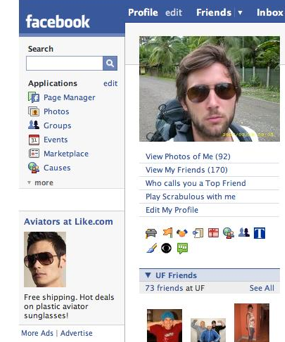
Is a picture worth a thousand clicks? You’ve heard of contextual ads triggered by keywords on a Web page. Now, get ready for contextual ads triggered by images on the page. Visual-shopping search engine Like.com is running ads on Facebook that appear to match objects in profile photos.
Notice the ad by Like.com in the lower left for aviator sunglasses in the screen shot shown here, sent to us by TechCrunch reader Luke Bearden? Yup, those look eerily similar to the aviator sunglasses Bearden is wearing in his Facebook photo. Well, at least we know that Like.com’s technology works. Or maybe it’s just a coincidence. (Can someone from Like/Riya let us know which one it is in comments?).
But if this indeed is Like’s image-matching engine at work, is it effective targeting? Bearden thought the ad was “creepy.” And, um, he obviously already owns a pair of aviator sunglasses.
He also obviously likes them enough to feature himself wearing a pair on his Facebook page. And maybe he lost those beloved glasses or they broke since the photo was taken. So I’d say the ad is both effective and creepy.
Would you click on it?
Update 6/2/08: Riya/Like founder Munjal Shah got back to us to let us know that, while his company’s technology could do this, in this case it was indeed a coincidence. He writes in an e-mail:
1) This ad is not contextually driven – it was just luck that the sunglasses matched – Facebook’s ad API doesn’t let you access the photo on the page for doing this kind of visual targeting.
2) We do have this visual targeting technology and use it on the Rockyou site (called Likesense), but it is not on Facebook at this time.
3) Other than that I liked the article – it is indicative of the direction we are heading…![]()
(Screen shot courtesy of Luke Bearden).


“appear to match objects in profile photos.”
Called co-incidence, not technology.
Ofcourse its coincidence.. You can not do such advanced targetting with facebook ads. All you can do is choose keywords, like “sunglasses” or age level, etc.
kill me.
*facebook* controls the contextual technology that shows the ads on facebook – like.com has nothing to do with it, unless they have partnered with facebook and that ad zone is a like.com javascript snippet. without seeing the source code we won’t know for sure, but I’m going to bet on it being the former, and like the other commenters said, a coincidence.
ads are so 1998.
how about putting a yes/no poll widget at the end?
Not sure if it is inteded use of the Like.com technology or coincidence, but whats “Creepy” about it? I never understood that whole vibe from people in stuff like this or Gmails context sensitive ads. Its not like the ad department are looking at peoples profile pictures and matching it up with something that looks the same. Its an algorithm.
Yeah right, if they has such advanced image recognition technology,
they would be in the web ad game.
If you find it creepy, don’t put anything personal on social network. And maybe encrypt your discussions so that Gmail or else can’t parse and build a profile of you… As I suggested in the past, you can use http://www.cgeep.com to just do that
(creepy ad in a comment, isn’t it)
I own the same domain in my country. Maybe they will go international.
Other than that I think that I think it is kinda dummy to show an item to the person who has it.
It’s amusing someone using narcissistic social apps would find something like that “creepy.”
Uhhh I am assuming Erick that you have not placed ads on Facebook – if you had I think you would see how it would be virtually impossible for like.com to weave their magic. Neat idea yes – however FB does not allow you to dig anywhere near as deep as you are suggesting.
FB is a great place for advertising – however they are a generation at least behind AdWords when it comes to deployment of the FB Flyers (their term for third party ads). So I would call this merely a coincidence at best.
Cheers – Eric
Sorry to ruin your facebook creep-out session folks, but this very same ad shows up on my non-sunglasses wearing facebook profile all the time. It is probably just targeted at my demographic.
Sure, I’d click-on. Then I’d:
a.) blog about it
b.) call a lawyer
c.) blog some more about it
d.) go around the office/house in a huff, until I got over myself, about 10 minutes typically
The technology is out there to do such a thing: http://tineye.com for example
Creepy, but also cool in a technological sense!
Mike,
I think to define the creepiness would help.
For me, if I were the user wearing sunglasses and saw the ad, it would make me feel like I wore the sunglasses purely because I like them and they are more individual to me. To advertise with them makes me feel a little like the product too, without permission, and like I am less individual than I thought. I know that’s an illusion, but no one wants to be “mary3918″.. i just want to be “mary” within my circle, even if there are one or two more. The ad points out explicitly that I’m sunglasses wearer like so many others.
Why I don’t think it will work all that well? When we go to social spaces, we go there to talk to our friends. That thought which I already had, was echoed to me by a guy at a party the other day, who has a Ad Network company where they put ads on Facebook and contextually matched. Someone mentions movie, they advertise the DVD and maybe later an associated movie (sort of like Amazon’s recommendations). No one clicked. Not even close to search or other associative ad clicks. Why, no one, in their more statistical study, wanted to buy anything when they were socializing with friends. They weren’t asking a product question, they were hanging out. It didn’t work at all.
I’d love to hear from Like how their numbers compare to search marketing numbers, or email numbers. I suspect they don’t compare at all.
mary
Look, it happened to me too, http://espndev....6/picture-4.png
Nah, I’d bet just like me (weight lifting), ol Luke just put something in his profile that many Aviator consumers share. Like hiking or something. Maybe someone even commented on his photo about them.
Although, recently, I shaved my head and then started seeing ads for hair loss products.
Hmmmm…….
2 years ago when I was using hi5 I happened to experience the same thing. The banner ads looked very much like the pictures I was looking at… very creepy. Are we being paranoiac or is this actual technology???
“Although, recently, I shaved my head and then started seeing ads for hair loss products.”
I predict 90 days before facebook becomes self aware and destroys us all.
Question: Does anyone know if Facebook is actually making more from its ads on the side than it would make outsourcing to Google?
@jsm
I think if they outsourced to Google they would make less money. Google is about context relevance and FB is about profile relevance. Profile relevance is worth way more for some advertisers than context. We advertise a lot on FB and if it was context then we would pull the ads because you cannot target the audience you want. Like @ Cody above showed – users that say they are into bodybuilding get bodybuilding ads and are way more likely to convert.
If FB invested in their Advertising platform they could really rake in some serious dough – however I think they are probably just going to outsource to MSFT as part of their investment deal.
In any event – bottom line AdSense would not work as well for them and CTR would be low and thereby would not convert into cash at the end of the day.
That’s my 2 cents
Cheers – Eric
I think you just gave a possible idea to Munjal and Team
You really think some program has coded every photo on Facebook for its content? There must be millions of personal photos, it wouldn’t be cost effective to do something like this in the off-hand chance someone would click on an ad.
Wonder if using Amazon’s mechanical turk, one can get the same job done with a better ROI (if you’re open to the idea of a sweat shop) ?
Liz:
Erick is suggesting that Riya’s image recognition technology is being implemented here. Thus, no need to coding every photo (or any photo). Unless they are in bed with Facebook though, it seems unlikely that Facebook has given them the access they would need to be able to contextualize images against theirs.
Quli:
Riya does exactly that, although not with Mechanical Turk. Not sweatshops, per se, but cheap offshore image matching (by the tens of thousands) is done by humans in order to “teach” their matching algorithms.
@Mary Hodder
The ad isn’t for you the person in the profile pic, it’s for you, the friend of the person in the profile pic. You’ve missed the point entirely.
And as everyone else has pointed out, while this is not like.com’s technology in action. What it does underscore, however, is what facebook.com *should* be doing to start generating revenue from the social graph.
Picitup was the first to come with a relevant technology, see http://www.picitup.com
Seems to me this kind of ad will be a hit w teens who are very interested in copy-catting each other’s outfits.
That’s funny. I wonder what would happen if my profile picture contained nudity?
Ryan
lesson in brevity: http://www.mofata.com
I’m guessing its been a slow day for tech Erick.
I’m not sure I understand the creepy aspect of this form of advertising (not that photo recognition advertising is available yet, that I know of).
Maybe Like.com has been investing in coincidence-advertising, by taking any available data which is available to them, such as age and gender and then matching this against current trends for that group of people and out pops aviators.
Still whatever may have happened here, I am sure Like.com will be very happy with the free advertising they have gained from TechCrunch.
I don’t think this is that creepy.
It’s not even as creepy a concept as the ads that show up in Gmail. After all, Facebook pictures are fairly public, while emails are strictly private. It’s a lot creepier for it to appear that something “knows” the content of our emails than the content of our photos.
I find FB’s contextual advertising to be a little creepy. My Facebook relationship status changed from “In a relationship” to “Engaged” and I’ve been getting wedding ads ever since.
If this is an actual implementation, I think it’s very cool, especially if you realize that when viewing friend’s profiles I would see ads for things they are wearing.
Still, this doesn’t address the core issue with social media advertising, which is that most people are not in “buying mode” when using social sites like Facebook. Something like this will never match the efficiency of advertising on Google for the keyword “sunglasses.”
Creepy, no. Just like any other technology you experience for the first time. Is Adsense “creepy?”
Any sufficiently advanced technology is indistinguishable from magic,
Arthur C. Clarke
I had a similar experience too yesterday with FB social ads. The ad headline was “32 and still single?” and was an ad for a dating agency.
To see contextual ads is one thing, but actually quoting your age and your relationship status back at you is taking the creepiness right to the next level.
Erick, I got a stunning tip-off for you, too. I found TechCrunch’s ads can also be contextually triggered by the images in the articles. Here’s the screenshot that’s worth 1,000 clicks: http://www.shop.../techcrunch.jpg . Notice the YSL sunglasses at the bottom. They look so amazingly similar.
Can Erick or Michael or someone from TechCrunch confirm whether TechCrunch is developing some creepy image recognition technology or this is just conincidence?!
my guess is aviators/ sunglasses/ outdoors/beaches/ or some other keyword in is in his profile. Not Riya, its the profile API.
You are not kidding. That is quite creepy indeed.
JT
http://www.Ulti...e-Anonymity.com
Sorry to be so blunt, but -
What an idiotic post, you didn’t bother to take 5 or 10 minutes and CHECK if it is a coincidence or advanced image recognition?
And Techcrunch is supposed to be the tech blog LEADER?
It’s fastly becoming a joke.
It’s a coincidence. The “technology” you’re suggesting does not currently exist for something so specific as aviators in a facebook profile picture.
Facebook definitely bases its advertising on its user’s profiles. I’ve been dating my current girlfriend for about 1/2 years…and its ‘facebook official’. Recently advertisements on both our pages have been geared towards engagement rings….creepy…yes.
This is creepy. I wouldn’t click.
I’d go to Ebay.
Sarah
Was that photo tagged with “aviators” or “sunglasses”? If not, then color me impressed. But if so, then still a great idea.
The question is, was that a partnership, or is Like.com just doing this on their own?
Or maybe it is a coincidence, I see other ads for Like.com that have nothing to do with anything.
Whatever the reason, you can’t argue that is was somewhat effective here. Who pays attention to the ads on Facebook? This one obviously caught someone’s eye.
Munjal?
That is pretty creepy.
@18 “Although, recently, I shaved my head and then started seeing ads for hair loss products.”
Me too! Are any ‘hairy’ men getting these ads?
For what it’s worth, I can verify that in my personal experience, if ones Facebook profile photo reveals one is, let’s say, follicly challenged, ads promoting hair-growth products appear regularly. Strangely, I didn’t think about the connection until this post.
Why don´t you find it out (and that is a very simple thing to do) instead of writing an article based upon a speculation?.
I heard Like.com can read you mind if you visit their Web site.
Really TC? Was this post a joke?
It’s called keyword targeting people.
Actually, to those who say it isn’t image recognition, go to riya.com (image based search). It even says it used their tech.