Everyone has an opinion on today’s move by Microsoft to shake things up in the search space. Their new Live Search Cashback product shifts search advertising from cost-per-click (CPC) to cost-per-action (CPA) and give a lot of the revenue back to users. Most writers are negative. Some excessively so. After hearing Bill Gates give the pitch and trying the service myself to make a couple of purchases, here’s what I think: It’s a bold move that goes for Google’s throat, and it will likely have a material impact on their search market share.
Our complete analysis is below. The key takeaway: Google’s search dominance is growing, and everything Microsoft has historically thrown at them has done nothing to slow them down. This new approach is both desperate and brilliant. Desperate because Microsoft is giving away most of the search revenue to get market share gains. Brilliant because they have such a small share of search revenue today that they have little to lose, and they are hitting Google hard in their core business.
The Numbers
Microsoft had to do something fairly drastic to get back in the search game. They’re third in U.S. search market share with under 9.1% of the total pie. Just six months ago they had 9.8% market share. Google, by contrast, has 61.6% and is growing steadily:
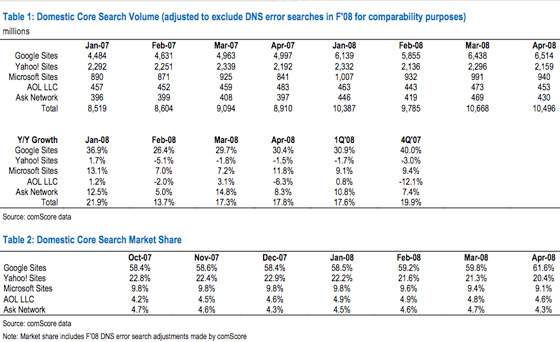
Without search market share, Microsoft can’t get search revenue market share. And it isn’t just a matter of splitting up the pie. This is a winner-take-most market: Having 9% of search doesn’t mean Microsoft has 9% of search marketing dollars. Far from it – publishers go to Google to partner on ads, which means advertisers must go there to get inventory, and a very healthy auction system pushes up prices. So not only does Microsoft (and Yahoo, and everyone else) have much fewer queries than Google, they are also generating much less revenue per query as well.
So how much revenue are we talking about? Today the worldwide online advertising market is somewhere in the $40 billion range, and there are estimates that it will grow to $80 billion by 2010. The search piece of that is big – about 40%. So $16 billion or so today, growing to $33 billion by 2010. Google gets the vast majority of that search revenue today.
Microsoft’s core revenue is derived from Windows and Office, and the future doesn’t look to be very bright for desktop software sales. Google’s revenues, currently at $20 billion a year, could someday surpass Microsoft’s (Microsoft is currently at about $50 billion/year in revenue) if nothing is done to change the game.
Remember how everyone feared Microsoft’s dominance in the OS and Office worlds in the late nineties? That’s Google today in the search advertising space, a much bigger long term market.
How To Disrupt Google
It’s clear that technology alone will not unseat Google as the dominant player in this market. Microsoft already tried that with their AdCenter improvements in 2006; Yahoo tried with Panama last year. Google’s dominance only grew.
That means Microsoft has to do something different than just build new software that improves on the cost per click advertising model. And moving to a CPA model isn’t enough – Google and others are already experimenting with that. So instead, Microsoft is taking the CPA model, which lowers risk to advertisers, and combining it with a straightforward payback mechanism to users.
This only applies to ecommerce related searches for now. But frankly that is all that matters. Only about a third of searches are commerce related, but those searches generate 80% of search revenue. Get the commerce searches and you’ve got the revenue. And here’s another interesting statistic – 68% of online purchases begin at a search engine or shopping comparison site. Only about 30% are from direct navigation to the ecommerce site itself.
Will It Work?
Yes, it will work and it will almost certainly increase Microsoft’s market share in search, particularly in commerce search. The question is, how well will it work?
A year ago Microsoft basically did a trial run of Live Search CashBack with Live Search Club, which lured searchers to Microsoft with offers of prizes to users for using Live Search. Microsoft went from 10.3% to 13.2% market share in a month, a nearly 30% rise. Live Search CashBack, which gives a much more straightforward payout to users, should see significantly better results.
And really, what does Microsoft have to lose? They have a tiny piece of the revenue pie today, pay out money-losing revenue guarantees to partners like Digg and Facebook, and the online division itself is losing a cool $1 billion a year on about $2.4 billion in revenue. This new model isn’t going to give them a lot of profit, but it isn’t a money loser, either. Sometimes, desperation is a good place to be because it forces you to try crazy stuff.
The User Experience
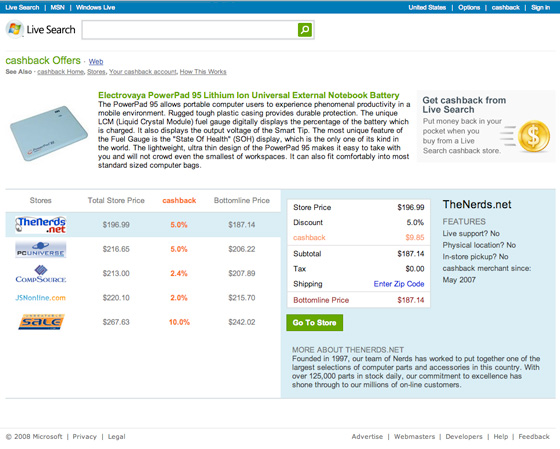
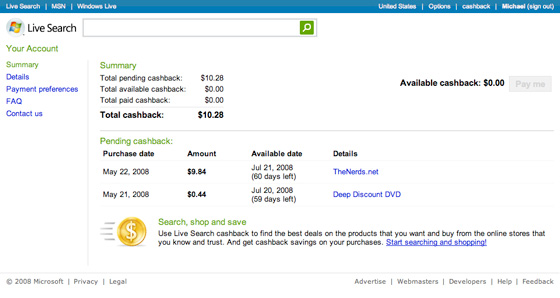
I made two purchases today with Live Search Cashback. Microsoft presents results in a straightforward manner with the price of the item and the rebate clearly shown. After the purchases, the rebate appeared instantly in my CashBack account. No hiccups, great user experience. I came away with a totally different opinion from others.
Google v. Microsoft
The first thing I thought when I saw Live Search CashBack was that Microsoft is hitting Google where it hurts, in exactly the same way that Google is hitting Microsoft with their free online Office offerings. Google isn’t making much money on Docs, but it sure threatens Microsoft’s core revenue stronghold.
Similarly, Microsoft isn’t likely to make much profit on Live Search Cashback, since they are giving most of the money back to users. But it hits Google in its sweet spot – commerce search. And it may have a bigger impact and a faster impact on Google than people realize. Docs is a still a future revenue threat to Microsoft – Live Search Cashback is taking money out of Google’s pockets today.
The question, as I said above, is how much money they’re taking out of Google’s pockets. That’s yet to be seen. But Microsoft also made it clear that this is just a first step in the search war, and things are guaranteed to get a lot uglier in the near future.


I think it will get some share away from Google, but will it be the kind of people advertisers want to reach? And does Microsoft have a brand name that anyone trusts in search enough to care that they are getting paid off to come and buy stuff over there? I know that in my buying behavior I don’t care about lowest price, but rather want the best service and all that. The trick is how will they get the word out? Are they going to spend massive amounts in advertising this? Even then, advertising generally isn’t that effective at getting people to visit Web sites.
How did advertisers react in the room you were in? I guess that’s really one piece of it. But the other piece is advertisers will go away when they realize the audience they want to reach isn’t there.
Very interesting move by MS on this and there are some interesting figures on the commerce search revenue mentioned here. I’ve said before about the problem facing MS and Y! is that users are so mentally bought into Google = search, that even giving them money to use an alternative might not work.
I do agree with your comment through, when the chips are down, sometimes the crazy ideas are the ones which get through because they are radically different and I’m pleased to see MS trying new ideas like this. I’m sure that this move will have a positive impact on usages (i think that we’ll see a 50% increase in the coming months) but I don’t think that this alone will change the game. They’ll need to keep on with this innovation over a long period to cause any real pain to the G.
Robert – “I think it will get some share away from Google, but will it be the kind of people advertisers want to reach?”
I know what you’re saying – that the cheapskates will flock to it to save money. But these are also the people who are actually buying things online. Advertising to this group on search alone is 1/3 of the total $40 billion online advertising market – they drive 80% of Google’s search advertising revenue. These are the people who spend money online, and advertisers desperately want their attention.
Coming from a mobile perspective, every money back promotion until now (YoSpace – Video Dowloading on 3 and O2 where users got 1p back if their video was bought) has been a success.
Its a fast way to get users interested and the promise of cash back works well with the “coupon addict”.
But what you find is that use tails off when users realise how little they actually earn and the service is used by a few core fans or wannabe money makers.
With search, the fact of the matter is that results are vital. If you want information FAST do you go to the best search engine with the best results or to a search that might give you a few cents and it will then take you a bit longer to find and buy.
On top of that someone will have to pay for this and it will probably be the advertisers.
Personally, I like it. Can I be bothered to sign-up? No.
If I was half my age now – would I switch for $? Probably.
@Scoble they will probably be even more qualified leads that Adwords ones, because people won’t switch Microsoft unless they are actually intending to make purchases.
And as Mike pointed out, those e-commerce searches are where the game is, not Versache branding clicks.
This is eerily familiar.
Does anyone remember the A9 search engine? Search using A9 and save on Amazon, at least that was the idea.
Nonetheless, I will advertise my flat rate data recovery business with cash back if I can do highly localized targeting that I get from Google right now.
Google Product search and Google Checkout (Google’s products for eCommerce Vertical) are the main target for MS with Live Search Cashback and they have done a very good job at it.
In my opinion Live Search Cashback (or say Live Product Search) is FAR BETTER when compared to
- Google Product Search in providing product results (with detailed info, price and reviews) and
- Google Checkout in giving users an Incentive to use the search engine (or their product for eCommerce)
Going with a zero revenue approach is going hurt them at some point in the future when they feel the need to actually make…..money. At that point, the fickle users who went to Microsoft will probably go back to Google.
Is this really that different than what they did when they bundled browsers? They gave something away and took a loss to try and destroy a competitor. Granted, they aren’t really leveraging the OS to do this, but it smacks as a desperate move.
Michael,
This was a great overview of how it all pieces together. Thank you for the in depth review.
As far as my opinion goes, this is a great move from Microsoft, but it is only the “one” in the “one, two” punch that they need. In order for this to work, they need to have something else up their sleeve – and it better be big.
Gary – i believe they won’t have to give back anywhere near 100% of revenue over the long run. As more advertisers join, the bids will go way up. Most advertisers are happy to give at least 100% of gross margin to get a sale, in the hope that the customer will come back. At least they know they’re making a sale when paying.
So lets say a retailer has between 10-20% gross marging, and 5-10% goes back to the users. that leaves a lot for microsoft, as well as third party publishers who get on board.
This is the first reasoned evaluation I have seen yet. Microsoft has already field tested this approach with Live Search Club. It works! Even though as geeks and techies, we gush about Google’s technically superior algorithms, we aren’t actually the ones that pay the bills — you and I never click on Google’s ads. The regular people looking for deals are the ones who contribute the most to Google’s profits. The cashback program is designed for them.
Michael – Your post should be titled the End of Empire…..we will look back one day on this as the start of what will admittedly be a long decline in MS market and industry power. The reality is that Search is game over – until some company we have not yet heard of emerges.
MS dominance on the desktop is under threat. OS is a mess. XBox has less strategic value than we all imagined. The initiatives that are working are not likely to move the dial.
Hail Google. To the victor goes the spoils, at least for now.
Why don’t you write something about JellyFish?
Thank you.
After hearing the news yesterday it was confusing to me.
Your analysis is simple , clean , and thoughtful.
Interesting analysis. I see a big difference in what google did with docs versus what MS is doing with cashback, on a larger-scale strategic level.
When Google went for MS’s jugular with docs, they did it by offering a product for free that was not positioned to be the company’s prime revenue driver for the future.
MS tries to go for google’s jugular by offering a product that strips most of the revenue in an area that should be a prime revenue driver for the future as desktop software loses steam in the next 20 years.
So google guts a side-business of revenue in the name of hurting MS, but now MS guts what should be evolving into a core business in the name of hurting google.
Plus, in the end, does increased market share really matter if it’s largely dissociated with revenue?
I dont care how much they % cashback they pay out… the bottom line is in the search results…. how effective are they? Can they be easily gamed by webmasters and SEO experts? Are they biased to sites with whom MS has tie ups? Since MS already has a bad name in the market as far as their credibility and tactics goes … i suppose they would play evil again in spitting out results ahead of others based on some internal contract. This is just a last (probably not last actually) ditch effort to gain a small tiny blip in traffic. You cna mark my words that this will not succeed. I’ve yet to try it out – but if the main pitch is “cashback” and not “good search results” – well, you already know whats going to happen in the long run as spamdexing takes over and the effect of the wild west takes over. Plus… if they’re builing a cashback product search engine – why not just restrict the offering to a ecommerce search engine rather than trying to call it a full bown search engine and stupidly take on Google. I don’t seem to see the logic with the guys coming up with strategy at MS. Oh yah. there IS a lot they can do if they approach the Google challenge intelligently. There REALLY ARE multiple ways they can muscle and topple them over. But I wont tell. I seem to like Google. And its a hard habbit to break (and so, another reason i wont switch).
Sorry. I did notice now that its just an ecommerce engine. Still, I dont see why they wont show preferential results based on internal tie ups rather than showing the most relevant ones.
@michael_arrington “… It’s a bold move that goes for Google’s throat, and it will likely have a material impact on their search market share. …”
My initial reaction is the same: hahah, hehe, ha ha!
Look, here’s what will happen:
1. Initially cheapskates will go there to try it out
2. You’ll have to give a bunch of personal information to MS which will lower the conversion rate to that service. When people wade through the registration forms they will ask themselves why, when they could have easily found and bought whatever it is they wanted on Google already.
3. Importantly, after the first pay period, people will realize how small the cash-back will be and just dont bother.
4. More importantly, after searching at MS, and realizing how insufficient the result set will be, they’ll go back to google after a few tries.
5. The same people for get and forward chain mails are the people who are going to be attracted to this service (a low-information, low IQ, middle aged demographic)
Its a bold move into stupidity. Traffic will show a bump, then settle back down with maybe a 1% increase. Just like what happens when TechCrunch links to your site
What about the publishers ? Any news about them ?
Does the publishers get any benefits from this ? Can anyone explain it in details…
I just read another article about ‘Live Search Cashback’ – their understanding was that Microsoft would wait 60 days before actually disbursing the rebate as a means of avoiding the possibility of buyers getting both a MS rebate – as well as a full refund by returning the product. Yet Mr Arrington says received his test rebate immediately. Not sure who needs to clean their contacts – but. we’ll see how the scheme pans out. Personally, I have a lot of confidence that MS will find a way to take an attractive idea and implement it poorly.
Let’s all remember michael’s newest BOLD prediction that Microsoft will gain significant share from Google. My bet is always to go against Michael Arrington. WHY? Because he’s often wrong — dead wrong — and his predictions almost never come true.
it’s pretty simple… they stole the fatwallet concept
will it work? sure deal hunters will come over bigtime – but will they switch for Web search which is what Microsoft wants? nope. they will just consider it another product.
what it could do is kill the other cashback systems out there.
if Microsoft wants to increase their revenue this way, that will work great – if they want to grow their search market share, that won’t happen.
well it makes sense the key thing is if they can get decent search results.
If they get these people over there and the search results are better than google then they will stay.
Googles results are getting worse all the time so if MS can improve their search to be better than google, google will have a problem.
Maybe they should buy some shopping comparison sites while they are at it.
“and things are guaranteed to get a lot uglier in the near future.”
just dying to see how google will strike back.
Bena #4.
You mention YoSpace in the mobile side of things rewarding customers as a positive, relating to this article. 90% of the service revenue YoSpace’s service generates is from Adult (XXX) content… not applicable here…
They are also trying to get search advertisers to pay CRAZY cost/click by setting the default bids at nearly $30.
http://adwordse...ids-on-new.html
The terms were NOT highly competitive.
Also, by getting people to log in when they surf on MSN…they can get better demographic info. With the “pay-out” tied to actually buying a product, MSN will be able to possible charge more to serve your ads to people who have spent the most money.
Bold and calculated move from MS. MS realizes that it has to fight Google hard and fast within the next five years before Windows and Office start getting obsolete. So far they failed. They are coming up with an XBOX like strategy, dont care about profits, just increase sales and revenues as long as you have other means of income. Together with their partnership with DIGG and Facebook and possible buy out of YAHOO!, they are planning a war on Google. First small step among many more to come.
Yeah, ok. And then what? You’re paying customers to use your service. Great brand. You have to pay people to use it. The loyalty from that is the same as paying people to be your friends. Oh wait, that’s what Bill already does.
And you’re going to build on that with…paying them more? Paying more of them?
You don’t build a sustainable business paying people to use your service. Besides, search on MS is a bit lackluster. So, then paying me a couple of pennies…is worthless when it doesn’t deliver the product I want: meaningful search results.
If this is the best MS can do, they need to go back to buying up their own stock. Buying friendship, buying value, not creating it.
meh. Cashback on purchases?
Microsoft, get back to me when you have a plan for actually sending me a check each month for bothering to go to your search engine.
I still don’t like you guys. I don’t like you for the way you did business when you were on top (and would doubtless still be doing, if you were still on top). I don’t like your leaders (see Steve Ballmer goes apeshit video). I don’t like your attitude toward the open source world. I don’t like your operating system and its backslashes, drive letters, and case-insensitive file names. I don’t like the bland corporate stench that infects absolutely every announcement you make.
I do like that you’re giving money to some worth causes, but I don’t like that you basically waited until you had so much cash that even investing it became a huge issue before taking that step.
You’ll have to pay me to use your search engine. Discounts are probably not enough. I’m talking monthly check. And even then, I would treat it as a relatively untrusted source of information in comparison to Yahoo or Google. You, Microsoft, are still tainted.
The best you can do for “the future doesn’t look bright” is that one gartner study that was full of mistakes. Laaaaammme. You do that office is selling better than it ever has right?
“Only about a third of searches are commerce related, but those searches generate 80% of search revenue.”
Source? Not questioning that it’s probably true. I just want the source of the data to understand more.
Microsoft Live can’t even find Cashback. In order to find this initiative, you need to search for it on Google:
http://jenslapi...ut-google-does/
I guess that as long as the search result quality on Live is at that level, Google won’t have to worry too much.
Danny,
If you haven’t noticed Michael has an issue with his readers. They tend to question his credibility quite often. Why? Because it seems as though he simply makes things up. No one knows for sure but it’s my guess that sensationalism rules on TC, not facts. And, yes, this is a sad comment.
Pasan, not questioning his credibility or suggesting at all that he’s made that figure up. I’m sure it’s a solid figure that someone has put out there. I just want to know the source cause, well, I like to know sources of stats
Most of the links don’t work for the service. The “Your Cashback Account” link ends in a 404 as does Help, Feedback, etc. C’mon Microsoft, stop acting like a start-up.
Danny,
I know that you are not questioning his credibility. I do because I see enough of these “facts” pop up in posts to wonder.
I seriously doubt that you will get a satisfactory answer to your question. It fits a pattern of pump and dump, exaggeration and carelessness. We like the site but wish Michael was more credible.
The only problem i’m seeing the future of CPC marketing. Hmm.. Most of the low/medium websites will collapse if the CPC campaigns come to an end.
It was a very good analysis. I really enjoyed it. It’s different from what Techcrunch normally do: facebook is doing this or that, this is a new start-up or that is new…….and so on
This one is something different.
My guess is that Pasan is right. You won’t get the facts from TC because they likely do not exist. This blog is good for one thing really – gossip. I treat this all as gossip, entertaining gossip, but please don’t believe what you read. That could be dangerous for your health:)
Microsoft has one huge problem — nobody will know about Microsoft Live Search Cashback. This article is the first I’ve heard of it ever (thanks to Scoble) and I’ve been an MS-centric dev and Hotmail user since before MS owned it. I see MSN every day, with the search bar right there and all of their adverts, but I’ve never heard of this cashback service. MS sucks at advertising themselves. They also never send a clear message to the consumer; it’s always so generic that nobody knows what they are talking about. Remember “Where do you want to go today?” — nobody knew what that meant for the products, it was advertising the company but it was the tagline for every product. Maybe they need to buy up the Apple marketing team.
I think many people on here are missing the point that this is a Disruptive Business Model strategy to change the economics of the industry and therefore remove some of the economic structure. Classic Porter stuff.
I have to laugh when I read ignorant, irrational and naive comments saying that this is simply a desperate move by Microsoft! C’mon grow up children.
And I am glad to read (finally) a few canny and rational people do realise this is just round 1 of a multiple round fight and that this is simply the first punch thrown with a few more up Microsoft’s sleeve later this year.
Microsoft also announced additional features to the underlying Search product as well which seem to have gotten lost in the mix. See this Video search result and just hover your mouse over the video results and they play in context – http://search.l...n&FORM=BVHP
I have heard that there are other significant advancements coming this year which goes to the other comments on here in that simply changing economics alone won’t work; Microsoft has to significantly improve the underlying Search product. ;D
And to pasan comment #21…get a life!
P.S. Great article!
Thanks Michael for finally putting together some logical analysis on the subject. The degree to which so many so called ‘experts’ have got this wrong is unbeleivable. I’m 100% in agreement that this is Microsoft going for Google’s throat (83. on the earlier article) and that it will hurt.
The only thing you have left out here is data. Having a profile attached to everything you buy is killer. Your purchase history is more valuable than anything else a company could get from you. If Microsoft knows you bought Lost series 1 and 2 they can target you with Lost series 3, if they know you bought annual home insurance on 14th May 2007 they can get those home insurance ads in your face around the start of May 2008.
This is better than anything you can pull from a social network (personal profiles is what their value has been based on) and way better than the farce that is the current behavoiural targetting industry (far too subjective, far too reliant on people as one of say 14 profile types).
The big issue as I see it is whether advertisers will let Microsoft do this long term. The more advertisers get onto the system, the less value it has for them and the more they are likely to be paying double marketing costs. The majority will start paying once for attracting the customer elsewhere and again for giving them their commission through Microsoft. My guess is yes as the majority of advertisers have very little idea of what is actually going on in the online world.
Either way, this devalues all online advertising and anyone relying on cpm or cpc had better watch out.
Actually, this is the side of Microsoft I like, the fierce competitor. Here, they are playing Chess, not Go. I just don’t like the fact that you just so happen to want to destroy the AT&T or GE or General Motors of the internet just to fulfill your business goals. Take Google to town with your own merit–leave Yahoo! intact–that’s the Microsoft I like.
Michael:
Thanks for this thoughtful analysis. This kind of insight is exactly why I and so many others read TC religiously. Keep up the great work!
Here’s one question: how does MS determine the percentage per item to be returned via Cashback? It seems to vary widely. Apologies if this has already been covered.
Brilliant, indeed.. really nothing to lose for Msft.
Cashback is an interesting feature, but people will soon find out that it does not work… I tried it last night for few hours, but could not find any real good deals, e.g.,
- Wii, $373 on cashback, $300 on eBay
- Wii Fit, $85 on cashback from CC, but out of stock in every store
I worked for a Search startup in Web 1.0. In Search, content and context are key factors… The biggest problem of MS Search is content. MS only has about 1/10 of what Google has. Also they are indexing much slower than Google on new content.. IMO, to compete with Google, MS will have to find some real solutions other than Cashback.
Martin,
If you like getting Michael’s version of “facts” fed to you without any question then I have some swamp land in Florida that you’re really going to like. Remember, this is the guy that loves Edgeio, OmniDrive, Seesmic, Microsoft (and everything they do), Dogster, Powerset, etc.
He hates Hulu (they are doing very well), CNET (just got bought) and so many that it’s hard to count. I am far from the only person on this board that thinks that Michael has a credibility issue. I do not think his other writers do. This is largely confined to Michael’s writing.
Excellent analysis. In the UK, search accounts for about 60% of online revenues (source is the IAB Danny!) and we assume that Google accounts for about 90% of that (it claims 82% share of searches based on last figures we saw). Sharing cash with users is going to be a very big theme in the chase for scale… and CPA is a model that the successful ad-funded businesses will have to make work. Great move by MS: bold, innovative, goes right after Google’s money-maker – and it just might work.
I have been trying to understand this move, but I still can’t do it. Microsoft’s answer to Google’s search advertising dominance is a comparison shopping site?
@Danny, and anyone else wondering where that stat came from, it was part of Gates’ keynote yesterday.
43. Mike – Each company sets their own cashback, dependant on profit and what they think is viable. For any of the advertisers, search for their affiliate scheme and you will be able to see what they normally pay affiliates. Most of the ones I found are giving 100% or close back to the user meaning microsoft is taking nothing or very little from this. That’s why its a complete Google killing policy.