OLPC 2.0: A Striking eBook and a Step In the Right Direction
by John Biggs on May 21, 2008

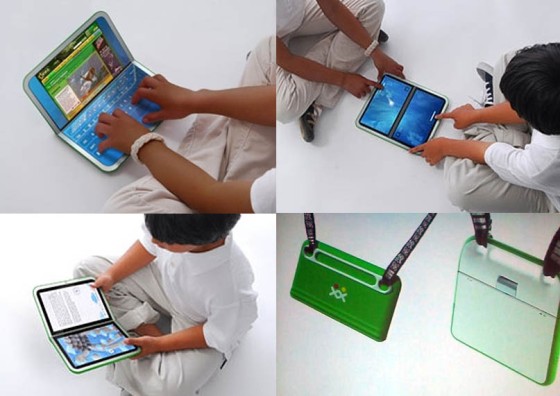
Here is the the next-generation OLPC. It will consist of dual touchscreens on a single spine and include keyboard, face-to-face, and ebook functionality. The touchscreens will be built by a start-up by former OLPC CTO Mary Lou Jepsen. These screens will be readable in direct sunlight, just like the OLPC.

I’m glad that the second generation OLPC is more of an ebook than a laptop. While the “laptop,” as a designed object, is an excellent tool, books are what define our early education and creating an electronic book that works and is actively useful seems far more intelligent than the original OLPC, which is a stab at a “less is more” mentality that eventually hobbles the very people it is designed to help.

I remember a very interesting statistic from Freakonomics: the single, traceable correlation between a child’s ability in school and his home life are the number of books a family has in their home. I’m paraphrasing, but I’ve taken it to heart and I believe it to be true. A laptop is an interactive tool. An ebook, even if it’s just a glorified, dual screen laptop, is a reading tool. That is why tablet PCs never took off in the mainstream: people don’t know what to do with a form factor that is clearly not a laptop yet is also clearly a powerful computer. There is no way to connect the act of “scratching out words on a tablet” to processing worksheets in a spreadsheet. Why doesn’t the iPhone have handwriting recognition? Because it’s a horrible way to talk to a computer, even now. But that’s a different rant entirely.

That said, I worry about the project as a whole.

Read more plus video…

Comments

Comments Pages: [1] 2 3 4 5 » Show All

Having watched the evolution of the OLPC and the current issues with Intel/HP etc, I have to say - AWESOME.

But, at the same time, what kids in the 3rd World need now on account of rising food prices due to oil, forest destruction etc - is FOOD.

cya


Wow.. cool concept.. dual touch screen.. readible in direct sunlight! Why don’t we have a mainstream product like this! Even though i like tactile keyboards having 2 screens would indeed make reading a book more enjoyable and would allow so many different forms input for games and other things (giant ds?:).


OLPC is no longer for children in need. OLPC is a PR stunt for these S.V. companies. If they really wanted to help kids, they should start a program to recycle old pc/laptop and send refurbished computers to these kids. Or is that not pretty enough?

OLPC is a joke.


John,
Just a note about your Freakanomics reference: the correlation between books and childhood success was definitely there, but the point the authors made was that books do not CAUSE success. In fact, the number of books in the household, and NOT the number of books read, was the correlation. The reason was that households with many books tended to have higher education parents, higher IQ parents, and generally and environment that cared more.

Considering that, the authors of Freakanomics would likely argue that throwing a bunch of ebooks at every child will NOT improve their success in life, since the correlation has not proven to be causal.

Still, it looks pretty rad! :)

Patrick


Kids in the third world need both FOOD and hope for the future. XO is at least helping to do that.

When you fill your belly and sit back, then what’s next? Wake up people!


Oh someone beat me to it! Yes Freakonomics made the point that parents with books tended to be more intelligent and they passed this on to the kids. Having the books was not shown to make a difference.

This error actually led politicians to hand out free books in the belief this alone would raise standards. Alas, as pointed out, the logic was slightly flawed!

Im sure it didnt harm though and there are many reasons why books, electronic and otherwise, should be accessible to all :)!


Is Kindle in trouble?


3rd world kids education more than food, why??, food is a help in the short run, but because they don’t have food because they don’t have access to the education that they need to be productive and feed themselves, they don’t have neither access to internet or a computer read the news or find a job. in short, teach them how to gain their food in the information age


John, I love how you rattle off opinions as if they were facts.

Silly, naive John.

Why doesn’t the iPhone have handwriting recognition? Because it’s a horrible way to talk to a computer, even now.

Oh really? Perhaps you should tell that to a Chinese speaking individual who has to figure out a way to be able to input up to 5,000 different Hanzi characters into a device.

I suppose you’d like a very large keyboard to do that?

Luckily John doesn’t work for Apple, as iPhone 2.0 firmware will support handwriting for Chinese characters:

http://www.macrumors.com/2008/.....-2-0-beta/


If a mass produced ebook was going to save the world Steve Jobs would have already done it. In fact, if a mass produced laptop was going to save the world, Steve Jobs would definitely have done it.

I also think it’s cute when white people love to use their hoighty-toighty rationalization for stupid things. Ooh boy, here’s an excerpt from Freakonomics: Books are great,they make you smart! Oh, no shit?

How about reconsider what it is that’s causing the turmoil and strife in third world countries? How about reconsider that it’s the millions in foreign aide and free food from the US that’s causing poverty? That sending and making countries pay for millions in electronic doodads doesn’t solve the basic necessities: clean drinking water, sustainable farming, and means of protecting oneself from the psychotic religious nuts and the power hungry war nuts?

How about instead of focusing on just making toys let’s just use less and consume less?


@Patrick - thanks for the fix. I was just trying to point out that laptops often do little to assist in classrooms but books, with some statistical validity, do.


Also, the OLPC 2.0 will poop rainbows and kittens!

Jesus Christ, after the last version finally shipped with half the promised functionality and twice the price, now we’re supposed to believe that this magical device is going to be available at third-world prices?


OLPC is on a fast downhill track — just read this if you haven’t already.

And regarding handwriting recognition — anyone remembers Newton? It had a most wonderful handwriting recognition technology, after only a few minutes I trained it to recognize 99% of my entries, without me learning any funny characters. I don’t understand why almost 20 years later literally no device has anything remotely resembling it…


@ Ali: of course the kids need food. But in many, many areas they do have food. So the next thing is education. Think about countries like Libya, Kenya, Urugauy, Guatemala, Brazil.

@Mogilny: old computers are not what they need. This old stuff is very likely to break down soon and with no repair shops in place. The old machines cannot stand rains, sand, mud and sunlight - everything a kid faces daily in those areas. The power consumption of these old bricks is terrible. So the OPLC has been searching for a machine that can be powered by hand, sun or wind, are easily repairable and are capable of these extreme conditions the kids live in.

I do not share the opinion of Mr Biggs. While reading is one very important aspect of education, there are certainly many more. How about learning to read for a start! And what about math, cooperation between kids, drawing and maybe even programming skills nowadays. And as the world grows more visual, how about watching educational video’s of educational games.

Ebooks are just a small part and that part is getting smaller everyday…

I hope this new version will run *solily* on open source. It is so sad that Mr Negroponte sold out to Microsoft by allowing the company to have XP run on it. I foresee a future where again money is transfered from poor countries to the West. This time license money for software :-(


Erhmm… above post was mine. Not Mogilny’s. Wrong cut&paste… sorry…


Does this still have its hand crank?


This is awesome. It seems like the project isn’t going too bad after all


This is a good half-article.


Freakonomics — most of their crap is talking head fooder and worthless.

OLPC — is as someone said a SV pet project. Kids in developing countries need high nutritional meals, then money for better teachers. OLPC is better for DEVELOPED countries to gain scale first not developing countries.


“…people don’t know what to do with a form factor that is clearly not a laptop yet is also clearly a powerful computer.”

Most Tablet PCs are convertibles today and look and perform just like any other laptop. In fact, I doubt most people can spot a Tablet because cosmetically they are so similar to standard laptops–except when they are in Tablet mode with the screen folded down. Slates (no attached, physical keyboard) are another matter. Interestingly, an iPhone is a Slate form-factor and not a full-fledged laptop and it is doing quite well. So this suggests that there’s more to it than simply whether a great Tablet is a good laptop as many have suggested.

In terms of pen interaction, there are some languages where handwriting makes lots of sense as mentioned, but in schools I’d take this further. Should schools format everything they teach so it can be interacted with using a keyboard and a mouse? Should math be all done with a keyboard? Think in terms of writing out the quadratic formula with a mouse and keyboard. Should programs assist this so it can be done easily with a keyboard rather than writing it out by hand? Same goes for writing something simpler like square roots or powers. And then there’s the whole question of art or drawing diagrams. Should everything be drawn with a cubic spline or a “spray” effect? I don’t think so.

If there’s one place where ink makes a lot of sense, it’s in schools. That’s one reason why the OLPC supports handwritten input on the digitizing pad. Maybe the 2nd generation device will take this further and will enable pen input on the screen so students can not only read on their two-screened eBooks, but they can handwrite, draw, or in a random access fashion markup their digital content.


I agree that the OLPC initiative might be seen as a PR thing, but if the results are there and the children benefit from that “PR” stunt, I strongly support it.

The device looks cool and I hope they can decrease the price asap.


Unfortunatly this will only be another gadget that rich kids will profit from.


@Mogilny2 (a.k.a. Marko) :). I agree maintenance is a bigger problem with used (not necessary old) machines. But even if we send them brand new computers, we still need to provide them support (how to use it, maintenance, etc.).

We are fixated on giving what we WANT to give them, not what they NEED. OLPC wants to give them a fancy laptop that even kids here don’t get. Is that what they need?


hmm. what is meant by “books are what define our early education ” . 1. does not sound grammatically correct which 2. implies the author here does not touch books…. since you know books are for kids


OLPC is another marketing and profit scheme from the think tankers. Just like carbon credit, insurance and credit cards. What will they think of next.


Don’t we have to get everyone in Third World Countries electricity before we get them OLPC? How do they recharge the batteries??


John,

Thanks for posting this and continuing to point to the need for us to have a more global understanding. I think there is a real trend here. OLPC, with all of its difficulties, might make it or might not. If they don’t, then another company or organization will step in to take their place. MITs OpenCourseWare, Harvard’s OpenAccess, and OLPC are all accelerating this trend towards OpenEducation. We are working on an educational platform that we think will help harness all of these factors over at http://www.nixty.com. We think this will be even richer with OpenID and OpenSocial applications that really promote communal learning. The next couple of years are going to be very exciting in this space.


Comment posted here:
http://www.gottabemobile.com/T.....puter.aspx

Is John right? He is partly on to something, but he is way off on the handwriting reco part. My understanding is that a very hot item in China right now are phones that accept handwriting reco for texting. Remember this piece about Chinese handwriting reco coming to iPhone 2.0? I think John’s argument about handwriting reco being a horrible way to talk to a computer is illogical, and is failed attempt to try to label the Tablet PC a failure.

However, I do believe he is spot on about a general problem with the Tablet PC and its lack of presence in the mainstream: people like dedicated devices to do certain things. My wife would never use a Tablet PC to read eBooks. She does, however, love using the Amazon Kindle. That is because the device is built well for what it is designed to do. I don’t enjoy UMPCs very much because the device tries to do tackle to much in software that ends up feeling clunky and uncoordinated. Although the dimensions of a Kindle are similar to a UMPC, I hate the experience of reading books on a UMPC. The Tablet PC is the same thing - for taking handwritten notes on the fly, marking things up, the Tablet PC can often seem overkill for the task at hand. That is why I often carry a Moleskine with me. I would love an instant on, ultra-thin device that I could instantly handwrite some notes on.

The flexibility weaknesses for Tablet PCs are also its strength - having handwritten notes with you, along with all of your text based notes, wherever you go. There is no better tool on the market for digital notetaking, and offering so much flexibility in how to use it. Flexibility in the tool, though, can be daunting to many people. Simplicity in use is paramount.

Handwriting reco isn’t the problem. It is offering a user experience that is unobtrusive and natural for the task it is designed for. Although Vista and Windows offers great solutions for Tablet PCs, dedicated solutions for handwriting, notetaking, etc in a form factor that tries to get out of the way would take off. That is why I think there is great promise for handwriting reco on devices like the iPhone, MIDs, and ePaper solutions.

Loren Heiny has chimed in on this, too. What does the Tablet PC community think about John Biggs’ opinion?


Handwriting recognition… THAT is what turned me on to Pocket PC in year 2000. I think I’m like a lot of people who (in some cases) want to hand-write notes or thoughts instead of typing them in. There’s a tactile element to the process that suits some “learners” better. While I agree that times change and people usually work in a manner they’ve become accustomed to (e.g. Lawyers using physical books to research matters, vs. electronic data files), there are some things that just don’t change. Certain people are auditory learners, while others are visual or tactile learners. One size doesn’t fit all… one person’s opinion about the validity of one approach is most often slanted because of their own bias toward learning. It’s difficult for anyone to understand that others don’t learn the same way THEY learn.


@Glen Moriarty, great initiative. This is the kind of project that really makes a difference in the world.

Best of luck, we need more like this one.


Great news to hear that the project is advancing beyond it’s initial product.

Peter
do you follow me @ http://www.twitter.com/peterurban


I don’t think this is for the third world countries(third world does include Saudi Arabia). It is for poor countries because I don’t see Saudi Arabia kids using this. I live in third world country yet I don’t see we have problem with education and I’m using a quite powerful PC right now.


Any kid that has one in a third-world country will get beaten up and robbed. Think iPod theft at schools in the U.S. times about 6000.


@techcrunchreader, thanks! I appreciate the positive feedback. We are pretty hopeful. Paul Graham spoke at StartupSchool on the positives of being benevolent. We’ve been hatching this idea for a couple of years now and think all of the pieces have finally come together to make it a great service.


While I agree with most of your article (and I eagerly await the buy 2, donate 1 promotion for this version), I have to take issue with your aborted rant.

While the current generation of kids and young adults in the US has grown up with QWERTY, in poor countries it is the keyboard paradigm rather than the handwriting paradigm that has never caught on. For someone who has never worked with a keyboard, writing on a screen to get text into a computer file is a much more logical way to “talk” to a computer (at least until you can truly talk to the computer).

While I can keyboard very fast and very accurately, I find that my productivity went up (and my obtrusiveness in meetings went down) when I gave up my ThinkPad for a Motion slate. Maybe it’s because as a boomer, I went to school when there were no keyboarding classes - just typing (and stenography). Or maybe it’s because handwriting works.


@StupiHead - power is from a hand cranked dynamo and solar powered wireless access points


Ah…so having failed to produce a kiddy-style laptop with a keyboard for $100 they’re now going to produce a slicker, sleeker design with handwriting recognition for 25% less.

Yeah, right.


I can see something like this coming to market long before it makes out to a third world country. The program itself is being used a publicity stunt and as I’ve read, the guy running it doesn’t actually care about the education.

But the purpose of giving these things out, be they laptops, refurbished computer, or eBooks, is to increase the opportunity of a kid in a poor country to better himself. Whether they take it or not is up to them. Culture plays a factor, politics play a factor, parents do as well. It might not increase the well being of every single child, but who knows, maybe some lucky kid will take that opportunity and end up rewarding his or her country by being a businessman, scientist, teacher, doctor, politician, etc.

Also, I will agree that many of these countries need food, but please remember that while the world actualy does have enough food to go around, it’s the socio-political aspect of various countries that keeps them in the dark many times about incoming food. I’ll concede that logistics sometimes affects regions and countries, but not every single one of them.

“Give a man a fish and he eats for a day, teach a man to fish and he eats for a lifetime”


“Technology to the next level taken by OLPC 2.0″
Seriously doubt the possibilities in OLPC 3.0(what else one require…)


They should sell these to US customers at double cost. The idea would be you buy one for yourself (or your kids) and another for a kid somewhere out there.


Wow! There will be no booksheves in the future.


They have to prove they are able to produce laptop below $100 or their project will be abandon.


So, it’s a laptop designed by a bookworm. No surprise here.


@Smart

Your idea is certainly the most brilliant one I have read in this thread…by far. It’s at least better (and a lot less elitist than say…product red).
Why does it take half a two dozen Crunchers to beat a good idea to death when it comes up. Typing is irrelevant in those countries…and food has absolutely nothing to do with PCs but your heart is in the right place–I guess.


kids in white clothes? if my kids are in white clothes they would get dirty in under 3 minutes…


This is the first laptop or eBook that has really interested me.

This could be great for Special Needs, especially the visually impaired who have to put up with A4+ photocopies of their school books which depend on photocopier quality for clarity, are very unwieldy for small hands, get bashed around in schoolbags so can’t be passed on once finished with and weigh down the schoolbag too.

If the photo shows a genuine eBook where the pictures are on one side and the text is adjustable (font size, colour and background colour) on the other side it will be brilliant for VI, dyslexics and many more.

I hope the RNIB and other special needs related bodies jump on this bandwagon.


You’re all missing the point here.

There are 100m children in the world of primary school age that are not in education. Education is the single biggest factor in the successful elimination of extreme poverty, hunger and disease.

The problem will not be solved by giving laptops to children already in school (though the aim is laudable), but by ensuring that there is universal primary education. This is the second of the UN’s millenium development goals agreed to by the the G8 in 2000. Developed countries agreed to give 0.7% of GDP towards the achievement of these goals and most have failed and continue to fail to meet their commitments.

And here’s the crunch. The $10bn a year that it is estimated it would take to achieve universal primary education is less than half what Americans spend on ice cream in a year.

Rather than an OLPC, a wind-up radio that allows children to listen to a lesson without leaving their village is a better investment (as long as the women in the village look after it).

But the best thing that people like us can do is use our skills to lobby our governments to encourage all governments, especially those in sub-saharan Africa to build schools that are free to attend for all their children.


think up to a scientist. We need competing they had pretty living


Comments Pages: [1] 2 3 4 5 » Show All

Leave a Reply

Create a Gravatar for your comments.
« Back to text comment