He Said, She Said In Google v. Facebook
by Michael Arrington on May 15, 2008

More details on Facebook’s banning of Google Friend Connect from the Facebook API earlier today. I spoke with Facebook Chief Privacy Officer Chris Kelly and Google’s Director of Engineering David Glazer about the banning to get a fuller picture of the conflict.

Here’s an example of how Friend Connect (more details) works in practice. A third party site may want to add social elements to their service. They can integrate with Friend connect and allow users to sign in. Those users choose a social network where they keep their profile (Orkut, Hi5, GTalk and, until today, Facebook) and log in via the social network’s API. They then become “members” of the site, using Google’s terminology. If any of their friends from their social network also become members of that site, those friends are shown on the site and you can interact with them. To see it for yourself, click “log in” at the top of this sample site, IngridMichaelson.

Kelly says the issue comes down to the fact that Google Friend Connect users don’t have control over data pulled from Facebook. In particular, Facebook is concerned that they have no relationship to the end site where the data is presented (in the example above, IngridMichaelson). Instead, Google has inserted itself as a middleman in the process.

Also, Kelly says, once permission is granted to share data, the user has no way to revoke that permission from their Facebook account. Facebook has a privacy control panel that lets users set and change privacy setting over time, including the removal of applications. With Google in the middle, Facebook has no way to stop the flow of data to these third parties.

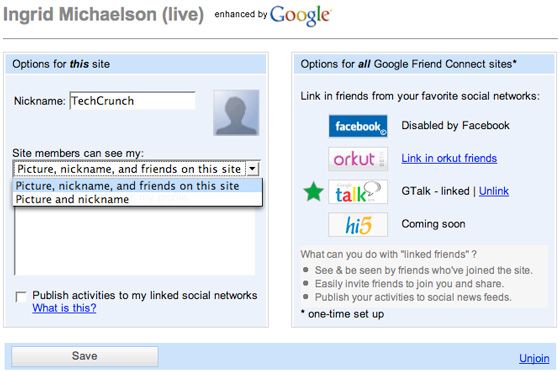
Google’s Glazer counters that they have a very effective method for unlinking to a site that a user has given permission to, so users will be just fine. In the screen shot below, Google gives an option to “Unlink” the specific social network from the site (on right) or change the data that’s shared from the social network (on left). Kelly is correct that you can’t trigger the unsubscribe from Facebook.com, but Glazer says that’s because Facebook’s API has no way of telling Facebook about the third party site the data has been passed off to.
Glazer says that they have been in “constant contact” with Facebook over the Friend Connect product, and are still trying to work with Facebook to get access to the API again. But Facebook has their own competing product to Friend Connect, called Facebook Connect. The longer the ban, made under the banner of protecting user privacy, remains in place, the stronger Facebook’s position will be competitively. My guess is they’re in no hurry to get through this conflict any time soon.

The fact is that Google is taking perfectly adequate steps to protect user privacy with their Friend Connect product, and it is a useful product for users. After talking with both sides, it seems to me that Facebook is relying on a very convenient catch-22 to stay out of Google’s network. They are the ones in control of their own API functionality, and they could add features that fix this problem. Until they do, there’s nothing Google can do to remedy the “problem,” and the walls around the Facebook garden get ever higher.

Responses (Trackback URL)

Comments

It makes sense for facebook to do this. They have no value without ringfenced user data. I predict facebook seeing a massive decline in value in the next year..


And someone’s involvement in Friend Connect is no doubt “opt-in”, while Facebook was just fine with “opt-out” Beacon”. I don’t think they have a leg to stand on, so it is a good thing most people (socnet users) don’t care, or know, anything about this “data portability” issue.


It’s typical for Facebook to have a two-faced opinion on data sharing. A company is a company, and they have to find ways to profit. Ideas like data sharing are detrimental, while ideas like Facebook’s Beacon are profitable.


Data portability and openness is a great idea in theory but a horrible idea in reality. Imagine logging into a service that claims to allow you to update all your user profile information for your social networks all in one place. Sounds innocent enough, but what do they get out of the deal? Nothing? Your data. The data of your friends. Detailed information such as age, location, interests, etc. The only companies you think you can trust (Google, Facebook, MySpace) are the very ones who will be peddling your user information to advertisers. Is anyone concerned about this? This is why everyone is trying to architect this open-id, access all data from one location solution.


So Google needs to put a preferences page in the canvas page of the Friend Connect Facebook app to allow users to specify what information they want Google 3rd party sites to have access to. Easy fix…


I don’t have a problem with Facebook doing this, per se, I just have a problem with them copping this “we’re here to protect our users” attitude.

No you’re not. You act like you own the users’ data and you want to keep it yourself. It’s an old-fashioned, top-down domination play and Facebook will lose in the long run if they keep it up.


This is like watching two children fight over the right to play in the dirty part of the sandbox. Is it really worth it? Though, I have to admit Jesse Farmer’s right. It’s not Facebook’s data, it’s mine. Shove off on telling me what to do with it.


No site is an island - It’s a shame facebook is wanting to go back to those neanderthal Internet values.


The information is worth 15 billion. If you had 15 billion, wouldn’t you want to protect it? However, i don’t think this bring out the shotgun, get out of my yard approach is correct. Maybe this is an awesome opportunity to make money. What instantly comes to my mind is tweaking their API so text ads are added to comments…. there are prolly a lot of better ways… but the shotgun approach is not what a 15 billion company should need to resort to.


This is another example of how Facebook is out of touch with its community. They decided to remove this feature but failed to ask any of their community members if they wanted this feature turned off. I am all for allowing users in other social networks to participate in my website. It’s my site and if they want to share what they do on my site via Facebook then they should be allowed to do so.

Facebook is not the social God, and they should stop acting like they are.


Facebook knows they tread a fine line… they need to capture and trap enough users to maximize their future revenue stream, but users are increasingly demanding more openness and portability. Facebook’s current business model collapses the more they let down the walls.


good bye facebook.


FB is trying to protect its $15 bn which is based on its content (user profiles). They have full right to do so but in the end customers always win.

Social Networks are based on the “society” and therefore the company should not put boundaries on the intent of individuals. People might start fleeing FB, if they feel constrained. I am sure that FB has thought all about this and would open up when it can no longer withstand the pressure of removing the “walls”. Till that time, its giving a hard time to Google! Fun to watch.


Facebook just pulled a Netscape. Nice detail Mike.

http://furrier.org/2008/05/15/.....-thinking/

PR stunt gone bad for Facebook. This is a big blow to their platform cred. Shall we pick that scab called Beacon?

How do you tell how clueless a platform company is (in this case facebook) - look at how high they build those wall. The bigger the walls the bigger the clueless mgt they have.. great point Mike at the end. This walled garden move is dumb by FB.


Just proves yet again that Zuckerberg is a smartass punk who just *thinks* he always knows the right answer.


Sorry, but I’m with Facebook on this one. They’re protecting their assests, and yes YOUR data is THEIR assest whether you like it or not. You can always delete your data if not.

The data portability whining is actually very annoying and isn’t a concern with mainstream users. Where’s the independent research showing the benefits of data portability? I’ve a theory that in the long run it will stifle competition, and thus innovation.


Two grumpy comments:
- Mike, Ingrid Michaelson was a bad choice for a sample site. Unless, of course, you want to illustrate the petty web design crime of autoplay. Music on a web site should be opt-in, i.e., you should have to choose to play it.
- Fellow commenters, enough with the $15B. FB isn’t worth that.


My guess is, Facebook Connect IS the new api that will be designed to solve these issues, and when Facebook Connect is released, Google will be able to play nicely with it using Friend Connect.

So, Facebook is in just as much a hurry to resolve this issue as they are to release Facebook Connect, because they’re two sides of the same effort.


Looks like the only winner here is Ingrid Michaelson.


That was the final nail in the FB coffin.

Good bye facebook.


Just to clarify the statement “Google gives an option to “Unlink” the specific social network from the site (on right)” the option on the right is to unlink the social network from Friend Connect totally, not just from the specific site. So you were either linked to Facebook for all Friend Connect sites or for none of them.

See the message at the top of the right side panel “Options for all Google Friend Connect Sites”


What does Google have to do with social networking and friends anyway? They are trying to insert themselves all over the place. They really don’t have social network on their own but would like to be middle man for all other social networks. Why is that? They start all these initiatives to get some buzz and raise the stock price (showing that they can grow), but all of these initiatives are half baked and poorly managed (Open Social, Android, Friend Connect…)


People keep overlooking the fact that even though Google talks about openness in the social space they are intentionally trying to kill Facebook.

Now comes Google Friend Connect. They included app developers in their private beta but implemented the social graph feed by using the Facebook platform instead of partnering with Facebook. Why is it that they give app developers the ability to customize their own iframes with ads but not the social graph iframe from Facebook? This is a clear attempt to eat Facebook’s pie and sell Google ads.

If Google wanted to play fair they would provide Facebook with AdSense information on every page the Facebook iframe was located on so that Facebook could target ads.


Facebook should have tested this before jumping into Google Territory. I don’t care if Facebook does not allow my data to be shared with Google. Who cares?? It is not something that will make you rich but you will have one more place to signup keep wondering - what the hell is this…


Facebook sux, the only good thing about it is that almost everyone i know is in there. so chew that ;)


Hi hi, let Google open search and adsense. King of search crying loser.


TanNg.

Google has a search API and an Adsense Api. There is also Google Coop and Google Ad Manager if you want to create your own search engine or run your own ad campaigns.

Google is more open than Facebook.


Having seen the internals of Friend Connect I find it hard to believe that any ToS is violated. Data is not retained per se. Instead a form is prepopulated with data from your profile data — which you can then submit to google to associate with the site.

Friend data is populated on demand, and never shared with the third party site — only the legitimate viewer can see this.

That’s why hi5 is supporting Friend Connect, it preserves privacy while making life easier for our users. win-win.


Hashim,

Yes Google has an ajax search and adsense API but that is so that you can show Google ads on your site. Google is not doing this out of the goodness of their heart, they are doing it because they get something substantial out of it.

Who has convinced the valley that Google(18,000 person, $180 billion company) is the David and Facebook (500 person, financing servers) is the Goliath?

Why didn’t Myspace, friendster, ning and other open social partners get the lucky slot of being the social graph provider for GFC?


Using prediction markets, i predict that comments on this post will continue to be predictably predictable. It pains me - predictably.

In other news, someone somewhere actually made a meaningful remark about this situation.


Why should FB allow google to rape their network - I mean do they pay them?

I think FB is completely right - google needs to learn that there’s no google’s law that allows them to hi-jack popular services whenever they want to.


I am just a musician that has found a leg up by searching this site for tech stuff that other bands on my level don’t have yet. some of the anti google comments don’t sound right. someone please explain. This is what I see…

Lets say I use facebook. I find a different cool site. send out a e-mail to all my people to check me out on that site. They do just that. as I travel the web signing up for other sites and telling my people to follow. we all go to facebook less and less and I start updating other sites. sometimes new fans ask me where they can find me and i don’t say facebook - I say the flavor of the week because i just finished putting all my crap on there.

So, lets ask our selves (and if I am a complete moron just tell me so that I can be informed) how could facebook make it so I can update my stuff with them, add my friends with them, send my people to them, use their blogs and stay down with facebook? They should just let other site use my data. As I understand they google is not giving data away. they are allowing other sites to reference the data on demand. Like that time I tried to Iframe myspace so I did not have to promote myspace at my shows - I could just give my website and people could figure it out when they got there. the problem was it looked stupid. Google has solved that for me. Sure facebook has a “connect” coming but they do not have the leverage Google has with other sites. Google is like the Obama of Open Internet - They say “yes we can” and people like Hi5 and others jump on. so lets recap…
1) it is My data..
2)google is not “giving” it to anyone…
3)FB Letting the walls down is probably the best way to prevent some unknown company to do to FB what myspace did to friendster and what FB did to myspace, because there will be less reason for people like me to leave and find more fans.
4) FB is popular that does not mean they know what they are doing. just like with music my fan base does not mean I am any good and ever since Linux got big we have consistantly see how, the more open you are the cooler you are. so we should be able to intuit what FB should do. Open on the web is like going green.

You are probably way smarter than me on this matter. If you could show me the error in my logic I could repeat it back to the lady folk and look cool. thanks for your help


There’s nothing ‘open’ social about this. As a user, I clearly STILL don’t have the option to use my Facebook data anywhere… only to FB sanctioned non-competitive partner sites…


As I understood the video introduction played on Google’s Friend Connect page http://www.google.com/friendconnect/home/moreinfo , the facebook user that signs up at a Friend Connect supported site 1) Chooses to sign in using HIS facebook id; 2) selects specific friends of his/hers to join this new site. At no point did it seem that suddenly all your Facebook friends would be joined to this site. Only friends that you specifically recommend would be invited.

Some here say Facebook has a point. But simply going by what the Friend Connect product does at this point, Facebook has no justification for claiming to be protecting user data. They are playing a defensive business move.


So, Google decides to use individuals’ data from other companies’ servers, sells ads with that data, and then funnels new users to Orkut through Google Friend Connect…and we’re still calling this Open Social and data portability? It’s Google Social. This is a Google product, not an open product, and they’re trying to muscle out these smaller social sites with their billions upon billions of advertising dollars, so they can make more advertising dollars with more personally targeted information. Explain to me how Facebook is the prick in this situation? No coverage of the fact that the even bigger site, MySpace, is also locking Google out? Who’s paying you yanks to write all this?


I guess the question boils down to whether Facebook wants to replicate Compuserve’s business model.


Leave a Reply

Create a Gravatar for your comments.
« Back to text comment