Touchwall: Microsoft’s Inexpensive Wall-Based Multi-Touch Interface
by Michael Arrington on May 14, 2008

Bill Gates will demo a new multi-touch computer and interface today called TouchWall at the Microsoft CEO Summit in Redmond.

TouchWall refers to the touch screen hardware setup itself; the corresponding software to run TouchWall, which is built on a standard version of Vista, is called Plex.

TouchWall and Plex are superficially similar to Microsoft Surface, a multi-touch table computer that was introduced in 2007 and which recently became commercially available in select AT&T stores.

In a demo yesterday, though, Microsoft Office Labs GM Chris Pratley and Director of Envisioning Ian Sands said that the two products are completely different. Surface is a multi-touch and vision system that uses cameras to sense what is on the table, where it is and what it is doing. It can determine, for example, if a cell phone is on the table and then interact with the phone in a variety of ways, such as pulling photos off of it (see video here).

TouchWall is a fundamentally simpler mechanical system, and is also significantly cheaper to produce. While Surface retails at around $10,000, the hardware to “turn almost anything into a multi-touch interface” for TouchWall is just “hundreds of dollars” says Sands.

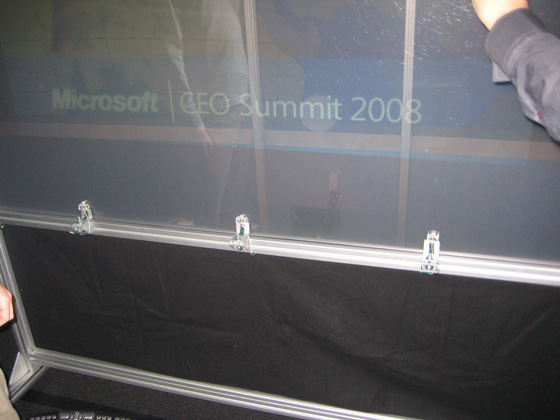
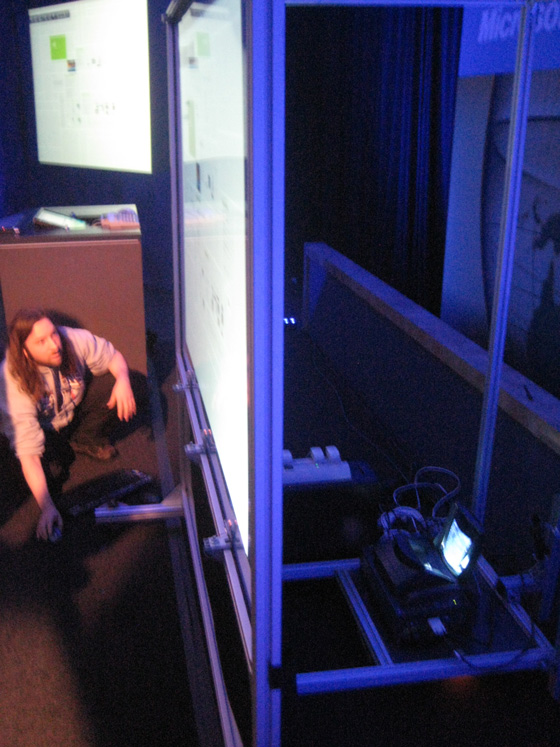
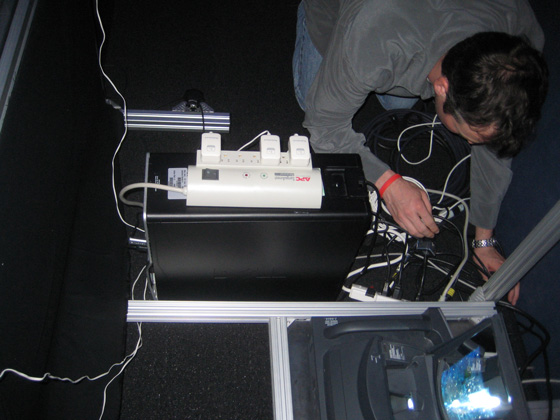
TouchWall consists of three infrared lasers that scan a surface. A camera notes when something breaks through the laser line and feeds that information back to the Plex software. Early prototypes, say Pratley and Sands, were made, simply, on a cardboard screen. A projector was used to show the Plex interface on the cardboard, and a the system worked fine (I’m trying to get Microsoft to release photos of the cardboard prototype, no luck so far).

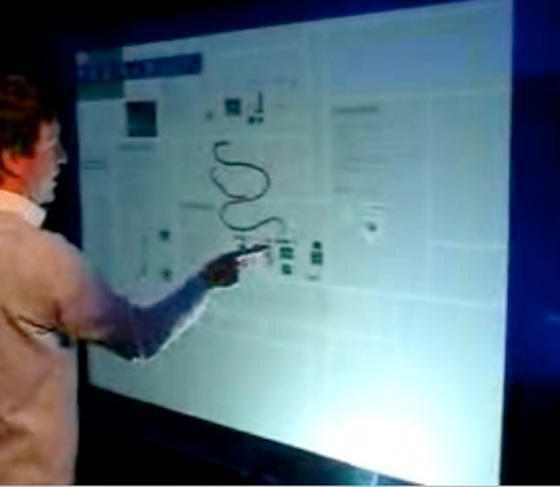
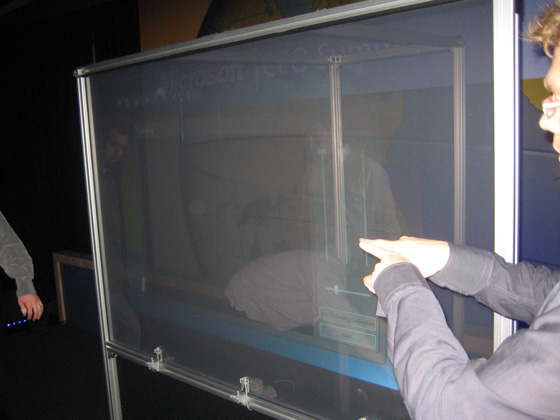
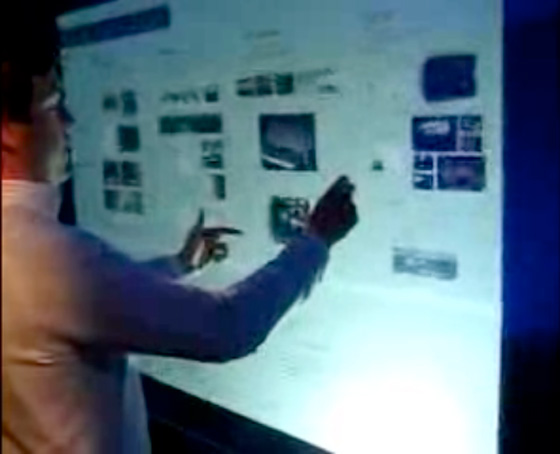
The TouchWall system I was able to test yesterday consisted of a PC running Vista and Plex, a 4×6 foot plexiglass screen, a rear projector, a infrared camera and the three infrared lasers. As you can see in the video, it worked, and well:

Sands showed a number of activities in the video - scrolling though mixed media on a desktop with his hands, infinite zooming in and our, playing media, and even using a drawing tool to turn the entire screen into a whiteboard.

Microsoft is quick to say that they have no current plans to productize and sell TouchWall. But the potential of the system is obvious - Prately spoke animatedly about a future where the computing experience is less monitor/keyboard/mouse and more like an architect’s desk, with user input primarily directly on the screen and via voice commands, with keyboard/mouse type input used more for data entry or office type editing tasks.

TouchWall certainly isn’t the first multi-touch product we’ve seen (see iPhone). In addition to Surface, of course, there are a number of early prototypes emerging in this space. But what Microsoft has done with a few hundred dollars worth of readily available hardware is stunning.

It’s also clear that the only real limit on the screen size is the projector, meaning that entire walls can easily be turned into a multi touch user interface. Scrap those white boards in the office, and make every flat surface into a touch display instead. You might even save some money.

More pictures below:


Update: More TouchWall video here.

Responses

Comments rss icon

  • This could be a revolution

    Can you imagine the next decade - how all this will develop

  • I want something like this for my house and after seeing this touch wall I am going to watch minority report now where they have their touch wall.

  • this will be a great tool for art galleries….http://jasonjenkinslive.com

  • This really gets you dreaming! Probably the only reason why I would update to Vista ;)

  • Nevermind the touch interface (FTIR, Diffused Illumination or whatever).
    “hundreds of dollars” for a high resolution, big-ass display that’s presumably flat (or projected) - i seriously doubt it.

  • It’s about time. Jeff Han has his own working multi-touch prototype years ago.

    Not to take attention away from Microsoft’s achievement, but it should be noted that Apple bought FingerWorks a few years ago. FingerWorks was one of the big pioneers in this field. The growing belief is that Apple is going to eventually make OS X natively support Multi-Touch as a primary input device.

    You’ll notice that when you look at OS X, all of the “fancy” graphic effects (CoverFlow, Spring-loaded folders, Genie effect, The Dock, Core Animation, Fast User Switching etc.) that all of the PC-fan boys have ridiculed in the past as “eye candy” are actually all perfectly suited for a native Multi-Touch OS.

    Eat your heart out keyboard lovers.

  • Science fiction has become a reality, wow!

  • Now local television can have the same touch screen bullshit that all the CNN pundits have. I am jizzing right now, I can’t live w/o more touch screen on TV.

  • This looks like another great product that will def be used in numerous situations in the coming years. I should have really wrote about this on my site, http://crenk.com

  • It’s true. Jeff Han invented tounch interface long time ago.
    He’s like Tech Mozart…

  • Actually, Jeff Han didn’t invent the (multi)-touch interface. The technology has been around since the 1980s, but not until recently has anyone done anything with it. Jeff Han is definitely the most well known individual who brought multitouch to a new level.

  • I just realized… inexpensive rear-screen projection, to any size, with touch navigation… this is the retailer’s (plexi-glass) display window of the future! Window shopping will never be the same! A shopper can view the entire catalog, on the BIG SCREEN, and order!

    Click “read more” (above) to check out the vid on CrunchGear.

  • WhiteBoard 2.0, Chalkboard 3.6

  • wow!! so far not a single negative remark about Microsoft.
    thats more amazing than the touch wall it self.

  • it is cool for business. I am thinking of ways I need this at home….
    a large picture frame… or I can integrate it with facebook, so I can actually poke my friends.

  • @12

    Claude — that is such a cool thought. Ever since seeing the Surface tool I’ve been thinking the same thing, but Touchwall is even cooler…

  • Great Work Microsoft, I don’t see a future without you being a part of it.

  • We tried one from a Canadian company two years ago they are very cool. Especially because people naturally gravitate to using one. But the software and hardware never play well together.

    Ours was in the $40K range, so I hope these are coming down, maybe Google will make them free if we put their advertisements on it?

  • This is great It remind me of the Iphone Idea, but then only wall based. I wonder there will be an wall based Iphone is coming. That will make the easier to operate and even watch movies and Internet with a touch screen on a wall based interface. Great post thank you!!!

  • Hmmm…no visible way to input text or edit? I’m not trying to rain on anyone’s parade here…but this appears to be a ways off. Everything was cobbled together…it’s fine for homebrew folks out there. But it looks like it’s year’s before we’ll see a Microsoft version for the common, everyday man or corporation. My money is on Apple or some other focused company. (And it won’t be cheap–not a few hundred dollars!)
    Until this can be produced inexpensively, be bug free, and be self contained where you can just install it yourself or have GeekSquad do it….there won’t be a mass market for it. Sorry for a dose of reality.

    Note to Ballmer: Focus. You’re losing ground in every market because you’re in too many markets.

  • Wait till somebody hacks ur touchwall and put some goatse on

    Btw, M$ sucks so much they rather let this die locked in their dungeons than let this technology freely available to everybody

  • Quote from the video

    “Basically, we are looking, here, is the opportunity to view content spatially organized in an infinite canvas paradigm, where i can, zoom in to and interact with content in an organic fashion.”

    Put that thru a bullshit filter, you’d get

    “Basically, we are looking, here, is a copy of Apple’s UI, which was designed for small screens, but we projected it on a wall, so users will awkwardly stand next to a wall in order to look at pictures and videos on a wall.”

  • It’s kinda laggy, isn’t it ? Especially compared to old Jeff Han’s demo.

  • this is really cool, love that it is really simple and not very complicated. I liked the idea of using infrared beams rather than making the entire screen touch sensitive[ like the way iphone is]. 10 on 10 to msft for this. Pretty sure this will used in lot of places

  • Hey all, here’s some multitouch interfaces history and perspective on who came up with what and when. It’s written by Bill Buxton, one of the pioneers in this field, who is now a research scientist at Microsoft.

    http://www.billbuxton.com/multitouchOverview.html

  • From a technical standpoint this seems very similar to the approach taken by Smart Technologies with their wall displays (www.smarttech.com). The approach works ok, but has serious limitations when you try to implement multi-touch, as a result of occlusion problems.

    By the way, for a good summary of the history of multi-touch, refer to Bill Buxton’s article. There is a lot more to it than iPhone and Surface:

    http://www.billbuxton.com/multitouchOverview.html

  • It’s the same setup that Jeff Han, NUIGroup, Reactivision, Cubit, and others use. They get your fingers to light up in a spectrum you can’t see (IR) and use a hacked camera to detect it.

    What would be nice is if they would open up Plex to give those of us who experiment with surface computing a more native way to interact with WPF.

  • who wrote this post? there’s the exact same post on crunchgear with john biggs as the author - good way to get on techmeme

  • I think that Canadian company Steven mentioned in post #18 is called SMART Technologies (http://www.smarttech.com). They have had multi touch products for years, and they are commercial, affordable, and available across the globe. Prices are significantly cheaper than the $40k range that was stated.

    They have both resistive touch screens and camera based touch screens. So everyone holding their breath waiting for MS to commercialize can relax.

  • #27, this is actually different from the Jeff Han approach. Jeff’s approach requires the user to press the glass surface, which causes frustrated total internal reflectance. The light is not intersecting with the the fingers, as with this approach. There are advantages and disadvantages to each method.

    By the way, we put together a demo of World of Warcraft on a 16 foot display with a Wiimote:

    http://www.youtube.com/watch?v=4ITeaCq1MTI

  • This technology is one way to keep the local machine important. It may take another 5 or 10 years before you can do all the same stuff over the Interweb without significant latency.

  • Rob, Sacramento, CA - May 14th, 2008 at 1:05 pm PDT

    To # 5 poster, Shulgi. How cynical and short-sighted can you be? Prices fall as more people adopt and the technology matures. Flat screen TV’s used to cost $10,000, now you can buy many models for under $1200. Some LCD projectors, which is what you need for this touchwall, are already under a $1000, which makes them already within the “hundreds of dollars” range.

  • This technology could help enhance a number of industries: healthcare/disaster relief/construction/etc. I’d love to see it come to fruition. My biggest fear, however, is that it will be just as fast to rollout as wirelessly syncing my music library to my car. Remember when Bill did a demo on that like 10 years ago?

  • I see this as being huge in the classroom. Many universities use smart stations, but they are outrageously expensive. If this is just a few hundred dollars, then I can see it being pretty disruptive.

  • A really cool company Innotive has had this for a couple of years now! http://tinyurl.com/6lxlxo

  • @Mogilny, Multi-touch is not Apple’s UI. Though, Apple did purchase FingerWorks a few years ago, and they have a number of patents in this field as far as physical interaction is concerned. And Apple has a lot of Patents for the iPhone interface, so other companies will have to be careful for handheld Multi-Touch. It will be interesting to see how this plays out.

    @Garth, Jeff Han’s got a Wall version too. He’s done it all, and he’s been doing it for years. But, even he admits that it’s not his technology. He’s just one of the leaders in the field.

    Basically Microsoft has done NOTHING new here people other than getting a hacked-up version of Vista to recognize old-school Multi-Touch technology. They might as well have just bought one of Jeff Han’s wall displays from 5 years ago and put a Microsoft logo on it.

  • This will be a huge leap in improving human/system interaction while mitigating all the RSI problms associated with mouse/keyboard/monitor input.

    Whoever comes out with an affordable consumer solution will have the next iPod on their hands…

  • Hang on … what am I missing here … Interactive whiteboards have been in schools for ten years …. now include versions that work with large Plasma/LED screens.

    So what’s new here? ….

    If you want info about IWBs then have a look at

    http://www.shambles.net/pages/staff/intwhiteb/

    and if it’s content you are looking for then see a very large pile at

    http://www.shambles.net/pages/staff/IWBcontent/

  • wow! but hey this has almost all the features of an iphone. I know cuz i’ve got and the only difference is that the screen is much bigger and this has a lot of the typical microsoft software features.

  • If you read more closely, you can tell that TouchWall has limitations for graphic design. For instance, because TouchWall is done with infrared cameras, TouchWall can’t discern pressure — which is quite useful in multi-touch situations.

    Jeff Han’s prototypes (which are now pretty inexpensive to make these days, mind you), recognize pressure, as he shows in his demonstrations on YouTube.

  • In response to posts 18 & 29

    A lot of the cost associated from some of these projects is the display itself. If it is done with a projector, then this is now rather minimal. However because you can also use LCD or Plasma displays, combined with a company’s touch-overlay this can add to your additional cost. However, it definitely can provide a superior picture quality/resolution, which is often necessary for certain applications. Schematic-viewing is an excellent example.

    Again, I would check out this company’s site for more exact specs and details:
    http://www.smarttech.com

  • wow, they made an interactive whiteboard!!! AMAZING! I’ve never seen one of those before (*cough* Hitachi, *cough* SMART board)

  • Wow looks nice!

    But its from M$ so how good can it be…?

Leave Comment

Commenting Options

Enter your personal information to the left, or sign in with your Facebook account by clicking the button below.

Alternatively, you can create an avatar that will appear whenever you leave a comment on a Gravatar-enabled blog.

Trackback URL
bugbug
  • MediaTemple Logo
  • QuickSprout Logo
  • OpenX Logo
  • Cotendo Logo