Morgan Stanley’s Internet Trends report from last month takes a big turn from previous reports – the focus is nearly 100% on social applications and how they are taking over the Internet (Yahoo apparently read it). Key takeaways:
- YouTube + Facebook page views > Google or Yahoo page views (and may be bigger than both combined)
- 6/10 top internet sites are social (youtube, live.com, facebook, hi5, wikipedia, orkut); none were on the list in 2005
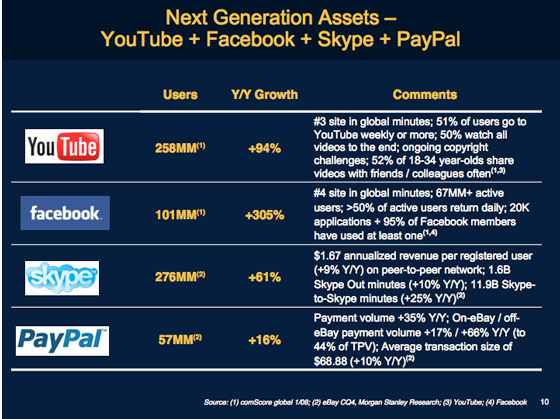
- YouTube has 258 million users, 50% visit weekly or more
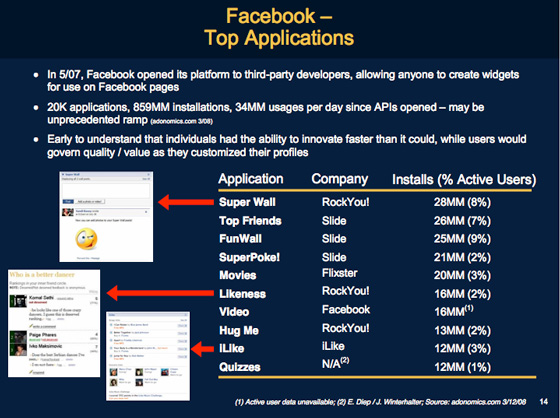
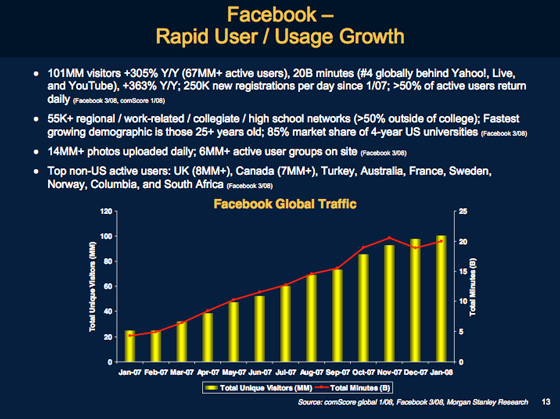
- >50% of Facebook users log in daily, 95% of Facebook users have used at least one third party application
- Skype revenue is $1.67/user/year, up 9% Y/Y
- 14 million photos uploaded daily on Facebook
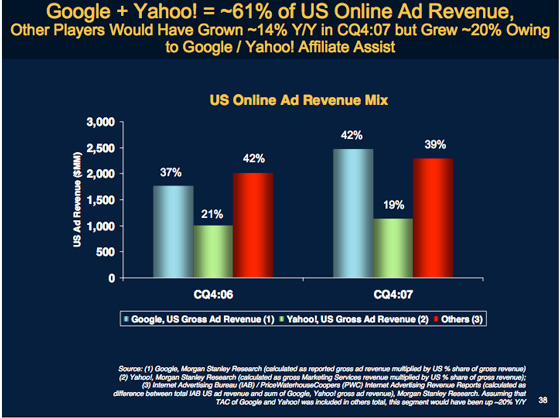
- Google + Yahoo = 61% of U.S. Online Ad Revenue
- Google: $4.4b ad revenue in Q4, paid out $1.4 billion to partners
- Yahoo: $1.6 billion in ad revenue in Q4, paid out $429 million to partners
Compare this report to the previous one from October 2007:


Everyone is saying that China, India, Brazil and Russia will be major markets. Maybe they have the population but what about the ad-spending and e-commerce transactions.
Azhar – check out the later slides in the presentation that talk about mobile use in asia. amazing growth.
The social web, invincibly, and, globally.
Also there is tremendous growth in internet users that open market for e-commerce transactions and other business sector.
Is the traffic and monetisation potential from widgets (and API’s) being underestimated as a trend here, eg, where do RIAs such as Twhirl using Twitters API fit in?
Surely applications like this have huge growth potential using platforms such as Android and iPhone SDK?
should be “YouTube + Facebook page views > Google OR Yahoo page views”
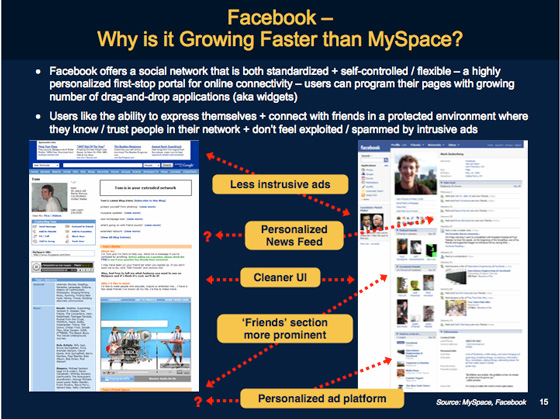
Chart 15: “less intrusive ads” is one of the reasons why facebook is growing faster than MySpace
Less intrusive??? mhhhhhhh… ;o)
Google takes in more advertising rev than all others combined ex. Yahoo. That’s just stupid. Google + YouTube = Everybody Else Loses
Small clarification to your post:
Live.com is not a social website (assuming they are referring to the search engine Live.com). But MySpace (obviously) is. The slide in question that you pulled the key takeaways from (#8) is highlighting sites which moved on or off the top 10, not those who are social. Since MySpace was in the top 10 in 2005, it is not highlighted in the slide.
thanks for sharing the report, great information to decission makers in the 2.0
http://www.enriqueburgos.com
Queen’s quality, always a good read..
Slide #25- MySpace is simply more popular in the US. Why doesn’t google follow the principles they pioneered; less intrusive advertising leads to better acceptance and conversion.
Morgan Stanley pandering for money….What Chinese Wall?
Ever wonder about Facebook’s valuation? Wonder no more: >50% of the 64MM+ users return DAILY. Remember last week, Yahoo! made a big deal about how their new strategy will create “stickiness”– they are dreaming about a day where they have Facebook-like participation.
Social networking is the trend!
BTW, would you like join the lucky draw for USD 30,000? All you have to do it click, click, click…
http://us.the1000links.com
That was possible the best thing i have scene in ages i loved it, especially cause i am finishing my business plan .. THANK YOU!
Yes Mike, i went through the slides, Really informative.
I don’t know about other Asian countries, but i would like to talk about India. Mobile penetration is huge here, when i say huge, people who don’t know what an mail id is have a blackberry. People who earn less than $150 have a mobile phone here.
Now to the other question, do mobile penetration really convert into higher page views or more revenue for publishers or companies?
Like i said most of the low earning people have a mobile phone here, We have a lifetime incoming plans here for $25. That means he just has to buy a $40 phone and $25 plan and he is connected for life. So even when the penetration is huge, he does not become a valuable customer, he does not browse internet, he does not buy things through his phone, he is using it for just being connected.
I am wondering it is the same story in China and Brazil too.
Most data revolves around Alexa…Its not at all reliable, or is it? I thought even you didnt believe in Alexa statistics
@Azar, Thanks for bringing that perspective. I agree, and it drives me crazy that people treat disposable income across various countries the same. “eyeballs” differ in value and the advertisers (Fortune 500) know this from my experience.
Morgan Stanley, Mary Meeker, the Internet is going to be big, big, big – is this Deja Vu 2.0 – Hang on to your savings
Porn industry still tops them all – 35%!
While facebook ads are ‘less intrusive’ what are thoughts on the click-through and saliency of the ad. I love facebook (and now with facebook messaging) I’m on the site everyday. But I am rarely ever paying attention to any of the advertisements as they seem to be somewhat disconnected from the content — unless the ad is related to my school, etc. Thoughts?
@17 Azhar: Most of what you say is true except for “he does not browse internet, he does not buy things through his phone”. Value Added Services, Ringtones, Games, Wallpapers (and a lot more) for a mobile phone has a huge market in India. (Agreed that the revenues are not comparable with that in US or elsewhere in the world because of currency conversion.)
Mobile version of any website has a better chance of reaching a Indian user compared to a normal website.
http://www.konsulted.com
Hasn’t this trend been going on for a few years now?
Good tips and informative.
Nat
http://www.workersinc.com
16% of total time online is spent on “social connections,” up from 0% three years ago
The “category didn’t exist 3 years ago”? These people must either only define categories for the sake of their own chart or have their heads deep in the sand. Friendster and MySpace were both popular three years ago, as well as LiveJournal and FriendsReunited, all very popular “social connections” sites.
Connect to the right people otherwise social networking sites can be an enormous waste of time.
one ugly presentation design
Couldn’t they come with some other color then dark blue?
but how soon can the social sites monetize this traffic? facebook’s projected revenue growth was uninspiring.
lol yeah that was an ugly presentation design but there was great information in that presentation — Most of the facts are rather simple and self-explanatory considering we all know the effects of social media, but seeing it in stats form will help many companies sell even more ads to businesses looking for ad platforms as well as social media optimization/marketing
Dan, FB has nothing on Y!’s stickiness.
Visits/month per user:
Y! (#1) = 26.8 visits
FB = 17 visits
Y! actually has the highest rating for that metric in the Top 100. Another metric, average number of minutes per visitor per month:
Y! (#2) = 268.3 min
FB = 167.0 min
Or may be average usage days per visitor per month:
Y! (#1) = 10.8 days
FB = 7.6 days
Facebook isn’t the standard for stickiness. If anything is, Y! is.
(US Comscore Data, March)
14M photos/day posted on facebook is an astounding number…i wonder how that compares to flickr. goes to show how facebook’s platform can begin to render more niche services increasingly obsolete (e.g., chat, photos, videos, etc)
what about Digg?
interesting, yet not much money coming from that area… I wonder when we will start monetizing that audience propertly (i.e. decent CPM and no user experience disruption)…
The big get bigger, the best sites from “the folks” get nothing – just like the real world!
Anyone else having trouble with the embed code?
I tried posting the slideshow to igoogle, facebook, etc and it wasnt processing?
I finally manually linked to the techcrunch article within my wordpress blog with a hyperlink.
Some great information. I always appreciate it when they make this research available.
Doug
Great research on the rising tide of social networking. Equally interesting is the monetization aspect of this ad inventory, as many notable companies (Fox, News Corp, Google, etc.) have had trouble monetizing this inventory over the last couple of quarters.
At PubMatic, we recently opened up data across 3000+ publishers (on Facebook and off Facebook) via the PubMatic AdPrice Index (http://www.adpriceindex.com). We launched it in April for Q1 data and plan to publish monthly going forward. The key thing we’re tracking is month over month trends in monetization, so people have some visibility.
In April we found that:
- Small sites tend to monetize much better (3X) than large sites. This is a tough one for facebook developers because even though their application may be “small”, they’re part of the much larger facebook monetization ecosystem
- At the start of this year, social networking environments monetized quite poorly with respect to other verticals at 22 cents eCPM in January
- Monetization has trended up significantly over the first quarter though, rising to 37 cents on average in March 2008
Just about all data inherently has bias, so I won’t pretend that our figures are perfect. But I do think they might arean interesting benchmark and indicator of trends.
Regards,
Rajeev Goel
Co-founder, PubMatic
Great information on the revenue some that social network giants bring like myspace and facebook. I’m giving facebook a try since it looks more professional than myspace but of course myspace has a good ability to customize to your taste…so many sites so little time…
good
I’m writing a research these days on social media and these statistics are very helpful. About the difference between “communications” and “social connections” (first image) – is “communications” referring to all kind of connections, such as business etc and social connections to leisure time connections only?