
Remember when wireless technology was supposed to help us get out of our offices once in a while? What happened to that? Sure, we might not be constrained to our cubicles all day - instead, we carry them around with us. And let’s be honest… We all know a certain blogger who could stand to lose thirty pounds.
It’s nice to see that sometimes this wireless stuff lives up to the hype.
National Geographic’s TOPO! Explorer gives daring technophiles a chance to create and share their favorite trails using detailed topographic maps provided by USGS. These maps support GPS integration, which makes things easy. Just upload a map to a supported device, head off in the general direction of the trail, and you’re on your way. You can also attach geo-tagged photos to your maps, allowing you to show points of interest (or beauty). And when you’re done you can share you experiences through comments or on the site’s forums.
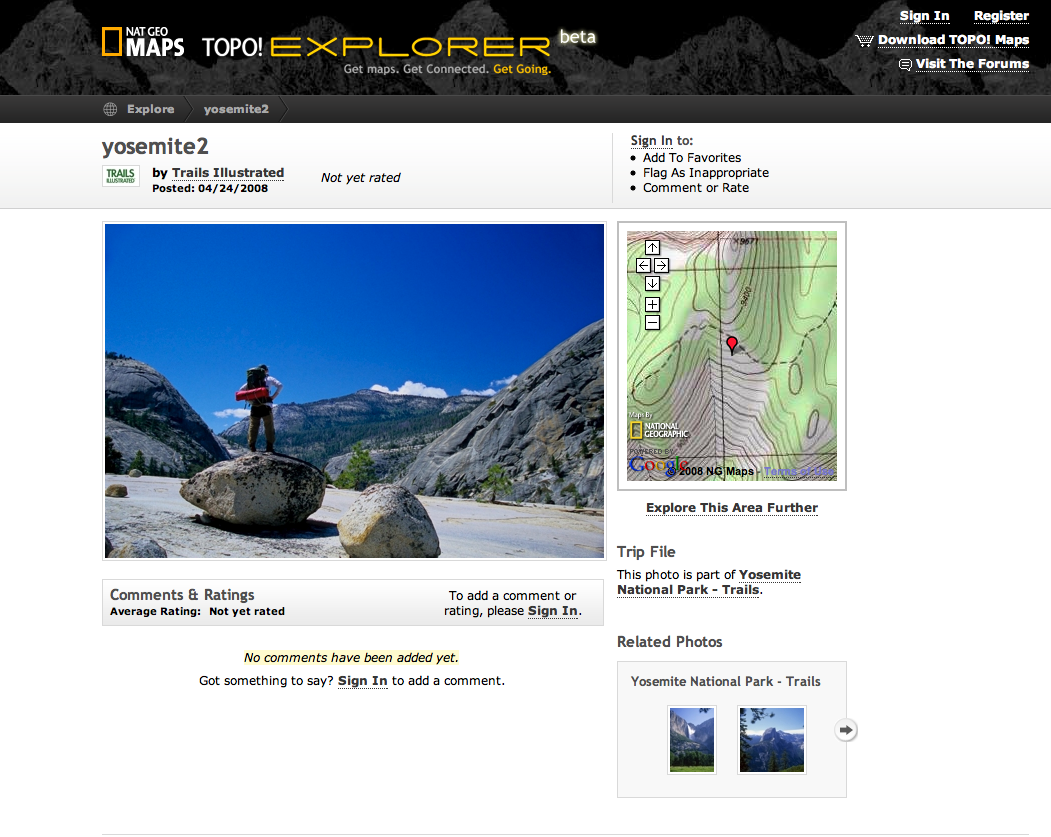
The site has just opened in feature-limited public beta, and hopes to fully launch on May 30th. Unfortunately, GPS integration, which may well be the site’s greatest asset, is not free. Currently National Geographic is charging $25 for the desktop software that enables this feature - a price that, while reasonable, may be the site’s undoing. Hopefully National Geographic will abandon this setup, at least while the site is establishing a user base. Maps are currently pretty sparse, and many people might be turned off by the prospect of paying when there is so little content to be had.
With enough users and some support more from the esteemed National Geographic brand, this site has a decent chance at taking off, or at least getting the hardcore outdoorsy niche audience on board.
Update: National Geographic has informed us that the desktop application is free, and that the $25 applies to map credits. This page is the source of confusion, and is going to be updated shortly.


See all


I am not a hiker nor do I own a GPS, but this sounds an awful lot like the site http://www.toposhare.org. Does it offer features above and beyond, or should we just use the free alternative?
I’m _fairly_ certain people hike outside of the US!
@gs I just checked out TopoShare and it doesn’t provide the actual topo maps that Topo Explorer does. You can get the raw GPX files (which you can send to a GPS unit and follow) but we’ve never had the actual topo maps before. Topo Explorer provides that on top of the easy-to-use Google Maps interface which is why it’s such a big deal.
But I hope and pray that they’ll open up some kind of API so that we can start using the Topo data in our own applications. That would be mashup heaven for us GPS nuts.
=Ryan
rstewart@adobe.com
@#2 - Yes they also need to expand their geographical focus as well, well at least add Canada. I live in the US but I travel to the Canadian Rockies once a year to hike their trails. Sorry, but their rockies are a bit different than ours and I imagine I’m not alone with jumping the “border” to experience new sights.
Also, I signed up for beta testing and they are a bit too demanding. National Geographic wants to know “How much time do you have for testing + sending reports?”. I’m not going to work for the company I just wanted to help out, nevermind….
This is Eric from NatGeoMaps. Thanks for the mention! A couple of points: The desktop application will be ready in just over a month and will be free. What people will buy for $25 is map credits to download 25 SuperQuads, including the various layers of topo maps, the aerial imagery and topo/aerial hybrid. By downloading these hi-res versions and using with our software, people can customize and print great maps, updating them with trails and points of interest from our recreation database plus their own info. And of course, you can communicate waypoints, routes and tracks between the application and your handheld GPS.
For those not familiar with USGS maps, they are the gold standard for outdoor recreation and offer exquisite detail not available on computer-generated vector maps. What they often lack is current trails and other recreation-specific information. We’re addressing that by compiling the largest database of recreation information, which will be supplemented over time by hiking clubs, other organizations and users. Most of the hundreds of thousands of users of our existing TOPO! products have created files they’ll be able to share with the user community. Watch the “miles of trails” datapoint on the home page as we populate the database. Yesterday it stood at 47,000. Today it is over 70,000. We’ve just begun.
While we use the Google interface on the web site, these are not Google maps. The topos are authentic USGS maps and the aerial imagery is from a leading company in that space, i-cubed. The aerial detail is consistent across the country, so it lines up with the topos. In most backcountry areas, these are the most detailed aerials available.
Mike, we have a limited number of beta testers for the application, so we just needed to understand that those who we include can respond. But everyone is now able to test the web site with no obligation. We agree that the geographic scope needs to be expanded, and we are working on that.
A little info on toposhare.org:
toposhare.org provides topo maps from terrasever. You can get them as PDFs in 150 dpi and fixed scale or you can view them in an Google Maps interface.
toposhare.org also provides an API. Read more here http://blog.toposhare.org/?p=46
And toposhare.org is a open source project (both content and code has a open source licens).
One of the oldest and most active social websites that gets people outdoors is Geocaching.com. Geocaching melds the best of online and offline. The folks up at Groundspeak in Seattle have done a masterful job for many years, with an extremely engaged and loyal population. I like what National Geographic is doing here but they get press (like this post) most likely due to the brand, not the substance. Geocaching is the real deal. Maybe TC has written up Geocaching before and I missed it.
My boys and I thoroughly enjoy our time spent exploring and finding random stuff in random places. If anyone wants help getting started geocaching, let me know!
I think competitors of this service are EveryTrail (www.everytrail.com) and some photo sharing service those supporting GPS integration.
# For example, Zooomr is already supporting GPS integration with photo.
So, I wonder what is superiority of this service except brand name of National Geographic.
can I use my iphone for the nat geo topo?