Free: Pack Of MySpace Branded Playing Cards »
Maybe The Fight Against Click Fraud Isn’t Hopeless After All
by Erick Schonfeld on April 25, 2008

clickfraud-1q08.png

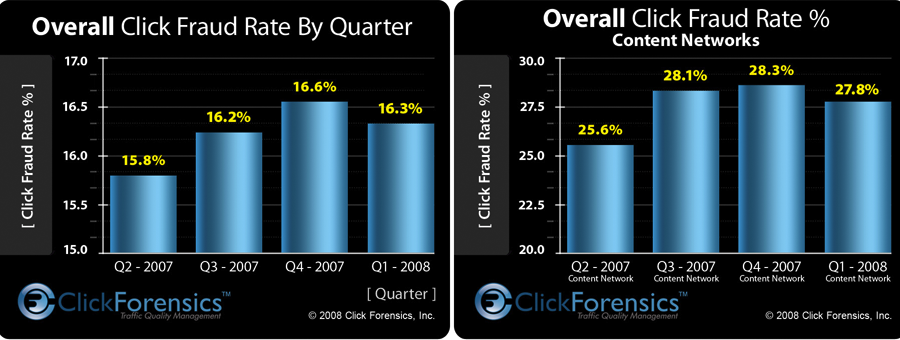
One good quarter does not make a trend, but there is a glimmer of hope in the fight against click fraud (fake clicks that can nevertheless cost advertisers money). Click Forensics is reporting that the overall click fraud rate was down half a percentage point in the first quarter to 16.3 percent. Although that is still higher than the rate was a year ago, it could be an indication that Google’s and Yahoo’s efforts to filter out bad clicks on search and contextual ads and improve the overall quality of those ads is starting to have an effect.

When you look at the click fraud rate on their respective content networks where the worst offenses occur, AdSense and the Yahoo Publisher Network, the click fraud rate there also dipped slightly to 27.8 percent from 28.3 percent in the fourth quarter. That is still nearly a third of all clicks and needs to seriously go down further.

Perhaps this year the overall click fraud rate can be held steady instead of rising 15 percent, as it did in 2007.

Advertisement

Comments rss icon

  • How can one truly know the intent of a click through without reading the mind of the person making it. I’m sure most automated click farms can be weeded out mathematically, but the human element is still there.

  • Click fraud is the worst dream for an advertiser, this type of fraud hit advertisers financially and source wise. I am pretty sure that all advertising platforms like Yahoo! and Google will soon take them more down. :-D

  • One guy's perspective - April 25th, 2008 at 11:11 am PDT

    Ad platforms are not incentivized to eliminate click fraud (if that were possible) but rather only to manage it the maximum level that advertisers will tolerate. Sad but true.

  • Why in the world would I trust a company that makes graphs like that? The y-axis scales are wildly nonlinear.

  • Good point. Why does this graph have non linear y axis.

  • bannerreviews.com,

    No. Only very basic cheating systems can be caught like that :-) I’ve been in PPC for about 5 years (not promoting and not cheating :-) ). Trust me, there are so many ways to cheat.

  • Also, I don’t get it (sorry, haven’t read post). Is this click fraud which wasn’t “catched” or total click fraud? Like cheaters were lazy this quarter so there were less fraud…

  • To be honest I would also blame social networks for that like Facebook and MySpace.

    Here is the situation:

    I post article online, that same article is RSS feeded by FaceBook or MySpace. Friend’s of mine click on that article and let say click on google adsense advertising.

    NEXT time I go to my friends house using his internet I login to Adsense or Gmail or any google app. Google would flag me as “bad boy”

    It happens! yet did not happen to me yet/

  • wow.. here is a company that has to rely on elementary visual tricks to survive..

  • CPC is dead, long live CPA!

  • Man, you guys have some serious pageload issues today. Makes the site hard to use.

  • CPA is the way to go in the future… it just isn’t profitable yet for the vast majority of sites out there.

    Jon
    http://woodmarvels.com – Create Unique Memories

  • These reports are worthless.

    If a third party had not problem singling out every fraud click, it would be even easier for Google and Yahoo to do so.

    The point is, the report makers don’t know what is a fraudulent click and what is not, period.

    What is more important, however, is that Google algorithms already discount the value of clicks that fit certain profiles through their smart pricing software, in cases making the clicks worth zero to publishers.

    Thus, Google takes care of clicks with certain profiles, which has the aim of making the profit from fraudulent clicks to as close to zero as possible.

    In addition, Google will stop showing ads with publishers that have certain click profiles.

    That is a background that should be understood when reading these reports.

    Reporting that there are indications of x % of click fraud but leaving the background out is lazy.

  • Agreeed with Dsquared’s first lines.

  • The overall click percentage figure is misleading. Virtually no fraud occours with the low cost keywords, yet we have seen 90% click fraud rates on keywords that cost $4.00 and up per click. The click fraud rates based on dollars, rather than clicks, would be the most valuable one to see. I think you would be shocked.

    We finally stopped using PPC advertising in February, saved several thousand per month, our visitor numbers dropped a lot. Yet, our online sales increased at about the same rate as when we were using PPC advertising.

  • … one more thing. Looking in detail at our server logs showed some interesting things. The keyword fraud was very clever. It was only on the highest paying keywords, it all came from the U.S., no overseas. It had browser platforms distributed in about the same share as the overall market, it came from 21 different cities and towns, and 76 IP addresses.

    The apparently random and normal distribution of the traffic is what caught our eye. Though we advertise nationally, our products only appeals to certain limited geographical profiles, and the browser platforms are very heavily Apple/Mac and our organic traffic reflected this. The PPC traffic did not.

    Also, ClickForensics did NOT identify this traffic as click fraud.

  • Google will not provide detailed information for each click (IP, time, referring page, etc.). That’s how useless click quality adjustments mean for advertisers! We need to put pressure on these ad networks to demand a more transparent reporting.

  • Question ! In order to validate my entry for a contest, I had to click on an ad. Is it a click fraud or not ?

  • Sophie (18) – Yes, I would call that click fraud.

  • I agree with Dsquared – this data is useless. No one has ever fully explained exactly how this “click-fraud” is detected or defined.

    Sure, advertisers on any of the content networks are clearly in danger from click-fraud. There the incentive is clear: publishers get paid when ads are clicked.

    Even the search network is a dangerous place to advertise because your ad can end up on parked domains – another place a publisher has incentive to click the ad.

    With ads on the search engines, though, there is very little incentive for click fraud. Will a competitor try to run out your budget – maybe, but this I have to believe is rare.

    wellletzc – Were your ads on a content network or just on the search engines? If on the search engines, how did you identify it as click fraud?

    The lesson: stay away from content and search networks – they provide poor traffic and open you up to click fraud.

  • I agree with Dsquared – this data is useless. No one has ever fully explained exactly how this “click-fraud” is detected or defined.

    Sure, advertisers on any of the content networks are clearly in danger from click-fraud. There the incentive is clear: publishers get paid when ads are clicked.

    Even the search network is a dangerous place to advertise because your ad can end up on parked domains – another place a publisher has incentive to click the ad.

    With ads on the search engines, though, there is very little incentive for click fraud. Will a competitor try to run out your budget – maybe, but this I have to believe is rare.

    wellletzc – Were your ads on a content network or just on the search engines? If on the search engines, how did you identify it as click fraud?

    The lesson: stay away from content and search networks – they provide poor traffic and open you up to click fraud.

  • PPC is dead!
    Long live PPK – (Pay Per Keyword)

Leave Comment

Commenting Options

Enter your personal information to the left, or sign in with your Facebook account by clicking the button below.

Alternatively, you can create an avatar that will appear whenever you leave a comment on a Gravatar-enabled blog.

Trackback URL
bugbugbug