One of the more useful Google advanced search features is the date filter, which limits results to recent pages. Results can be limited to the past day, week, month, year, etc. Google’s Matt Cutts and GoogleOperatingSystem wrote about it late last year.
You can access the search via the URL as well, by simply adding “&as_qdr=d” to the end of any query (Apple v. Apple in last day). simply change the =d to d5 for 5 days, or w5 for five weeks, or y5 for 5 years, etc. With Google indexing sites so regularly now, it would be great if they let users refine searches down to the hour as well.
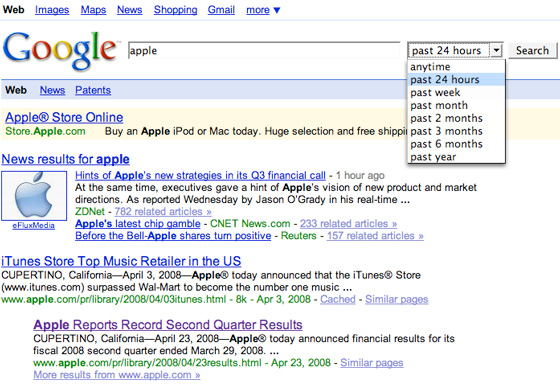
One other thing I like about the feature is that once you’ve searched by date, it stays as an option next to the search bar for that session, so you don’t have to keep adding it.
Google may also be testing date searches with some users even without them voluntarily setting it. Our Israel correspondent Roi Carthy resports that it appeared in one of his searches without him using the URL string or advanced search. A quick poll to my Twitter followers asking if anyone saw it yielded mixed results. A few people said they saw it without setting advanced search, but they may have just seen it stay in the session after they set it.
If anyone sees the data box in Google search and they didn’t set the URL string or advanced search, please let us know in the comments. And try to take a screen shot that includes the entire URL string, preferably even before you’ve done a search.
Update: Matt Cutts says no user testing on this feature is being done.


It would make sense for G to detect whether a query was the sort of thing that people might want to filter by date and show the box accordingly. I don’t see it myself though.
That’s funny, I had just noticed this feature the other day when doing some research for Clicky…. but it doesn’t seem to work terribly well from my limited testing. Like in your screenshot, you have it set to 24 hours but the second result is from April 3. Site’s as big as Apple I’m sure are indexed every single day so there’s no way Google didn’t see that PR release for 21 days.
I do use this feature quite a bit in Google blog search, which seems to work a lot better. Unfortunately if there are no results for the time you request, instead of showing the same interface to change the time range, it jsut says no data found an dyou have to click “back” to get back to the interface to change things. Real bad design in my opinion…
I saw it only after using advanced search….
You can use http://archive.org too.
BTW, I am here right now in case anybody is in the area.
http://www.yelp...ouse-long-beach
There are some venture cap people talking loudly sitting a few sofas down from me. I’ll be here for another hour waiting for a meeting.
Yep I see it, pretty nice feature to have.
A feature I use frequently. Yahoo on the other hand only allows for a as recent as 3 month setting. perhaps that’s because Y! search doesn’t crawl as fast as Google?
Mike,
Check out this firefox plugin – Link Diagnosis – to get the date (and hour on recent pages/posts) when the page was published. Its great for investigating when the websites were launched, or blog post written up to a minute etc.
It would be useful to search for results from *before* a certain date, too. For example, to see what a candidate said about a topic before it became a major campaign issue, or to see where the first use of an online slang term came from.
I really like the fact that stumbleupon thumbs up and thumbs down are added to my google.
Tests Google’s Refresh rate quite well
This will definitely be useful for tracking public relations events and campaigns.
They are also factoring previous queries into the mix by session as well.
http://www.jaan...oogle-rankings/
You could use a search provider to add a google recent search in your browser. I setup an example on my site, http://tubejump...m/googlerecent/
The example creates a provider that does a “past 24 hours” search.
that’s nice – “simply adding “&as_qdr=d” “
I was thinking about this the other day. Good idea. Gives users more avenues to narrow their search, particularly in relation to a “hot topic” at the moment. (e.g.: presidential election race)
nice feature.. does this mean frequently changing websites will have a edge over static pages ?
This feature has been around for a long time and has never worked properly. Here’s a quote from a research paper written in 2003 (http://rdues.bc...bCorp_DRAFT.pdf):
“When run in Google on 24/06/03 and restricted to ‘the past 3
months’, the ‘weapons of mass destruction’ query returned over 1.3 million hits. However, when accessing each of the hit URLs directly, we found ‘Last
Modified’ headers containing the dates 20/03/02, 08/11/02, 11/07/01 and
27/07/00 amongst others, making it impossible that these pages were written, or even altered, in the past 3 months. Price & Tyburski (2002) have noted similar problems with date queries in search engines and suggest that there may be a bias towards the date on which a Web page was last indexed by the search engine, rather than towards the date it was written or last modified.”
Hi Guys,
I’ve written a Greasemonkey to make this box appear by default: Google Search By Date
Cheers.
its actually a good feature for SEO purposes?
Very interesting. can be pretty helpful
thanks good a lot
Great feature…
Thanks for the post!
I like it!
Thanks for take the time to share.
I Like it!
Thanks for taking the time to share.