Do not panic. We accept late submissions for TechCrunch50, but please submit soon. »
Does The Google-Yahoo Advertising Test Amount To Collusion?
by Erick Schonfeld on April 24, 2008

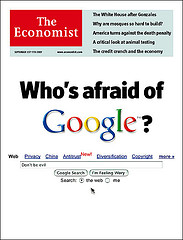
whos-afraid-of-google.jpgThe Justice Department has opened an investigation into the antitrust implications of Yahoo’s recent test with Google to run Google ads on about 3 percent of Yahoo’s search results. Reuters is reporting that “some of the government’s concern focused on a telephone call from Google Chief Executive Eric Schmidt to Yahoo Chief Executive Jerry Yang to offer help in thwarting Microsoft’s bid.”

The test was a response to Microsoft’s unsolicited bid for Yahoo. If a deal with Google can goose Yahoo’s profits, the thinking goes, then shareholders may accept that in some combination with another deal (possibly merging with AOL) as a viable alternative to selling to Microsoft. There is still a 60 to 70 percent gap between what Google collects for each search ad and what Yahoo is able to get. So just handing over search advertising to Google would result in a considerable short-term jump in Yahoo’s finances.

But there is an antitrust problem, which Microsoft (no stranger to antitrust law) has been pointing out all along: Google and Yahoo’s combined search market share is about 80 percent. Just the fact that the two companies are talking to each other about combining forces brings up the specter of collusion. Both companies informed the Justice Department of their joint test. And if any deal were to happen, it would likely only be for a portion of Yahoo’s search advertising in an effort to avoid triggering antitrust objections from the government.

But Yahoo and Google are already skating on thin ice. They have already triggered an investigation. And the focus seems to be on collusion, based on the mere active planning on the part of the two search giants to change the market dynamics by cooperating together against Microsoft. Even if this investigation goes nowhere, Google is being warned here that it is dangerously close to monopoly status in search and that the government will treat it accordingly. Different rules apply to monopolies. Just ask Microsoft.

(Image via dullhunk).

Comments rss icon

  • I understand why the laws are in place, but it seems a but un-American to say “If you’re extremely successful, here’s a list of people that you’re not allowed to phone.”

  • This is exactly why a deal between Google and Yahoo will never be done, and is not a serious threat to Microsoft. I think the real reason for doing this test was to help Yahoo quantify the value of their traffic. If it is good (which appears to be the case,) it could result in Yahoo getting more money out of Microsoft, which is in turn good for Google.

  • jason l baptiste - April 24th, 2008 at 8:11 am PDT

    hey erick, thanks for updating with source on justice department from reuters. :-). Was looking for that.

  • “it would likely only be for a portion of Yahoo’s search advertising”

    I wonder if this kind of deal, if it were finalized, would be based on “permission first” or “forgiveness later?” And where’s the line for what “portion” is too much? Interesting stuff.

  • Beyond this fight, the best thing Microsoft can do is to build a keyword exchange market and join forces from many different ad networks, just like any currency exchange market.

  • Y! will continue to surprise the world… stay tuned.. :-o

  • Afraid of the Dark - April 24th, 2008 at 9:15 am PDT

    @6 … “continue to surprise”? What exactly have they done that has been a “surprise” to the world? Have good earnings? If that’s some sort of great surprise then it’s not looking good.

    As for phone calls. The airlines were busted back a decade+ ago when the anti-trust department caught AMR’s CEO calling a competitor and saying that the price wars they were having were ridiculous.

  • the investigation is largely without merit. sure they will control 80% of search advertising, but there is still other types of advertising on the internet and other types of advertising in general. It’s not exactly the same as Rockefeller owning every single refiner and having a global monopoly on a basic commodity. Unlike airline travel, oil, or operating systems people aren’t completely dependent on search based advertising for business survival. google can’t gouge their customers because if it doesn’t justify itself economically they will quit advertising.

  • The tech industry has Microsoft (circa 1999) to thank for this scrutiny. The jig is up — tech companies will now be on permanent watch by the feds.

    Google will probably find any and all of their activities closely watched by the feds going forward. Thanks, Microsoft!

  • Different rules apply to a monopoly? ask Microsoft agan ;-) {seesmic_video:{”url_thumbnail”:{”value”:”http://t.seesmic.com/thumbnail/TBk7RSiNxM_th1.jpg”}”title”:{”value”:”Different rules apply to a monopoly? ask Microsoft agan ;-) ”}”videoUri”:{”value”:”http://www.seesmic.com/video/evRT2IsaVk”}}}

  • Even if there were a monopoly, as in a hostile single entity controlling an entire market, I don’t think I’d care. This is so overblown and such a waste of time, money, and source of FUD in technology slowing down innovation.

    @1 you’re right, it’s ridiculous.

    @5 exactly, it just goes to show that there are always alternatives. Especially on the Internet– it’s not like someone can buy up all the property to keep someone out.

    I don’t care if Google controls 99% of online advertising. They can’t force advertisers to buy non-profitable advertising. There are always alternative.

    Capitalism– it’s voluntary.

  • The Googlopoly Has Come - April 24th, 2008 at 10:18 am PDT

    “Google is being warned here that it is dangerously close to monopoly status in search and that the government will treat it accordingly. Different rules apply to monopolies. Just ask Microsoft”

    FINALLY!!! :-D

  • We conduct dozens of search engine programs on behalf of our small-cap and micro-cap clients via Google and Yahoo. I can tell you that prices can significantly differ at times, leading us to switch from one provider to the other. As such, any combination of Google/Yahoo search would significantly reduce competition and effect my business.

    Regards,
    George
    AGORACOM

  • The problem with winning the market is that all the innocent conversations between companies in the industry start to look not so innocent. If you have Frank call up Steve, Scott, Jerry, Larry and others and mention that you’re not too happy with something a competitor you don’t like is doing in the market and through all those back channel conversations indicate that you think it would be nice if everyone just did little things to make life difficult for that competitor and by the way if that happened you’d very much appreciate it, then it would start to look like collusion and abuse of market power.

  • I am getting pretty sick of the American gov’t…. the country is bleeding money, the housing market is a mess and the oil companies are the only people in the country turning a profit while we all pay through the nose for gas just to get to work every day…

    but yea - you go ahead and investigate this… because why would any company want to partner with another company who makes a good product and can be profitable for both…. I am moving out of the us…..

  • You know, they deserve it, if for no other reason than they went whining to the gov’mint over MS’s desktop search. An absolutely shameless and kind of pathetic bit of politicking that I imagine a few of the google defenders here thought was great just because the were sticking it to MS! So stupid. Not that this is a response to it but it was utterly boneheaded of google to dredge up antitrust/monoply issues of any kind since they are so obviously headed in that direction. They will continue to dominate search like MS dominated the desktop and that may ultimately be more valuable than preloading windows on everything in sight ever was. Why they ever partook in such petty whining is beyond comprehension but they seem to have done it just because they could. Seems like that’s what the feds are doing here.

    @11

    Did you care when MS breath-suckingly controlled the desktop market?

    @15

    So the government should be investigating oil companies instead?

Leave Comment

Commenting Options

Enter your personal information to the left, or sign in with your Facebook account by clicking the button below.

Alternatively, you can create an avatar that will appear whenever you leave a comment on a Gravatar-enabled blog.

Trackback URL
bugbugbug
The CrunchBoard
  • MediaTemple Logo
  • QuickSprout Logo
  • OpenX Logo
  • Cotendo Logo