April 17, 2008

Web 3.0 Will Be About Reducing the Noise—And Twhirl Isn’t Helping

Erick Schonfeld

164 comments »

twhirl-mania-small.png

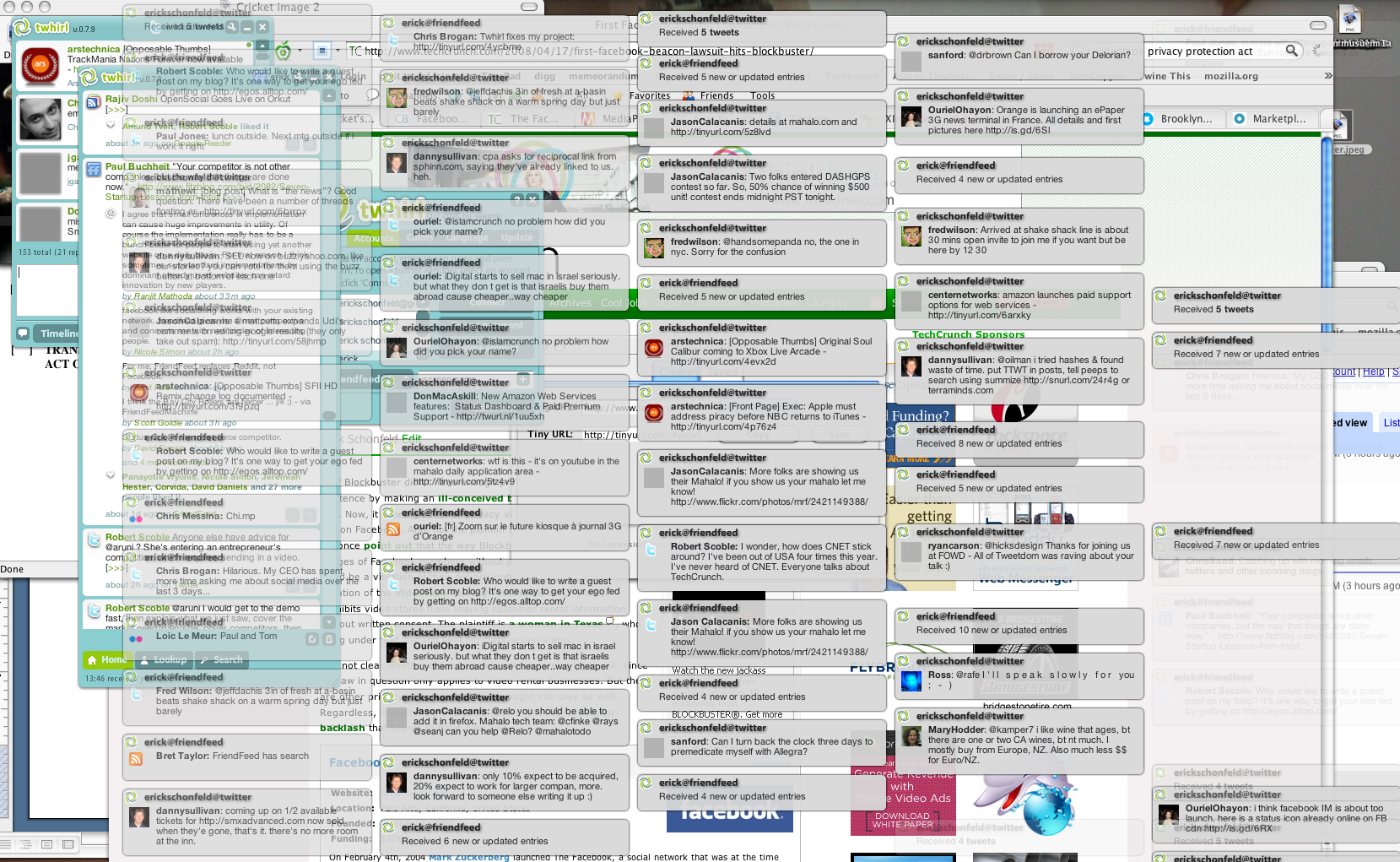
It’s my own damn fault. I should have never listened to Mike. This morning I installed Twhirl on my desktop in a failed attempt to keep up better with Twitter and Friendfeed. I was hoping it would help me manage the never-ending flow of information from those two services—which, I admit, I’ve been increasingly ignoring. Instead, it took over my desktop and I couldn’t make it stop (see image above).

Twhirl solves one problem (the need to constantly visit the Twitter and Friendfeed Websites), only to create another one (information overload that clutters your desktop). I’m sure there is some setting I could change to fix the issue, but this highlights a bigger problem with the Web today. There is too much to pay attention to and not enough ways to reduce the noise. Even Robert Scoble, the biggest Twitter whore on the planet who follows 21,000 people and receives one Tweet per second, can’t deal with it anymore.

And it is not just Twitter. Lifestream aggregators like Friendfeed are supposed to make things simpler by consolidating the activities of everyone you know across the Web into one single view. But every day a new lifestream aggregator pops up to the point that it’s gotten to be ridiculous. Now, desktop utilities like Twhirl and Alerty Thing are taking these services out of the browser so that they are always on your desktop.

But if you think it is hard enough to keep up with e-mails and instant messages, keeping up with the Web (even your little slice of it) is much worse. Putting Twhirl on your desktop and hearing the constant “ding” of new messages coming in will make you realize that this is IM on steroids. (You will quickly turned off the sound).

Bringing all of this Web messaging and activity together in one place doesn’t really help. It reminds me of a comment ThisNext CEO Gordon Gould made to me earlier this week when he predicted that Web 3.0 will be about reducing the noise. (Some say it will be about the semantic Web, but those two ideas are not mutually exclusive). I hope Gould is right, because what we really need are better filters.

I need less data, not more data. I need to know what is important, and I don’t have time to sift through thousands of Tweets and Friendfeed messages and blog posts and emails and IMs a day to find the five things that I really need to know. People like Mike and Robert can do that, but they are weird, and even they have their limits.

So where is the startup that is going to be my information filter? I am aware of a few companies working on this problem, but I have yet to see one that has solved it in a compelling way. Can someone please do this for me? Please? I need help. We all do.

  • Sphere It

Trackbacks/Pings (Trackback URL)

  1. » Twhirl overload?
  2. Here Not There » Your Brand, Your Self: Web Identity Coming Of Age? | A journal about the web, design and the business of creativity
  3. Stop Twitter Spam » Scoble says 20,000 followers is enough
  4. TechCrunch Japanese アーカイブ » Web3.0はノイズを減らすもの - Twhirlじゃあだめなんだ
  5. Are better applications the solution to the information firehose?
  6. Anonymous
  7. La Web 3.0 será sobre cómo reducir el ruido » eConectados
  8. Scoble the Twittering Machine « I’m Not Actually a Geek
  9. Marc’s Voice » Blog Archive » Keeping up with the BlogJones..... mid-April '08
  10. Link of The Day « Mr Hulk’s Blog
  11. Technarium » Blog Archive » Twitter: Can’t stop the signal (or the noise)
  12. Web 3.0 - Making Web 2.0 More Efficient | RyanSpoon.com
  13. My use for Twitter, and my not use | AaronSpencer.com
  14. The noise in Web 2.0 is mainly a Tech Elite’s problem « Alexander van Elsas’s Weblog on new media & technologies and their effect on social behavior
  15. Social Media Overload: Be Smart About It! « I’m Not Actually a Geek
  16. duncanriley.com » Note to Erick, This is how you deal with overload
  17. Links for Thursday, 17 April 2008 « David’s Blog - What Did You Think?
  18. Feedonomics » Blog Archive » Scoble is not the target user
  19. Um, you just created your own problem
  20. » IDEA #83 - Digg for Twitter! - By Steve Poland - Ideas for Making Money Online
  21. The Product Guy’s Weekend Reading (April 18, 2008) « The Product Guy
  22. Join The Web Content Conservation Movement - Publishing 2.0
  23. PownceCast 3: Under the Weather | PownceCast
  24. Lifestreaming Services Need Better Filtering Mechanisms | Lifestream Blog
  25. The Lifestream Filter Will be the Next Great Algorithm War
  26. oddflower.org » Blog Archive » Back to the future
  27. Information glut: It’s gonna get worse before it gets better « Meaningful Data
  28. rascunho » Blog Archive » links for 2008-04-21
  29. InternetActu.net
  30. Real-Time-Stress « Mjays Planet
  31. geekydoc » Blog Archive » Web 2.0 Noise
  32. Ressources2doc » “Pour une écologie informationnelle”
  33. Pour une écologie informationnelle : keywordbar
  34. iKnowlej » Blog Archive » Network Centric Contents, more organized world
  35. Topify!

Comments

RSS feed for comments on this post.

  1. Darren

    Twitter whore… That’s awesome.

    -Twitter twat.

  2. Zaid

    “Web 3.0 Will Be About Reducing the Noise”

    Word!

  3. Jens

    I agree. What we need is much higher quality information, not more of it. This doesn’t mean that one couldn’t scan 1,000s of information sources, but I just want to see the top ‘blips’ that really matter to me.

  4. Search - Harry Wang

    I can see those who blog to make a paycheck but information overload is something that can be cured rather easily. Staying up on top of everything is akin to Aspies need to know everything about Star Wars, or trains, or dinosaurs…it just doesn’t fucking matter. Just use a mantra…

    Harry “I just don’t give a shit” Wang

  5. Jesus H Christ

    Web 2.0 = web acting like desktop apps
    Web 3.0 = sites fully integrating with each other and sharing information (APIs)

  6. Alaska Miller

    Except most folks don’t have nor will ever have the same problems. Most folks don’t get 2400+ unsolicited emails. Most folks don’t have 10,000+ twitter BFFs. Most folks don’t need a website to let them know what their friends are up to.

  7. Jerry

    Hmm I was just writing about Twitter and was about to do a section on twhirl…now I’m scared..

    Sorry if I sound naive having not installed yet (ever?) So can you not block tweets then?

  8. Steve

    I don’t see the need for stand alone twitter apps… why not just add twitter to your google talk and then it just is all in one IM window..

  9. GeekMommy

    Honestly - http://crowdstatus.com/ is helping me to manage my Twitterfeed… Grouping actually helps.

    I know that’s probably too much work for most folks - but sometimes I only have the time to check a handful of twitterstreams I really want updates on - and it’s easier than typing in the urls.

  10. Ivo Quartiroli

    A spiritual teacher, Almaas, said “There is nothing you can ultimately say, but you have to exhaust all the words.” Hope Web 4.0 will be about silence and meditation.

  11. Raskin

    I’m working on it…

  12. Ryan

    So is web 4.0 when the Internet pervades into our home appliances? Like the toilet, kitchen cabinets, the microwave, the fridge, etc…

  13. Mark

    Absolutely. Spot On.

    I’ll bow out of the debate about what is 2.0 vs. 3.0, but we have to remember that readers of this site are in the minority with our desire to process large quantities of information, but in the majority with being inundated with more and more content every day.

    The sites that curate content and reduce noise will win.

  14. bhc3

    I don’t even try rto stay on top of the constant flow of FriendFeed and Twitter. I check in form time-to-time in my work day and at home. So there’s a bit of serendipity as to what I learn there.

    There are certain people I specifically check on for their FriendFeed updates.

    I also subscribe to specific search terms on FriendFeed in my Google Reader. That’s a really interesting play - find people who have expertise and interests in things you’re in to.

    Those are my filtering strategies.

  15. JJ

    The model for filtering information is already out there, and it’s dead simple.

    It’s vertically oriented content aggregators/social news sites.

    Digg screwed the pooch by trying to be all things to all people. Techmeme is pretty effective for Technology news, and similar sites will emerge (hint, hint).

    Name one social news site that isn’t growing? Trick question….they are all growing.

  16. * Miss Universe

    There won’t be a Web 3.0

    Tech Advances are so continuous that they would occur in chunks as in the past

    Future measurements will probably be divided by year as opposed to assigning a number - things are just occurring too fast.

    The Web is a classic example of the Wisdom of the Crowds and probably the real first example ever in history because the common person as well as the experts can contribute what they can and let the creme rise to the top naturally

  17. Holy Cow!

    OMG!

    That screenshot is like what Dante would have written into a lower circle of Hell for Geeks.

  18. Tim

    Seems like you mostly need to shut off Growl notifications for Twhirl.

  19. Siddharth

    Browser based demons are more easy to handle then making them land on the desktop. Twitter craze is everywhere and the Egyptian case too. I can only say that in this time we can only Tweek!!

    I still trust RSS to gather info on new.

  20. Tim

    Forgot Twhirl is an AIR app… Seems like you just need to change notification settings.

  21. Brad Blogging.com - Making Your Blog Better Through Personal Experience

    I’m not sure that Web 3.0 is here.. Yet.

    Don’t forget, Web 2.0 was only introduced a while ago and is still influencing many website designs..

    We will just have to WAIT AND SEE :D

  22. Sebastian

    Besides the people that use Twitter as a promotion vehicle (like TechCrunch-employees or Scoble), nobody actually has more than 10 to 15 friends, which make Twitter a VERY consumable thing.
    The same goes for FriendFeed.

    Just because you’re using Twitter *wrong* (or better: unnatural) doesn’t mean that a whole “Web 3.0″ will be needed to fix it.
    You’re using it not the way it is thought to be used, but it’s part of your job, so stop complaining.

  23. weckman

    Where the heck did You guys get twhirl v.0.7.9 from (as seen in the screenshot)? According to their website such a version does not even exist yet! Very odd…

    Oh, and isn’t trying to follow more people than one can comprehend even counterproductive to begin with? Until there actually is some sort of hyper-interpreting super AI that knows what I want to hear and read even better than me (plus how much random fun stuff I can bear depending on my stress level etc.) I’d say it is advisable to limit the amount of data that gets to You in the first place, no matter how much You desire to hear the world (as in every single person in it). DOES NOT COMPUTE! :-)

  24. klub

    I fail to see the point of knowing what everyone is doing all the time anyways. Get a life.

  25. blackfeathers

    what i sort of imagine is a fully customisable pseudo-bayesian filtering for lack of a better description. take what research has been progressing in the world of spam filters and other applications and apply them to configuring a tailored & customised user experience.

    part of the challenges are:
    1. automation: r&d towards more programmatic intuition algorithms to appease any regular manual intervention (more adaptably automated given the circumstances) and
    2. manual input: a highly effective user customisation with consistency tailored close as one can get technologically to their desired output(s).

    it may require a certain level of psychological profiling in a trusted computer base in order to have the algorithm understand what the user wants and filter the results accordingly -inclusive of mood and other factors.

    it must be acceptably practical and simple enough for most users to understand. most of this is probably best implemented in a framework structure that is adaptable to the user’s interests/needs.

    we’ve come from data processing in the early age now towards information distillation, where security and r&d are essentially important and continuing themes.

  26. ClintJCL

    Dear Erick:

    Are you stupid?

    It’s called RSS.

    This post is a problem looking for a solution — one that was invented YEARS AGO.

    Get with the times. TechCrunch is where I first heard of RSS. Maybe you should read your own magazine. :)

  27. Joe T

    Web 3.0 will be about real-time, language 2 language IMing!

  28. Lemon

    New data everyday, social networking brings new personal data everyday.
    Information Architecture concepts can help set a baseline (group, catalog and then label).
    If the data continues growing this way, the web will auto-destruct, this seems already started.

  29. EyalRofe

    sound’s like you need to follow less friends.

  30. John C McClore

    Web 3.0 will be about people realizing they don’t need to know what every person in the world is doing at any given moment.

  31. YDrive

    Web 3.0 won’t do it.. web 4.0 mightbe, when artificial intelligence comes into play.

    Web 3.0 would be the true start of datacosm… and web 4.0, valuecosm.. in between, there’s only youcosm, and mecosm, which are real, plus this mycosm, which is virtual… :P

  32. Lee

    Amen.

  33. Mark Krynsky

    As much as I love Lifestreaming, I agree that there needs to be a better way to filter the firehose of data we are now subjecting ourselves to. Several services have become successful at doing this with RSS. Lifestreaming needs to be next.

  34. Nick Vidal

    ISS (Instant Syndicating Standards) is a set of open standards that helps people to get news and information that matters to them the most by letting people themselves express what matters to them at an individual level. Each individual connects with their own personal social network to receive and disseminate information. The cascading of trustful social networks works as a world wide distributed recommender system perfectly tuned to output a very personalized journal. This trustful network filters out irrelevant information, while still letting good information pass through.

  35. Charlie Park

    I fully agree that there’s too much to track at any given time. You might want to check out Mark Hurst’s book Bit Literacy.

    From the site: “There’s finally a solution for information overload. Bit Literacy, the new book by Mark Hurst, describes how to manage e-mail, todos, photos, a media diet, and other sources of stress for people today.”

    “Bit Literacy is written for normal, non-techie users, and it doesn’t require any special software or computer skills. Read the book and you’ll start working more productively, so as to live a fuller life outside of work.”

  36. Sean

    I agree with this post for the most part, but I think the real problem is that people are just trying to keep up with too many sites/people at once.

    I just started using twitter recently and am only following 4 people, techcrunch being one of them because i actually give a shit what Michael has to say, and he doesn’t post a billion messages per day like Scoble or Calacanis. I originally added both of them to my feed as well but they both just post a bunch of bullshit that doesn’t matter. Calacanis sometimes posted interesting things but for the most part he won’t shut up about Mahalo Idol and giving away stupid GPS receivers, so I cut him off.

    The fact that Scoble is following 20,000 people is just ludicrous. Why would anyone do that? There’s no possible way to get anything meaningful out of that much blabbing.

    So the solution is just not to subscribe to so much stuff. Most people just say the same shit that other people have already said. So just subscribe to the people and sites that really matter. Everything you need/want to know will eventually be said by one of them.

  37. kevin gao

    i completely agree, erick. you can almost imagine a sort of behavioral profiler for users which figures out based on your activity, personality, etc the things that you need to know the most and automatically recommends services and then filters information within those services that are deemed most relevant. once the dataset is large enough, you can build smart algorithms that get good at this sorta recommendation filtering.

  38. Darren

    Isn’t this where attention data processing comes in?

  39. Daniel Johnson, Jr.

    It’s really your own fault, you see. If you follow many people, you will get lots of updates. If that becomes unmanageable, then prune, baby, prune.

    A lot depends on what your goals are with social media. You either pursue a desire to “get out of the fishbowl” or keeping your content only in specific channels. You can’t have it both ways.

    My $0.02.

    Make it a great day!

  40. Daniel Johnson, Jr.

    Here’s a Yahoo! Pipe to help with the Social Media Firehose: http://pipes.yahoo.com/update_....._fire_hose

  41. Gil

    Even Mike can’t handle this, he asked in the past for application similar to what you need for all his emails.

  42. Chad

    Here’s a nifty idea… Unsubscribe to the feeds or twitter posts you don’t want to read.

    The web has grown into what it is today because we all asked for more information in more portable formats. You signed up for all that info, and praised the web for being able to give it to you.

    Now, you want the web to anticipate what you really want to read, and weed out what you don’t?

    Not only is that extremely ironic, but it’s the epitome of laziness.

  43. Josh Crandall

    Will you add your screenshot to our Flickr group - Project Netpop?

    Images of the digital age and how it is changing our lives.

  44. 113.com

    :lol:

  45. Danny

    @29

    Amen.

  46. Jeff O'Hara

    I long for the day where we can reduce the noise. Get better data, not more data.

    -Jeff
    http://edmodo.com

  47. tommyl

    Twirl can filter stuff easily. There’s an icon right above the update box. It’s supposed to be a filter, but it looks more like an inverted plunger to me. Type in what or who you want to read, and it pares away all the other tweets.

    Better yet, don’t follow anybody and just use the Search function that connects with Tweetscan - it’s in the drop down menu below the update box. Just look at the stuff you’re interested in, and ignore the rest.

    And check the preferences box for showing summaries for more than 3 tweets.

  48. Eric Atkins

    Uh. You asked for it.

    I hate to break it to you, but you’ve got MySpace Syndrome.

    You’ve turned your Twitter account into a mobile whore of a MySpace. Way to go!

    Why don’t YOU defriend more people on Twitter?

    Or, why don’t you make a Yahoo! Pipe to split your Twitter feed into feeds of different priority.

    A person with 5 friends on Twitter can share more information and be more productive than a person with dozens, hundreds, or in the case of Mr. Scoble, thousands of friends on Twitter.

    If you want to use Twitter to do productive things, then you need to restrain how you use Twitter.

    Better yet. Why not ditch Twitter and stick to Facebook. It’s more powerful than Twitter. You can have thousands of friends and still only get to the information that you want. Mobile updates? Reply streams? Grouping of contacts into lists? Configurable updates? Oh. And you can seemless update your Twitter feed from Facebook with Twitterfeed. Facebook has a lot of features that people want in Twitter.

  49. Jake

    I can understand the position that it may be information overload, and that you only want to see the information that’s important to you. But this can be brought down to a simple case of ‘control’. Many who badmouthed Facebook for being no better than MySpace with it’s application spam - it’s a simple case of regulation. You can forever block applications on a Facebook for example, so you never get bothered again. Many who despair and have left these networks probably never understood the control they actually had over this information. My first attempts of controlling this onslaught of Bacn was to create rules & filters - namely through my Gmail. It would be great if you could get what you want, when you want - but nothing in life is for free. I’ve probably spent more time getting my preferences set than actually reading them - but this is a long term investment that will pay off (a bit like buying double-glazing!)

    Projects like Yahoo’s PIPES (http://pipes.yahoo.com/pipes/) looks set to be a really interesting news outlet for many different sources of information. The ability to filter RSS etc. for key topics I’m interested in means I can scour the net for only the most relevant information to me - with only a few rules needed to be made. The best part is the ability to share your own setup with other people, something I’ve been wanting for a while (though mine involved general browser/plugin etc setups!).

    Web 1.0 saw us connecting to everyone in a largely unregulated & unstructured mess. Web 2.0 seems like it’s worked at creating the means to connect to each other, and make that connection meaningful in someway. Web 3.0 will probably see the recombining of Web 1 & 2 - taking users away from the recently developed, socially incestuous ‘friends only’ exchanges and putting us back in touch with everyone in the world - but this time in a structured and meaningful way.

    Btw, anyone else look at the Borg in Star Trek and think - jesus, THAT’LL BE US!

  50. anon

    The startup is called “not using these stupid services.”

  51. Luca

    Now that we know the productivity increases from 2-monitor configurations, we have to switch to 3 monitors:
    - one for email
    - one for the browser
    - one for twhirl

  52. Raph T.

    I really don’t see the point of tracking what everyone you happened to add to your [insert favorite social app] contacts does or says all day long.
    This just has nothing to do with “important” information.
    “Important” information is what profoundly alterates your thinking, and your real friends know when to send you an email with that kind of thing, right ?
    As for what I would call “real content” - namely, blog posts and other written news content - there is indeed RSS… even though probably there’s still too much noise in that area too.

  53. whoopie

    you point a firehose into your mouth and then complain about the volume of water? solution seems simple…

  54. Uway

    I don’t think When These Companies Made These Apps Had Your Type Of Numbers That Techcrunch can get in just a matter of days. Nobody Else on the network besides the developers that would have that many friends. I have a difficult time getting request i have to follow everybody.

  55. Chris P.

    The first thing that occurs to me is that this sounds like a self-made problem. Why not try self-filtering, or more accurately, self-regulating? If you know you only need 5 pieces of information in a day, and you’re following 20,000 people on Twitter, then (and I quote) “UR DOIN IT RONG.”

    Why not just follow the Twitter public timeline at that point?

  56. pflodo

    “It’s my own damn fault. I should have never listened to Mike.” - and one by one the people came to their senses.

  57. YouYap.com

    i dont get this web 3.0 site. Any example web 3.0 website out there?

  58. Decana27

    For social networks such as Twitter I believe the user should be given the opportunity to rate the level of importance for their message. If they choose a low rating say 2 out of 5 then it wouldn’t alert you. However, if the person chooses 5 out of 5 then it would definetly let everyone know ASAP.

  59. A

    who really cares about who added who and when did your mate farted in the “blogosphere”, it is all spam, life is becoming one huge spam machine, and the rest are the suckers who just delight on that spam until it chokes you (or you get diarrhea, which ever comes first)…

  60. Ray

    Did anyone else picture Scoble in a pretty blue dress with bright red lipschtick on when the phrase “Twitter whore” was mentioned? Hrmm maybe it’s just me…

  61. Krish

    Eric, I won’t say I need less data. I definitely need more data but I also need the complete granular level power to get the data in the way I want. I should be able to adjust the level to meet my needs. If this can be done (here, Semantic Web or Web 3.0 (as some people like to call) will help), I can reduce the so called information overload. I will be able to handle more data than today without getting overloaded.

  62. Paul Vallee

    Hi Erick,
    I met with some people working on AideRSS and this is exactly the problem they are working on. They do a remarkable job on my blog of separating the wheat from the chaff. Try it out, it’s at AideRSS.com.
    Paul

  63. Trench

    Twitter isn’t Web 3.0.

    It’s IRC 2.0. (Minus the filesharing.)

  64. Anders Abrahamsson

    Dunbar rule applies. Follow the 150 or so most important people to you. It’s not how many follow you, it is the one’s you follow that matters. Everyone’s a filter, right?

    And next thing, Web 3.0 could be about reducing noise, but continuum thinking making me think that we don’t see things developing in distinct jumps and chunks. Still, steps of significances occur, and my guess is when the semantic web empowers/generates collective and collaborative wisdom, filtering what’s relevant becomes a result of the semantic web crunching it out for you.

    But for a starter, de-follow, sign off, clear up. And get a life!

    http://andersabrahamsson.vox.c.....acter.html

  65. ventureblogalist

    mspoke is working on filtering

  66. keep it simple

    Eric,

    Simple, get rid of such garbage.

    Loic Le Meur is simply keeping Twhirl / Seesmic in the news for self promotions.

  67. John Evans (Syntagma)

    At last someone agrees with me.

    Humans are not built to deal with the whole world.

  68. fLUx

    There won’t be a Web 3.0, it doesn’t exisit, Web 2.0 explained something, Web 3.0 doesn’t.

    Some could argue we are already in Web 3.0, or at least 2.9, but at that point your getting stupid.

    Web 1.0 was, well, you know, GIFs and tables. Web 2.0 was creating a great UI with user generated content. Web 3.0 will be some 3D environment where SecondLife style simulation doesn’t make you feel like a retard, in the year 2050 or something.

  69. Shafqat

    We’re building NewsCred to do just that. Shameless plug I know, but most regular web users (I use that term liberally) can’t keep up with the twitters, friendfeeds or even diggs of the world. They just need the important news in a simple format. Thats why Yahoo News and Google News work - in the tech echo chamber, we sometimes forget that.

  70. Phillip Rhodes

    Web 2.0 == “never existed and never will”

    Web 3.0 == “never existed and never will”

    Web 4.0 == “never existed and never will”

    Web 5.0… you get the picture.

    Please quit with the “web x.0″ crap already.Talk about adding more crap data to the conversation…

  71. x.0rss.com

    Will do.

  72. jonathan

    I don’t know if it should be called web 3.0.. but noise is a huge issue. Jaanix uses an algorithm to filter based on your likes / dislikes. It learns as you use it and has some nice manual overrides..

  73. Bruce Lewis

    I botched the trackback, but here’s an account of how OurDoings is contributing to the Web 3.0 revolution:

    http://ourdoings.com/2008-04-17

  74. alan p

    Heck, we’ve been arguing for filtering, not aggregation, for yonks - recent posts:

    Part I

    http://broadstuff.com/archives.....er,-dammit!.html

    Part II

    http://broadstuff.com/archives.....rt-II.html

  75. Edward Vielmetti

    I handle web overflow in part by having lunch with people regularly, and talking to them about what they are doing and what they see on the net.

    This deals with the problem of overflow in many ways, not the least of which is that if you only have a few minutes to talk to someone in person, they often focus on important or relevant things and not on the 24×7 spew of the net.

    see e.g. http://vielmetti.typepad.com/v.....ummar.html for a (non-summary) of events.

  76. Phillip Rhodes

    All joking aside, dealing with the “noise” is an interesting issue. The obvious naive answer is “quit listening to so many sources, nobody can parse through *all* the data that’s out there.” But that does lead into our fear of missing something useful… so if we accept that we can’t reasonably digest all of the information that’s available, what choice do we have but to let somebody (ai algorithms, collaborative filtering, both, something else, whatever) listen for us and narrow the stream down to the stuff that matters.

    I’ll be interesting to see what approaches to this come out. :-)

  77. John C. McClore

    First of all, why the hell are you using Apple Computer?

  78. Confused

    It was a beautiful day on the East Coast today…did you catch it?

    It will be gorgeous and sunny tomorrow…will you miss it?

    Try turning it off…and spending a little time with Web 0.0 :-)

    If you have problems doing this…try one of the great 12 step programs that have been working well for almost 50 years :-)

  79. Phil Bradley

    Silly thought - but why not just follow fewer people? If you’re following too many then you’re not following any.

  80. Frank Cioffi

    Perhaps organizing the noise is one answer. One news-based example:

    http://www.googleinvestornews.com

  81. Scott Rafer

    No one commenting here, including me, would know what “Web3″ was if it jumped up and bit us in the keester. It’ll be started outside the normal crowd and be over a year old before any of us notice an underlying trend — just like Web2.

  82. Ross Hill

    Perhaps follow less people instead of trying to follow the world??

  83. nellabara

    reduce noise=reduce net freedom

  84. Jacob Marley

    Check out Jaanix.com

  85. Jono

    The problem is not the apps, but the people using them. People are using these platforms to post crap, do crap and follow crap.

    Who cares if jimmy is feeling happy, or Jane is sad. No I do not want to be poked or poke my friends back on face book. No I do not need to follow the actions of 1,000 people as I am not that much of a control freak that I need to know everything that is going on around me even when it does not involve me.

    I find my web experience very manageable by using it for practical purposes only.

  86. Lisa Brewster

    Screw you hippy assholes who think following fewer people is the answer. What happened to your sense of ingenuity, your creativity? People like Erik start following people because they obviously at some point had something valuable to say, and I bet a dollar he’s exposed to more valuable people in a day than the rest of you guys are in a year.

    The problem is that twitter introduced a brand new paradigm, but nobody’s analyzed how we use it enough to re-optimize how we communicate. We can’t apply the same concepts from email, or RSS, or IM. All the people saying “just use RSS, idioth” seem to be forgetting that Twitter is omni-directional, time sensitive, and mobile.

    #48, I completely agree. That’s what happens when you have a popular service that people can use for anything they want without controls. The problem isn’t how people are using Twitter, it’s that too much power to interrupt my attention lies outside of my influence. Users will revolt like disco if Twitter (or somebody else) doesn’t come solve this problem.

    Now if I’ve got YOUR attention, you might want to check out the specific specific problems I identified before I actually read all the comments here. Kthx.

  87. Joshua Konkle

    Yes, you are correct, I thought Twhirl would help, but they picked the wrong combination of words…

    I’m working on all this right now…it’s called, you’ll love this….

    Feeddy, it’s a combination of feed and eddy.

    It takes all known Feeds, then uses the security and search algorithms developed by the greatest minds to identify the threads that result in money. Using the fluid dynamic theory of eddy, the feeds that flow by are inspected and anything with cash in them will emerge and be held in Feeddy.

    Then It converges them all into my PayPal account and distributes money to the patent holders and to my bank account. I expect to sell it to eBay or IBM, since PayPal makes money and IBM is a large patent holder.

    I’m incorporating in Bermuda and look forward to cashing in on all the pennies I can make from the feed vortex.

    LOL

    JK

  88. Erick Schonfeld

    I actually don’t follow that many people. 131 on Twitter. Maybe I should prune, but that assumes I know which ones will have the most interesting things to say. You can turn off the world and ignore it. that is one answer. But I think there is a better way. Something that separates the signal from teh noise and says, “Here are the 5 Tweets you need to pay attention to today.”

    Those Tweets could come from any one of those 131 people. That’s the point. Same with a great link on Friendfeed, or comment to a blog post that is more insightful than the original post. It is a hard problem to solve.

  89. Jono

    What if users categorized their tweets and you could select which categories you wished to monitor as opposed to the whole lot.

    Then within the categories, you could further refine (e.g. only show me “where am I” tweets when the person is within 20km of my presently known location).

    Forgive me if the above is already being done or just does not work as I am not a twitter user myself and am unfamiliar with the service.

  90. Jono

    ^^^
    Many could probably be auto categorized as well, either at twitters end, or by a 3rd party service.

  91. chris ramey

    tired of all the bitching about noise. no one’s holding a gun to your head.

    sent from: fav.or.it [FID295277]

  92. GW

    I think the real solution and best way (for most people) is just to “follow” the few people who you really find import to follow. i.e. Those people who tweet information that has a high value component for what is important to you.

    I think R. Scoble (and I am sure others who literally have 1000’s of followers) needs to take a look at what he (they) is doing, and say, do people really want to read most of this unimportant blabber (sure he and others have some valuable things to tweet). Twitter should not be used (in my opinion) as a method to blah blah spam rems of unimportant information. Start setting a better example Scoble (the rest of you who think have mega followers is an important attribute) , for those who want to benefit using Twitter. NOt as a tool to create useless information overload.

  93. Julian

    [quote]I need less data, not more data[/quote]

    I think the key is about prioritisation and classification of data, rather than volume, so that only the important stuff reaches you. A mountain of data can get to a point where it is meaningless - sifting out the information is key.

    http://www.tiiny.com

  94. Zach Weisman

    Using Twitter to keep track of random bullshit that your friends are doing is DIFFERENT than using it to keep track of TOPICAL COMMENTARY on news/blogs or whatever.

    If people could catergorize their tweets or if some code could filter the BS into another feed then much of the problem could be fixed. You could peep your friends BS when you have time. You could track their commentary the rest of