Do not panic. We accept late submissions for TechCrunch50, but please submit soon. »
FriendFeed, The Centralized Me, and Data Portability
by Michael Arrington on March 30, 2008

It’s definitely FriendFeed month in Silicon Valley. The company, founded by ex-Googlers, let you aggregate information and activity streams from all of the various services that you use on the internet - Flickr photos, YouTube videos, blog posts, delicious bookmarks, Twitter messages, and other stuff (33 services total to date). Your friends subscribe to your stuff, and see a stream of data on their home page coming from everyone they follow.

The site also allows users to add content directly, comment on information and, more recently, added an excellent search feature that is still sorely lacking in Twitter. The site is more than a list of feeds that can be re-exported. FriendFeed wants to be a destination site, too.

And their growth is very strong, given that the service only launched publicly a month ago. The number of users was growing 25% per week earlier this month.

Last week the site announced the availability of an API, which allows third party services to easily add in FriendFeed data and features. The first batch of these applications are starting to be released now.

The Centralized Me

But there’s something just a little weird about FriendFeed, some people are starting to mumble. It’s an aggregated “me” but it sits in a centralized site (in fact, centralization is kind of the point). FriendFeed is a (and hopes to become “the”) Centralized Me. It’s a data silo. True, it’s a friendly data silo, with APIs and RSS feeds to move some of the data around, but it’s ultimately housed on their servers, and always will be.

Loic Le Meur sort of summed it all up tonight in a blog post where he says that we grew used to having a Centralized Me in the days before all these services popped up, starting in 2004 and spreading since then. That Centralized Me was the blog. Then we grew used to having a Decentralized Me - your stuff was literally everywhere. Go here for photos, here for the blog, here for videos, and here for bookmarks. Robert Scoble today is sort of the quintessential Decentralized Me - his stuff is everywhere, and he seems to love the chaos.

What Loic wants, and I think other people will want it too, is a place that they control where this information is aggregated. That may be right back at the blog for some people. For others it may be Facebook (who understands this fully). Wherever a person considers their home turf is where they’ll want all this data.

FriendFeed can become that place, but it’s an uphill climb. So many other services have already become the psychological home of their users. Changing that is like swimming upstream.


Is Data Portability The Anti-FriendFeed?

The Data Portability Project may turn out to be the answer that people are looking for. And it may turn out to be a sort of anti-FeedFriend. The whole point of Data Portability is to get social networks talking to each other and exchanging user data, with their explicit permission. Want to add your flickr photos, twitter messages and YouTube Videos to your blog? Data Portability is working to help make that happen through consensus driven policies and procedures. In essence, data portability embraces the Decentralized Me, but lets users re-centralize it wherever they please.

Frankly, not enough people know much about DataPortability yet. That will start to change, as founder Chris Saad is starting a road show presentation to talk at a high level about what he’s trying to accomplish. Some big partners are joining, even if just in spirit so far.

Ultimately, Data Portability is to the Centralized Me (all your stuff) as OpenID is to identity (your literal identity). And just as the big players are sort of supporting/exploiting OpenId to maintain their user accounts, they will also support/exploit Data Portability to remain the place users consider the Centralized Me.

Serious politics and power plays are coming. What I’m wondering is if FriendFeed can get big enough fast enough, and get enough users to think of it as their Centralized Me, to be in the game.

Responses

Comments rss icon

  • Yes. FriendFeed is really remarkable and has already earned its place as my home page of choice, beating out TechMeme.

    I’ll be interviewing them on Monday at 11 a.m., want me to ask anything?

  • Cool service. Centralized Me indeed.

  • I prefer friendfeed over socialthing [well basically I do not use the latter because I do not want to give out my passwords], and others may even prefer a third option. I also don’t mind decentralizing me - but I do mind that I have a hard time following / keeping up.

    It weakens the experience and makes for a more throw away conversation which is sad, because the only link missing is to make it centralized for me again in the fashion I would like to see it. Open standards to work with it could help to allow me to choose the tools I like while still allowing everybody else to have their choice too.

    Maybe I will live to see that day …

  • I think I’m on the side of those who want to be able to control their ‘centralised me’. It would be nice to have this back at my blog - I’d like to be the one to choose where the ‘centre’ really is. And I think DataPortability might be the standard which lets me do this.

    That said, I think a FriendFeed-like service with better filtering might be enough to tide me over in the meantime. FriendFeed as it stands is just too noisy.

  • Robert, did you read past the first paragraph?

  • “I think other people will want it too, is a place that they control where this information is aggregated. That may be right back at the blog for some people.”

    We can only hope!

  • this post is just an over analysis of a service that is just launched. There is one thing bad about FF, that is, it does not allow fined grained control over importing data from other services like delicious. It imports all the old bookmarks for example instead of what I would want to control (specific tags) . Same with twitter imports. It records all the junk that your friend is posting. Give me more control over information I’d like to see.

  • anyone noticed that when you go to digg.com insted of regular digg favicon the Google’s G appears as a favicon? april fools or whats going on?
    Did Google buy Digg?

  • Mike, yes I did. You know I’m very interested in data portability. I think that if we really do get any data portability that it will HELP services like FriendFeed and SocialThing, not hurt them.

    But I’m cynical about getting much movement on the data portability front. There’s too much disagreement among people about what that really means. Look at how many people thought I shouldn’t be able to take an email out of Facebook and put it into Outlook, even after that person friended me and gave me access to their email address.

    But, while I’m cynical, I am hopeful. Hope Chris’s efforts pay off for all of us.

    Regarding FriendFeed, I was trying to tell you that it’s won me over already. Will it win over everyone else? I think so, unless something better comes along.

    Already I’ve seen a competitor coming soon that does filtering, which is mondo cool. But they need to get their service up and running and keep it up. That’s not easy.

  • You should take a look at noserub, http://www.noserub.com/

  • too much junk.. need a better one… :-o

  • Centralization needs decentralization & decentralization needs centralization.

    “In the beginning God created the heavens and the earth.”

    In other words, both are needed.

    :-D

  • I prefer a local solution over yet another webservice. I use the iMacros *Firefox add-on* to automate the login (and navigation in) all the 4-5 services that I use daily (facebook, flickr, online banking(!), etc…) . While this generates no “stream” it certainly works well for me and many of my friends.

    And it seems that iMacros is at least as popular as Friendfeed:

    http://siteanalytics.compete.c.....?metric=uv

    https://addons.mozilla.org/en-US/firefox/addon/3863

  • Can FriendFeed become the centralized me while it sits on a site I don’t control? Can it become the centralised me without bringing together the other aspects of my identity (including OpenID)? I don’t think so; we would just be getting a more efficient way of not solving a problem.

    I want my friendfeed and my identity sitting on a site that I control, that is the centralised me whether I choose Friendfeed as a provider of services or want to switch to social thing or Chi.mp. I don’t just want pretty apis, I want to be able to completely move everything away from Friendfeed if I find out they are powered by the blood of baby seals. If people say all this is impossible, I say wait a while this is all far far closer than you think.

    Own. Don’t be owned.

  • Well some people want to build their house, some people just want to rent an apartment, some people want to live in hotels, some people prefer mobile vans, etc etc.

    Another analogy being, how people put their money/monies into the where/s…

    Not too many people want to build their own bank/s, whether they can or cannot…

    Data banks aren’t much different…

  • The best thing about friendfeed is their rapid speed of innovation and accepting user feedback instanteneously, which will make them the next google/facebook/twitter. But they should now start earning some money from it. Otherwise they are just making the service to be auired soon by one of the bigggies.

  • FriendFeed is just a people-focused feed reader (i.e. Bloglines/Google Reader). The value that they add is that they focus the act of subscription to the person level (rather than the feed level). I can do everything that FriendFeed does with Bloglines, it just takes a lot longer.

    Many services in the past have offered feed splicing features that allowed publishers to create meta-feeds from other feeds. Examples are FeedBurner, Blodigger Groups and Yahoo Pipes.

    Centralized applications are more efficient; decentralized applications offer the participants more control, but have a more difficult time growing. RSS, king of the decentralized solutions, didn’t take off until there were centralized services like Bloglines and My Yahoo that supported them.

    As a business, FriendFeed, as it stands now, does not have anything that a few decent programmers couldn’t duplicate in a short time. Small features like filtering will also be easily copied by competitors. Their advantage is that they have great buzz. If they can add some real intelligence to each user’s FriendFeed (along the lines of how Facebook has to the news feed, or how Techmeme does to the blogosphere), then they may have something. But there have been many services so far that have aimed at providing personalized recommendations from user-selected content sources, and none so far, other than Facebook, have had much traction (examples include Findory, TailRank and several of the Techmeme clones).

  • @my great self

    some may indeed want an apartment, but it would be nice if every time I moved belongings into it they didn’t become property of the landlord

  • @Tony, agree, but if such landlord continues to do that, nobody will rent from them.. :-o

  • I love Friendfeed as a lifestream but it won’t be my homepage until it imports my other contacts, allows me to customize and publish my interface.

  • I’m not sure if this will help solve the problem, but I think it is relevant. I found this site called http://www.zude.com, and started playing around with it the other day. It’s a really neat application, because it’s highly customizable (you can even edit the page properties if you know some html etc - but if you don’t know anything about that mumbo jumbo, it has a great application that helps you get started). I first took a look at the demo and was immediately convinced to try zude because of the impressive drag-and-drop feature. I can also add pages to “my account”, so my zudescape is like a little portal to me. It sounds like everyone is looking for a more automated process to centralize all you on-line data, but either way, zude is still a pretty cool place to get started.

  • Seems to me that this is a problem that the vast majority of internet users simply don’t have. They don’t have a decentralized me. They’ve got a facebook me, or a myspace me, or a shutterfly me, and frankly, not much else. The question of whether or not this will change over time is certainly valid, but with people’s propensity towards simple, easy to use, one-stop shops, I think it’s far from a given.

  • Centralized-me sites (eg., http://www.allofme.com seems to be another soon) will prevail.

  • About 2 months ago I got Visio out and drew the architecture and RSS links between my own Web2.0 presences. The results were somewhat surprising as the sheer sprawl of site presences (25 or so) made me realise that single point consolidation is what is really needed. Extending what Plaxo (Pulse) was doing I also created a LifeMashup – an RSS feed mashup of all my activity across those disparate websites. FriendFeed is obviously therefore something I find interesting and useful. Rather than having 25 (or now 11) sites to suit my Web2.0 requirements, I would prefer one, acting as an aggregator. This would facilitate much simpler maintenance. Still, perhaps this is a step in the right direction.

  • I actually think FriendFeed’s Facebook app and widget embed (friendfeed.com/embed) do a pretty good job of letting me share that centralized data. It’s not true portability, but it is useful because it allows me to put that data stream on my 1) my main social network and 2) my blog.

    As Martha would say, it’s a good thing.

  • Soup.io is preferable to me insofar as the interface is prettier and video and images show up and it is more intuitive.

  • huh? what’s the takeaway?naturally, scoble’s first to comment. LOL

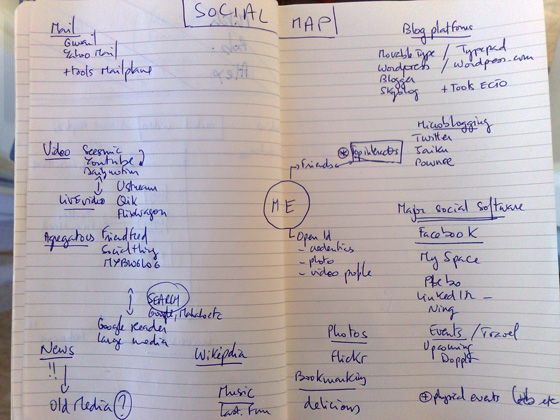
  • Love that photo of the “centralized me”. I was thinking a lot about that when i started mapping Social Media Tools that i use:

    http://www.istrategylabs.com/t.....u-can-use/

  • mike, this idea of the “centralized me,” where “i” can keep my information where i want it, give access to whom i choose, and abstract my information away from my identity (in the case of dealing with other parties, where i want them to see some of my preferences, but in an anonymous manner), is a significant portion of what doc searls is spearheading with the ProjectVRM initiative at Berkman.

    more here:
    http://www.projectvrm.org
    http://www.socialcustomer.com/....._rela.html

  • edit to add: the centralized me idea is fundamental to the “me-ville” (top left) and “global village” (top right) scenarios here: http://www.socialcustomer.com/.....arios.html

  • I prefer a local solution over yet another webservice. I use the iMacros *Firefox add-on* to automate the login (and navigation in) all the 4-5 services that I use daily (facebook, flickr, online banking(!), etc…) . While this generates no “stream” it certainly works well for me and many of my friends.

    And it seems that iMacros is at least as popular as Friendfeed:

    http://siteanalytics.compete.c…..?metric=uv

  • FF will have a tough time because the vast majority of people already get their FF from FB News feed. For those who create media and do not get the best experience of News feed, then FF is great. But that is a limited audience. There is just not a need there for the mass audience.

    Look at basic RSS readers. They still have not crossed the chasm from tech industry to mainstream. We need to remember that the majority of the world does not hoard data like techies. They want to know who is dating whom, where you moved, and the pictures you took last night (and uploaded to Facebook). Yes I’m limiting myself in that respect, but Facebook is the photo site of the masses.

    Other content, like video, is still very early in terms adoption by non-tech creators. I have too few friends who create content, outside of blogs, that I need an ‘aggregator’ other than News feed. Until I hear the rumblings from my non-tech friends on their ability to aggregate data, then this will be a tough gig.

    (Sorry for the gloom, but I do wish you all luck and prove me wrong!)

  • Have you seen http://noserub.com? It’s an open-source project that essentially lets you run your own “friend feed” on your own domain.

  • 6 months ago, a number of investors wanted to change our name. All of a sudden, having “feed” in your name is hot.

    Want not use FriendFeed to aggregate your conversations, Mefeedia to aggregate your media, Facebook to aggregate your relationships and groups, and Google Reader or NetVibes to be your launch page? I think each service has its strong points.

  • I’m a big fan of the service. The “data silo” aspect doesn’t bug me too much. I’m not planning on using FF as a data source (other than commenting/liking items), rather as a data aggregator. It’s useful for chatting and surfing info from contacts. I’ve found I was able to unsub from many RSS feeds because I can use FF as a source of “ambient information” like how I used to use Twitter.

    In terms of getting FF information back into your blog, there’s already one plugin for importing FF comments back to your WordPress comments.

    It’s a pretty hackable little site for adding new features and getting data out of it. Here’s some greasemonkey scripts I’ve already created for Friend Feed:

    http://internetducttape.com/20.....y-service/
    - Add “filter by service” links to all pages

    http://internetducttape.com/20.....ted-links/
    - Add an integrated Twitter client to the FF homepage:
    - Automatically remove any links you’ve already clicked on:

    http://internetducttape.com/20.....8-scripts/
    - Automatically load the next page when scrolling (pagerization)
    - Increase the number of items per page
    - Add a “reshare this on delicious,digg,stumbleupon,etc” link to every item
    - Automatically expand the “4 more item” links

    I’ve just hacked together a way of importing Xbox 360 played game info into Friend Feed as well.

  • FriendFeed will only become the “centralized me” if you let it become the centralized you. I deleted my account there, since I’d rather folks interact with me through my blogs, Flickr stream, Twitter, etc. and my friends are savvy enough to subscribe to those things in a feed reader.

  • Robert,

    But can you see that FF is a work-around for a problem occurring in an immature space? It addresses the fact that social networks aren’t 100% quite yet, and as each one springs up, without ALL of your friends moving to it in an organized fashion, early adopters need a boot-strapped solution to keep them in the loop. IF there ever is a magic bullet social network the need of a service like FriendFeed is nil.

    You could argue that social networks will segment themselves if niche solutions become dominant, but even then why couldn’t this basic feed function not built into social networks themselves? Why can’t I get a linkedin update on Facebook?

    The way I see it FF will enjoy a short burst as it hits the needs of the early-adopter community square between the eyes. (Hence this recent frenzy) But I cannot believe that a service predicated on having at least three life casting services will catch on outside of the valley and its immediate circles.

  • My online life is spread out over lots of services and I love it. It actually helps being lots of different places–some of the most read and most enduring posts on my personal blog have nothing to do with it’s normal topics but are day trips I’ve taken where I’ve mixed Flickr, Google maps, Del.icio.us links, etc., into a crosslinked mess that actually works to promote each other (it’s not unusual for me to be four of Google’s top ten links for the more obscure topics I do this link mixing with).

    About six months ago I saw this trend toward combining feeds into a running multimedia commentary and rejiggered my personal blog toward that (http://www.quakerranter.org). It’s hacked together but works. What I don’t understand is why some clever developers don’t spend a week throwing together plugins for Movable Type and Wordpress. My blog looks a heck of a lot better than my lame-as-hell FriendFeed page (http://friendfeed.com/martinkelley). It’s my URL, I can theme it, I can present the services like I want, etc.

    There’s no reason blog platforms can’t provide the FriendFeed aggregating function better than any third party service.

  • I just get the feeling that no one REALLY cares what I did or didnt do…I think that 2 much emphasis has been put on what your supposed friend did two days ago…It’s played out…

  • FriendFeed is great for the average ‘techcruncher’ but how many of your non-geek friends will care?

  • RE: Growth.

    I’m beginning to wonder if that metric needs to be reexamined. Measuring growth purely in terms of user signups is tragically flawed. 1) Many users sign up but do not use the service. 2) Many services allow for (and how could they stop it, anyway) users to sign up for multiple accounts. 3) Other head-count related problems also exist, such as with sites like Digg, where you can use the RSS feed and avoid the site all together. Others?

    So, I’m wondering if a new metric is in demand. Perhaps one that measures the volume of user-contributed _content_. This would provide an empirical calculation of use.

    Shot that down. Need a reality check if necessary.

  • Quite honestly, I think it it going to be the smaller services/companies and efforts like the DiSo Project which make this happen. I wrote more about this on my blog yesterday in response to a great post by Brian Oberkirch. http://daveman692.livejournal.com/331226.html

  • Damn it, stop pushing your friend’s video startup.

    At least make it clear you are biased.

  • It’s definitely FriendFeed month in Silicon Valley. The company, founded by ex-Googlers, let you aggregate information and activity streams from all of the various services that you use on the internet - Flickr photos, YouTube videos, blog posts, delicious bookmarks, Twitter messages, and other stuff (33 services total to date). Your friends subscribe you your stuff, and see a stream of data on their home page coming from everyone they follow.

    Is FF about Centralized Me or Centralized We? Granted that narcissism may be a strong motivator, my FF page and the Facebook app shares the lifestreams of friends. This seems to imply a Centralized We model.

    Of course, if more friends imported their blogs into Facebook and use the Notes application to read shared notes, the FF river may be redundant. LinkedIn and MySpace needs to add notes, shared notes, and notes import. A FF Open Social app would accomplish the same Centralized Me or We.

    Is Data Portability The Anti-FriendFeed?

    The Data Portability Project may turn out to be the answer that people are looking for. And it may turn out to be a sort of anti-FeedFriend. The whole point of Data Portability is to get social networks talking to each other and exchanging user data, with their explicit permission. Want to add your flickr photos, twitter messages and YouTube Videos to your blog? Data Portability is working to help make that happen through consensus driven policies and procedures. In essence, data portability embraces the Decentralized Me, but lets users re-centralize it wherever they please.

    Ed: Data portability is the decentralized me. It exports me (or my blog) to many social networks and media portals. (FEEDS, WEEDS, READS, AND USER NEEDS - http://adecon101.blogspot.com/.....needs.html) It’s a river delta (or magazine rack system) that distributes content closer to circles of friends in different communities.

    Rivers, streams, and river deltas are a different metaphor for the confusing acronyms in social media.

  • It’s clear that friendfeed is a big deal for tech bloggers that are active on many social sites but is it a non-event for average users that are not technically savvy? For middle America, “feed” probably conjures up images of animal feed LOL.

  • Mike-Did You even read the first paragraph? “Your friends subscribe you your stuff,…” WTF does that mean? May be a typo that should have been caught upon first reading.

Leave Comment

Commenting Options

Enter your personal information to the left, or sign in with your Facebook account by clicking the button below.

Alternatively, you can create an avatar that will appear whenever you leave a comment on a Gravatar-enabled blog.

Trackback URL
bugbugbug
  • MediaTemple Logo
  • QuickSprout Logo
  • OpenX Logo
  • Cotendo Logo