Some Retailers Oppose Google’s Secondary Search Feature
by Duncan Riley on March 23, 2008

g1.jpg

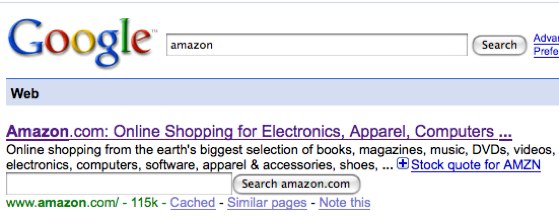
Google started offering secondary search boxes for major sites March 4, and TechCrunch readers split 55% for, 45% against the feature. Now the New York Times reports that some companies oppose Google offering secondary search.

According to the article, objections are focused on Google selling adds against the secondary search results and potential customers being led astray, by both competitors ads and because they are not immediately searching via the particular site.

Google users have long been able to search within a site with a site:abc.com search term query or via an advanced search. Google’s secondary search box simply makes an existing function easier to use.

The argument ultimately seems to come down to control. Consultant Alan Rimm-Kaufman told the NY Times:

Mr. Rimm-Kaufman said the new Google service also diminishes a Web publisher’s role in helping users find potentially useful content. “You may want to editorialize differently when someone searches, and maybe put a premium on certain reporters or content,” he said. “This moves you further out of the loop.”….

Retailers, Mr. Rimm-Kaufman added, should be even more leery of this feature, and not because they will lose sales to competitors whose ads appear in Google’s refined search results. More sophisticated retail sites have search functions that take into account a customer’s past behavior to suggest certain items, as well as more accurate data on which items are in stock.

There was some sense though at the end of the article:

Pam Horan, president of the Online Publishers Association, an industry trade group, said online executives were growing accustomed to the idea that users often did not find their company’s content through the site’s own search box or its front page. More often than not, she said, users would find links to specific articles or products on blogs, search engines or other sites, and navigate to that page.

“So publishers are building their sites,” Ms. Horan said, “to make sure the experience is the same, whether users are coming in through the front door or the side.”

Advertisement

Comments rss icon

  • Customers being led astray? All merchants are concerned about is losing a page view and onsite traffic. In the meantime, Google is providing a killer public service and shortcut.

  • We’ve heard stories from customers (online merchants) who have lost 20-30% of sales due to this change. This change has had significant effect for those retailers that rely heavily on google (organic and ppc) traffic.

    Roy / Magento

  • these retailers need a reality check, the world doesnt revolve around google.

  • Had I seen the poll to vote whether or not this “secondary search”, I would’ve voted positively.

    What are these sites going to do next? Be pissed off that Google puts ads on primary search results?

  • I wish I could enable it on more sites within their results.

  • I like the idea.

    Michael B- owner of http://mikesmon...ub.blogspot.com , the most legit site for making money online.

  • thanks Michael B, because for a second there I thought I was reading a post from the Michael B of Michael B’s restaurant in Alexandria, MN

  • what if google slowly integrates an affiliate program into their secondary searches. For example the rover cookie for ebay or the affiliate cookie for amazon. Thats alot of extra revenue that the companies would have to pay and also it would give google more control over these companies.

    that could be one argument

    kelsey

    http://www.helpuu.com – the google-powered search engine that helps

  • Small Correction - March 23rd, 2008 at 7:51 pm PDT

    ads not adds “objections are focused on Google selling adds against”

  • Yawn.

    Duncan, I fear you buried the lede: “Google users have long been able to search within a site with a site:abc.com search term query or via an advanced search. Google’s secondary search box simply makes an existing function easier to use.”

    If there’s a story here, it’s that now regular people will get the same useful results as the small minority of Googlers who know enough to type “site:”

  • “Google users have long been able to search within a site with a site:abc.com search term query or via an advanced search. Google’s secondary search box simply makes an existing function easier to use.” Whoa, Duncan. you mean to say regular internet searchers were somehow aware of the ’site:’ advanced feature.

  • How many times have I come across a site and WISHED they used Google to run their site search instead of their own gibberish search that returns irrelevant results? Don’t make this any harder than it should be.

  • This is in line with what Google is all about. It’s all about users first. Users, thanks to Google can compare competive prices of products and choose what’s best for them, for us, for you the user the one searching on Google. THANK YOU GOOGLE!

  • How many ppl would actually do site:abc.com…

  • google’s search on some of these sites is better than their own, so as a user, it’s a great feature. afterall, i get a great utility for free!

    if i am the site owner, i should be pissed.

    (a) i get fewer page impressions and hence lower monetization, and at the same time google gets more page impressions and gets more money. basically i am giving money to google with this feature.

    (b) in turn, will it improve my monetization? probably not. if the user is on my site, i can show recommendations and/or rich supporting information to keep the user on my site and probably get the lead along the way to stick into my email campaigns.

    if google is doing it right by the user, they have to ensure they are doing it right by the website owners (ie., better rev share) as well. as it is, they have been short-changed by google for way too long.

  • The Google-opoly - March 23rd, 2008 at 9:20 pm PDT

    Dear former web site owners — STOP
    Your services are no longer required — STOP

    Do not use us as a reference — STOP

    Love, Google Borg

  • Good comment from JeremyB. I was thinking the same. Users could always search within a site. It’s just that we have better UI for a useful feature now.

  • Where did the secondary search go? It looks like Google took it off after this article.

  • Pretty useless, if I want to find something on amazon I add “Amazon” to my search query(none of that site: bullshit)

    To tell the truth, lately I haven’t even used actual google site. I just use the firefox url bar, and then just type out what I want and then I either get the Google search results, or if I specified a specific site i.e. wiki/imdb, it opens the actual wiki/imdb page that I’m looking for bypassing Google entirely.

  • The retailers should look at their site search and ask themselves “Why my site visitors make a decision to leave the site and go to Google. What is not enough in my site search?”

  • This new approach by google will enable searchers to search for a specific product within a company’s website. However, google ads will appear next to the actual site’s search results thereby increasing the probability that customers will not end up purchasing through the given site. I understand why site owners will be opposed. Google aims to navigate all online trafic – now even traffic within websites. This makes life much more difficult in terms of marketing and overall online experience.

  • i think google is trying same things like microsoft
    google know he is market leader in search engine market and using this thing to harm other small players.

  • I oppose.
    Google doesnt index all the pages of a particular site.
    For example in my site http://nachofoto.com i run my search indexer twice a day.
    But google doesnt index that frequently. So there might be a case where a user might not find results using google’s secondary search box than using my site’s search.

    To further my point, google shows search results only from pages they have index.
    Pages that have yet not been indexed is a total loss for us.

  • Slideshows said: “I oppose. Google doesnt index all the pages of a particular site.”

    What does that have to do with anything? Google is not taking away the ability for the site owner to have their own search.

    All this is, is a button that in essence says, “hey would you like to restrict your search to pages on this particualar site? If so I will add site:blah for you.”

    Anyone who has ever hit the advanced search link or knows about the site: keyword does this all the time.

    Besides, ’site:’ works on all the major search engines, not just google.

    Provide a good search engine, and make your search option obvious on every page and people will use it. Most sites have terrible search and make it hard to find the search function which is why folks want such a feature.

  • If your business is reliant on free service me thinks you should re-consider how its ran. I never understood why traffic from Google became a right and not just a nice little extra.

    Sure it takes a little bit of elbow grease to build up a product and brand but considering how much SEO goes into placing into Google maybe that time, energy and money should be spent elsewhere.

  • I’m guessing my site does not have to worry about this, but as a retailer I understand some of the concern. There are a number of people who do not differentiate between the url bar and google. I see it mostly with users who don’t really understand the concept of the internet and think that you have to go through a gatekeeper to get anywhere.

    I think that all readers of techcrunch are so far above the “average” internet user in terms of being “internet savvy” that they forget that the average users had no idea what the site search tool was before this came along.

    As a retailer I love google but also have a healthy fear of what it can do to marketing efforts outside of Google. Let’s take as an example a product for which there is not great awareness. Company A spends $250,000 publicizing the product. Since almost everybody uses Google many customers type the landing page url into google or perhaps just search for the product name. Companies B,C,D, E, etc. bid like crazy on the competitor’s url (who has already sunk $250,000 into the promotion). In the short term this is great for consumers and manufacturers because prices get pushed down and sales increase of the product (all at the expense of the retailer’s margin).

    Google does a great job of helping us find what we are looking for, but they may spell the death of allowing retailers to pay to promote products.

    This isn’t a complaint, more of an observation.

  • I wish Google gave this option for my site… Heh…

  • As an internet retailer I am very, very much opposed to this feature. I’ve spent many years and lots of money making my site search better and quite frankly Google can’t do as good of a job. I will list the reasons why Google search on my site would suck.

    1) Not all pages indexed, but would give the illusion that they were.
    2) My database is normalized and I know more about the content than Google.
    3) Google doesn’t use a proper ranking algorithm for most popular retail products
    4) Google doesn’t understand my taxonomy.
    5) Google doesn’t understand my niche’s synonyms

    I could keep listing reasons, but I think that’s enough. Bottom line, if your search is tailored to your niche, you don’t need or want Google’s help.

  • I don’t think this is a big deal in terms of clicks or dollars, truly. But does subvert the editorial prerogative of the site owner to handle their own search, and it feels Evil to pull searchers away from the brand. My analogy is tossing hamburger at vegetarians after they asked for a meat-free dinner:

    Google To Vegetarians: Eat The Damn Hamburger!
    http://www.rimm...ogle-hamburger/

  • Alan, I think it can mean a large loss in clicks and dollars. Let’s take an amazon example, searching for “piggybank”.

    Google:
    http://www.goog...lient=firefox-a

    Amazon:
    http://www.amaz...p;x=20&y=27

    Amazon’s result is far superior. Particularly because “piggybank” doesn’t necessarily imply pigs and their #1 result is a bestseller that out-paces all pig banks.

  • @yakov-21 I beg to differ. Like other said internal search engines will almost always produce more functional results than google.
    for a consumer, the decision of using secondary search against a site’s own search engine will not be dictated by the performance of the latter but by the convenience of doing it in one go. and by the popular belief that google knows all.
    I agree though that retailers will have to adapt, but that’s unfortunate.

Leave Comment

Commenting Options

Enter your personal information to the left, or sign in with your Facebook account by clicking the button below.

Alternatively, you can create an avatar that will appear whenever you leave a comment on a Gravatar-enabled blog.

Trackback URL
bugbugbugbug
Techcrunch on Facebook