Google Mobile Learns the Need For Speed, But Is Still Not Fast Enough
by Erick Schonfeld on March 19, 2008

googlemobile4.JPGThere is nothing worse than waiting for a mobile browser to fire up on your mobile phone (especially if it’s AT&T). That is why mobile apps customized for your phone still tend to deliver a better experience than going through the browser. Anyone building mobile apps knows this. Cut out any unnecessary steps and lag time, and the usage of your mobile app will go up. The folks on the Google Mobile team live by this rule and have been working hard to make their mobile apps faster (for search, Gmail, Maps). (More at MobileCrunch)

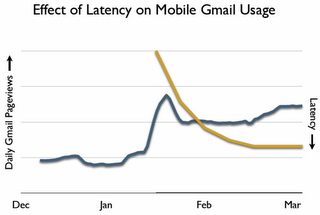
Below is a chart from Google showing how usage of Gmail on the iPhone took off once latency issues were resolved.
gmail-latency-improvement.png

What is true for the Web is doubly true for a mobile phone. Slow me down, and I’ll bail on your app. Building custom apps lets developers tweak their performance to each device. The downside is that consumers have to open up a new app for anything they want to do on their phone. There are only so many apps most people are able to juggle between (even on a full-sized computer, I use no more than five or six applications on a daily basis). What we need is a general-purpose app to access the Web from mobile devices that is also fast. What we need is a better mobile browser. Or faster mobile networks. Or both.

As fast as the mobile version of Gmail is, it is still not fast enough. I have it on my Blackberry. Google nailed the mobile interface, the search, and the address auto-completion. It is a much nicer interface and more fully-featured than my Blackberry mail. But I hardly ever use it because my Blackberry mail is much faster. The native Blackberry feature already fetches all of my Gmail messages for me and I don’t have to launch it as a separate application. It is just always on, always updated.

That is how all mobile apps should work. Of course, Blackberry has the advantage of being able to build its device around this particular app. If you are going to have to launch an app to access the Web, you should have to do it only once.

Comments

“How usage of Gmail on the iPhone took off once latency issues were resolved”? That chart shows nothing of the kind.


I think we will see this change as more devices get up to the same level of tech as the iPhone. Once email and search stats are being seriously changed by the predominance of mobile phone usage to such an extent that they rival their desktop counter-parts we will likely see a different attitude to the mobile space all together.

The thing is, many are still sitting it out until they see where the mish mash of tech takes us… and so far the iphone is the clearest logical step… but is not exactly “mobile” rather than “tiny desktop computer” in terms of how we interact with content on our phones.

Anyway, it’s going to be a good one to watch.

David G
InstalledHome.com


For mobile mail, nothing beats a native app. I use Pop3 on Treo750/WM6 and it works great (probably will move to IMAP). Backberry still provides the best experience for email access (except for international roaming).

BTW, Google did an amazing job on GMap (another example where the native approach is best)

I use mobile browsers mostly to browse news, and so far, speed has not been an issue. However, formatting is (BTW, when a mobile friendly TC?).


Native apps blow away we-based apps *but* if you’re using the browser for email access, you can continue with other web-based activities far quicker than with native apps. Browser based access is the way to go in my opinion. As you said - having that app ready and waiting is the key. CHeck out some examples of x86-based access.
http://www.umpcportal.com/modu.....toryid=937

Chippy.
UMPCPortal.


I have Gmail on my Blackberry and it automatically updates with new mail? At least with recent mail. I notice as I scroll down it needs to fetch mail. I presume this is because the application was based off a standard J2ME application that was trying to be conservative with storage space. If that is not the case then I am surprised as to why they did not do a better job of a dedicated Blackberry Gmail version!
The UI itself is well done though. Just a pity they didn’t go that one step further. Bottom line though is it’s a lot cheaper than Exchange with a BES server.


The truth is, mobile web access is not large enough yet - once the mobile web usage increases, the power and speed of internet access via mobile web will increase as well. Native apps are excellent, for they are synced directly into the system (whether it is the iPhone or any other mobile device), while custom apps usually are not efficient enough to help enhance speed - once things get more advanced and there is more usage, the mobile web will be faster and faster.


TOTALLY AGREE with the Gmail App on Blackberry. I actually do use it but find it to be far slower than the BB mail app. I always ask myself if the slight added value outweighs the sluggishness….


What we need is a general-purpose app to access the Web from mobile devices that is also fast.

This is why google desperately wants you to use gmail - easier to lock you into other apps like calendar, spreadsheets etc


A closer look at that graph ruins one of your points. The way I see it they gained the most pageviews while their latency was still quite high. Usage was completely flat while most of the latency decreases were made, and now that latency is not changing they are showing a gradual increase.

So while lower latency may be great, it looks like their real user gains are following a different trend.


That’s the most ridiculous conclusion I’ve ever seen. How is there any correlation between those two lines? What else happened in mid-January to increase the usage? If usage correlates to latency, then why did usage go down and then flat while latency finished it’s downward curve?

Did you make this conclusion, Schonfeld, or did Google? Either way, I ain’t buyin’ it. TechCrunch continues its “pseudo” journalism…


There is a correlation. Read the original Google Mobile blog post (linked to above). This is how Google explains what is going on in the graph:

“We saw something similar after we launched an updated interface for Gmail on the iPhone during MacWorld earlier this year. Lots of iPhone users tried the new interface (hence the bump in Gmail pageviews between January and February), but they didn’t stick around like we hoped they would. Over the course of the next few weeks, we made some tweaks to drastically improve the speed of the product, and Gmail pageviews on the iPhone not only stabilized, but began to rise, as the graph below shows:”


I guess that makes jason a “pseudo” reader.


Ah yes, the rest of the story. I guess you are right…way to go bashing your readers too (#11).


The correlation is probably more due to the fact that Google “breaks” POP connections on the iphone, making the web connection the only reliable way to access it.

I noticed their breaks happening with increasing frequency and they tend to coincide with mobile releases. I’m convinced they’re doing this intentionally to force people to try the mobile version.


Have you completely forgotten Yahoo! Go? It is much easier to manage and now allows you to use 3rd party widgets along with the best email, photos (the Flickr widget is amazing), etc. on the web.

The great part of it is that it isn’t a pain to load like most mobile browsers, yet it allows access to a wide variety of services. And if you can’t use it on your phone, you can still use a very similar webapp at m.yahoo.com Google seems to have little experience here (not the Android team). I think Yahoo! Mobile is often underlooked and should be getting more attention here.


OK, this is a plug, but the issues in this article is EXACTLY what my product ‘SQIJ’ has attempted to address, and it’s been around for a year now. (but, only for Windows Mobile).

A single app, with many ‘Applets’ inside it, easily add-able, removable. Single sign-on. Fast. Cheap data bill. ‘Push’ capable, etc, etc.

And, so far, it’s all free. http://www.sqij.com


That chart almost made my head explode. So you have two variables on the Y axis, one going up and one going down, and you have two lines that signify what exactly? This is about as understandable as Google’s business model…


Totally agree with SR (15 )


“What we need is a general-purpose app to access the Web from mobile devices that is also fast. What we need is a better mobile browser.”

This is precisely what we at Skyward Mobile have been developing over the last two years. Our APX technology can be described as an “Application Browser” and it gives us the best of both worlds: fast, specialized, fluid user interfaces coupled with the ability to continually expand and refine the applications from the server side.

Our first 10 apps have been released and can be downloaded individually from http://web.skywardmobile.com/prd . Soon we will be offering a single download which gives access to all of these apps as well as a growing collection of many more.

We hope its what everyone has been looking for, and welcome your thoughts and feedback.


Leave a Reply

Create a Gravatar for your comments.
« Back to text comment