
If you haven’t been keeping up with the noise, FriendFeed is the hot startup of the minute. The service launched to the public February 25 and announced $5 million in funding at the same time.
The concept of FriendFeed is simple enough. You add disparate accounts across blogs and social networking services, and Friendfeed aggregates them so friends can follow what you’re doing. The interface is clean, not surprising given the company was founded by ex-Googlers, and using it is easy.
I asked for some feedback on FriendFeed via Twitter and Michael responded saying that Friendfeed was this year’s Twitter, complete with SXSW inflection point. Others, such as Steve Rubel and Louis Gray are talking about the service like it was the most amazing thing they’ve seen in years.
I signed up to FriendFeed yesterday to see what the fuss is about. Having used it for a day I don’t get why FriendFeed is that much better than the range of other services that do exactly the same thing. Plaxo Pulse immediately comes to mind, and there’s Spokeo, Second Brain, Social Thing and Iminta as well. Certainly FriendFeed wins (by a small margin) on usability and scope, but it’s still yet another service in a sea of similar startups.
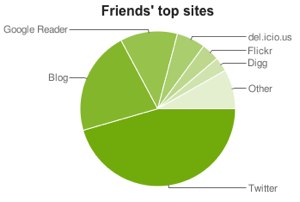
Then there’s the why behind wanting a feed of content from your friends in the first place. As the chart I pulled from FriendFeed demonstrates, nearly half of all entries from my friends come from Twitter. But if I’m a Twitter user and these are Tweets from friends wouldn’t I be reading them in Twitter anyway? Next comes blogs, and while I may not have every friend’s blog in my feed reader, the ones I mostly want to read I’m already subscribed to. Like Twitter this seems like duplication to me, and FriendFeed doesn’t offer the content from the post either like a full feed would. Google Reader is next on the list: again, duplication as it pulls shared posts from Google Reader…which are shared within Google Reader.
Ah, but you can leave comments on feed entries some will point out and engage in a FriendFeed conversation. If most of the content on a FriendFeed is pulled from Twitter, wouldn’t discussing the points on Twitter be the logical outcome for the majority of people? Blog posts get comments on FriendFeed as well, but how rich an experience is a comment thread based on a headline with a link? As a publisher, wouldn’t you want people to hold these discussions on your blog? There’s already a precedent of sorts as well: coComment tried to take blog commenting to a centralized point without 100% of the conversation remaining on the blog itself, until it realized that it was a failed model.
There is a market for aggregation services, and yet instead of creating a two way interactive service like Google’s still in development SocialStream will be (the real future of aggregation), FriendFeed seems to be nothing more than a fancy RSS service with commenting thrown in for good measure.
I may be wrong on FriendFeed; it took me months to get the appeal of Twitter so I may well end up becoming a FriendFeed convert as well. But what I see so far keeps prompting me to ask “what am I missing?”
- No
- Yes, FriendFeed’s a great service
- Undecided
Total Votes: 1603
Started: March 14, 2008


There are a lot of services similar to FriendFeed, but none of them do enough IMO. I’ve got some ideas of my own about how this “lifestreaming” thing should be done. BTW, Profilactic and Correlate.us seem to me to be the best startups in this space.
Its on my todo list. It looks cool but I think the reason its getting such buzz is just down to the terms like “Ex-googler’s” and “gmail creator”. If it didn’t have that legacy then it would be no where I think.
I totally agree ; Frienfeed has a real potential of development, but I don’t see why ; in some way, reminds me mahalo. Best to come in the way to coonect others with more API and marshup way.
Totally agree with you Duncan.
I’m subscribed to my friends’ blogs, sometimes read their Twitter updates and keep track of their photos with the Flickr ‘Photos from my contacts’ RSS feed. That’s the only thing I want to know about them through the web, the rest is just distracting.
Is FriendFeed this year’s Twitter? Hmm…
I’ve had a Friendfeed profile since private beta so here’s my .02:
It’s extremely low-maintenance and everyone I follow has more than just their Twitter accounts linked to the feed. I can see if someone likes a particular blog or website (Digg, StumbleUpon, Del.icio.us) or video (Youtube). It will also tell me if a friend has uploaded a photo (Flickr) or blog post as well as added a movie to their (Netflix) queue.
I think the primary reason I prefer it over some of the other life stream services I’ve seen is because it has very simple GUI but I’ve been around since the days of MSDOS so I’ve never been a fan of too much graphic crap on a page anyway.
“…Michael responded saying that Friendfeed was this years Twitter, complete with SXSW inflection point”
Ummm…False. No one stopped to ask me my Friend Feed URL, not once. But ever other person I ran into asked for my Twitter name so they could add me.
Fire Eagle was the “buzz” in Austin last week, not Friend Feed.
This post is surprisingly inaccurate, normally TechCrunch is right on the money.
It may be they are trying to make feeds and commenting more mass market, but a better in interface to feeds (with a comments API enabling commenting on any blog) is already being offered by a UK startup we covered on TechCrunch UK recently:
http://uk.techc...-invited-crowd/
hmmm agreggating feeds from your friends… googlereader already does this for me…. (and more convieniently) so I have no need for friend feed.
Todd
if we take post show buzz I don’t think what Michael has said is inaccurate. There’s an awful lot of noise around FriendFeed now, whether it takes off long term like Twitter did is yet to be seen.
*Yawn*
Friendfeed just aggregates all your data into one place – including duplicating it. No Koolaid for me.
Just like twitter, maybe it might take me a while to “get” it
Am I the only one who thinks that this whole “know what your friends are up to every waking minute of the day” thing is a short-lived fad?
Maybe I’m just a misanthrope (okay, I definitely am a misanthrope), but I really don’t care what my friends are doing, certainly not enough to subscribe to some sort of activity stream feed. There’s enough information overload in the world as it is. It just seems like the signal to noise ratio on friend feeds is pretty skewed towards stuff that I could live without knowing.
Everybody is rushing to add activity streams to their sites, ripping off Facebook’s news feed, adding “… and share it with friends!” to their marketing pitches. But to me, this is all just the 2.0 version of “forward this email to 100 friends, or your cat will eat your baby.”
I think people are going to quickly tire of all this sharing, and will view it more on an annoyance than anything. You can already see that scenario being played out on Facebook. “No, I DON’T want to take a quiz to find out which Disney Princess I am. And if you keep ’sharing’ this crap with me, I will burn down your house.”
“Sally is home from class.”
“Joe needs an umbrella.”
“Julie likes soup.”
“Warren cancels his FriendFeed account.”
When I look at the FriendFeed-chart of sites I use most often, “FriendFeed” makes up nearly a half, because I use the sharing part most of the time. Why is the sharing-part interesting? Because of the people that share and comment on content.
So I can’t say if FriendFeed will have mainstream appeal, but I can definitely say that it’s a neat service to follow discussions between the A-List bloggers and throw in comments as well.
Also remember that we had the same discussions about a year ago about Twitter. Is it useful? What for? It has too much noise! And suddenly, Twitter was everywhere.
For me, FriendFeed has much more value, because rather than seeing unstructured/unfiltered comments where I have to be actively online to be able to follow, I can see conversations that are preserved – even if I join it later.
In amongst all the ’startup noise’, FF stood out for me due to its simple style. The ex-googlers thing certainly helps add to its credibility too though.
Like Twitter, it doesn’t matter if others have better technology, you have to go where the people are and right now, it is FriendFeed. You don’t have to invest an enormous amount of time to it, just set up, follow some folks and see what happens.
Friendfeed seems to be a nice tool but I’m beginning to wonder how these social services are going to make money. If MySpace.com, Facebook.com, or Twitter.com were not free would you still use it? Would you use twitter if there were a few ads on the page or mass marketing tweets?
Hi,
I’m not sure I understand your point: “coComment tried to take blog commenting to a centralized point without 100% of the conversation remaining on the blog itself, until it realized that it was a failed model.”
sorry: my mouse submitted without my agreement
I wanted to say about this: yes we centralize comments in order to help users to track/discover conversations. But we do not take the commenting out of the blog: commenters still need to go to the blog to enter a comment. So the traffic coming from the conversations remain on the blog.
I’m not sure to understand either who realized that this model failed.
Could you please elaborate on this ? We are always very interested by comments/critics toward us as it help to build a better solution.
Thanks
interesting…time to join.
Duncan: thanks for trying our FriendFeed, and thanks for taking the time to write your thoughts. It is thrilling for me and the rest of the FriendFeed team to have this kind of interest, even if some of it is a bit skeptical
At its core, FriendFeed is about discovering and discussing content. The web has been transforming media since its inception, but the past five years has seen a particularly massive proliferation of blogs and user-generated content like YouTube. By leveraging your social connections, FriendFeed is becoming a nice way of sifting through that content so you can easily find the one YouTube video you would find funny or the one blog post about the upcoming Pennsylvania primary you would find interesting. We obviously have a lot of work to do on our relatively young service, but I think a lot of the bloggers that have written those nice reviews these past few weeks have found that FriendFeed is a pretty effective tool to find the most interesting topics of the day (for their social group), and a great forum for semi-private, intelligent discussion as well.
The discussions on FriendFeed are definitely our most popular feature, and your points about centralized vs. distributed discussion are something we have talked a lot about. I think there is a big difference between discussions on FriendFeed and discussions in public forums like the comments on this blog. On FriendFeed, the same blog post may be shared in 100 different social groups, and those social groups will have radically different conversations about it. The end effect is that the conversations take a more personal form than forums like comments on this blog, which inherently take the tone of most public discussions (impersonal, or, in many cases, flame wars like YouTube’s comments). While publishers might want all conversations in one place, many people are intimidated by or don’t derive much value from participating these types in public forums. To use a crappy metaphor, the discussion on a widely read blog is like a radio show that takes callers, and FriendFeed is more like a discussion with friends at dinner.
Many of our users are not bloggers or publishers, and they did not use features like Google Reader shared items or YouTube favorites because those actions didn’t go to anyone in particular. With FriendFeed, those actions deliver content directly to people they know. Many of our users have reported that they are enjoying the products they already used a little more because FriendFeed makes them more social.
There is no shortage of competitors in this space (seemingly a new company every day), but I think we have created a nice experience that motivated a lot of these recent reviews. Many of these companies have taken different approaches, and if I had to draw a distinction, I would say FriendFeed is less focused on aggregation “for the sake of it” than using that aggregated content as fodder for discussion and a unique social experience. We have no plans to pull in purely social activity like superpoking or relationship status – we are trying to enable users to broadcast content to their friends as seamlessly as possible, and aggregating feeds is an integral component of that goal.
FriendFeed has a viral feature….which is the source of its current rockerting growth….it recommends friends to you…subscribe to one of the recommendations and another set of recommended friends shows up based on a Friendfeeder social graphic of person you subscribed…
Great points on FF’s simplicity and hold on the market. One thing that kept me from really getting into Plaxo Pulse and some others is “who uses them” – I signed up for FF in beta and signed on again yesterday and saw a bunch of people already following me. jeez. Where did they come from? On Plaxo Pulse, I couldn’t find anyone using the service. Lame. Here’s the lesson – make your app easy and blow it out at SXSW – if you don’t do that, forget being the next Twitter.
christophe 18
I was referring to coComments first incarnation, not its current form, a conversation I’ve had with Matt btw and given you changed your model would further suggest that the original was flawed.
I sign up for a bunch of new services and most of the time don’t end up using them for too long, primary reason being the service does not have that hook to keep me engaged.
Thats has not been the case with friendfeed. I started using friendfeed since last few days, and i have found my self liking the service and spending time on it.
- the interface is very simple (but powerful) and not intimidating, makes you feel its an easy thing to use
- I added about 8-10 of my feeds, it was very easy to do that and it was fast
- in not time I found my self my self looking at friend recommendation (really like this feature), browsing thru friend list of others and in no time I had a list of 12-15 friends
I got onto twitter about a month back, but never got hooked, the way I am hooked to freindfeed. Infact I am seeing more twitter updates on friendfeed as compared to twitter website/notifications. I have also been looking at blog posts via friendfeed.
So overall I like it and Friendfeed is now part of various services to which I keep open all day on my firefox and I find myself going back to the window to look at updates and add more friends etc.
Of course if you’re like me and your closest friends consider Facebook to be the beginning and the end of social web, Friendfeed is just one more way to shout into the void, making plenty of noise that no one will hear.
Seems to me just another example of the echo chamber at work. Then again, I thought the same thing about Twitter 9 months ago.
coComment failed because they rely upon a plug-in which was never going to succeed. As Mike Butcher points out fav.or.it is already doing commenting centralisation, we support 50+ million blogs and already partnered with Disqus + Sezwho to support those commercial platforms. Would be happy to talk with the FriendFeed guys if they wanted to integrated commenting into their application. (comments that go back to the blog that is!)
sent from: fav.or.it [FID57330]
really liked warren’s post for some reason.
maybe i’m just dense, but i am yet to see what all the hoopla with twitter is about. but then that goes for most so called web 2 sites for me.
I just signed up for Friendfeed a couple of days ago, and instantly liked it. There’s something organically appealing about the flow of information it provides … especially as I add informative and engaging bloggers and writers who have an open stream.
It’s a quick way to “take the pulse” of the Web, and discover interesting bits of information as they first come to light.
@Darren had it right. It’s nothing more than name recognition. I didn’t get it when I first reviewed it and I don’t get it now that people are jumping on the bandwagon. It’s ugly. It’s too simple.
My preferred aggregator is still Dandelife, but none of the cool kids seem to want to hop on. It does all the same things FriendFeed does, looks prettier, and allows you to include “stories” which are essentially blog posts. It doesn’t have that overly simplistic “even a two-year-old could use this” look that FriendFeed seems to have brought along from their Google days, but I really didn’t think anyone who NEEDED an aggregator needed overly simple in the first place.
It’s Web 2.0, though. All that matters is what the cool kids are using.
If you, as a web 2.0 junkie, are having a hard time finding the product useful, think about how unlikely it is to appeal to the mainstream masses. As hard as it is to believe, most people out there don’t have content/friends strewn across many sites. Most people have 99% of their life on one site, be it facebook, myspace, whatever.
dont forget about socialthing!
I love Friendfeed, but I was forced to unsubscribe from subscriptions that had too much Twitter in them, because I agree with you that’s not really helpful.
Is it possible the mainstream is finally catching on to the overhyped aggregator industry?? As soon as we read about FriendFeed receiving their VC money we blogged something quite similar:
http://www.whyd...dw-insider/216/
I have not tried it out, will go and have alook. Thanks.
I just signed up for FriendFeed based on this post, and have accounts with Iminta, and SocialThing as well. The problem with all of these services, as everyone knows, is that they only pull the content you’re posting on social networks, which really only solved half the problem. The first service that allows me to post a link to all of my social network accounts: Digg, Reddit, Mixx, Facebook, SU, Newsvine, etc., etc. will win this space.
Of the three that I’m on, the only service that is hinting they will do this is SocialThing.
By the way, if anyone knows of a service that does this –Votrs.com is the only thing I’ve seen that comes close — please let me know.
I think friendfeedfeed is much better myself :p
As or more interesting than the question of whether friendfeed is better than its mentioned competitors above, and whether an aggregator service of this type adds enough value over twitter, blogs, etc. separately, is the question of whether this type of service can take on a bigger boy like Facebook.
Facebook sprung up overnight because (to my mind) of the increased friend feed and communication and networking etc. aspects that were superior to linkedin and others. If Friendfeed goes further than Facebook in this regard, and I believe actually that it does, Facebook could potentialy be at risk.
Just as Facebook was initially addictive (and Twitter), any service that incorporates earlier addictive site capabilities can displace those earlier sites if they don’t catch up. Already I’m spending a lot less time on Facebook since I started using Friendfeed.
The nice thing about ff is that you set it up once, and just add it you you good old RSS reader. Others can follow you if they want and you could follow your friends if you want. Very low maintenance required. If you want to engage, you can simple engage them using the underlying service or ff.
After Twitter I go to FriendFeed.The diversity.
I will go with Stan on this one, profilactic is definitely the favorite in this category. Maybe profilactic is the new twitter, any comment on that Duncan?
@12: Maybe I’m getting old, but I’m with Warren here. I just am not getting the whole concept of reading about what people are doing with the mundane aspects of life. If people are doing something like setting up a meeting or seminar that might actually affect me, I might be interested, but I don’t really want to see pictures of their kids playing with Mr. Potato Head. Guess I’m turning into George Carlin.
My theory on this is that people (myself included) have oversubscribed on Twitter. FriendFeed is a fresh start where you can start over, bringing over a handful of “high signal” friends from Twitter. You can also cherry pick the top 5 or 10 daily reads from your RSS reader, etc. What you end up with is a river of news that combines all of the things that you are keeping track of in one place. Just like Twitter, what you get out of FriendFeed is going to vary from one person to another. If you add 500 Twitter friends to this you’re going to get overwhelmed but keep it limited to the stuff you are really paying attention to and it turns into a great stream of information and discussion.
I agree with the points made about discussion happening on FriendFeed and not on the blog where the blog author probably wants it to happen. I’d like to see someone like Disqus come up with a way to suck in comments from lifestreaming services like FriendFeed so that all of the comments that have been made on a blog post – both on and off-site – are pulled together in one place.
FriendFeed is an incredible service. FriendFeed is similar to Twitter in that you can select who you follow and how busy you can make your stream, but it is so much more interactive than Twitter or Spokeo or any of the other services you mention. FriendFeed enables me to deliver a single aggregate feed of all my Web activity, and collaborate with friends and peers, through real conversations. While Twitter is well known for its limitations, through # of characters, and its downtime, FriendFeed is known instead for its flexibility and openness. Duncan, I’m glad you finally looked at FriendFeed, but it’s so much stronger than you got to see in your one-day rendezvous. There’s a reason I switched my browser home page to http://www.friendfeed.com from Google Reader. It’s because I’ve found the one service that delivers me all useful, relevant information from my peers in an interactive way.
Two things I like about FriendFeed that haven’t been addressed here:
1) being able to follow acquaintances in FriendFeed that I don’t follow directly in the other services;
2) being able to follow friends who use services that you don’t (e.g., I’m on Pandora, some of my friends use last.fm).
What I don’t like about FriendFeed is that I can’t turn off the spigot for individual services for each friend I follow. As noted by others, if I already follow them on Twitter, why do I need to see all their tweets again here? They just get in the way. I hope this is a feature under development.
I agree with Duncan’s post.
One thing those of us in tech fail to remember is that most people don’t even know what a feed or RSS is, let alone the concept of aggregating them and the need for that at all. Most people check their Facebook account, type in the address for a friend’s blog or two, and call it a day.
So while feed aggregation may useful and understood by early adopters and tech enthusiasts, it will be a long time before the mainstream elements pick this up, and FriendFeed isn’t worth much until that happens. In the mean time, there are so many other services that will pop up and do it better, such as the Google one Duncan mentions, and FriendFeed will quickly become nothing more than a jazzy but antiquated RSS reader.
@Warren Maybe you need to find more interesting friends to follow. And I don’t mean that to be insulting to you or your friends, but if all you’re seeing posted in social networks is trivial and mundane, then you’re following the wrong people. Try following some of the big players in your fields of interest on Twitter (yes, people you don’t necessarily know personally) and see where that leads.
Friendfeed is about content and the comments and “likes” that follow.
In Friendfeed, the main attraction is the content. When a content is written or linked or rss’ed, all reactions or comments follow through the content, just like you see in a blog post. Which is different from Twitter, because after a nice link has been posted, you won’t be able to track comments on that post; instead after hitting refresh, you’ll see what #12 pointed out: “Sally is home from class”,
“Joe needs an umbrella”…
It’s different from a blog post because it aggregates data from over 28 services plus blogs and feeds.
I think Friendfeed is a great service.
Here is my pet peeve: Is it just me or would FriendFeed be almost twice as enjoyable to look at if they took the underlines off the links for everything? Each time I look at it I feel like they make the feed look more “stressful” instead of inviting, as say Twitter’s interface…
FriendFeed feels like a Web 2.0 site in Web 1.0’s clothing…
@fishwreck – I see your point, but then it’s not “FriendFeed”, it’s “InfluentialPeopleYouRespectButDon’tKnowFeed.” That’s a perfectly legitimate use for it, but I’m guessing the utility of that is limited to geeks (a group to which I proudly belong).
My point is more about the mass appeal of these services. My mom is not going to Twitter fascinating minute-by-minute tales of “nuclear f*cking fail” from SXSW. She’s going to tweet boring stuff that is interesting enough if mentioned (barely) in passing, but is not worthy of getting bombarded with 20 times a day.
I’m guessing the guys at FriendFeed or any of these other services, either the aggregators or the aggregated, do not have an end game of appealing solely to geeks. They want mass appeal and mass adoption, and I get the feeling there are a lot more boring than interesting people in the world.
As with email, the ones who forward the most are typically the ones you want to hear from the least, and the stuff they forward goes right into the garbage bin. With these activity streams, these would be called “power users.”
I’m loving FriendFeed, though out of all of the others mentioned in this space I’ve only tried SocialThing. Yes, it duplicates a lot of stuff from twitter and feed readers, but half of the tweets you see in friendfeed are probably past page 5 on twitter itself, so it gives you a second chance to see them. It also offers a more rounded perspective on people, being able to see all of the other minority services and adds conversation ability to things such as bookmarks, upcoming and youtube videos (in youtube’s and upcoming’s case, ff provides focused conversation with friends instead of discussion with the masses on the sites themselves).