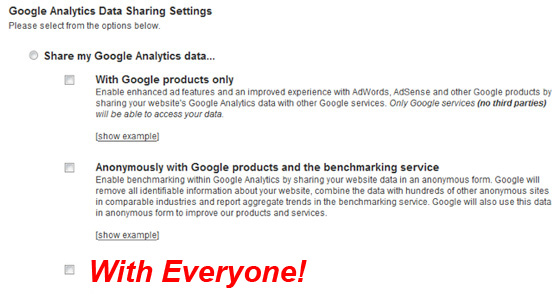
Google Blogoscoped (and the Google Analytics Blog) is reporting that Google is now giving users the opt-in option to share their Analytics data with other Google services, and/or in an anonymous, aggregated way in a new benchmarking service.
This is certainly useful for some companies – particularly since Google is only making new services based on this data available to users who’ve opted in: “only users who have opted to share their site’s data with Google may use these new or improved services.”
A screen shot of the options is above – but I’ve added my own fantasy third option in addition to the first two that Google announced today.
What I want to see is a flat out option for people to share some or all of their Analytics data publicly, without restriction and without anonymitiy. We’re seeing startups send us this data more and more often to counter under-counting in Comscore, Alexa and other services. They say they’re more than happy to see us publish the data, so readers will understand exactly how well they’re doing. A lot of companies want this data to be public.
Transparency is a good way to gain the trust of the community, and I think Google would be surprised to see how many customers would be perfectly willing to share their analytics data publicly. The logistics of the sharing is less important – it could be done via a widget or an API, or a variety of other methods. But I believe the demand is there. All Google has to do is flip a switch.


This is better than nothing, but the major question is – how representational is that data of the global community of Websites.
Sophisticated Webmasters savvy enough to use Google’s tools and opt in to their analytics would appear to be an esoteric sample.
Excellent — looking forward to seeing TechCrunch analytics data. This would be helpful.
I’ve already been publishing it from time to time on crunchnotes.
From my point of view, these options are un-necessary. Companies who choose to use Google Analytics automatically hand over all the data to Google. Once Google does not disclose the data to any third parties except the government, it’s quite reasonable for Google to use the data to improve its products such as Google AdWords, AdSense, etc.
I give you an obvious example. How can Google know a keyword is highly demanded or not? Google just collects each search made by billions of people and then work out an algorithm to calcuate how much a click for a keyword an advertiser should pay to Google and how much Google should pay its contents network, which is the essential foundation of Google AdSense and AdWords.
My observation is, when Google does this they do not seek permission from any user for that they will use her searching words as a source to develop Google products such as AdSense and AdWords. Instead, when you use Google to search something, Google records your searches, that’s it.
That’a ok Mike – once we finalise the DataPortability blueprint, we’ll make sure we communicate the business case to Google that opening up helps everyone
http://liako.bi...ser-value-fool/
Bad for competition. Not many sites will do it. Reminds me of the late 90’s early 2000 when everyone had those heinous “Stats4All” and “HitCounters” plastered on every page. While it’s helpful, it’s not logical.
#6 – I don’t agree. Companies that are transparent will get credit. Those that aren’t will simply be assumed to be hiding reality.
I agree that pushing this type of transparency can only help businesses as it allows people to make decisions based upon accurate data that can be compared to other companies. It feels similar to how public companies publish standard financial metrics that can be used to help guide investment decisions. Savvy investors will also dig a little deeper into the metrics/Analytics, company, and market to make sure they are relevant to their evaluation, but companies that do publish their Analytics data will then benefit from a transparency premium.
Google does nothing for the good of the community without other motives. Figure it out.
Michael, your wish will most likely come true one day in some form or the other.
For one of our properties we use http://www.quantcast.com
When investors or advertisers come calling, I just send them an URL. Its real easy and transparent.
There’s nothing to be gained by hiding the traffic you have, unless it really bad, and you want to pull the wool over other people’s eyes. Its like saying you have a 10 incher in your pants but instead you’re a measly 4 inches.
There is no good reason not to share your site stats.
As a followup, we’re “quantified”. Which means we use the quantcast pixel on that particular property.
It’s about time, and I agree having an opt-in full-transparency mode is a wicked good idea.
I think that the key thing here is that there is a consistent set of data to compare companies with. Google Analytics seem to be convenient at the moment, but any system of analytics (small “a”) that can be published an analyzed is fine. I don’t purport to know Google’s motives, but would agree that it would be wise to remain aware of their needs versus those of your company or community.
But this is already doable, Michael.
Sure, not via Google Analytics, but you can easily get your site Quantified and share your results with public.
For example, Technorati is Quantified, and you can see it gets around 14M Uniques per month (I’ve been watching it for the last few weeks and it seems to be growing nicely).
Here is where you can see the numbers:
http://www.quan.../technorati.com
But Technorati chose to hide some of the Quantcast data, unfortunately.
But if you want to see what else Quantcast offers, have a look at this:
http://www.quan...m/www.simpy.com
There, all kinds of nice data, all public.
Oh, and it seems TechCrunch is Quantified, too:
http://www.quan.../techcrunch.com
But again, data is hidden….. transparency?
ericson smith – yeah, we just started working with them, too. we’re testing it for a month to see if it tracks analytics and then the data will be public. but we don’t need two systems…and everyone but the very biggest guys are on google.
I always wondered if google shares data between different services. E.g. analytics data can be useful for determining search relevancy. If a top search has higher bounce rate then those down the list then maybe it’s not as relevant or not as good?
I’d open up my analytics, no problem. I wish http://whos.amung.us would provide a bit more info like total counts, uniques, etc.
Otis, see my response above. we just started working with them. but the richness of goog analytics is superior. and it wouldn’t require two services.
Mike,
Since you’re exposed to both public (and somewhat inaccurate) data available through services like Compete as well as the private (and presumably accurate) data available through embedded services like Google Analytics, can you provide a rough mean (in percentage terms) for the under-estimation that obtains within the public data? Or is it just all over the map?
Thanks!
Anyone who think this data should be completely public knows very little about MARKETING. Those analytics are a valuable ASSET to a company. Although there are ’some’ other tools that can ‘estimate’ traffic sources, etc. none of them are completely accurate (or ‘deep’ enough).
Why on earth would any successful business want any of their competitors to be able to see exactly where all of their online lead generation comes from as well as any potential conversion data? THIS IS IDIOTIC.
Gabe – for small services comscore is almost always off by 2-3x or more. The big guys are way more accurate, approaching statistical significance. Yahoo and Google, for example, have told me that comscore tracks them pretty accurately. Of course, you can work with comscore directly, too, and give them server access. that certainly helps.
Clicky lets you make your stats/analytics 100% open to the public without “the public” evening having to login, just a link to the dashboard (this is off by default of course but is easily enabled). All metrics are available in public view, it’s not some dumbed down version or anything.
(Click my name to go to the web site)
Sorry GoogLytics, I’m not feeling it. (Not you point Mike about making it available to all. I’m feeling that.) But I’m not feeling like sharing our GoogLytics data to create some semi-complete “industry” norm data set.
If you want to start charging for the service fine. Do it. But trying to sweet talk companies into sharing our data for the good of the competitive landscape does not compute.
Not all the way because they’re careful not to repeat the facebook beacon history?
great idea mr. arrington. i’m with u. i’d definitely go all the way with google.
@ Mike,
If it’s simply to get credit, then of course they wouldn’t mind posting this info. This happens all the time by looking at a statement of retained earnings or a balance sheet.
I still feel like there is a sense of superiority with not posting stats.
yeah im for going all the way. I think its the best idea.
I really want this. On my blog I track sports sites and use Compete. I tried last month to get analytics screen shots and some people were open to sending them out but its just too time consuming to be sending emails back and forth to get this information on monthly basis.
I actually found that Compete can be off by 6 or 7 times as much for the smaller sites that I track. For new startup sites its all over the map.
What level of transparency do you want from everyone Mike? I am willing to share my numbers with business partners, media buyers, and those of importance, but there is no need to publicly display those numbers. I don’t think our readers really care about our traffic, they care about the content we produce.
I would love to give/share our numbers with Comscore though, as they grossly understate everyone’s numbers.
I’m confused. Is this ‘issue’ about sharing all analytics data, such as how much traffic is coming from what keywords, campaigns, etc. or merely a ‘total’ traffic figure? i.e. what their real traffic is per day, etc.?
@4 – that’s not how AdWords/AdSense works. The prices are determined via an auction mechanism; each advertiser bids for certain keywords, and the winner & price are determined by the mechanism.
Ian – your first and second paragraphs disagree with each other.
thanks for the info Mike!
(comment #19>#21)
yes yes yes, take me google!
This is really interesting – and totally agree with Mike’s position: transparency = credit = value.
What would be even more valuable is for site’s to share the context and social insight behind the numbers. At UnLtdWorld we launched a Research Lab (reviewed on Mashable: http://mashable.../04/unltdworld/) which aims to this openly. We will also soon release APIs to allow for dynamic builds on top of the Lab’s data.
The key questions should be around – how many will release and share data to add value for users vs. for commercial reasons.
If you want to publish your web analytics data (widgets, graphs, etc.) you can use the open source software Piwik. It provides powerful APIs that make it easy to export your data in all formats. It’s still alpha though, but it works well already
On the homepage you can see examples of graphs you can export everywhere (http://piwik.org) and you can have a look at the API (http://piwik.or...-web-analytics/)
Nice move by Google.
As you mentioned correctly, transparency is the key in any industry.
It could take away the hiccups and bubbles in the long run.
http://techtren...t.blogspot.com/
There is nothing wrong in showing stats. I would love to have a GA URL that I could share with my friends and potential advertisers. Of course, visits and pageviews are the only data that I would like to share, other parts must remain secret.
@28 You can use software to automate this
I use iMacros for a very similar task (control panel automation) with good success.
You can already share your Google Analytics data by linking another Google Account to it – just make sure they are a limited user and not an admin.
@38, if you only share pageviews, this data is not useful.
You can use any perl script (or the iMacros Firefox plugin) to inflate it. I did a test on my own site and GA report 100000 visits per DAY after running some test imacros for a few hours.
Test it for yourself with http://www.iopu...macros/firefox/ and the LOOP button
As long as they protect user privacy, I agree this would be a great feature. I would release my stats!
I would definitely open our Google Analytics up publicly. I just started being “quantified” by Quantcast the other day so we’ll see how that goes. We are doing about 400-600K uniques and 6-10M page views per month (seasonal peaks and valleys in a niche market) and yet Quantcast, Compete, and Alexa (not sure about ComScore) rates our uniques and page views 8-14x smaller!
I have given some of others access to our Google Analytics account to see our real numbers (and even that not including anyone without javascript–Quantcast at least gets these). And I would gladly open up a limited view of our traffic stats (visits, uniques, pageviews, etc) to the public if Google allowed it.
Do it, Google!
I’m in.
I’m confused about what that first checkbox actually does, since Google’s privacy policy already says that they may “combine personal information collected from you with information from other Google services or third parties to provide a better user experience, including customizing content for you”, even if you don’t check that box.
As a relatively new start-up, we’ve been providing the same free benchmarking service for about three months now starting with the Music industry. Unfortunately we don’t have Google’s reach to instantly enable hundreds of industry segments at once. Where I think Google is missing the boat is subject level comparisons within an industry segment, or maybe that’s in the product roadmap. What I mean by subject is the occurrence of any product, brand, service, album, etc. within a categorized page type (item details, blog, etc.).
Industry specific subject dashboards allow you to compare the performance of say, your top 100 products against the industry averages for those products (page views, engagement time, loyalty, etc.) – or further broken down by genre or feature type. It allows you to apply web analytics data to the subject level when normalized correctly. What this allows you to do is see if you are missing opportunities with the products (or content) you carry, or have possibly miss-categorized a product that performs well within a vertical industry segment, but not on your site. What does your referral traffic look like at the product level? It also shows you true advertising effectiveness on any uplift in page views or engagement time for a particular product (subject). As a part of our offering to publishers, we provide them with this type of information for free, which is far more useful than a page view per visit comparison to an industry segment.
I don’t know if Google has this on their roadmap, but it would be a logical next step. Hopefully the patents we have filed on the system and method for identifying and measuring trends in consumer content demand within vertically associated websites will provide some level of protection if they go that route. If you are a site owner in the music industry, feel free to give us a shout to see what I am talking about.
Why not.I think Google will be amazed to see how much users will publish their data.All this will be done to attract people towards the business.
As a Search Marketer, I’d love to see all the keywords that my competitors bid on as well as all their natural search keywords….as well as the financial sales information within..as well as the defined goals.
yeah…awesome…i’d LOVE for somebody to know that stuff about MY sites
(eye roll)
It is nice to see Google move in this manor. But it would be nice to see your suggested third option as well. I would love to parade around my statistics as my sites experience strong growth…it validates my efforts in web marketing…that I am that good!
Chris
Hmm, transparency…I’m all for it but I think it would be best applied to Google, first.
How many times have AdWords/AdSense customers had a new stone tablet dropped off from the Googleplex with no explanation or recourse? Too many.
Roger