Did the Market Overreact To Google’s Click-Through Woes?
by Erick Schonfeld on February 26, 2008

bear-sterans-google.png
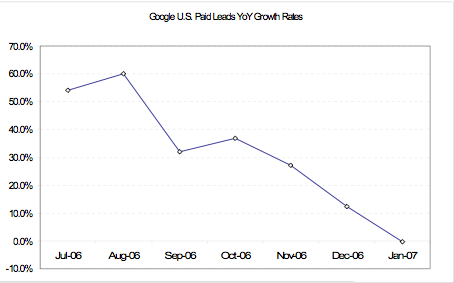
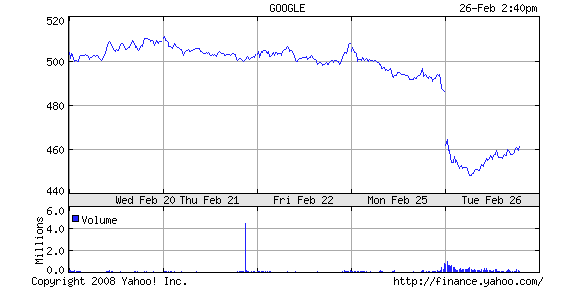
Google’s stock took a big hit today—still down 4 percent to $465—on comScore data suggesting that the click-through rate on its paid search ads is decelerating. As the chart above from Bear Stearns shows, the year-over-year growth of paid clicks on Google in the U.S. went from 37 percent in October to 0.3 percent in January. Since these are year-over-year numbers, seasonality is accounted for (there are more clicks in the months leading up to Christmas than after, but this January should not be flat with last January). The deceleration is alarming, to say the least. Even Henry Blodget, Mr. Google $2,000, now thinks this is a “disaster.”
goog-chart-225.png

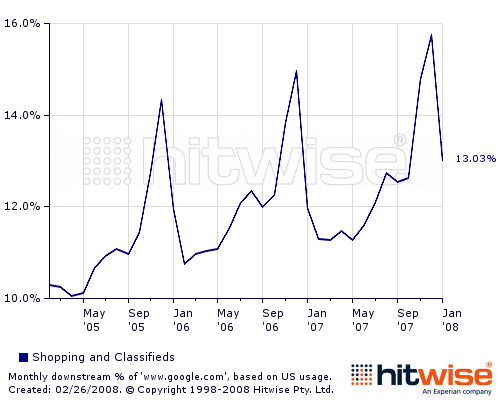
One explanation Wall Street analysts are putting out there today is that this could be an indicator that Google is not immune to the general economic slowdown. While a recession may be coming, that explanation is not convincing. Yahoo would have felt it as well, yet comScore reported a 15 percent year-over-year growth in paid clicks for Yahoo in January (to 242 million, compared to Google’s 532 million). Also, as Bill Tancer at Hitwise points out, traffic from Google to shopping sites is still above last year’s levels (evidence that paid clicks may actually be improving):
google-recession-1-small.png

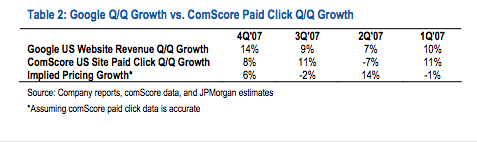
A more likely explanation is that Google is tightening the reins on clicks to combat click fraud and generate better clicks in general. Also the correlation between comScore’s click-through estimates and Google’s revenues has been highly inconsistent in the past. It definitely isn’t a one-to-one correlation. For instance, in the fourth quarter of 2007, comScore showed a 25 percent year-over-year paid click-through growth rate, yet Google’s actual U.S. revenues grew 46 percent. In the third quarter of last year, comScore showed a 48 percent growth rate for paid clicks, compared to an actual 58 percent growth in revenues. Sequential quarter-over-quarter comparisons are even more all over the map, according to calculations by JPMorgan.
jp-morgan-goog.png

So the comScore’s data maybe a leading indicator that all is not well at Google, it is not precise enough to calculate what the actual impact will be on Google’s business. What we are seeing here is the flip side of Google’s tight-lipped policy when it comes to giving investors any guidance whatsoever. Given this information vacuum, when the slightest bit of negative data comes out such as it did today, the market will assume the worst.

Where Will Google’s Stock Be In A Year?

Total Votes: 1871
Started: February 26, 2008

Advertisement

Comments rss icon

  • Is it possible that maybe a lot of sites are starting to move away from Google advertising as a result of several of the “anti-publisher” moves they’ve made recently? Things such as the reduction of the “clickable” area on ads and also the dropping in referral payments for both international adsense referrals and google pack downloads. It’s a total guess on my part, but if I were heavily relying on adsense revenue, I might see those as signs to find some alternatives…

    Does that even impact these scores though, the number of publishers running actual ads?

  • It’s not about search after all, it’s about advertisements, isn’t it? Is it the end of era of keyword search ads?

  • the market didnt overact, they underacted. When the google reports earnings, dont be surprised to see underwhelming results.

  • @Chris – reducing the clickable area of an ad is not “anti-publisher”. If a visitor of your site really wants to click on the ad, they will figure out that they need to click on the hyperlink – that’s Web 101 stuff. Allowing for the white edges to be clickable was leading to a lot of inadvertent clicks, and although AdSense publishers weren’t complaining, I also wear an AdWords advertiser hat.

    What is seemingly bad for the AdSense folks is a huge positive for the AdWords community.

    It’s just like any other market that has to cleanse out the garbage from time-to-time. The foundation of their business has not changed, however.

  • I agree with the Holiday seasonality numbers…December is a huge month for Search Marketing Budgets from small shops to the largest e-commerce sites. There is always a natural dip after the large Q4 ad spend for the holidays. Combine that with some large PPC advertisers in the lending / mortgage markets that have made huge cuts (and many are top 50 online advertiser) and that combination is likely responsible for a good chunk of the dip.

  • @allen – I agree with you 100%. It was still anti-publisher though, not anti-advertiser. You can guarantee that a ton of publishers were making money from creative positioning of ads so that they received inadvertent clicks. I know they were garbage clicks, but they still made people money…

    No dig on Google for making that change. I could see if effecting some publishers decisions on posting ads though…

  • @bs – they JUST DID report earnings:

    “Google reported fourth quarter net income of $1.21 billion, or $3.79 per diluted share, up from $1.03 billion, or $3.29 per diluted share, in the same quarter last year. Excluding special items, earnings per share amounted to $4.43, falling below analysts’ estimates of $4.47 per share.”

    $4/share x four quarters x multiple of 40 = $640/share and that’s a pretty low multiple in comparison to most tech stocks.

    Not too shabby – missing analysts expectations by .04 means the market value of a company gets sliced in half?

    I’m going to just assume you are one of those that likes to short stocks, then bash them to death whenever possible.

  • @Chris – it will only be a matter of time before all advertising platforms make a similar change, if they haven’t already. I don’t mind if the garbage sites don’t publish ads for my site – they kill our CTR’s (click through rates) anyway. It actually saves me time since I don’t have to explicitly do it myself. AdSense isn’t meant to fool people into clicking something; it’s meant to supplement a site with alternatives for visitors.

  • Googles HoneyMoon period is done, it will have more troubles if it ONLY depends on its Ad revenues.

    even though google have entered other areas, nothing is successfull enough to earn revenue. (well, most of google services remain in beta’s for who know’s how long).

  • Most analysts think GOOG is way oversold, so *any* negative is going to take wind out of their sails from a market perspective. The market moves, IMHO, have more to do with fundamentals than with anything specific; this news just added fuel to that fire.

    That said, $80 Bln in market value has been shaved from the company since the beginning of the year (from the $700/share price point.) It doesn’t send a strong signal that people are bullish on the stock anymore.

    GOOG actually gets a break by hiding behind the economy-is-affecting-us line they’ll surely provide as an explanation. If those click-through matters don’t get resolved, we may not have seen the bottom of this decline.

  • The problem is that two of Googles Click farms were offline for a while but now that they are back up and with twice as many mice, $2,000 is no problem.

  • This is self-inflicted.
    Between the page ranking changes and the changing of the clickable areas in there ads they had to see this coming.

  • Sorry, but can someone tell me what other income does GOOGLE have beside ads? their search server? customerized Search engine?

  • This may have also been caused by Google’s crackdown on arbitrage. There were people and companies (Geosign) generating HUGE volumes of clicks up until late last year. Yahoo! just put an end to it as well.

  • My opinion is that google will go under $350 before it starts to rise again

  • Um, is anyone going to stop using Google anytime soon? No… Will advertisers and publishers continue to use adsense/adwords the primary monetary foundation of the internet? Hmmm using logic, Yes… so stfu psuedo stock analyists.

  • I fail to understand how the drop in click-through as measured by comScore can be explained by Google combating click fraud. comScore metric is the number of clicks users make on Google. This should not get affected by Google combating click fraud, since this is not number of revenue generating clicks, rather it’s just the raw clicks. The click fraud crackdown can have an indirect effect on the number of clicks though, since incentive for the fraudsters gets reduced. That would take months to pan out and can’t happen this suddenly.

  • Something DID change starting in December and has persisted.

    I’m not sure if some companies were kicked off of Google, or click fraud was reduced somehow, but my Google Adsense revenues across all my sites has been down nearly 40% with no real slow in traffic.

    Some of it could be related to the above, but I’m not sure. It would be very interesting if over-zealous “let’s be good” filtering has reduced their revenue growth substantially.

  • The dot-com bust saw a 27% drop in overall internet ad revenue between 2000 and 2002 (IAB). Yahoo!’s stock price never recovered.

    And that damage was LOCALIZED, mostly to advertisers in the internet sector. Yahoo! at that time was more diversified then Google is today (they had broader marketing products and 5% rev was transaction fees)

    Google is 99% exposed (!) to internet advertising failure, the other 1% of revenue coming from licensing at al (annual report 2008). Not appealing.

    mobilekick – a LOT of advertisers have stopped using Google AdWords, and a lot of advertisers have stopped spending *as much* on Google AdWords. ROI on AdWords has dropped tremendously for me over 4 years.

    Whats scarier – many mature publishers have stopped carrying AdSense due to ROI (see ProBlogger), and some new ad programs will not allow you to display AdSense ads alongside their ads as they feel they give an amateurish appearance as AdSense publishers have been poorly screened for content and usage for years – users are associating the ad units with junk pages.

  • As an advertiser I can say that a two or three years ago I was using Google’s content network but now I don’t touch it. That maybe speaks to Tim’s point of cracking down on arbitrage or the general threads about reducing click fraud, so reducing the # of clicks and therefore the CTR. I know my CTR plunged after turning off the content network, but my conversions did not change materially. Proof, at least in my mind, that the content network is not a good channel.

  • #19,
    True on Adsense associated with Junk pages. Anytime I surf without ad block, I tend to ignore most of Adsense ads. However, I think the bigger problem with search and Adsense ads is that as people spend more time online they start to ignore any types of ads especially Google text ads. Sure, some inexperienced users will click on those but their numbers are declining. Not too mention brain filters those areas even without the ad blocking software. And unlike ad software, brain filtering happens with non techy users too.

    So while Internet advertising is still a huge business Google needs to realize that with the recession coming it’s unlikely that significantly more dollars will go to Internet advertising. They need to move into brand advertising as well as reducing their costs, and expanding into Asian markets.

  • Adblock Plus for Firefox has been downloaded almost 14 million times over the last 2 years, and I’m guessing that number represents a good chunk of heavy internet users. Does anyone suppose it might be having an impact on advertising? After all, you can’t click on an ad if it’s not on your screen.

  • @21,
    The human brain is a very interesting thing. As people learn, they start to recognize patterns, in this case, design patterns. Unfortunately for Google AdSense, because the ads are so consistent in their appearance, they are easily recognized by our brains as advertisements and are dismissed immediately. I think the turning point was when ads started to be placed in the middle of content. The reader’s brain recognizes a new pattern and eventually adapts the way they read content in order to block the ads.

  • I guess the drop in click thru is due to the fact that Google limit clickable space on their (adsense) ads to the title and the link itself? This greatly reduce the total clickable area of each ad by up to 80%.

    Maybe that affects the click thru rate.

  • Statistics don’t mean much. I think it’s a big over reaction.

  • Marzipan from Toledo - February 26th, 2008 at 9:49 pm PST

    @7

    PE of 40 is low? That’s equivalent to a yield of 2.5%. Adjust for beta and your real yield is probably sub 2% in nominal terms since GOOG doesn’t even really throw off a dividend.

    You have to understand with GOOG you are not paying for a dividend, what you are paying for is a company that hits the lofty targets set forth. It doesn’t matter if the stock is trading at a P/E of 5 … if they miss their target or the street thinks they will miss the target, the stock is going to get nailed.

    They missed their last quarter, and they might miss this one too. Combine that fact with a market cap that has just recently begun to deflate (from being in the stratosphere), and you have a stock to stay away from.

  • I LOVE it!!! MSFT must be laughing every day!

  • why doesn’t anybody disagree with the basic thing…. is ad-based revenue a viable business model long term?

    i don’t think so… because i hate ads, period… because there is so much online wall space, and relatively few ads… because the actual return to the advertiser has been wildly overestimated up until now… and the fraud thing won’t go away…

    so, is google, like facebook, over-valued? me thinks so, it just is not politically correct to say so

  • I would be an interesting financial analysis, to show how recession hits pure IT companies like Google. Anyone?

  • Adblock will finish them off.

  • Well he whole company is built on hot air and the perception that they are not evil

    the stocks themselves were overvalued

    and their true colors started to show now with their recent “lets hijack 404 pages so people have a faster path to our ads!” brainwave which is pure evil and something i would expect only from spyware (speaking of spyware why does google tool bar have to send a report of every page i visit to google?!)

    maybe they’ll wake up and realize 99% of their eggs are in one basket and just about every attempt to get into other markets failed

  • Simple reason is that there are too many competitions in the market and technology is available. So you have the technology, you use it, someone else do the same.

  • Ad Sense is a concept that weakens by the time people understand that context sensitive ads are in 98% not relevant to them. The click rate might therefore decline with this learning curve of the audience.
    Google is the very engine of an essential part of web2.0 – it makes us believe that ad-based business models are pure gold mines, whenever high traffic is involved. Im not sure if this will work out…

  • The Ace of Spades that doesn’t hide in a hole - February 27th, 2008 at 5:40 am PST

    Dropping stock prices, Wall Street excuses, the madness of crowds – few investors acting in isolation would buy stock in a company like Google . Hell, from where I’m sitting in Cape Town its looking like a bubble.

  • and now – “Websense is reporting that Gmail’s CAPTCHA has been broken, and that bots are beginning to sign up with a one in five success rate. More interestingly, they have a lot of technical details about how the botnet members coordinate with two different computers during the process. They believe that the second host is either trying to learn to crack the CAPTCHA or that it’s a quality check of some sort. Curiously, the bots pretend to read the help information while breaking the CAPTCHA, probably to prevent Google from giving them a timeout message.”

  • Just a quick switch in perspective: Have you noticed the power of providers of key statistics like comScore? The power to influence the valuation of a company like Google in such a way is the main message I take along from this piece of news. Not only Google is currently a cheap buy, but also comScore looks like fairly cheap to get in… Oh well, in the end it is all a random walk down the street…

  • The currency trading market can be cloudy but this post has brought out the sunshine. Thanks.

Leave Comment

Commenting Options

Enter your personal information to the left, or sign in with your Facebook account by clicking the button below.

Alternatively, you can create an avatar that will appear whenever you leave a comment on a Gravatar-enabled blog.

Trackback URL
bugbugbug