February 18, 2008

First Look: Kluster’s Market Approach to Crowdsourcing

Erick Schonfeld

65 comments »

kluster-logo.pngCrowdsourcing may work for Wikipedia, but few commercial companies have figured out how to make it work for them. The basic concept is to get outsiders, preferably customers, to swarm together to design a product or complete some other project. Crowdsourcing is quickly becoming a crowded field—there’s Innocentive, Cambrian House, the soon-to-launch CrowdSpirit, and Ideablob, to name a few sites. But Ben Kaufman, the CEO of a startup from Burlington, Vermont called Kluster, thinks that what is missing are market-like incentives to motivate contributors and push the best ideas forward.

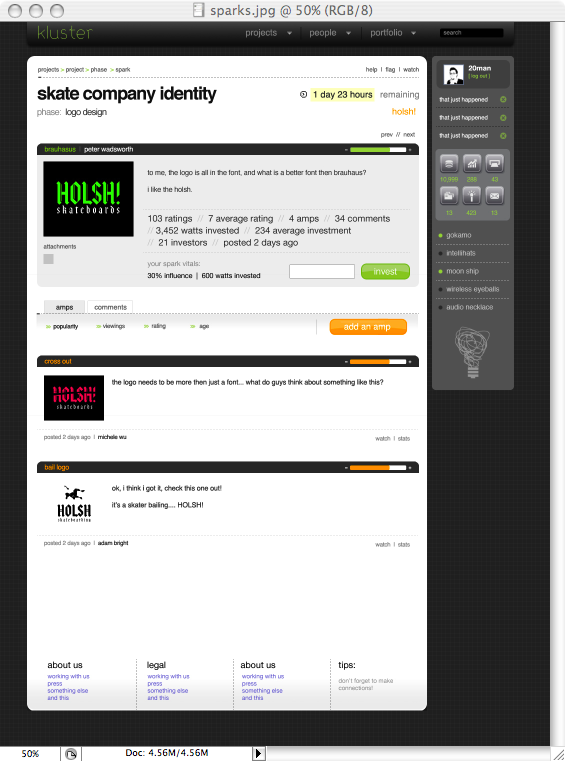
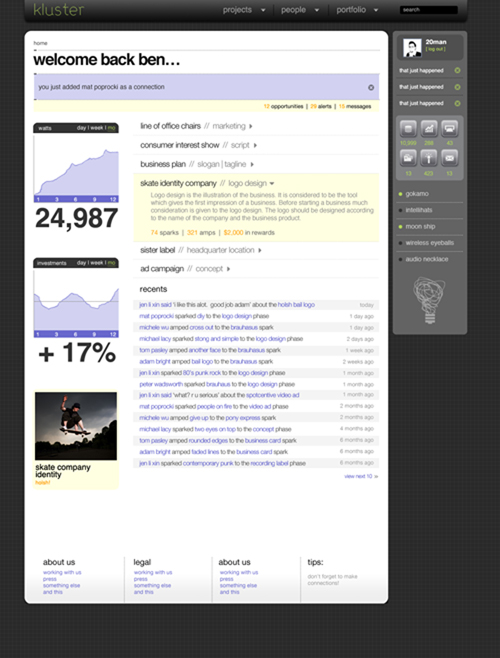
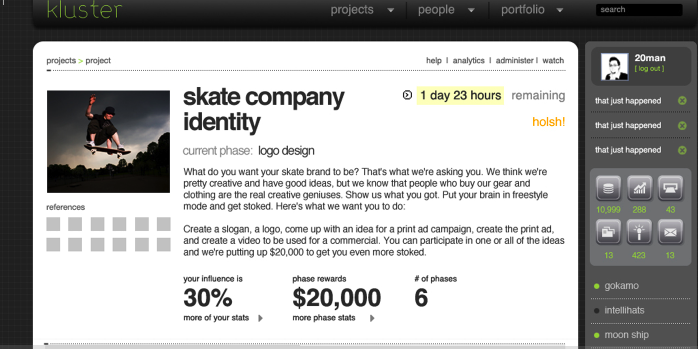
Kluster, which is supposed to launch later today in a public beta (Update 2/19: the site just went live a day late) and will be used by attendees at next week’s TED conference, is designed so that companies can offer cash rewards for each phase of a project. Participants who back the winning idea get to share the reward. Projects can range from creating logos and marketing campaigns to designing a product.
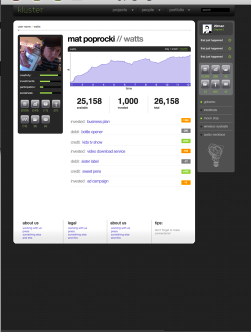
kluster-stats-small.pngParticipants start off with points, or “Watts,” that they can invest in different projects. Explains Kaufman:

Our Watt system is like a currency. You get a certain amount of Watts. As you do more things you get more Watts. Instead of voting on ideas, you invest your Watts in concepts you like.

So if a company decided to offer $5,000 for the best new logo to come out of Kluster, some graphically-inclined members might upload a few sketches. Other members could then invest Watts in the design they think is best suited for the company’s product, make suggestions for improvements, or upload their own variation of the logo. Whichever logo gets picked by the company at the end wins the $5,000, which is distributed to all the members who backed that particular logo based on how much they contributed to the idea, how early they got behind it, and what percentage of their total Watts they put at risk. Kluster computes what your stake is in any given project.

Watts are never directly convertible into dollars, but they do influence how much of a cash reward each member is entitled to. At the end of each phase, all the Watts invested in the losing ideas are redistributed proportionately to the investors in the winning idea. As people collect more Watts, they gain standing in the community and have more to invest in subsequent projects.

mophiebevy.jpegKaufman came up with the idea for Kluster at his last startup, Mophie, which makes iPod accessories and was recently sold to mStation for an undisclosed sum. One of Mophie’s hit products is the Bevy, an all-in-one iPod Shuffle case, bottle opener, cord-wrap, and keychain. The company designed it at last year’s MacWorld conference in 72 hours with input from 30,000 customers using software that was a precursor to Kluster. According to Kaufman, Mophie sold hundreds of thousands of the $15 cases.

He took the proceeds from the sale of Mophie, plus $1 million from Village Ventures, to capitalize Kluster. The business model is to collect fees from the participating companies. For each cash award that is distributed to members, Kluster collects 15 percent on top of the award. If a company wants to run a crowdsourcing session for a private group, Kluster charges for that separately based on the number of participants (public projects are hosted free). Kaufman is also exploring other ways to make money: recruiting users with particular skills to a project ($5 a head for each experienced graphic designer, for example); selling sponsored “feature” spots on the homepage to promote a project; user surveys, analytics, and targeted advertising.

Kluster’s success or failure will depend on the quality of talent it can attract to its site, and how active members become in contributing to projects. Members can debate different ideas, upload photos, videos, and even CAD files. Everyone has their own profile page, and can keep track of how many Watts they have. Unfortunately, the site doesn’t offer any Web-based product-design software, which is what a crowdsourcing site really needs.

But Kluster seems to get the economic incentives right which is half the battle. The other half is convincing companies that this is worth their while. For now, admits Kaufman, most companies see this primarily as a marketing exercise to engage their most avid customers and maybe generate some viral buzz. It will take a hit product to come out of this process for them to look at it as an actual source of innovation.

Rather than offer a cash reward up front, Kaufman initially wanted to structure the economics so that winning products get a $1 royalty per unit that is eventually sold. That turned out to be too hard to sell, but it is the direction where all of this is going. For crowdsourcing to really take off, the market needs to decide which are the best products. Not some brand manager.
klusterhomesmall.jpg
kluster-1.pngklusterskate-logos.png

  • Sphere It

Trackbacks/Pings (Trackback URL)

  1. TechCrunch Japanese アーカイブ » 初見:Klusterの市場アプローチによるクラウドソーシング
  2. Daily links 03/05/2008 « The World According to PMgD
  3. The Magnificent 7 ride in to town! « Mediary
  4. Kluster’s crowdsourcing platform to focus on incentives |
  5. Swaroop C H, The Dreamer » Archives » Why does crowdsourcing work?
  6. When Crowdsourcing Fails: Cambrian House Headed to the Deadpool
  7. When Crowdsourcing Fails: Cambrian House Headed to the Deadpool « Tecno Week

Comments

RSS feed for comments on this post.

  1. First

    First.

  2. chris_st

    OH man… I see lawsuits galore. Fred does some simple-minded logo sketch, then sues Fran who “won” because she “obviously” stole his idea and made “minimal” changes. Oh yeah, Kluster’s in it as “clearly” they play favorites and are conspiring against Fred…

  3. jarvan

    We have been using http://www.employeesuggestionbox.com for internal employees to logo ideas from employees, customers and vendors.

  4. Alaska Miller

    so like mturk?

  5. Ed

    Seems the space gets more crowded every day.

    http://www.aggregatemind.com

    Still pre-beta, but we’re taking a different approach, simple, brand-able, low cost, and meant to be used by customers. Comparable to what Salesforce and brightidea are doing, but for smaller scale businesses.

  6. Evprator

    Too complicated to work. This will bomb out shortly.

  7. Marzipan from Toledo

    can somebody name some of the bigger things to come out of cambrian house or some of these other sites?

  8. JeffC

    Welcome to the Open Innovation jungle, gentlemen! It is getting a bit thicker (we launched last summer). 2008 should be a breakout year … everything points to companies embracing this emerging trend, so it’s not surprising to see more start-ups … starting up. Personally, I love it.

    It’s all about enabling and encouraging Ideas and Innovation at every possible point (employees, consumers, customers). Why would a company not want to do that?? Innocentive has proved an Open Innovation model can work. I agree with Erick’s assessment of the hurdles for mass acceptance (incentives and success stories). It looks like Kluster is thinking these hurdles through.

    This is Web 2.0 at its best, giving Power to the People, enabling Small Business to think Big, and Big Business to seem Smaller by connecting to consumers.

    Anyone heard of the World’s Largest Innovation Box? We got that, along with the first Innovation Widget/Button to connect company websites to it. And an Open Innovation platform that any business can use to tap a global pool of consumers (inexpensive, self or full service). Oh, and a brand new (Webforce 2.1) off the shelf (or white label) co-creation and idea portal solution. One time fee, unlimited users. I’ll shut up.

  9. ceiling cat

    i made you an innovation box, but i eated it

  10. Greg

    …fuk

  11. Matt

    interesting. a lot of potential in this space, cool to see a player integrating other movements such as community paybacks…

  12. Alan Wilensky

    Meh.

    I think something like this would be better for skilled technical workers to collaborate on complex troubleshooting projects. Design is a very iconoclastic business, and the stars like to work alone.

    You would need a better lexicon to enable such a ‘pooled knowledge community’, something beyond text. A visual iconography, perhaps.

  13. Alan Wilensky

    techcrunch crashes another website - Fellowforce.com

  14. Evprator

    So much marketing 2.0 and so little usability. I’m guessing JeffC (#8) works for them.

  15. JeffC

    Not crashed gentlemen, just a slower load time than preferred. That can, and will, be fixed.

    Anyone read Wikinomics? Or checked out http://www.wikinomics.com? Great as a primer on Open Innovation.

  16. Ed

    Re: Evprator

    I have to agree on some of these. So much sparkle and selling, but I can’t grasp how to implement it for my company.

    I mean, our thing starts at $35 a month and admins can literally sign up, sign in, and set it up in 5 minutes. Maybe I’m missing something, or maybe I’m just naive.

    Seems strange to me that it needs to be so involved.

  17. Jasmine

    Crowdsourcing is a very viable method of designing or advancing anything from new logos, to consumer products , or even leveraging smart mobs to give feedback on business plans or which ads they prefer.

    The difficult part is nailing the rewards and incentives models to encourage participation. Members of the crowd have to feel they’re getting something in return - from glory in the community, to equity or even percentages of revenue if a product goes to market successfully.

    At Cambrian House - anyone can use our platform to crowdsource an initiative (not just software) and divvy out Royalty Points (percentage of net profits), dollars and more. But - beware in any crowdsourcing initiative… Wisdom of Crowds (or feedback, input, etc) is far easy to get than Participation of Crowds (members rolling up their sleeves and swarming together to work).

    They have to be passionate and you have to be sure to give them the kudos they deserve! Your company also has to be ready to accept an open and transparent culture.

    Regardless, we love seeing more people get into this space!

  18. Brian

    How about some of the crowdsourcing plays relating to graphic design?

    Obviously, there’s threadless for t-shirts, but there’s also 99designs.com which seems incredibly active with projects & graphic designers working on everything from logos to webpage design.

  19. Blue

    @Marzipan from Toledo

    - Yes, I can name stuff that’s come out of Cambrian House, along with Gwabs (crowdsource game they are releasing) and FilmRiot (crowdfunding for independant film makers) there is my site, http://www.greedyorneedy.com. These, along with others, will built with Cambrian House’s crowdsourcing model.

    We have an extremely loyal and sticky community, where the average time spent on the site is 26 minutes a day. That’s THIRTY FIVE pageviews per visit, on average.

    http://www.greedyorneedy.com continues to use the Cambrian House community to develop and improve the site.

  20. John A

    I fail to see how any of these websites, kluster, Cambrian House, or otherwise actually provide any value right now. This is a highly ‘conceptual space’, as in I don’t understand what output I’m getting for my considerable amount of input. Why spend the time understanding these complicated models of labour and reward when I can jump on craigslist or odesk or whatever to just advertise what I need and offer up that forgotten ‘currency system’ in exchange for their services… currency.

    All of these sites will never cater to a wider audience, because they are not mass consumed. The average person would never even understand what the hell they’re trying to accomplish. Keep it specialized, keep it niche, because the idea that anyone can magically start and run a business on any of these platforms is diluting themselves. Get rich quick schemes are just that, absolute schemes.

  21. JeffC

    #20 John A:

    I would argue that the ‘value’ provided will be exponential in the future (hopefully near, not far), but I would agree that this is still the infancy of Open Innovation (broad term, encompassing Crowdsourcing).

    It’s not rocket science, and shouldn’t come across like that. But it is an emerging trend, and we’re in the middle of a years long education and news cycle process. It’s simply asking anyone (crowdsourcing), or a targeted group (crowdcasting) for ideas and solutions. It’s also being open 24/7 to ‘ideas out of the blue’, from employees, customers, consumers. It’s basically idea encouraging, enabling, and management. And the companies that begin doing this now, I believe will reap huge rewards as time passes. You not only open yourself to potential innovative ideas, but you build goodwill with employees and consumers, who you invite to ‘co-create’ with you. It’s great marketing and PR - the Doritos user generated Super Bowl ads being a prime example.

    Fortune 500 bigs like Proctor and Gamble have been on to this for years (they use Innocentive heavily). They know that if they are not pursuing ALL innovation channels, then they’ll get run over by the fast moving and disruptive digital business environment. As far as competition, I welcome it. The more the merrier in terms of getting the word out, and hopefully our model will stand out. We (Fellowforce) are trying to bring Open Innovation ‘to the masses’, to any consumer, to any size business, and it’s certainly an evolving process. The great (and humbling) thing, is that you’ll always get plenty of feedback, by virtue of the business we’re in! And all constructive feedback is welcome.

  22. John A

    @JeffC

    It’s not that I don’t think something like this will never catch on, because I think it will… it’s just fighting so much entrenched inertia of how businesses operate and get off the ground. On a one-off project basis, I think it will gain some corporate traction, but it will not underpin an entire organization in the short term. In fact, the corporate internal offering is the angle I think you’re right about. Sell it to the P&G’s of the world, not Clueless Bob who has no idea how to start or run a business and expect people to come flocking to help him….

    just my 2 cents!

  23. Kevin_Cox

    Cambrian House is a disaster. The staff at Cambrian House expect the crowds to do *all* the work — not just come up with the ideas but to reformulate the ideas into perfectly competitive products/services.

    And then the Cambrian House staff complain when the “crowds” come up with some not so good or well thought out ideas. Can you blame the crowds? Take a look at Digg — crowdsourcing at its best/worst — Top Ten Lists anyone?

    The problem with some of these sites are the site operators. They seem to think they can put up a site in a week and then expect the crowds to do all the “real work” of coming up with that original/winning idea.

    Entitlement at its best.

  24. Matt Greeley

    Brightidea.com has been working in the crowdsourced-innovation space since 1999…

    We ran our first crowdsourcing campaign with Sears Kenmore in 1999 to collect ideas to improve the refrigerator. We were instantly overwhelmed with more than 5,000 ideas in 30 days. It took a month to manually parse the responses with print outs and highlighters.

    What became immediately clear was that it would require a wholistic approach to make this work. If it “takes a village to raise a child” it “takes an entire industry to crowdsource a single idea to reality”.

    That industry requires:
    - Community Site (eg. Ebay for Ideas)
    - A Community of Innovators
    - Idea Ranking and Prioritization Tools
    - Corporate Relationships
    - Legal Precedent for Exchange of IP
    - Product Development Tools
    - Project Estimation & Valuation (eg. Predictive Markets)
    - Portfolio Management Tools
    - Advanced Technologies (eg. Semantic Parsing)
    - General Consumer Awareness

    Our WebStorm product was recently used by Cisco to power their I-Prize Competition (www.cisco.com/iprize/). Cisco collected, developed and prioritized 1,100 ideas, from 2,000+ users in 70 different countries over 90 days, with no manual intervention.

    There is much work to be done. If anyone would like to partner, to build out this ecosystem, please contact us.

    Matt Greeley
    Founder and CEO
    http://www.brightidea.com
    Brigthidea.com :: Powering Ideas to Reality TM

  25. Brian

    I just wanted to put you all wide to a great series running on BBC radio called ‘In Business’. This particular program deals with ‘Democratized Innovation’ and features interviews with the likes of Don Tapscott, Eric Von Hippel and Innocentive.

    http://www.bbc.co.uk/radio4/ne.....ness.shtml

  26. Damien

    Crowd sourcing makes me think of the phrase “Cluster F**k” unless that’s the aim in a tongue in cheek way?

    I can see a lot of flame wars coming out of who thought of what and when and how that was more important to the eventual result. Coupled with money that’s a Klusterf**k waiting to happen, but it will keep the lawyers busy…. now there is a thought. What better way to go ambulance chasing if you are actually driving the ambulance.

  27. JeffC

    @John A

    Very valid points. “Entrenched inertia” … I could not have said that better. But it is changing. I’m having conversations with several Fortune 500 companies right now, very exciting conversations about white label ‘idea portal solutions’, and the winds of change are blowing.

    I think Open Innovation platforms will become one option for companies, certainly not the only or main option. Just like a company uses several recruiting channels (Linkedin, Monster, Facebook, Dice), companies will deploy Open Innovation strategies to make sure they’re covering all of their Idea and Innovation bases. To me, it’s stupid to ignore your workforce, since they’re in the trenches and have ideas bubbling around their brains. And consumers … well, they use your products and services, and they’re typically willing to share their ideas. With the right incentives, these ideas are ‘released’, gathered, vetted, and the good ones used.

    I wouldn’t write off small business though. Here’s the cool thing for them: with a nominal investment, they can ask a global pool of consumers and experts for help with a project, say a marketing plan or slogan. Post a ’self serve’ Innovation Challenge/Opportunity on our platform for less than $200 and ask for ideas. Add whatever incentive is offered, and that’s the total cost. The added benefit: by engaging consumers for ideas, you’re also marketing your products and services to them. And if you get a worthy idea, announce it, celebrate it, and start over again.

    I agree that Clueless Bob cannot and should not expect consumers to save his bacon. They might come up with a fantastic sandwich to put the bacon on though …

  28. Jasmine

    @ Matt - I like BrightIdea :) I also like IdeaCrossing and think any chance to open up conversations and problem solving to the masses can help identify fantastic solutions - ones may of us would never come up with within our organizations’ four walls.

    The term crowdsourcing is certainly struggling to avoid the “buzz word of the month club,” as any new term does - but the value it can provide far outweighs some of the concerns. From John Harrison (the longitude challenge) to GoldCorp to Kluster, Cambrian House, Sell-a-Band and more - many experiments though history and the present are being looked at to determine what works and what doesn’t in the world of open innovation.

    But open innovation or crowdsourcing should never equal free or cheap labour.

    @Kevin_Cox: Cambrian House is a platform for anyone to crowdsource ideas, businesses and products - the team at CH may invest in ideas and businesses that gain traction within the community, but we don’t ask the community to work for us - instead we want to provide a place where anyone can collaborate - with us or without us. I will admit, once in a blue moon the video blog may pick the best and worst ideas of the week - but it takes a lot of acorns to grow an oak tree. And - the great thing is, when any community rallies around an idea, they often work together to polish it and make it better.

    @JeffC - You’re right that open innovation should include your work force, too. I think sometimes people forget about the crowd within their four walls… And we all know someone, somewhere in your building has a bight idea that just might take off. All they need is a system that gives them a voice and a culture where managers will listen.

  29. JeffC

    #25 @Brian

    Thanks for the heads up on that BBC series. I’ll definitely check it out. Read “We Are Smarter Than We” yet? Forward by Tapscott. Website:
    http://www.wearesmarter.org. The book was basically crowdsourced.

  30. Jasmine

    We Are Smarter Than Me is excellent!
    And don’t forget about Jeff Howe’s upcoming book (pre-order on Amazon). Here’s his blog: http://crowdsourcing.typepad.com/

  31. Kevin_Cox

    OK, I am the real Kevin Cox from CambrianHouse.com there seems to be users trying to steal my identity. If you want you can message me on the site to prove that I am real. The views expressed in the comments here are attempts by others to bad mouth the site. I never said anything of the sort.

  32. gordon mcdowell

    Kevin… then how do we know THIS is the real Kevin posting…?

    I believe this scene happened in a movie once. Either it involved 2 identical twins… or an alternate universe bridged to ours by some sort of wormhole.

  33. Kevin_Cox

    As I said before:
    You can message me on http://www.CambrianHouse.com to prove that I am the real Kevin_Cox.

  34. John A

    Here’s a better question: who gives a shit if you’re the real Kevin_Cox?

    no, seriously … ?

  35. JeffC

    @Jasmine
    @Gordon

    Cambrian House … what a great ‘coffee house’ feel to the site. I mean that in the best way. Feel and mood are overlooked with most websites, and yours has a creative atmosphere and whimsical character. Jasmine, glad you brought up the Jeff Howe book (for anyone who doesn’t know, Howe is credited with coining the term ‘crowdsourcing’). I’ll be pre-ordering that tonight. :-)

  36. Trudy

    “Clusterf##k” It is funny but potentially a real problem. The Crowd does need to be rewarded fairly along the way and share fairly when a project hits the bigtime.

    I would also be concerned that organized businesses will organize to scoop the best work of individuals and throw the real innovators chump change.

  37. Evprator

    Kluster F*#kup is what this is.

  38. Caligula

    My God… are you serious?

    This is the same sort of idiocy that led to the first internet meltdown. The only difference between Web 1.0 and Web 2.0 is that some marketing geek gave it a quick handle. You’ve learned nothing. Nothing!

    Let’s go to facts that are missing from just about all of these articles:

    1. Most of you still have no idea how you’ll ever turn a worthwhile profit. Shockingly, it’s almost never mentioned.
    2. Most of you believe a sound business plan is to start a company and hope to be bought out by a larger company.
    3. You all don’t even have the value of WebGrocer.com, which at least created a service that people could theoretically use. You’re creating things to solve problems NOBODY in their right mind has.

    As for “crowdsourcing,” why don’t you admit what you’re really looking for? It’s called “free work”, or in this case “as close to free work as possible”. And no professional designer — you know, the kind of people who design logos as part of a larger marketing focus — will contribute. For decades, young designers sent in their ideas to “competitions” held by companies — until folks noticed that “losing” artwork often showed up in use several years later. This isn’t new. And you’re serving the needs of not one creative professional I’ve ever met. I’ll bet that the entire market research for these retarded ideas came from the corporate buyer end.

    Can you ultra pro-active investors just make sure you don’t ruin old people’s pensions the next time you screw up our economy with this tripe? Tiens.

  39. Caligula

    Ah yes, how could I forget this one?

    @ Trudy
    “The Crowd does need to be rewarded fairly along the way and share fairly when a project hits the bigtime.”

    Yes, Dear Prudence. It’s called a “paycheck”.

  40. Andrew Johnston

    Crowdsourcing…a term which has been floating around for just under two years now. Sure we could pull out a book (wikinomics) and read all sorts of past examples that apparently worked, but honestly have we seen much done with the concept in the past two years? Blue and Jasmine…both reps from CambrianHouse would LOVE you to believe that they’ve built all sorts of wonderful sites. In two years they’ve come up with some concepts and had very little traction. GreedyOrNeedy.com (btw, the logo is missing…might want to get someone from your crowd to fix that!)…a revamped RobinhoodFund.com wasn’t built by any crowd, and neither is this Gwabs game which has been in development for a very long time and was supposed to be launched last year. Both projects built in house under big financial backing. I smell lies.

    KlusterF*#kup is exactly what this crowdsourcing is. Open Sourcing shows that scattered people working together CAN and DOES work very well, but so far no company has been able to make it work for them. Once you add money people get stupid. Threadless.com is about the best example to date of people getting paid for submitting work. Although you’d hardly think anyone submitting t-shirts finds it ‘work’. Not like submitting hours of code for a possible chunk of royalty on a project which MIGHT work out. Fingers crossed…pray to a God.

    Open Source works, but crowdsourcing is a pipedream. Good luck Kluster!

  41. Trudy

    How about that “Ideablob”? $10,000 / month x six months. It looks like it is all comming to a close. Was it just a one time (six times actually) sweepstakes with a lot of creative energy supporting a 60k investment?

  42. Anil Rathi

    IdeaCrossing’s been tapping the crowd since 2002 starting with the Innovation Challenge MBA business competition (http://www.innovationchallenge.com) with sponsors like Hilton, AMEX, Harley-Davidson, Shell, IBM and then powering the Red Hat Challenge (http://www.redhatchallenge.com) and the most recent HopeLab Foundation Ruckus Nation competition (http://www.ruckusnation.com). Each of these contests attract thousands of people from dozens of countries…that’s the easy part.

    In talking with our clients, I believe that for crowdsourcing/crowdcasting to work, we need to move from the ‘raw idea’ (that I thought of while showering this morning) to ‘refined ideas’ that prove a compelling business case. Even then, a refined idea may take an investment of money, skill, time and resources to bring to market.

    So, how do you get the crowd to produce refined ideas and be rewarded fairly when we fork them over? I guess that’s why we’re all here. Kluster looks like an interesting model. good luck.

  43. tim

    we too are working on a site to crowdsource from designers, this is the key distinction between this site and others like cambrianhouse, crowdspirit et al. very hard for those ideas based sites to turn their ideas into reality.

    i disagree with the authors comment…

    “Unfortunately, the site doesn’t offer any Web-based product-design software, which is what a crowdsourcing site really needs.”

    as one poster said, the work is mostly of an individual nature. Sites like conceptshare, tracbac are working on the real-time collaboration approach, takes a fair bit of time to develop those sorts of features.. good commenting features should be sufficient at least for version 1.x.

    also about the ownership issue. eg “lawsuits galore”. This can be solved relatively easily by allowing the community to submit previous derivatives/copyrighted works etc and an arbitration process with interested parties before winner is announced etc.

  44. Ian Kemmish

    It sounds like a hideously expensive way for client companies to do something they’re already doing much cheaper elsewhere.

    There’s a good reason that design, production engineering and brand consultancies don’t charge their clients royalties. A competitor who tries to charge on a recurring basis for work done by people with no track record is really on a hiding to nothing.

  45. Kevin-Cox

    I’m the real Kevin Cox too..

  46. Kevin Cox

    No I’m the real Kevin Cox

  47. Kevin Cox's Mum

    He’s not the real Kevin Cox. He’s a very naughty boy. Now go away!

  48. JeffC

    Crowdsourcing certainly has its hurdles. But Innocentive has already proved there’s a demand, and there’s a way to profit from that demand. Their ’solver’ community of researchers, engineers and scientists numbers about 160,000, and do business with the likes of P&G and other Fortune 500s all the time. Bright Idea has been inking deals with the Ciscos of the world since the late 90s. I believe their idea management systems run into the six figures and beyond. Idea Crossing has had success as well. Anil Rathi’s comment is a good window into the ‘raw to refined’ issue with ideas.

    We’re finding there’s a growing demand for the ability to tap ideas 24/7, thus our Fellowforce Innovation Box, with connected Innovation widget, and our new Webforce 2.1 Engine for Consumer Feedback and Co-creation. Crowdsourcing a particular project is one thing, but being open to ideas that may improve your business, and being able to encourage and manage those ideas properly … there’s a definite demand for that, from Fortune 500s to SME.

  49. JeffC

    “Kluster, which is supposed to launch later today in a public beta”

    Not launched yet … any update?

  50. Brian

    #29 @JeffC

    I haven’t had an opportunity to read that book but I’ll try and get hold of it. The other book which I think is interesting at a glance is called Herd written by Mark Earls.

  51. Caligula

    Yes, JeffC, Kluster wasn’t “seize vertical web services” enough and the geniuses spent the rest of the day in front ye olde dack.com bullshit generator, hitting refresh and waiting for a winning combination.

  52. tim

    ok so i take back what I said about kluster going after the designer crowd. This site is very much the same as crowdspirit, cambrianhouse et al just more refined.

    At the moment they have 375 users, and about 15 distinct but very empty projects (ignoring duplicates).

    I think they will find the, ‘build it and the masses will fill in the blanks’ mentality will stretch only so far. These sites tend to attract a core community that does the bulk of the work.

    For example, cambrianhouse stats..

    * top 25 users contributed 10,780 comments (over 37% total).
    * Nearly 50% of all ideas submitted in total are from new users. 90% of these users only ever comment on their own idea.

    stay tuned folks,

  53. mickey Reese

    KLUSTER… The new dumping ground for crap ideas.

    Ideas are cheap, execution is much harder..

  54. hypocriticist

    ideablob, which is the only one of these sites that I’m familiar with, is a poorly conceived concept. Projects win $10k each month based on votes from registered users. To demonstrate how non-meritocratic it is, I heard about it when my friend’s brother mass e-mailed 100 people- random people- to get them to register on ideablob and vote for his (bad) idea. Well, I voted for him, and registered. Then I realized what a popularity contest it is. Stupid ideas constantly win there b/c the winners rally the most votes from friends and family. Its a terrible system.

    Kluster at least tries to combine compensation and some real business projects. I will register with Kluster and check out some of these other crowdsourcing sites. But I won’t put any of my own business or design expertise or my own ideas on there. Not until I have some certainty that the originator gets a respectable chunk of cash for the final idea, and that the system isn’t rigged. I have a few sily little business ideas that I might go with on there, just to see if it can work. But here’s what I need to know for sure, in writing from Kluster with the CEO’s signature: that my work is my property (until it gets purchaased, of course) and then, how am I paid? Based on an algorithm that weights other people’s contribution of time, energy and… monopoly money? Hey look, I like crazy ideas, but I mean, jesus. Did any of their sophisticated investors ever ask the question about lawyers and intellectual property during their pitch? Or did that just get skipped because we’re in Web 2.0 now?

    Anyway, I just read Black Swan so nowadays the crazier something is the more optimistic I am about it… I’m cautiously optimistic about this.

  55. Jaap Bloem

    Losin’ Your Mind Over Crowdsourcing?

    Check Xzibit, Snoop Dogg & Dr Dre:
    “Out of a crowd, picking em out (and what?)
    Digging em out to kicking em out (and what?)
    Surviving the game is what it’s about (and what?)”

    Look & listen: http://youtube.com/watch?v=4iWIsgVX_3U

    My posting (in Dutch alas, but I can translate it if you like): http://www.frankwatching.com/a.....gg-dr-dre/

  56. Chris Stewart

    I’ve really enjoyed reading these comments. It will be interesting to watch the Kluster platform in action during the TED conference this week. Supposedly Kluster will unveil a TED attendee-developed product on Saturday morning. Check out Kluster’s site for more info.

  57. Thomas P

    Hey kudos to you guys, I think the SME market is where it will be for you, I don’t see bigger business using this internally for any kind of product development.

    However can I just say that I’m fascinated by the nature of the idea. Unlike other points of expertise/art, an entrepreneurial idea is something that EVERYONE has, but very few have the mechanism to validate it. Thats why this model is both fascinating and fatally flawed.

    In our experience (product development) very often the most successful products or innovations HAVEN’T come from a crowd-vindication (e.g. customer emails/demands) but rather from a single mind that has thought obliquely about the problem and produced a feature that STILL isn’t validated in terms of its function until its in the hands of its user. So in effect the amping of an idea in our experience hasn’t been the function that has returned a profit.

    Internally we use Copper Project (http://www.copperproject.com) to set up our initiatives and run through our testing/productization/approval/protoyping/ marketing, maybe you could hook in with those guys?

  58. James Gillmore

    I used it intensively today and think it’s awesome! I just wish there was a way to make your project private. I realize that the point is crowd-sourcing and the more the better, but sometimes you have a private startup or something, ya dig. I requested that they add this feature.

    James
    from
    FaceySpacey.com, Your One Stop Social Media Shop