 Peer-to-peer lending is coming to China. This morning I interviewed a Chinese-American entrepreneur living in Shanghai named Calvin Chin working on a stealth P2P lending site for Chinese student loans called Qifang. (The name, which translates to “bloom,” comes from the Chairman Mao quote, “Bai Hua Qi Fang”—”Let a hundred flowers bloom.”) Consumer lending is just getting off the ground in China. Most college education is financed by group borrowing associations rather than bank loans. Chin wants to bring that group lending dynamic online with Qifang. In fact, P2P lending might have a greater impact in China and other developing countries than the U.S. because of the absence of other consumer banking alternatives.
Chin was born in Michigan, went to Yale, and worked in banking and a few tech startups before moving to China. He founded Qifang in August, 2007. He is aiming to a launch the site in China in the spring. So far it is a real bootstrap operation. He has raised $200,000 in angel money from investors in Hong Kong and other parts of Asia, and is in the process of raising a series A financing. Qifang was inspired by existing P2P lending startups like Prosper and Zopa, but Chin is developing it with a Chinese twist. He says:
We feel strongly about China’s Internet being pretty embarrassingly all about copies. And while we were inspired by other models, we feel like we need to challenge ourselves to be different and better and fit the market. We think of it as innovation leveraging—take a good idea and make it work for China by making it different.
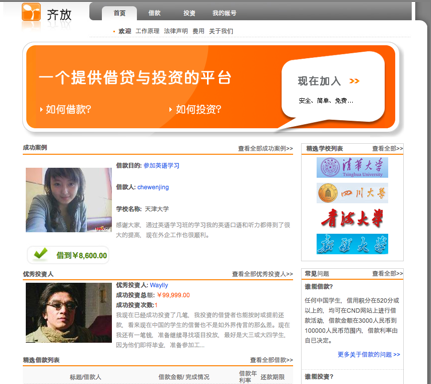 Simply porting over Prosper’s business model won’t work, given the lack of credit history, the lack of a large student loan market, the still-young Internet culture, and the severe regulatory environment. As with Prosper, individuals with money to invest can come on the site and register as lenders. They can browse through the profiles of the different borrowers to decide who to loan their money out to. Unlike Prosper, Qifang is starting out only with student loans.

And it is not the fist P2P lending site in China. A broader one called PPDai offers P2P loans across many categories (see this write-up in English). But Chin thinks that starting with student loans is the better strategy in China because of the need to stay in the good graces of the government. Anything that helps promote education is popular with government bureaucrats.
It is also a big market. Chin estimates there are 25 million students in China, who pay an average tuition of $700 a year. That is $17.5 billion in potential loans.
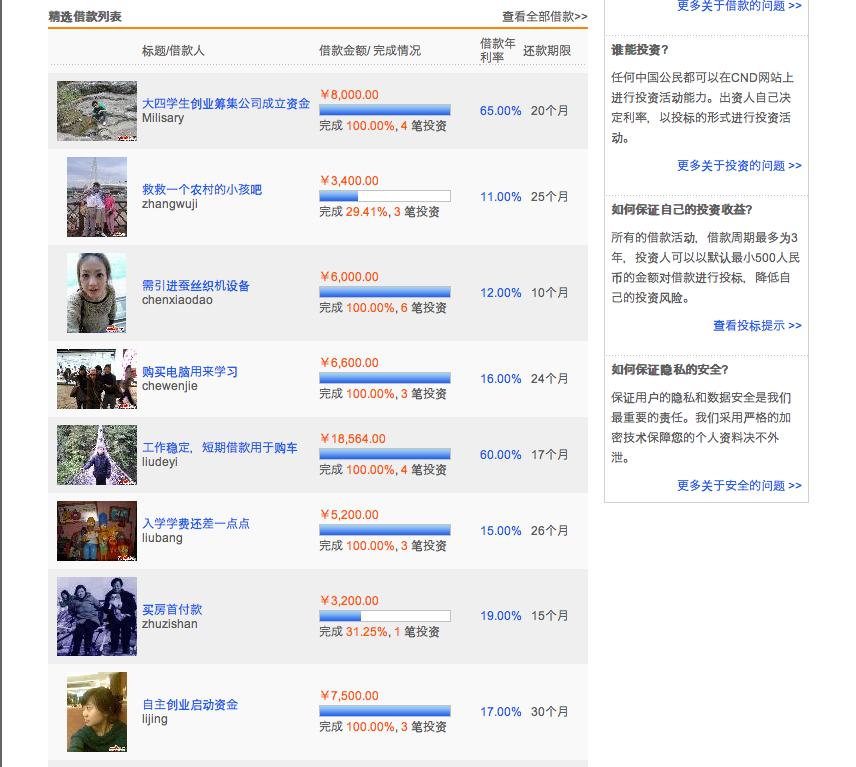 Chin expects the interest rate on most loans on Qifang to be between 8 to 12 percent, a decent return. The interest rate will be based on how many lenders bid on each loan. The site will recommend that lenders invest in a portfolio of loans to reduce their risk, but if they choose, each one can put all their money in a single loan. Since there is very little credit history on individuals in China, the site will use other proxies to calculate risk. Each borrower must scan in their national ID cards to verify who they are, and list their school, major, grades, hometown, parents ID cards and income. Chin is creating partnerships with the schools directly, so that the information students supply can be verified and so that loan payments can be made directly to educational institutions. “We don’t want students running off to Macao,” he jokes.
There will also be an interesting social calculus that takes place on the site. Since each borrower’s parents will be named on the loan, failure to pay it back would result in a shameful losing of face for the parents. “Social pressure is very powerful here,” notes Chin. Default and delinquency rates will also be visible by hometowns, school, and even major. Banks don’t benefit from that sort of social pressure. Whether it will have any effect on default rates will be worth watching.
As growing economies like China develop their banking infrastructure, P2P lending has a shot of growing up with it rather than fighting against an already-entrenched way of doing things. In that sense, P2P lending might have a better shot in China than it does here.