
Have you nominated someone for a Crunchie today? »
Wikinvest To Add Unique Comp Data For Stock Research
by Erick Schonfeld on February 6, 2008

wikinvest-logo.pngFinancial and stock research sites like Yahoo Finance, Google Finance, Marketwatch, or CNNMoney have done a lot to democratize investment research by bringing reams of financial data for any publicly traded company to investors at the click of a button. But when it comes to financial metrics, much of the data they provide is the same for every company: revenues, earnings, PE ratios, market caps, assets, liabilities, analyst estimates, and so on. To really understand a company, this data is just a starting point. By the end of next week, Wikinvest is planning on introducing a new feature to help investors dig deeper. Says co-founder Michael Sha:


People have a thirst for information and data, but the traditional data available does not make much logical sense. They don’t help you understand the nuances of companies and industries.

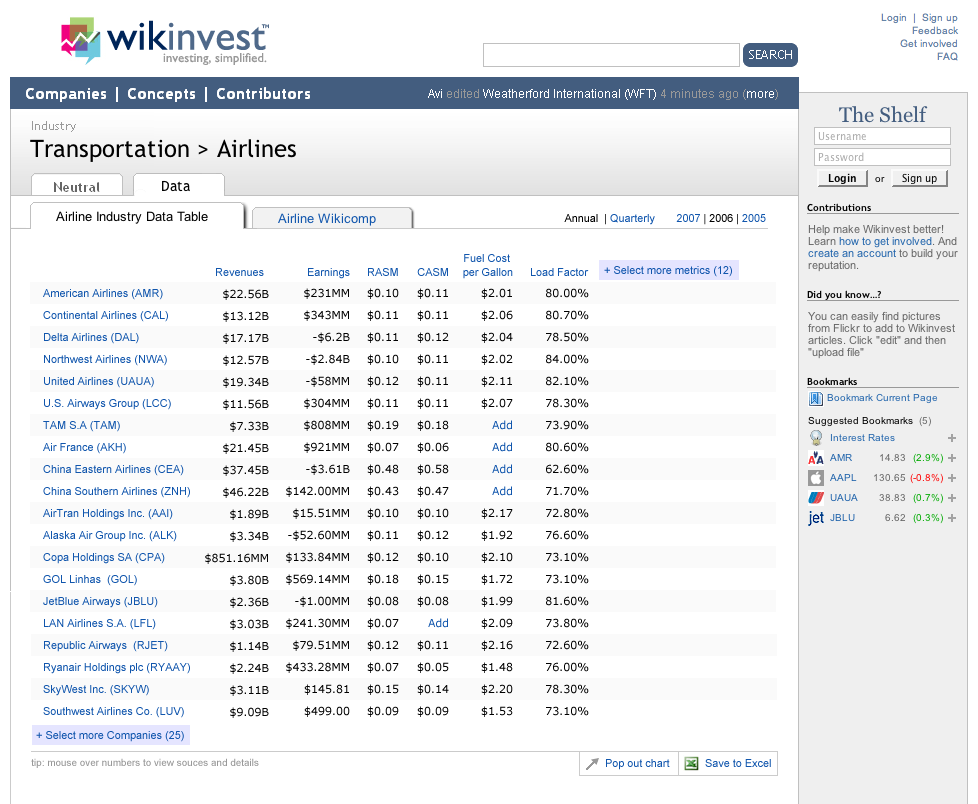
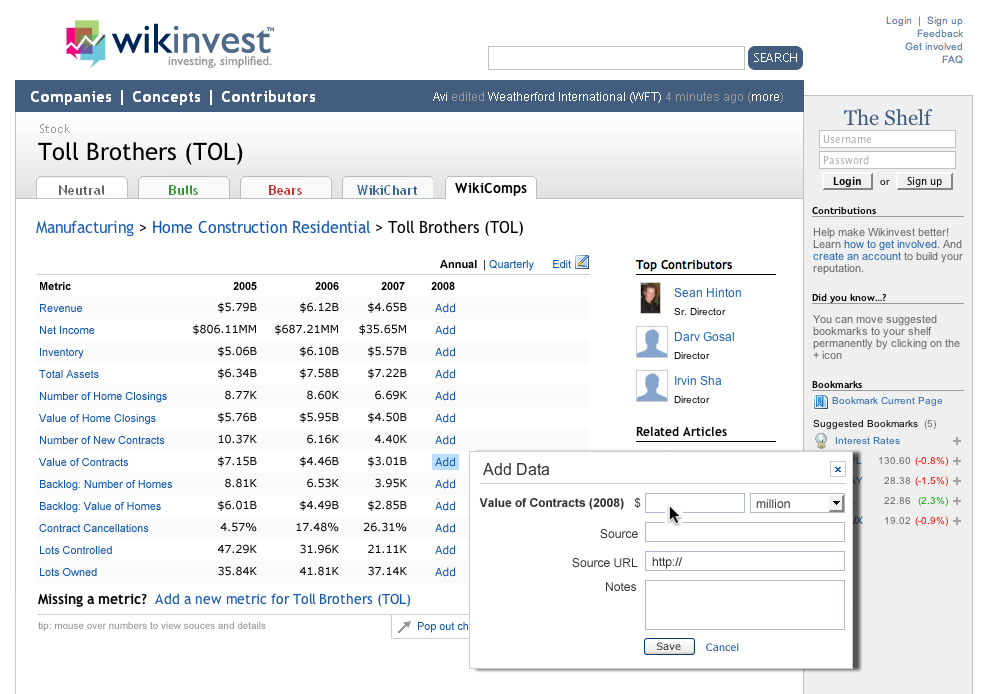
Each industry has its own unique set of comparable metrics by which analysts and professional investors gauge the health and productivity of the companies in that industry. For airlines, it might be fuel costs, revenue per available seat-mile, cost per available seat-mile, and load factors (what percentage of seats are sold per flight). For home builders, the comps might be number of home closings, number of new contracts, and number of canceled contracts. For manufacturers, you might want to look at inventory turns. For banks, default rates and interest rate spreads. It is too much for any one individual investor to calculate and keep track of.
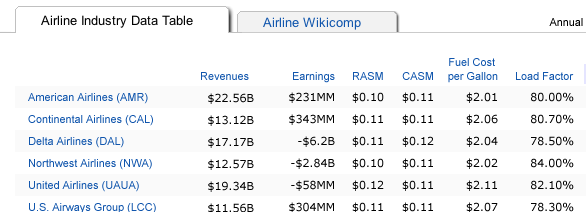
wikinvest-chart.png

But that is where Wikinvest comes in. As the name suggests, the site is like Wikipedia for stock research, and is part of a growing trend of investment sites that tap into the wisdom of the crowd for investment advice. (See also, Cake Financial, Covester, and Motley Fool CAPS). All it takes is for one member to add a useful piece of data for everyone else to benefit from it. The company will seed about a dozen industries with comp data, and then invite its members to fill out the rest. Each data point must be footnoted with a source.

This is a really powerful example of what can happen when people collaborate around data. The comp numbers will appear on each industry page, relevant company pages, and a metrics page for each metric. They will also be embedded within articles about specific companies or industries. Explains Wikinvest’s other co-founder Parker Conrad:

What we are building is wiki for data. You might have data on our site that appears in multiple points on the site and that data point is updated everywhere it appears.

That’s great if the data is right. But there is one caveat: errors will also propagate more widely as a result. Wikis are eventually self-correcting by nature, but tell that to the investor who takes an erroneous piece of data on faith in the middle of an edit war and buys or sells a stock because of it.
wikinvest-wikicomps-example-industry-airlines.pngwikinvest-wikicomps-example-company-toll-brothers.png

Advertisement

Comments rss icon

  • I don’t understand the sharing concept around financial stock data. If I have unique, valuable data on a company why would I want to share it? Once the data has been widely distributed, the opportunity to profit from it is gone. You don’t see hedge funds opening their doors and sharing.

    • Well, perhaps I don’t have enough money to invest to make money from predictions. But, perhaps by letting others know that I am a great stock picker I can establish a reputation and later on make money by selling my advice. Think of it this way: “During the gold rush, who made the most money?” Answer: Not the miners, but the people who rented out the tools (picks, shovels, etc…). Great stock picking advice is like a tool. Rent it out to thousands of people and who will make far more money than if you tried to act directly on it.
      Hedge funds on the other hand offer to invest your money with their tool in exchange for a cut of the profits. Well, not everyone, even one with a great stock picking system, can convince others to let them invest their money.

  • This is a Yahoo finance clone at it’s best.

    Great concept. Go to finance.yahoo.com and promote the website in the forums.

  • @ #1. Right on.

  • Wow–this is definitely deeper than what’s available on YHOO if the airline metrics are an indication. Re: mmt’s post–a lot of the data look to be from annual report filings with the SEC, rather than being proprietary. Can someone confirm where the numbers are coming from?

  • Marzipan from Toledo - February 6th, 2008 at 9:48 am PST

    Wikinvest?

    How about I log into my brokerage account, look up AMR, and download the multitude of research reports on AMR which includes industry specific research, metrics, and comparison against the competitors.

    Same thing.

    I agree finance sites are a start, but for more in-depth research sign my brokerage gives me access to all the research I want from the likes of GS, JPM, etc.

  • #1 agree.

    and it is dangerous for ppl to disclose wrong information and try to move the market.

  • Contributor & Wikis… Many investors see another cyberslacking company.
    How does Wikinvest make money?

  • Wow, I’m a consultant and I feel like I’m looking for this kind of stuff all the time when we’re analyzing various industries. If they really get good coverage on a variety of industries, this would be amazing.

  • Marzipan, I think you are missing the point of this site a bit. First off, if you go to your brokerage account and download information about some company, you can assume everyone else has access to that same information – early profit opportunity lost. Also, these sites are limited to what their own analysts are finding vs. a much larger wealth of information that may be out there.

    A good example I heard recently: there may be some obscure compound that is discussed in a medical journal – the company working on it isn’t mentioned, but it’s described as a potential breakthrough on some disease. Analysts on the Street would probably never pick up on something like this. Sleuths on the Internet, however, may and with some work may be able to figure out who is working on this compound, publish it to the wiki, and therefore be able to take up a position in a stock earlier than the masses. It’s the same premise as Reddit or Digg – people finding interesting stuff that other people would find interesting that they wouldn’t have found themselves.

  • These guys have Harvard degree and asking for Contribution.
    Are you kidding?

    Why would you help Harvard graduate if they good at something?

    Why???

  • serious investors have Bloomberg/Reuters, but it costs in excess of 1k/month.

    as a former trader, I would not trust such a site – maybe because I’m spoiled by using those 2 sources…

    Wikinvest will then target small, amateur investors who don’t want to pay for data, so it will have an audience, regardless of the quality of the information it offers.

    Good luck to them!

  • Using a wiki for investing has to be the dumbest thing I’ve ever heard.

    If this would catch on, the possibilities to mislead investors would be endless and the only ones profiting would be those supplying the false data.

    And #1 is also spot on. No-one will share their valuable data unless they get well rewarded for doing so, such as in a investment analyst – client relationship.

  • From the screenshots, it looks like a major strenght that wikiinvest has over other financial websites is how painfully easy it makes it for ppl to compare the data side by side, not just access it. As long as they keep the data accurate…

  • The problem with financial websites is not the lack of information, but rather the information overload. Adding more metrics, even industry specific, will not make the portfolio return difference just as adding comparison metrics in Yahoo finance didn’t, or adding “similar companies” in Google Finance didn’t.

    What retail investors are longing for are in a way – Personal Digital Assistants that encapsulate all that information overload into a simple digested answer – what to buy or sell, and when.

    As pointed by others, sharing knowledge can practically dissolve a person’s profit advantage. However, sharing other resources for a mutual purpose that is beyond the scope/capability of a single investor) such as gathering available computing power as a powerful decision support tool can be both rewarding from a social perspective, and from a profit-taking perspective once you get the calculated results. This is exactly the concept behind GStock.com, a virtual supercomputer for calculating best performing strategies per stock.

    The outcome is that users can see simple BUY and SELL signals for their preferred stocks – practical metrics, and not information overload. These signals are based on best found strategy for that stock, and the computing power for finding that strategy, which anyone can now use freely, was enabled by people volunteering some of their available CPU power. Try it. It’s free. http://www.gstock.com

  • In active trading, too much information will paralyze you. At Dividend.com, we watch the tape and report it. The tape will not lie short-term, you just have to be nimble and not overstay your welcome. For long-term investors, the answer is dividend stocks with consistent dividends. The key with that is to tell your broker to re-invest the dividends. Dividend stocks have averaged over 11% annual returns for the last 75 years. Solid dividend-paying stocks are ones that you should be happy to buy when they go on sale. Check it out, we cater to active traders and long-term investors.

  • I think this type of industry-specific information would be of great value to me as an individual investor. Although sharing data is relatively easy- it’s much harder to help investors who have never seen a specific data set understand how to interpret it or to explain how it’s related to other financial metrics. This is the real challenge in front of Wikinvest. Hopefully they will deliver!

  • Check this site out. Enter your stock symbol and just pick selected stock research sites to see charts, quotes, insider info, prognosis, etc. for this stock:

    http://mysite.v...net/stockbuddy/

Leave Comment

Commenting Options

Enter your personal information to the left, or sign in with your Facebook account by clicking the button below.

Alternatively, you can create an avatar that will appear whenever you leave a comment on a Gravatar-enabled blog.

Trackback URL
bugbugbugbug
Techcrunch on Facebook