Sweden’s Twingly To Launch Europe-Focused Blog Search Engine
Michael Arrington
22 comments »
At first glance, blog search as a category is oversaturated. Ok, at second glance, too. Not only did Google enter the market directly in late 2005, they’ve also increased the rate that they index blogs and other regularly updated sites for core Google search. TechCrunch, for example, is now indexed multiple times per day by Google, and new posts are often available in a normal Google search within minutes of posting. Most people today say the best blog search engine is, simply, Google.com.
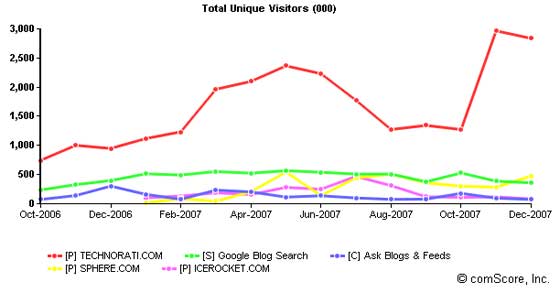
And there are many competitors. The Comscore chart below shows the relative traffic of the major ones - Technorati, Google Blog Search, Ask Blog Search, Sphere and IceRocket. Feedster is gone, although there are additional smaller engines like Zuula and Blogdigger as well. Every one of those companies is U.S. based (note that Paris-based Wikio has blog search as well as a Digg-like service).
Now Europe will have it’s own blog search engine - Twingly. I met Martin Källström, the company’s CEO, at the DLD conference in Munich earlier this week. Their focus, he says, will be to have a spam-free engine (something none of the others can claim) at the cost of inclusiveness. And at least at first, the engine will be focused on European blogs. Twingly’s search engine hasn’t launched yet, although I do have a screen shot of what the home page will eventually look like:

Twingly already has a product - a nifty screen saver that shows blog posts on a world map as they are written. The new search engine will use some of the back end technology they’ve developed for the screen saver - mainly their ping server (see here for our overview of what ping servers are) and existing index of blogs.
The search engine will be different from others, Källström says, in that it will be almost 100% spam free. How are they doing that? Instead of trying to index every blog in existence and then removing spam via black lists and other methods, they are limiting the blogs they monitor to those that are proven to be legitimate. They started with a small list of known blogs, and then spidered out from there based on links to other blogs. The assumption, which is fairly sound, is that good/real blogs will not link to spam blogs. The end result is a white list of real blogs that are indexed - everything else is ignored.
Källström says that, in addition to the consumer-facing search engine, they’ll partner with large content news sites to show blog posts related to news content. This is something both Sphere and Technorati have had success with in the past, and the company can do revenue-sharing deals on additional page views. Content providers like it because it incentivizes blogs to link to their content (to get a link back). Twingly may not be able to compete with Sphere and Technorati in getting U.S. based partners, but he says he already has some deals with large European publishers completed.
The company has raised €1 million in a July 2007 round of financing from Servisen. They have seven employees. Look for a launch of their search engine in the next month or two.


Blog search, I question about the value. Since a lot of websites will add dedicated blogs do them. A lot of blogs have some characteristics of websites. As a separated blog search, it does not make too much sense for me, May be I am wrong. But I think there is a merge of blogs and websites. Blogs and websites because less and less separateble
I doubt they have any real technology advantage. Focusing on European blogs ‘vertical’ should help attract initial users from Europe but they can compete with Google blog search is unclear.
I tried to test it. Doesn’t work!!! oh boy… I just lost it….
No interest.
I want a expensive search engine design by Microsoft or facebook or high profile companies that can remove blog spam websites such as Techmeme, Techcrunch, Crunchgear, all famous blog publishers. All Blogging websites is a joke. I mean it’s cyber slacking.
It’s too many corporate vandalism. I need search engine with serious business. Non-proaganda blogs & coprorate leaks. I want professional business search engine with corporate suit boys & executives and people who went to private school like Oxford. I want that kind of search enigne.
I wish someone can make search engine that blocks blogging websites. I want someone to make this dream come true.
“The assumption, which is fairly sound, is that good/real blogs will not link to spam blogs. ”
Not strictly true. Real blogs link to spam blogs when (1.) good links go bad due to domain transfers, bait-and-switch tactics, etc. (2.) included search widgets link to spam (3.) etc….
The assumption that “real blogs very very rarely link to spam blogs” is more workable.
Many media, journalists, WGA & large publication companies blame 6 billion blogging website on search engine. Many companies lay off thousands of workers and angry journalists. They got good salary… But blogs created economic problems.
For example, Mike Arrington killed million dollar Wikia search engine for writing bad remarks, and critics boo. Wikia could lose much of its employees.
If I was investor of Wikia. I would lose millions dollars. Luckily, I’m not investor of wikia or programmer of wikia.
I need serious search engine. Where I can do shipping business or talking saudi oil. I have spam blogs put in front page of search engine. I can’t do the business . I can’t fix the solution. I quit the job.
I like to say. Mike, you are an idiot… For saying something bad for Wikia & investors of wikia. I have right to say it. I can’t Google the business. I have start business over again.
Find me blog spam free search engine.
I´m writing from Sweden and I must say that Twingly has had some success in connecting news content and blogs. A couple of big media sites have been using it and Twingly is now well known here. I don´t know about this searchengine thing though. Very tough competition.
I hope wikia could fix their search engine. I don’t need millions of blogging search engines.
Many people losing their jobs. I tried to do shipping & handle business. They send stuff too late. I did phone calls. I do search…And than… All these famous blogs such as Wordpress, Technoriti, Techcrunch, techmeme… Pop in front of Google.
My friend quit due to numbers blogs invasion. He couldn’t get job done. I tried to bring him back on. My other friend, johnny, in seattle. His father who worked coal mining, Complaining at him. it was all blogging problem.
I quit.
I tried to save factory and union workers.
Wait.. SPAM FREE?!?!
That’s crazy talk, man.
Job once you love. But you couldn’t save yourself. Blogging is new virus or economic cancer. They just got larger than five years ago.
I hope you guys do shipping business. Some trucks sending wrong direction.
I’m done. Look at how big blog…6,820,000,000
http://search.yahoo.com/search.....amp;fr=sfp
The bigger it bacomes. It’s far difficult to find business. I hope stuff & food gets expensive in silicon valley, California.
This obviously implies that the website will not become very highly ranked. But usually good websites start with a smaller domain (in this case), and then proceed to a larger one (Asia, N.America)…
bookmarked @ http://livbit.com
Hats off to Twingly for what they’re trying to do. There’s certainly a need for a blog search engine that is at once comprehensive and timely — like Google Blogsearch — yet spam free (which Google increasingly is not).
I suspect that keeping their index spam free will be the easy part for Twingly. The hard part is going to be making the index comprehensive and up-to-date. That’s why it’s actually not a bad strategy to start with a more narrow geographic focus. It makes the “comprehensive and up-to-date” part easier to accomplish.
The other challenge, of course, is the fact that blog search is a crowded field with some strong, established competitors (Technorati and Google), as well as some smart, hungry newcomers (Sphere). In fact, a lot of what Twingly is trying to do sounds similar to what France-based newcomer Blogdimension is trying to accomplish. (We recently added Blogdimension to the eight other blog search engines at Zuula; Blogdimension is a strong entrant, definitely worth checking out.)
In any case, thanks for the info on Twingly, Mike … and, of course, for mentioning Zuula.
Relying on links on blogs may not be a good idea. Some people add links to their blogs and then forget about them.
The major benefit of launching a new product is that it allows you to innovate by taking something away, without annoying a lot of existing users. I.e. the greatness of Twitter is in part due to it’s limit of 140 characters. We are taking spam away from our index using a whitelist instead of a blacklist, at the cost of inclusivity. This is something the existing players could never do.
Imagine to be able to search for “Viagra” and only getting serious discussions on the topic. I’m not suggesting it is an interesting search to everybody, but it paints a powerful image.
We will do everything it takes to be able to provide and sustain that. And all the tools we later provide on top of our search will benefit from the spam-free index. Imagine a blog ranking system not biased by spam.
Cheers! // Martin, CEO Twingly
I didn’t get the point until I read Martin’s comment. It sounds like you’ll actually put in some editorial work, something that is sorely missing in this Web 2.0 world. Of course I can do sort of the same thing by adding blogs myself to Google Reader but this does save me some time. Kör hårt grabbar!
If you are not a friend you are a spammer!
I think that what that Twingly is about to do may become the solution for spam altogether. Using social networks and “good guys” we can isolate the spammer away.
http://usingit.wordpress.com/2.....a-spammer/
We, at Blogdimension.com, totally agree with Zuula’s Boris thoughts (comment #12). Nowadays, one has to be particularly courageous to propose a pure blog search. There are at least three challenges on that niche:
1) Ist the blog market big enough to build a revenue model on it?
2) Is it defferentiating enough vs competitors blog search modules (majors like suggested by Boris)?
3) Is the blog market really spam-free?
First remark, spam-free in blogs is not possible at all. Because by definition blogs make spamming accessible to anybody without any programming skills in the contrary of classical websites which require some techniques in web development. So, blog technology is a real highway to spammers of all sorts even amateur ones, in a way. At least, it is difficult to fight blog spam automatically, needs human intervention any way (we know it well at BD). One idea would be to imply the users to fight the spam, making thus a real Web 2.0 large scale anti-spam projetc.
The main characteristic of the blog market, we feel, is that blog content has usually a very short life span. So, this fact justifies dedicated niche search engines, like Twingly.
But at Blogdimension, we feel that focusing only on the “blog” segment is not enough. That’s why our value proposition is to bring to the users all other syndicated or RSS/Atom content along: blogs, microblogs, forums, online news, commented images, podcasts and of course online videos. This way we cover a wider spectrum of the blog-like content. We dub ourselves as a Web 2.0 Search Engine, and we are probably the first one with such a declared positioning at the moment.
Next challenge is to bring all this ‘heteroclitic’ Web 2.0 content to the mobile universe. Doing that potentially doubles your revenue expectations.
Search systems like Zuula have also a smart strategy by verticalizing their search and sources and we are particularly happy to be partners with them.
I wish all the best to Twingly and welcome into the blogosphere fabulous search industry!
Henrick Kac, CEO Blogdimension.com
I hope that this new blog search is successful. There is a lot of spam out there in the serps and the only way to fix it is to create better vertical engines that rely on a mixture of algorithms and human editing to return more relevant results.
Twingly I wish you the best of luck, if you can eat away at Google’s market share I am all for it.