December 26, 2007

Is Google Reader Sharing Too Much?

Erick Schonfeld

44 comments »

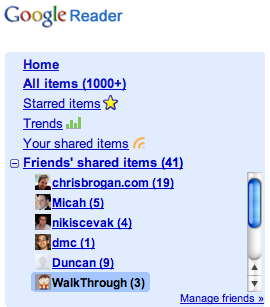
google-reader-list.pngA small privacy debate is igniting over a new sharing feature in Google Reader. A couple weeks ago, Google turned on a new feature in its feed reader that lets you share posts with anyone in your Gmail or Gtalk contact list (assuming you use either of those other Google services as well). The problem is that sharing is an all-or-nothing proposition. You either share posts with all of your contacts (who also use Google Reader) or with nobody. In other words, sharing is the same as making your selections public. There is no way to pick and choose with whom exactly you want to share particular posts or feeds.

Without giving consumers that granular control, the sharing feature is in danger of becoming a spamming feature. Just because I’ve sent you an e-mail in the past does not make us friends, and it certainly does not mean that you want to keep track of every random blog post I decide to share. If that happens and I become too generous in my spreading of ephemera, Google Reader does let you hide the posts that I or any other particular contact is sharing. But it does not let you block or specify who can see what you want to share. How hard would it be to turn that around and let you block certain contacts from being able to see your shared posts or to create different private sharing groups? If we’ve learned anything from Facebook’s Beacon experience, it is to give users of social services as much control as possible over who can see their data.

To be clear, Google Reader is not broadcasting every feed you subscribe to out to your entire contact list. The default is to keep everything private until you deliberately click the “share” button. But once you do that, you lose control over who gets to see what. The appeal of this approach is that it is an effortless way to discover what a subset of people you know are sharing. But it might also create privacy issues for people who do not understand exactly how it works . There is a creepy surveillance aspect to this that might also turn some people off, or keep them from sharing anything at all.

Update: Google responds here.

  • Sphere It

Trackbacks/Pings (Trackback URL)

  1. Human Modem » Blog Archive » Friday Morning Fun - 12/28/2007
  2. Blog Surfer » @media Ajax London, here I come
  3. jodhpuriGuy » 2007 The last post…
  4. Blog Surfer » Min-width and Max-width template
  5. KnowledgeCafe » Indiaase gigant Wipro gaat voor CapGemini?
  6. Web Development 2.0 » Blog Archive » Web Content: Not just YOUR words and pictures
  7. The Robert Scoble Experiment With Google Reader —Prediction Market Edition | Midas Oracle .ORG
  8. Google mocno pracuje nad kontaktami | buzzbuzz.pl

Comments

RSS feed for comments on this post.

  1. Yako

    The only solution is have no friends

  2. Nick Vidal

    I suggest Google Reader adopting ISS (Instant Syndicating Standards):

    The advantages of adopting ISS are:

    the display of a tagcloud for each contact will help people become
    aware of friends’ interests more easily;
    people will be able to subscribe to exactly what they want to read
    from their friends;
    it will promote information-sharing in the long tail;
    it will add personalization and trust;
    it’s a non-obtrusive solution.

    Adopting ISS will not require a major shift in the current system. The
    use of tags is already part of Google Reader and Google Talk already
    uses XMPP.

  3. Jurado

    A better solution is to terminate your gmail account…or just give everyone your password…what’s difference?

  4. Michael C. Neel

    Slow news day eh?

    A button labeled “Share” let’s others see what I shared. FYI, if you looked into what this button did before the new feature was added, it shared the post on a public webpage (mine as example http://www.google.com/reader/s.....9410942877). It shares the item with the internet. Since I’m guessing the internet has more users than your google friends list, complaining here seems pointless.

  5. murph

    I’m with Michael Neel on this one - I use the shared items feature to highlight interesting articles from other blogs on my blog in a widget. So I am already sharing them with the world and not surprised by the lack of privacy.

  6. John Minnihan

    The ‘controversy’, though a bit overblown in some threads, is in how the feature was changed & rolled out.

    It is unlikely that many Google Readers anticipated this wholesale sharing; the obfuscated URL may have been a key feature for those using it.

    Even though the service is free, changing basic feature behavior(s) without notification is simply poor practice. It will devalue the brand and make users suspect of future offerings.

  7. Seth

    It only shares with people who use Gmail and with whom you’ve chatted with Google Chat, I believe. Simply sending an e-mail with Gmail doesn’t trigger it.

    Still, it would be better if it were opt-in with a clear explanation, as the one given on their blog.

    The pages are public no matter what, no log-in required. But the URLs are obfuscated.

    Google also seems to snatch your profile photo from your e-mail program and display it to other Gmail users, without asking.

  8. mills

    this is news?

  9. Deepak

    I just don’t get this one. People like complaining, so they need to pick on something.

  10. Erick Schonfeld

    @4, that is why I call this a “small privacy debate.” The issue is not so much privacy. As you point out, users of the share button never had any privacy, nor did Google say they would. The issue is consumer perception. Building a few more privacy controls into the service could go far towards avoiding any consumer backlash, regardless of whether or not such a backlash is warranted.

    And, yeah, it is a slow news day.

  11. Ryan Coleman

    Yeah - this is a non-issue.

    Sharing has been in Google Reader for a long long time now and it’s always been all or nothing and they’ve always been clear about that point. Up until this friends notion they were simply posted to a public page along with an RSS feed your friends could subscribe to.

    If you want to share something privately with someone there’s this wicked invention called “Email” (also been around for a while) and Google has conveniently provided a link to that feature on every post too.

  12. Udi

    If you’re looking for a more fleshed out feed sharing environment, check out http://feedeachother.com

  13. Teresa Valdez Klein

    I think you’re really making a mountain out of a molehill here. I’d guess that 99% of people who are savvy enough to have a Google Reader shared items feed understands that shared items are public.

  14. hectare

    @John Minnihan They didn’t change the basic feature without notification. There was a HUGE, screen-blocking interstitial for everyone logging into Google Reader after this was released that told us our shared items would be seen by Talk contacts and to undo that, we could click a link. The interstitial was really clear about the feature, and what I needed to do to opt out of it.

    Of course I would have appreciated avoiding clearing my shared items to opt-out and instead be allowed to copy my shared items to a different, obscure tag that behaved the same, old way. Of course, Google DID implement this a few days later, but too late for me. Still it’s not a big deal for people who want the old behavior to have it back. Go to Reader’s settings page and go to Friends and click “move or clear your share items” to move them.

    I’m also told you can move them to a new tag right from that big interstitial BEFORE anyone else sees your shared stuff. Can’t confirm because I already started using shared items now. Anyone else know?

    +1 not news, sky falling hype

  15. Intercon

    Sharing all or nothing isn’t necessarily bad.

    But, like Feedburner, Google Reader will need some replacement competitors soon.

  16. i48998

    I’m gladly sharing my shared feeds and interesting news (check my blog), in fact, I’m looking for more innovative ways to share the same and making sure that others could get to it. I do not understand what is the big deal here? If you do not wish to share your feed items then just don’t select the share option and read your stuff in privacy, it is as simple as that.

    http://i48998.blogspot.com

  17. mrshl

    Google Reader actually has some granular privacy controls over who things are shared with. Each tag/folder can be independently shared on its own “obfuscated” web page. All you have to do is create a tag and then share it under the tag settings. For example, each item you tag “Jsmith” will be shared with on a separate page that displays only those items tagged Jsmith. This item will not appear on the generic “Shared Items” feed that is accessible to gmail contacts.

    To me, this offers a whole lot more control than simply clicking the share button. And it’s a feature that’s been part of GReader a long time.

    Also, @hectare (#14), dude is dead on. This feature wasn’t a surprise to anyone who actually uses Google Reader.

  18. Ballmer

    Others call it security breaches, spam enabling, phishing feeders, privacy breakers. But when it come to Gaggle you call it sharing too much?
    sheesh!

    fakesteveballmer.blogspot.com

  19. John Minnihan

    @hectare - thanks. yours is the fist mention I’ve seen of the warning mask at login, but even so… it sounds like it came after the fact.

    I don’t use Google Reader, so honestly I couldn’t care less how it functions. But I do use Gmail, so I am paying attention to this within the context of ‘how is Google handling feature change(s)?’

    Big news? No. Just a bit surprising, given the hell-raising that Beacon generated.

  20. Michael Hamann

    @mrshl: I don’t really agree with you, what you call granular privacy control isn’t that much privacy… This big number that represents a user is the same one in every link, so if you know the url for one label, you can easily generate the url for the users shared items or another shared label, if you know the label. So when you are using names as labels, one can easily look whith whom you are sharing what.

    So when you want real privacy, you shouldn’t use “share”. But nevertheless I wouldn’t expect privacy when I click on a “share”-button and get a public url.

  21. mrshl

    Michael,

    Duh. Yes, “sharing” isn’t private. I agree that people who want true privacy should use the email function or private tags (both of which are readily available). Just pointing out that people who were using the “share” button for less public sharing are still able to do so. They just have to know how to use the application.

    Google Reader has so many options for sorting, searching, organizing and sharing feeds…it’s possible to tweak these options to get the balance you want. The people bitching need to either adapt using these superior controls or migrate to a service that offers fewer options. Those are the choices.

  22. eschnou

    The big deal here has nothing to do with share or privacy, but as Erick point out in the way Google implements the notion of ‘friend’. My address book is not my friend list, and as a user, I expect Google to provide me with a way to manage a friend list wich is separate from the address book entries, and this is exactly what is missing !

    I understand that Google wants to catch up on the social space, but they should implement features in the right order: first the social network, then the sharing :-)

  23. Michael Langford

    TC is not highlighting the issue:

    People were not warned this would happened when all of a sudden the privacy of the shared items link vastly changed.

    I know of one gentleman who had hundreds of pages of industry research on there for a select group of invited colleagues, and when google flipped the switch, it shared all of this work with his competitors.

    Another story is that is showed one man’s political leanings to his family, who then devolved into an email shouting match which ruined their xmas.

    You should never, ever, lessen the security of a batch of data that your users have entrusted to you without notifying them first will ample time to opt out in some way, even if it is deleting the data.

    –Michael

  24. blah blah

    there is a *real* privacy issue & that is I can now see which one of my “friends” uses greader even when they have not shared ANY items as it let’s u know who uses greader and who u can invite to greader!

  25. Shun

    I think all of the Google-lovers here are missing a vital point, highlighted by #23, above. Google did not give adequate notice that this change was going to occur. They told everyone on a Friday night that this feature would be implemented, then went ahead and made the change immediately.

    Adequate notice would have been something like: “Google is thinking about doing so and so. In 15 days, we’ll be switching to this model. Please email or call if this will inconvenience you. Otherwise, follow these directions.”

    Then 15 days later, the change would happen. #14 points out that there was a splash screen after the change. Sorry, but that’s too late. By then, the damage has already been done.

    I know Google isn’t the court system, or the government, but the best way for them to have done this was to tell everyone first about the proposed changes, give people adequate time to comment, then go ahead and do whatever they were going to do anyway. Hey, it worked for the FCC.

    Telling everyone what happened after the fact is a cop out.

  26. hectare

    @Michael Langford, @Shun - Users were clearly notified, so I think your statements are incorrect. As I commented above: there was a large, screen-blocking interstitial for everyone logging into Google Reader after this was released that told us our shared items would be seen our Talk buddies and that we could opt-out by clearing (or moving, it seems) our shared items.

    In fact, I didn’t show up in my girlfriend’s account UNTIL I clicked thru the interstitial. I was notified BEFORE the feature was turned on for me. People who didn’t see the interstitial yet DIDN’T surface in their buddies’ Reader list. (Possibly still don’t, can someone confirm this?)

    Like others, I’d prefer that Google would provide more powerful controls for sharing. It looks like they did notify all users however.

  27. Mark Evans

    Must be a slow day within the blogosphere given the furor over “share” within Google Reader. Seriously, what did people think “share” meant? And compared with what people offer up on Facebook these days, the GR privacy issue is a joke.

  28. Ryan Coleman

    “I know of one gentleman who had hundreds of pages of industry research on there for a select group of invited colleagues, and when google flipped the switch, it shared all of this work with his competitors.

    Another story is that is showed one man’s political leanings to his family, who then devolved into an email shouting match which ruined their xmas.”

    Sorry #23… but in both cases those users were, pardon my french, fucking idiots… Google has never once pretended that the “Share” option google was anything but “public”, regardless of how the URL was obfuscated…

    Honestly Erick, you’re better than this kind of reporting… this is a non-issue and people who consider this a “privacy issue” really don’t belong on the web… this is nothing…

  29. Dan N. Moldovan

    Is Google Reader ready for a “street” hard life?
    Just read this:
    http://danmoldovan.blogspot.co.....eader.html

  30. 이정일

    구글계정을 탈퇴하는 것이 더 나은 해결책이라는 댓글에서 웃음. 쿡

  31. Eric Dawson

    Sensationalist, Irresponsible article.
    Is this a call for features or privacy breach?
    Google Reader shared articles has always been for public consumption. period. Sure I want granular sharing… wait for it. just like the rest of us.
    IMHO this is a stupid, pointless post.

    actually sounds like the features I want are already there. maybe this article isn’t pointless…

  32. kara

    The share url was only ever as “public” as any obfuscated URL. You can post a photo to Flickr, Facebook, or Picasa marked as private and it will similarly produce a publicly viewable url for that item. The Reader shared URLs had near-zero discoverability using a random string of 20 numbers. Does anyone really believe that is insufficient protection?

    But thats almost beside the point. Having Google Reader reach out and touch random contacts from GMail without offering an opt out is just wrong. Why should my ex-girlfriend who I haven’t spoken to in months suddenly be popping up on my sidebar and me in hers? Maybe this isn’t as bad as Beacon, sure, but it demonstrates a similar dimwittedness on the part of these devs towards the unintended consequences of forcing new features onto users of a social network.

  33. matt

    Google needs to stop with trying to drag people into their stupid “share all” world.

    There are three kinds of people who use the internet. The first kind are the ones who don’t really understand what’s going on, the ones who use facebook, google, myspace, they don’t know what “web 2.0″ means, all they know is that for the most part it’s cool.

    The second kind of person are the entrepreneurs of the internet who are trying to find out what the people in the first group will think is cool. They add new features and try to “revolutionize” things constantly, whether they do so in an intuitive way or not. They roll out new features and whether the users in group 1 understand how it all works or not BE DAMNED!

    Then there’s a third group. They are usually tech savy, and have very specific things they use the internet for. They understand things from a backroom perspective. I’m in that group. Those of us in that group suspect that the “web 2.0″ push is motivated by entrepreneurs who want more and more access to their customers, hence the sharing features and targeted ads that keep popping up all the time. We are the ones who desire an “opt out” from all these “features” because we suspect that it’s not about giving us what we want, but rather companies trying to wiggle their way into our lives so they can learn what we like to buy or who we want to vote for… Or whatever information is “bankable”.

    I don’t “share” with anyone. I don’t like it when companies want me to “share” with anyone. I don’t like companies that create profiles for me that I have to go and clear of personal information after the fact. I want a solid opt out. Web 2.0 DOES NOT mean that I have to adopt each and every new, stupid feature that some company rolls out.

  34. Ultimate Diligence Blog (=^ v ^=)

    Thanks for sharing! ^o^

    hi, if you have time, go to my blog take a look, thx!!!!! ^o^

    The blog have many informations, hope to able to help you!!!^^

    Ultimate Diligence Blog (=^ v ^=)

    http://ultimatediligenceblog.blogspot.com/

  35. mrsdurff

    That this discussion comes up at all belies our present struggles with control. We culturally have become control happy instead of master collaborators. Intelligence is collective therefore ignorance is solitary. I have desire to be more ignorant than i already am!
    I doubt learners in k9 right now would initiate this discussion. Their lack of concerns should be a beacon to us all - they are on to something!

  36. djchuang

    The feature name is what I think throws (some) people off. If they called it public/private, that would imply a simpler all/ nothing deal.

    Youtube has an “active sharing” fn, which is all or nothing. I wish that was selective, too, but right now it’s a checkbox for all or nothing. Simliar concept.

    Oh, yeah, forgot, youtube is part of Google. :)