
uTest Gets $1.7M for Crowd-Sourced Quality Assurance
by Roi Carthy on December 18, 2007

Boston-based uTest has raised $1.7M to bring to market a crowd-sourced quality assurance (QA) marketplace and community. The service has begun recruiting testers in anticipation of its official launch, expected in early 2008.

No fuzzy logic here; uTest presents clear and communicable value propositions: For companies in need of QA, uTest is providing an on-demand environment for the management of full testing cycles. For testers, uTest is providing an oDesk-like marketplace through which they can be hired and paid on a Pay-per-Bug basis.

The company’s founders recognized that QA and usability testing solutions are inefficient. QA departments are either under-utilized when waiting for versions to test, or over-extended when a new version comes out. To most SMBs, QA outsourcing is neither cost effective nor available “on-demand”. Then, of course, there are cost-cutting measures that leave companies unable to sufficiently fund QA efforts, ultimately shipping buggy applications to users like us.

The uTest testing platform itself is entirely Web-based and provides the management of complete QA cycles, from creating/loading test scripts, to selecting the target community (profile and environment) of testers required. The platform also provides test case management tools, real-time information on bugs and defects logged, statistical information on release maturity level, as well as QA coverage and market readiness. Support for bug tracking systems includes Bugzilla, Jira, FogBugs and will be expanded over time.
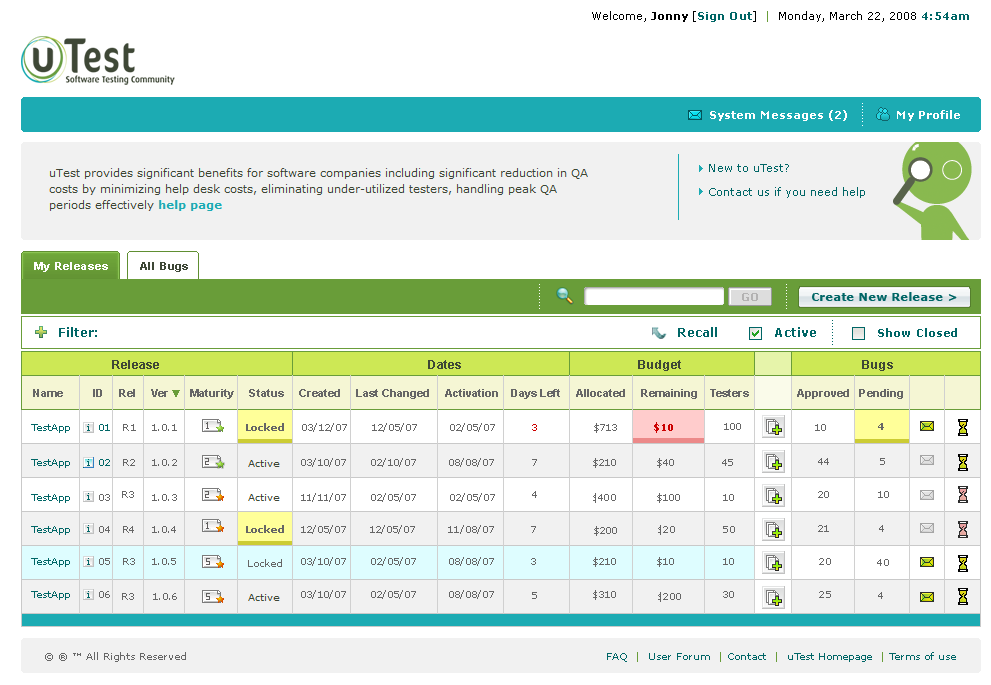
In a smart business move, uTest will not charge companies to use their platform to manage testing and QA cycles—this will be entirely free of charge. uTest will only charge for the services provided by the community of testers.

The uTest offering makes a lot of sense to me and I expect it will be warmly embraced for several reasons. First, consider for a moment that for many SMBs, QA management solutions such as those offered by Mercury or IBM-Rational are beyond their reach. Speaking from personal experience, the majority of the testing cycles I’ve seen have been “managed” on Word or Excel. The “on-demand” model which has been proven time and time again on the Web from CRM to ERP, should work just as well for QA. The fact that the platform will be offered free of charge, pushes the offering to “no-brainer land”.

Second, beyond the manageability aspects of uTest’s service, companies will obviously enjoy the cost saving aspects of paying testers by the bug. It’s this aspect that in my opinion will make uTest’s offering relevant not only to SMBs but to large organizations as well. Logic would dictate that if they embraced off-shoring and near-shoring, crowd-sourced QA shouldn’t be too jagged of a pill to swallow.

Third, recruiting a userbase of testers should not be difficult. There are droves of potential testers in countries such as India, China, Russia, Bulgaria, Estonia, etc. Also, getting hired through sites like oDesk, Elance and RentACoder is becoming increasingly difficult due to the growing number of service providers. These same individuals can theoretically provide testing services instead of programming.

All-in-all uTest sounds quite promising and has earned a place on my companies to watch in 2008 list.

Advertisement

Comments rss icon

  • This sounds awesome – I can see a lot of demand on both sides.

  • Very Niche play…. though? What is their best case exit?

  • The link to the picture (http://www.tech...reenexample.png) is dead Mark.

  • who would give their unfinished product to strangers before it rolls out ?

    do they have hte business knowledge to do so?

  • in Response to #5:

    It happens all the time. QA is not a very high priority in most companies. I work for a company that does outsourced QA for other companies. Most companies provide us with no knowledge about how their product is supposed to work except for the product itself. We do the best we can and help them make a better product, ideally they would provide us with more information, but they don’t want to spend the time and money so we make do with the situation. We test a few hundred software apps a year like this for various companies and are located in the US. Most of the apps are not programmed in the US and have silly errors that you would not have, were they written by an American or someone working on site with the company with the program idea.

  • Sorry, screenshot image link fixed now. Also, post was written by Roi not me, so that’s corrected too.

  • It’s interesting to read this story……. as far as I’m concerned I believe that blogs such as TechCrunch can fill this void anyway.
    Simply a company contacts TC and says I need X testers. In turn TC writes a story and asks for testers and sends them over to a TestCrunch section…….in return TC gets first dibs on the story. VOILA!!

  • How does the payment system work exactly? The company testing its product is left in charge of determining how much each bug is “worth”? Typos are worth less than NPEs?

  • This article looks like a copy of a Press Release. Is it PayPerPost or just mates club?
    But who is Roi Cathy, anyway? He is a PRODUCT LAUNCH CONSULTANT. He will get you exposure if you pay him. That’s just too low for TechCrunch given your stance on PayPerPost.

  • Can’t Amazon’s Mechanical Turk do the same thing already??

  • Shouldn’t it be called weTest?

  • No it should be called Us-Test!
    fakesteveballmer.blogspot.com

  • Doh! They need to have some QA done on their site! See the pyramid at the bottom of http://www.utes.../solutions.html – two typos in it!

    And this techcrunch article mentions usability testing, but their site does not. Does techcrunch have inside info? Or is that an error?

  • Just when I thought software quality assurance couldn’t get worse… The dead pool awaits. Seriously, if your hired QA is bad…

  • @10 do you know if Roi has a current or past business relationship with any of the uTest people? If so, not disclosing it would be a conflict of interest so large it would make the annoying posties look ethical.

    Roi, please clarify.

  • I think this is a great idea. Especially for UAT.

  • Who is Roi Carthy? Nothing about him on the Techcrunch about page.

  • FogBugs should be FogBugz

  • “There are droves of potential testers in countries such as India, China, Russia, Bulgaria, Estonia, etc. ”

    I understand India, China, Russia and Bulgaria included in the list…but why Estonia? I am myself originally from Estonia, but I would not count on our country as a resource pool. Atleast not anymore after companies like Skype and Playtech are consuming most of the professionals. There is a huge lack of specialists for internal market. I would be surprised if it would be possible to outsource even 1000 tester a year from whole country…

    Mark

  • Most of the big corporate have their own QA and usability testing unit, I hope it is proposed for small scale software development companies and freelancers.

  • This is an absolutely fantastic idea.

    I will definately try it out on multiple projects when it is released – if anything, just to see how well it works!

    I’m glad to see that social sites are being built for things other than just advertising….or building worthless virtual networks of friends.

    ….This has real potential.

  • It is a new approach and should be considered. Not sure about how NDA can be handled in some cases.

    Now, is typo considered a bug? :)
    http://img232.i...testtypoho8.png
    How much this would be worth?

  • They had better be careful: it sounds like a breeding ground for an insane number of dupe, no-repro, & poorly written bugs. The bug triage process can be fairly high-touch even without this problem.

  • This is very similar to:

    http://www.trybeta.com/home/

    Which I have been using for a while.

  • We have been doing software QA for some product companies in the US — however, we do it the “old fashioned” and as some people like to call it — the “unsexy” way. We read specification, write test plan documents, do strict regression tests, test coverage for each new builds etc etc.

    uTest looks like it is aimed at software vendors not willing to invest in creating a quality product. The use case seems to be the following:
    a) Think of a product
    b) Write some code
    c) Hope it will work — oops! it does not
    d) Get it QA-ed (uTest, tryBeta!)
    e) Fix or patch bugs that get discovered — ones that don’t lie along to bite the customers later

    I think this is not the way Software QA and Software Engineering ought to be.

    For a serious QA team — please visit http://www.atishae.net/. We will help you deliver a better product, faster!

  • I have mixed feelings about this and I basically agree with Lucas (#23) and #5 but also with Mayank (#26) … only time will show … In the meantime you can consider using our Software Testing services … http://ework.cz

  • I have also written a review of how do I see the service … here

  • I have also written a review of how do I see the service … here

  • “We have been doing software QA for some product companies in the US — however, we do it the “old fashioned” and as some people like to call it — the “unsexy” way. We read specification, write test plan documents, do strict regression tests, test coverage for each new builds etc etc.

    uTest looks like it is aimed at software vendors not willing to invest in creating a quality product. The use case seems to be the following:
    a) Think of a product
    b) Write some code
    c) Hope it will work — oops! it does not
    d) Get it QA-ed (uTest, tryBeta!)
    e) Fix or patch bugs that get discovered — ones that don’t lie along to bite the customers later

    I think this is not the way Software QA and Software Engineering ought to be.

    For a serious QA team — please visit http://www.atishae.net/. We will help you deliver a better product, faster!

    What a shameless advertisement of own services by cursing others. Looking at there website, I would suggest them to get it QAed once :p

    Utest has really open up opportunity for a development company to reach testers from across the globe. Testing is done with more open and wide perspective, rather then a specified format of a company environment. Reach mass cannot be more easy and cost effective.

    And since its a competitive business for
    Testers, everyone would take some extra intiative to get hold of nasty bugs.

    ‘the “unsexy” way’ – LOL, If you cant produce interest in your services you are not required.

Leave Comment

Commenting Options

Enter your personal information to the left, or sign in with your Facebook account by clicking the button below.

Alternatively, you can create an avatar that will appear whenever you leave a comment on a Gravatar-enabled blog.

Trackback URL
bugbugbug