Free: Pack Of MySpace Branded Playing Cards »
Google Preparing To Launch Game Changing Wikipedia Meets Squidoo Project
by Duncan Riley on December 13, 2007

When it comes to Google, nothing should surprise us any more. Last month it was Digg style social voting on search results, this month its a new project called “Knol” (which apparently stands for a unit of knowledge), a user generated knowledge project that combines parts of Wikipedia and Squidoo (and to a lesser extent Mahalo) into what could easily turn out to game changer in this space.

The idea behind Knol is “to encourage people who know a particular subject to write an authoritative article about it.” A knol on a particular topic is “meant to be the first thing someone who searches for this topic for the first time will want to read.” Google essentially is the conduit for user generated authoritative content, Google provides the tools (editing tools, space etc) and you contribute the content. Then we get into Squidoo territory as writers will own pages (”The key idea behind the knol project is to highlight authors”) and the trump card: Google will offer a revenue share of ads displayed against the content.

Duplication could become an issue however, with Google saying that they will not serve as an editor in any way, and “will not bless any content.” To quote Google:

All editorial responsibilities and control will rest with the authors. We hope that knols will include the opinions and points of view of the authors who will put their reputation on the line. Anyone will be free to write. For many topics, there will likely be competing knols on the same subject. Competition of ideas is a good thing.

It would appear that Knol’s will appear in Google search results, but which ones appear would be based upon peer review, which pages able to be voted up and comments left.

Once testing is completed, participation in knols will be completely open, and we cannot expect that all of them will be of high quality. Our job in Search Quality will be to rank the knols appropriately when they appear in Google search results. We are quite experienced with ranking web pages, and we feel confident that we will be up to the challenge. We are very excited by the potential to substantially increase the dissemination of knowledge.

I’m sure they’re excited, once again they could change an entire market space. Screen shot as below and full details on the Google Blog here.
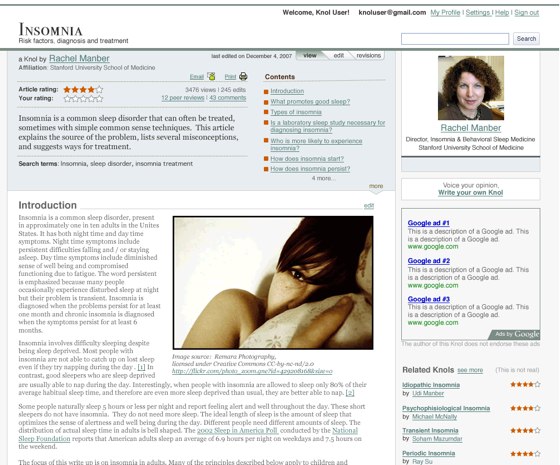
knol.jpg

Advertisement

Comments rss icon

  • Google must be stopped!

  • “We are very excited by the potential to substantially increase (our total revenue) the dissemination of knowledge.”

  • ha, I commented just minutes before this post went up about knol on the recent post about Google Answers, should have just waited a minute :)

  • Bye-bye Wikipedia.

  • It just goes to show that an idea can be improved upon. Wikipedia has a great site and gets a ton of attention for it but that doesn’t necessarily mean that it is the best way to pursue that idea. Only a large company like Google would have the power to challenge a site like Wikipedia, I think it’s a great idea.

  • I think collective articles/guides can be even more helpful. With industries changing so much, hard for just one person to stay on top of it.

  • Hi,

    It looks like, having lost out on the Q&A market, and not owning Digg or Wikipeda, and having seen the developments happening at companies like Answers.com, Google wants to create a better monetisation engine, regain the market-initiative/ownership and enable/provide content which would also get ranked by its competitors.

    Quite a cynical/commercial move, but it does look like it brings all the pieces together in one place like Finance.google did for its segment, which is good on a UI level, though also remains a non-player in the market.

    The only question is: will the serious content-generators bite, or will it be left to the sploggers, meta-posters and fanboys?

    Yours kindly,

    Shakir Razak

  • How are you people saying bye-bye wikipedia? I mean, really? Just because Google launches something does not mean it will succeed.

    Out of curiosity, what was Google’s last “game changer” out of the products they’ve thrown at us?

    This looks like About.com mashed with Wikipedia. Not very interesting. Google is yet to succeed in the UGC space and social in general — minus Orkut.

    I’d take Wikipedia any day.

  • Is there some way of enforcing an anti-competitive clause to stop the Googs.

    @4 You are right…but they can always do the right thing and sell.

  • Please note that the original google blog post dose not mention the word “wiki “at any point. They are bold enough to compete against wikipedia and even dare to change the name to market their own “knol” word. Don’t get me know wrong here, i love google, but they are starting to act like microsoft….trying to copy any sort of successfull products. they should start the knol by defining innovation…so that they can remeber who the once were: open social, android, digg search results, etc etc….all “me too” products. it’s cool to integrate new trends into products and create similar ones, but still innovation is key. i belive “don’t be evil” should be changed for “no copycats” or something. i protest cause i want to keep defending google for years to come and the only way to do it is to innovate……

  • I think this will be very useful for product reviews in particular. This isn’t something that Wikipedia handles, and I think it’ll be a great differentiator.

    Also, having a WYSIWYG editor should make writing articles considerably easier than Wikipedia.

  • This is a really interesting turn of events. Google IS a social network. They’re building the pieces first, and when all of the dots get connected, watch out.

  • @8 You are right, but Gmail was pretty substantial.

    I think this, as with Blogger, is like any Advertising seller wants to do, own more capacity/content of their own to place adverts on.

    What they could have done if they were more idealistic is re-version Wikipedia, partnering with it, and even this I assume will include substantial content/links from Wikipedia.org; however, who will own the content on these Knols’?
    Will it be individual author copy-rightable, will someone like John Battelle be able to create one that will be about search/google that appears at the top of all related searches and points to hs content-properties?

    Kind regards,

    Shakir Razak

  • I don’t believe this will kill Wikipedia and as Jonathan (#10) points out, this isn’t a Wiki project. It takes the focus on authoritative knowledge Wikipedia has (or the many smaller clones) and raps it in a Squidoo style setting (although notably the emphasis appears more on knowledge than links…unlike much of squidoo, or in particular say Mahalo). Sites like Squidoo (and to a lesser extent Mahalo) that rely on Google SERP’s in becoming authoritive destinations on topics have the most to lose here, and if Google decides to use Knol results instead of Wikipedia, Wikipedia won’t die, but it might eventually take some sort of traffic hit.

    Adrian Keys (#9)
    at some point it’s a question that will be asked at the highest levels, how big will the US Government allow the Google Borg to get before it intervenes?

  • I love that Rachel Manber’s been used for the mockup. I think she’s Udi Manber’s partner. Udi’s a search dev guru at Google. If you’ve seen him give a talk, you’ll know he’s nearly as effective as Rachel at helping people get off to sleep… ;-)

  • I also think that this will kill off Wikipedia and I think it will is that when you search for something using Google you are likely to find results from the knols on the top and everything else later on. For me thats a bit worrying.

  • It happens when you’re sleeping. It happens during the day. It happens in very slow, deliberate movements.

    One day, though, everyone will realize what Google has morphed into. No one will like it, but since they provide everything for free and spend their money on heart warming projects, no one will say anything.

    Remember, Google Power coming to a house near you. Yes, we’ll be more than happy to provide power to your home for free, just let us install these LCD panels with integrated cameras so we can provide content and a smidge of advertising as well. :-)

    Gee, I wonder where the “knols” will rank for search terms?

    Seriously, why didn’t they just buy out the wiki folks and be done with it?

  • It’s a slippery slope when Google (or other search engines) push their own content in their search results.

  • Is anyone else seeing a shift in the way Google is doing things? I’m seeing a company whose core product relied on aggregating and sifting content from other sites, to a move to them building (or buying) content (or the underlying technology) that they have ultimate control over.

  • Paul Short … yep. The control they will extend over it is in the best interest of the user, don’t you know? :-)

  • This project looks liable to spam and clickfraud. And with Google’s record with Blogspot spam, that’s exactly what they will let happen.

  • Google continues its steady progression from a neutral content switch to a content owner with a vested interest in promoting it’s own content.

    Unlike the good old days when a Google SRPs simply guided you to other people’s content, soon all we’ll see at the top of a Google SRPs is links to Google content (eg local business info) or content managed, hosted or otherwise enabled by Google. In either case, Google will control the monetization and keep the lion’s share of the revenues.

    I predict a time when we’ll start our searches on Google and never leave some portion of the Google empire to get the info we need and/or acquire the products or services we seek.

    I read: “Google’s mission is to organize the world’s information and make it universally accessible and useful.” I suspect their true mission is to own and control the world’s information and make it universally monetized by Google.

    IF most searches start on Google AND most searchers click on the top 5 results AND Google can give itself the top 5 spots for all lucrative searches THEN Google wins and the rest of us compete for the leftovers.

    Can’t say I blame them, I’d probably do the same if I were lucky enough to be in their position. But it’ll soon be the GWW not the WWW. Perhaps the greatest monopoly position in history.

  • To Duncan,

    Point taken. Wikipedia might not die, but the idea of google promotig the creation of content is kind of strange. I though their core mission was to become the finders of all the imformation of the world, not the sort of “keepers without intereference” type. I think google have still a lot to do when it comes to search and ads, and shouldn’t be distracting itself like yahoo did. growing too thin migh be dangerous. right know they are experimenting …and that’s good. but it’s important to stay focused.

  • @14, “if Google decides to use Knol results instead of Wikipedia”?

    Eh? You mean if Google stops showing Wikipedia links in search results? Right now Wikipedia is a top result for many of the topics I search for organically (e.g. that little thing called PageRank that Google is somewhat known for). If Google starts artificially altering search results than they’ve officially gone evil.

    Wikipedia, is in a my mind, a force to be reckoned with. They were able to win over the academic community who are largely responsible for the content there. If Google is able to lure those users to a service like this then I think you would see it start to impact Wikipedia, but I don’t think that will happen.

  • This is a move I don’t like and I am a big Google fan. These bastards are doing what we asked Wikipedia not to do. We asked them to keep Wikipedia free of ads and so far they kept it. Every year they get my donation and I will keep supporting them.

    Now comes almighty Google trying to screw a good project and making money while they are at it.

    Bad Google!!! BAD…. No Christmas gifts for you this year!

  • @18 – They can’t buy Wikipedia since it’s a non-profit. Otherwise Jimmy Wales would have cashed out long time ago.

    Duncan, I have a hard time seeing how the revenue sharing will be implemented. How will this be done?

    - If I edit an article, do I get a portion relative to the size of my edit? If so what happens if someone entirely “rewrites” the article but only shuffles words and phrases around?
    - If the original author gets all, what stops somebody starting thousands of one word articles that some one else will fill in.
    - If it’s whoever has the highest rated rev gets all what will stop secret mailing lists/digg voting mafia to vote up certain people.
    - What about keeping things tidy? If it makes sense to merge two articles into one, why would the authors want to do it? They can make more money from organic search results by keeping the topics separate.

    If Google frowns on paid links because they spoil the integrity of page rank, why wouldn’t what are essentially paid wiki edits corupt the integrity of a knowledge base?

  • Balke Macho
    it’s a big if; Google isn’t saying they will do this but they are talking about Knol’s being in search results, it may not be a one or the other equation. I also don’t (as I mentioned in the comments) believe this will kill wikipedia, wikipedia is way too entrenched and popular for that, but in some shape or form this will slow Wikipedia, be that in traffic growth or even through the loss of editors….they’re already seeing a slowing down in both those areas, where as Knols will simply increase the slow down…maybe even to the point of Wikipedia going in reverse…not to death at all (this 100% WONT kill wikipedia ) but they do get a lot of traffic from Google.

  • So uh… what happens if some enterprising “author” found a way to upload the entirety of Wikipedia to knols?

    No one seems to have mentioned it yet, but in addition to Wikipedia/Squidoo/Mahalo, this is also an attack on Citizendium.

  • George (#27)
    based on what I’ve read and filling in some gaps
    1. Like Squidoo, an author “owns” the page
    2. It’s not a wiki so others cant just come along and edit it. There’s a voting (or peer review) process that Google will use as part of how they rank each Knol page in terms of authority, particularly given there will be duplicates.
    3. I’m presuming like Squidoo and similar sites that it will be a straight % cut of ads shown on pages: as it’s not a wiki and each page has an owner who gets paid this is the easy part. I’m guessing that it might be tied in to Adsense like Google Co-op is now
    4. The tidy part to me is where the idea may have its biggest flaw: Google are saying that they won’t mind duplicates and all knowledge is good etc… but having thousands of pages on Viagra and Mesothilioma will cheapen the site in a similar way to the millions of spam blogs on Blogger. They think the solution is in search, that may well be but it doesn’t make for (in my mind anyway) the best experience for the reader. Time will tell I guess.

  • Duncan, are you sure about the “no edits” policy? The sample page has an edit tab and lists 245 edits. (Or is this the from the point of view of a logged-in author? That’s a lot of edits. Then again, this is a mockup.).

  • Google has Joe Kraus & jotspot (a cool version of wetpaint), egroups (also wrote Yahoo groups), Brad Fitzpatrick (Livejournal / open social) — I see yahoo answers + wikipedia + wetpaint + groups + open social = the initial construct of the semantic web.

    Great idea for the creation of a highly scalable, user generated, open, searchable, advertising integrated, library of authoritative content.

    I find it thrilling to watch google “own nothing” (i.e. open platform / user owned) and “own everything” by having the primary index and advertising platform.

    Assuming they solve reputation — it will be a heck of a system.

  • i love wikipedia and google, but no way google can take over wikipedia, it’s huge and just perfect.

  • Opensocial killed facebook.
    Google apps killed microsoft office.
    Gmail killed yahoo mail.
    Google maps killed mapquest.
    Android will kill Symbian.
    Picasa killed flickr.

    This will most certainly kill Wikipedia.

  • Oh, and most important of all — Google checkout killed Paypal.

  • I think we all are just thinking too much about Google. Wikipedia is by far most in effect in getting people real structured content.

    Google has been the parallel of an actual tag search so far. Far less accurate than Wikipedia, Google mostly caters to business search and such.

    Google can be just a temporarily successful search engine.

    Parul
    http://www.bhopu.com

  • I don’t think at this point that Google is a making a wise call, if indeed they are positioning this to muscle Wikipedia.

    At some point, you have to concede that the predominant player in the reference article niche is Wikipedia, and that it will be difficult, even for a behemoth like Google, to overcome the inertia in order to gather a community of zealous editors that have grown organically within the Wikipedia ecosystem.

  • George (#31)
    It’s definitely not a wiki so pretty sure, if you take a look at the screenshot it’s a page as shown by someone logged into it as opposed to simply a casual visit, I’m presuming the same person owns the page. I could be wrong but that’s how I’ve read what Google has said in terms of editing so far.

  • Will people link to these articles like they do Wikipedia? And if they don’t, will Google cheat and push these articles to the top of the organic Serps? Because if these articles don’t show up in organic search results, this project is DOA.

  • anatoly-face book is bigger than open social., google apps is not bigger than office, gmail is good, i prefer yahoo mail, mapquest is still big, and wikipedia is huge, i mean look no way they can simply take over. google should do online dvd rental.

  • Fake Steve Ballmer, with all due respect, please stop posting. You’re getting really freakin annoying!

  • Google is venturing more and more away from it’s core competencies and values.

    I don’t see those making good content already taking the time to do Knol pages unless their creations get preferred treatment in Google results.

    And that would be a major additional step away from showing unbiased results, which has already been happening with the introduction of universal search, which is just pollution of Google’s 1st page search results with Google properties.

    If that preferred treatment happens (why not, they’re a company like any other), this might take people from making content to Wikipedia, where your knowledge and hard work on a subject is not rewarded in any way, and from making own web sites.

  • @Duncan: I quote from google Blog:

    “People will be able to submit comments, questions, EDITS, additional content, and so on.” (caps are mine)

    My guess: You can edit an article from somebody else, but She has to approve it.

  • JP
    maybe so, certainly that would make a lot of sense, you can suggest edits but they have to be approved or what not. I’d still think in terms of rev share that the page owner gets the cut irrespective of later edits.

  • Duncan Riley is the Court Jester of Hyperbole. “Game changing” before it even is released…awesome! I would call him the King of Hyperbole but that would be too generous…

  • Wait. Anatoly (#34, 35)…. You’re just sarcastically demonstrating that Google does NOT automatically dominate every market they enter, right? I hope that’s the case, anyway.

    Google isn’t the market leader in any of those spaces. Not only are they not the leader, they’re not even close to being the leader.

  • Eli 46
    what else would you call a 1000 pound gorilla entering a space with a rev model that may kill some of the competition, and with the power via search to make it happen. It’s game changing in anyones book.

    Sam 47
    I think it was sarcasm, but as much as it’s easy to point out Google’s failures it overlooks the power it has in many more areas. When you wake up one day next year and Knol is the top result for something you’re search for, what then? they f*cked up answers because it wasn’t open to anyone (you had to be approved to answer + get paid), they’re not making the same mistake twice. This is all about volume + presence + showing ads, Google has learnt from its mistakes

  • Speaking as a Wikipedia editor – it looks like they’re bending over backwards not to make this actually freely reusable content. Which, y’know, they could easily do (all editors agree to release their work under GFDL or CC-by-sa). So that immediately makes it less interesting to Wikipedia in terms of what we’re actually doing, which is a lot more than running a hugely expensive website with no ads. This immediately places Knol with about.com and Scholarpedia.

    If the quality of the work is good, we’d probably use it for references, like we do about.com.

  • Duncan (48)

    While it might be space changing as I pointed out both in my post (http://www.wine...-and-marketers/) and in a reply to a comment by MG Siegler the problem is going to be that given their care and control of things like splogs and link farms etc what can we expect the quality of these Knol’s to be like. Especially since you could easily end up with more than just simple duplicates of topics once marketing firms and other less reputable people join the party.

Leave Comment

Commenting Options

Enter your personal information to the left, or sign in with your Facebook account by clicking the button below.

Alternatively, you can create an avatar that will appear whenever you leave a comment on a Gravatar-enabled blog.

Trackback URL
bugbugbug