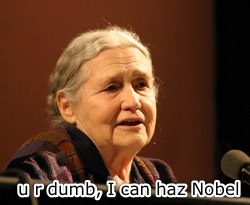
Nobel Laureate Says The Internet Makes Us Dumb, We Say: Meh
Duncan Riley
173 comments »
Newly awarded Nobel Prize winner Doris Lessing has used her acceptance speech to tell the world that the internet makes us dumb.
According to Lessing, who was too old and ill to make the speech herself and instead had someone else read it out, the inanities of the internet have seduced a generation, and we live in a fragmenting culture where people read nothing and know nothing of the world.
It gets better, apparently if you study “computers” you lack culture as well:
We are in a fragmenting culture, where our certainties of even a few decades ago are questioned and where it is common for young men and women, who have had years of education, to know nothing of the world, to have read nothing, knowing only some speciality or other, for instance, computers
Whilst Lessing’s words should be taken somewhat in context: the ditherings of an ignorant old woman, Keensian (as in Andrew Keen) anti-internet speeches grow as the cultural elite in society continue to have their previous (often born-in-to) positions eroded. The likes of Andrew Keen and Doris Lessing ignore the many benefits the internet has provided in expanding access to knowledge to many, many more people than who may otherwise have had no access before. Whilst it may be easy to mock the utterances of hundreds of millions of bloggers and social networking site users, the 21st century will be remembered as the time that communication was democratized, a time where the power of a few was replaced by the power of many. Let them eat their elitist intellectual cake, because the world is changing for the better, and there is nothing they can do to stop this.
For all those dumb people reading this who might never had read anything of substance before, may I suggest Wikipedia, it’s apparently a place where you can read interesting things, but it isn’t on paper, so it might not count.
The Guardian has the full text of Lessing’s speech here, which I note aside from the internet comments is a great, and often inspiring read.
(image credit: Marknad)


Like any other media, the internet is what you make of it. Claiming that it makes you dumb is like saying literature makes you stupid because my grocery store sells schlocky romance novels at the checkout counter.
I’m not too sure what this post is about??? Can you, please, re-write it without using such big words?
“For all those dumb people reading this who might never had read anything of substance before, may I suggest Wikipedia.”
WTF?
The balanced, informed tech reporting I’ve come to appreciate from TechCrunch is slowly being couched with, for lack of a better phrase, immature “bloggyness.”
Josh
What she’s saying deserves some fun, obviously humor is something learnt from books as well
She probably is NOT taking about THE INTERNET…..
She probably means THE WEB
Many people confuse the two - but they are distinct.
We are currently putting together a history of The Internet and Silicon Valley
Tino (#2)
lol
Silicon Valley
I checked the speech, she definitely says internet but I take you point, she’s actually referring to the web.
agreed, josh…
something is up, first gamespot begins it’s slide into oblivion after firing a longtime employee over his truthful video game review, then the evil wikipedia empire is exposed in a leaked email…
and now techcrunch puts a rant about an old woman in what used to be in my “news” group of rss feeds…
come on, in a decade, attention shifted from art, politics, science…, to the possible release date of the iPhone v2 and the Facebook’s PR issues. And this is not just for the geeky readers like the ones like us here, but for the masses.
we know more, for sure, but do the relative quality of what we learn…
and this post is, even though supposed to be read lightly, pretty offensive. And nastily defensive.
ahh well she is part of a a dying breed which in a few decades will become extinct, the “Homo sapiens” .
We are part of the new breed the “Homo Interconectus”
Hey Duncan,
With all your defensive and offensive babble. Is this post, your blogging or Wikipedia Nobel Prize worthy to begin with?
What an appalling attack on a truly beautiful, humane and insightful speech delivered by one of the greatest writers alive.
Duncan, I must wonder if you read the entirety of her speech, and if you did, were you able to absorb the underlying premises? These were: She is conerned by the movement away from a relationship with enduring stories, towards an embrace of the instant (stories and communication are by the nature of this medium, quickly forgotten. She was also concerned with reminding us of the value that people in pre-industrial societies still place on books, which are rare in their parts of the world.
Incidently, her mention of computers was to use them as one example of an area where people concentrate their knowledge and learning. She was absolutely not stating that “if you study computers, you lack culture …”
Naturally one can disagree with her premises, conclusions, or both - but to argue your point in de-contextualized soundbites is extremely disrespectful to a woman who, if you read her amusingly unimpressed reaction to the announcement that she had won the Nobel Prize, can hardly be dismissed as “elitist.”
Wow, you guys completely missed the point. Her speech is not anti-internet. The one egregious line Techcrunch quotes was supposed to be funny.
This paragraph is the real point she makes about the internet.
>What has happened to us is an amazing invention - computers and the internet and TV. It is a revolution. This is not the first revolution the human race has dealt with. The printing revolution, which did not take place in a matter of a few decades, but took much longer, transformed our minds and ways of thinking. A foolhardy lot, we accepted it all, as we always do, never asked: “What is going to happen to us now, with this invention of print?” In the same way, we never thought to ask, “How will our lives, our way of thinking, be changed by the internet, which has seduced a whole generation with its inanities so that even quite reasonable people will confess that, once they are hooked, it is hard to cut free, and they may find a whole day has passed in blogging etc?”
Duncan,
You should have read her whole speech before announcing to the “tech” crowd of your interpretation! Plus, she is somewhat right in her original statement whether you like it or not.
That’s bad blogging or journalism. Period.
10 years ago I spent my summertime and weekends in the park competiting in basketball, soccer, chess games. I engaged in debates, arguments, discussions, etc.
In the recent years, I noticed that our parks has grown weeds, there aren’t long lines of registration in social and intellectual gatherings and stuff anymore. The kids are gone.
Visit any internet shop in any village as early as 7 am. and you would find it exploding with kids watching nonsense/funny Youtube videos, playing online games, viewing pornographic materials, etc.
Before I had a reliable internet service, I was always in the internet shop and in the times I was there I always experienced a parent who would suddenly burst inside the internet shop shouting and looking for their kid and dragging them out of the shop. The kid was being scolded for either missing classes, haven’t done their household chore or missed some simple responsibilities as he was having a time of his life with nonsense videos and beautiful girls on the net.
Doris Lessing has a point and your post shows that only educated people can understand her. Einstein, Isaac Newton and the likes didn’t need an internet for their voice to be heard for centuries and for all eternity.
Mark, Kevin, Valley Nomad:
Writing like this is the reason why such speeches come up.
Google is the living proof to the saying “Knowledge is Power”
I often find such sweeping statements ignore worthy. However, when people in positions of responsibility and people who have a say in the world, should research their ideas before uttering them.
Perhaps Mr. Lessing spends too much time on Myspace or something? :-\
Duncan. The Internet. Capitalized, please. It’s a proper noun. There is only one, and you’re writing in English. It’s much like the word English. (unless you want to be e.e. cummings and capitalize nothing).
Techticles
please: you’re writing from the same book she is: cultural elitism.
Kevin
she dissed the internet, but I take you point that the speech, in particular in relation to Zimbabwe was a good one…it was just ruined by the “internet is bad” sentiment. Are you seriously suggesting that the world is a worse place for the internet, or that indeed the greatest coming together of knowledge in the history of mankind is creating a generation of people who know nothing of world? The opposite is true, if anything the internet is a great enabler, a place that brings the knowledge of the world to everyones home, that gives opportunity to many who may otherwise have never had it due to race, religion, socio-economic status or geography. I reserve the right to continue to be a fanboy for the wonders of the internet, if you don’t like the net so be it, but she is still wrong. Words do not have to be written on paper to make them valid.
That is so ignorant I don’t even know where to begin.
It is patently obvious that most any new technology, if used in the wrong ways, can be destructive — even if it can also be wonderful. As a society, we should be profoundly concerned about how we use new technologies — not to is an invitation to moral, cultural and literal self-annihilation.
Nobody said get rid of the internet. She said the internet it making us dumb. Worth considering. Even if it has a lot of good things to go along with it, the question is, how do we achieve a balance with more goodness and less dumbness.
Not asking questions and walking around with your head up your ass may be fine for you — it actually may be, and we may be better off for it. But someone’s got to be thinking about what we’re doing, so it would be nice if you didn’t try to shout them down with ignorant blather.
Duncan, I’m afraid you just proved her point. How can one be so arrogant is beyond me.
You should leave your web browser for a day and learn the meaning of humility, as in humble.
Q (#18)
actually the capitalization on the i in internet dropped from use a couple of years back. Some people still capitalize it, many media outlets don’t, I’ve always subscribed to the lower case i although I do sometimes regress
Thanks for calling this to our attention, Duncan. If it hadn’t been for your story, I never would have been turned onto this woman’s wonderful Nobel acceptance speech.
Eric
no probs, the rest of the speech was actually quite amazing…brilliant speech actually but spoiled in part by the ignorance directed towards the internet.
Mozartfan (#21)
so you’re saying that the internet is making us dumb and we should be reading more books? Hey, I know, lets revisit my youth where it cost $10,000 to buy an encyclopedia and knowledge was mostly the domain of the wealthy and well connected, that will make us all smart again!
Again: I reserve the right to defend the internet and all that is good about it, and I couldn’t give a rats that she has a Nobel Prize; if anything someone with that level of knowledge and that audience shouldn’t be bad mouthing the net, if anything she should be encouraging net access in the Africa she feels so strongly for.
Duncan, you know, you kind of just proved Lessing’s point with that deeply ignorant little dummy-spit.
And so Techcrunch loses at least one reader.
What nonsense. I thought I learnt a lot from the Internet than from my professors who however smart they were could not teach the nitty gritties of engineering that well. Internet has definitely been a boon to people like me at least.
Duncan,
Stop being a prick. Show some respect… she’s your grandmom’s age.
Im sure she has formed an unfavorable opinion of the Internet after an encounter with a smart alec like you.
Besides, she is entitled to her opinion even though she may be wrong. Heck, when we tolerate your dumb views, why not a Noble Prize winners?
In a way she is right , by 2025 there will a group of people ( who hate techonolgy), and that group will be a major percentage within the living population.
Nick (#26)
so I’m ignorant in saying that the internet isn’t dumb…isn’t it then ironic that you’re leaving comments on a blog; as an internet user doesn’t this make you dumb as well…oh wait, you might read stuff on paper, that’s the magical ingredient that keeps civilized society civil
duncan ur right, only the rich had encyclopedias, and kora- that will never happen unless you live in africa. Internet has helped us in so many ways, it’s not even funny. she is retarted an who knows the way technology is advancing someday we’ll be able to bring her back to life once she dies and we’ll laugh at her speech, she couldn’t even read.
Avinash, CAR
thx. I’m glad there’s some ppl who don’t look at this from a anglo white American upper-middle class construct.
Sid Justice
I’ll show her respect when she respects the internet. The fact that she’s old and female should not bar her rather insane view of the world to be argued against, indeed in a politically correct world her age and sex are irrelevant, because we are all equal in a colorfree humanist society.
I think what she means is “The Internet makes HER feel dumb”. She’s clearly from a generation that still can’t set the clock on her betamax, and every peice of equipment in her house is constantly flashing 12:00.
Duncan, with this post and the humorous twitch you are giving it, I feel you are really missing the whole point. I do’nt mind if you try to humor an old lady, don’t even mind if you downplay her message as “the ditherings of an ignorant old woman”.
But it seems to me that it is her, not you, that seems to understanding the impact that the Internet (or web whichever you want) has had on our lives. Yes, it has provided us access to knowledge, to people, that communication has been democratised (in some ways).
But has your or my blogging inspired millions of people? Have we made a difference in places where whole generations have been struggling with the simple things in life like food, work, education, things we are taking for granted here. Has your Facebook profile enriched your life as a human being (whcih happens when you read a great book), deepened relationships, in ways you couldn’t have before?
Yes. Democracy has reached communications making us all writers and bloggers. But let’s face it, all you need for that is to be able to read other blogs, copy their content and add a few lines and hey, we’re hot shot bloggers. Hmm, I haven’t gotten a nobel price fo that, maybe it actually needs hard work, and talent to be an excellent writer.
I think Doris Lessing understands the value of the Internet much better than we give her credit for. I’m taking a deep bow for this “grand old lady”. And when you are done feeling sorry for yourself and all those other bloggers out there (that includes me I guess) I suggest you actually read the whole thing, not just skim through it, but read and understand it. I know, it takes time, effort, energy all precious things us Internet guys don’t have time for. But hey, it will definitely enrich you life! And that is what books and text should be about.
(Oh, and I was just joking about everything I just said about us bloggers, we’re all great, don’t worry)
@34: Being a Nobel Laureate doesn’t make you infallible. They’re people too, and sometimes people say stupid things. The only reason this is an issue of contention at all is because she’s wielding that funny looking statue they get.
If this was any random person off the street giving the same speech most of you would’ve went “meh, whatever” and left it at that.
If Mike ever wanted to roll back a published story, this has to be it. Duncan its not about “anglo white American upper-middle class construct” but its about covering the whole picture and just focusing on one statement that is part of a great speech. You just missed the big picture. Thanks to you for pointing to that great speech. It was thought provoking.
Duncan you are an ass who deserves to be fired, just as everyone has been screaming since you came on board. As long are you’re still working, stick to simple reporting please. You’re too dumb to even notice the troll comments supporting you. No one cares about your opinions. They are absolutely worthless to anyone but you and possibly your mother.
Duncan,
I’m a bit pissed off with that blog post. The wisdom and insight of - as you put it - elitist intellectuals must not be underestimated. The Nobel Prize is no heirloom.
I’m not telling you to take such words for granted, but instead of striking back with common web 2.0 phrases like web democracy (like being shown every day in China or with editor wars over at Wikipedia … just to add some of your above practiced sarcasm) one should reflect why she said this and try to understand the actual message of the speech.
I agree with Valley Nomad, comment #14.
Mathias
What’s the URL of the RSS feed of TechCrunch without Duncan? We need it now more than ever.
Man, I can’t get over this shitty “reporting”… Unfuckingbelievable!
Duncan - this was a good article and your responses are fair.
The mere fact that you can read her entire speech online speaks to the power of the Interweb with all those tubes. She is of course a wonderful writer and should be heard - but agreed with that is another matter.
It is very amusing to see how hostile some people can get over a posting - but what really gets me is the language from the readers you have pissed off - I keep waiting to seem something like -”Lo! what a proof in light adversity! But ye, my birds, I swear by all your bells, Ye be my friends, and very few else”.
I would say more but we are having tea in the drawing room and my great uncle has returned from Persia with stories of mystery.
Cheers,
Eric
LMAO…
In general, I don’t think that the Internet is making me dumber. This post, however, was a different story.
I love irony.
As someone who came to the “tech” world through the Arts & Literature I was dismayed by the arrogance and ignorance of the original post. Doris Lessing wrote some of the seminal novels of the 20th Century, and has been a tireless campaigner for Human Rights and Democracy.
Your contemptuous dismissal of her speech as the “the ditherings of an ignorant old woman…” is simply contemptible. Just because you don’t understand an argument it doesn’t make it wrong.
Try harder!
@40, trying to keep it simple so Duncan can understand. All this loathing of the ‘elite’ is just so Australian. But really, the problem with the “article” is not Duncan’s misguided opinion, but his absolutely shoddy reporting hitting new highs. When he completely misunderstands the quote he includes in the article, you know something is very, very wrong. Arrington will have to take action this time.
It is human nature to take the path of least resistance in a macro view, work smarter not harder. Many times in history other forces were applied, survivability being the main one, for science/technological advancements to happen. Without feeling the survivability factor in many industrialized societies, the motivation to work hard in developing new science/technology hasn’t been present and the resources to do it have not been allocated for the most part. WWII/Cold War seems to be the last giant push and allocation of resources worldwide into developing something “new”(1940’s atomic spending, 1960’s internet(data storage defense from a nuclear attack)). The force of profit/greed in the business sector seems to be the only source of resources into science/technology currently. The internet is just a coincidence not a driving factor in our current situation.
You can bet when survivability comes back into play and major resources allocated, with the rate at which we can transfer information, some crazy science/tech stuff will be built.
Education really can not be compared from one time period/generation to the next as it is always changing. Society needs ditch diggers and they need doctors, as long as society operates, education as the sum total of a populations scientific/technological output is irrelevant.
Anyone care to look up worldwide GDP and % invested into research for say the past 100 years to validate my hypothesis?
Calling someone who’s earned a Nobel laureate an “ignorant old woman” just proves you’re an “idiotic blogger”.
I look forward to the day you stop blogging and writing your “thoughts”.
Personally I think this woman is quite right. Knowledge gained off the internet is very different from knowledge gained from a book. You can easily learn facts on the internet, but the in-depth study required to actually understand a subject can only poorly be done in any way apart from reading books.
That’s what she means - people are not yearning for idle entertainment a la Fark.com, what they want is understanding about the world. That’s what those African people want, and that’s what she wants the people in the west to want also.
That’s why she does not consider the internet equivalent to reading. I have never read a blog that moved me, taught me, or inspired me like the novels I have read.
The internet is simply a tool, infrastructure if you will. I think we all can agree that much of the information that flows across the internet is of questionable social value. Consider the recent articles about the most frequent Google and Yahoo search terms:)
I think if we adjust for the context and misuse of terminology that we would find that she is really criticizing the content.
We have all heard many times that (watching) TV makes you stupid. There is not much outrage about this comment because most of us would agree that most of the content on TV offers very little in the form of learning.
The internet is the same way. Sure there is plenty of great, educational, quality content on the web. But much of the content on the web will do little to enhance a young mind.
It is a choice, by the individual, of how to use the tool. And we must admit that the majority of internet users are not learning the majority of time.
One thing that may be interesting to examine is information retention. I think the need for the individual to retain information has lessened in the era of this unbounded always present encyclopedia.
@CAR
“unless you live in Africa”
I am guessing that you have never visited and/or know very little about Africa. Africa has internet startups, established carriers, internet cafes, and GSM mobile phones just like everywhere else. Countries in Asia like Chine have already figured this out and are building relationships. The growth rate in Africa has been, and will be better that most developed countries. You have read the world bank report? Its online:)
Courageous comments in a world where things are not going well. What happened to the freedom of people to express their views and open them for debate. Isn’t that being educated? Isn’t the schoolboy post by this blog just the opposite?
Shit gets worse on this blog every day. I need to come here less often.
She’s got a point:
As a father of two very young kids (5,3) , I’m aware of the importance of the process in which the kid seeks for the solution before finding it .
The internet has many advantages, but it makes the process of seeking almost redundant.
In addition, I find it hard to believe that Facebook makes its user more intellectual (sending a poke ? common - nothing can be more stupid than that .)
besides, don’t take it so personally , Duncan , she’s talking about the internet mob, which is very similar to any other mob.
Great post Duncan, it feels reassuring to have someone always standing up and fighting for our internet. Besides, the image gave me a good laugh.
Mogul
fair enough call.
Ben M
ignorant and racist, great qualities you have there.
A general question: is the world not a better place that we, and our children can access the knowledge of mankind at the command of a mouse? Or were we better off 20, 30 or 40 years ago when we were all worker-bees who worked then came home and watched mindless TV? Forgive me if I’m an apologist for the internet, but despite the attacks here I still think she is wrong. The internet was (as many others have suggested elsewhere) the beginning of the information age, a new and enlightened age in the history of the world, and I for one still think that’s a good thing, Nobel Prize winners saying otherwise aside.
Jonas, thx.
lost on many was the fact that I purposely chose the lowest form (intellectually) for the headline + the image. Does LOLcats feed into what she is saying? maybe, but who am I nor her to judge the humor and pastimes of today, no matter how much (from an elitist perspective) it may be easy to do so in the negative. I can’t help than wonder that maybe in 20 years time LOLcats will be studied in Universities as part of the evolution of the internet, along perhaps with Fark and even the Star Wars Kid…indeed the latter is often already studied as one of the earliest of viral videos
First, HEY EVERYONE: SHE’S NOT CLAIMING THAT THE INTERNET MAKES YOU STUPID! RILEY ONLY CLAIMED THAT’S WHAT SHE SAID! SO WHETHER YOU THINK THE INTERNET IS MAKING US STUPID OR NOT, THAT’S NOT REALLY THE POINT, IS IT?
Second, echoing many others that have already posted: this was an amazingly ignorant post, though not because Lessing’s a good writer or a Nobel Prize Laureate. Her past works, her honors and her age are no reason to avoid a critical assessment of what she’s written here (and even an attack and ridicule), and I disagree with those who rush to her defense claiming those as shields.
If you are going to attack her, however, attack what she’s written, not the strawman argument you’ve created. Critique her argument that the Internet, among other modern technologies, has fragmented the human experience and moved us away, as Mark #12 said, from a relationship with enduring stories, towards an embrace of the instant (stories and communication are by the nature of this medium, quickly forgotten).
Don’t attack her for claiming that the Internet is making us dumb, because that’s not what she claimed.
Even the part you quoted says nothing about the Internet making one dumb. Nor does it, as you speciously claim, mean that “apparently if you study ‘computers’ you lack culture as well.”
Since it’s apparently not clear to you, I’ll explain it. In that part of her speech, Lessing is simply pointing out that as technology has advanced our knowledge has become increasingly specialized, and often those that are most expert in one subject are very ignorant of others. This isn’t a new argument, nor is it a point to which anyone interested in the human condition would simply say “meh.” It’s just a point she’s making eloquently, and one we need to consider as we move forward.
Of course, it’s also just part of her much larger point, “that the innerwebs r making us stoopid.” Wait, I mean her much larger point that the same advances in technology that are dramatically improving our lives are also fragmenting the human experience at all levels - both in our intellectual pursuits and our day-to-day lives. There’s no judgment here. It is what it is, and we should be cognisant of it and thankful for her eloquence.
“A general question: is the world not a better place that we, and our children can access the knowledge of mankind at the command of a mouse? ”
But how certain can you be regarding the quality of this knowledge ?
Besides, with current technology, the minds of the people will, I think, be much less ‘free’ - a web site can control , and will control , the browsing flow of a user, thus reducing the amount of ‘real’ information that gets into that person’s head .
For instance, yahoo! gets around 140 million uniques a month (I didn’t count - compete.com data). Influencing these 140 million can make a huge buck. Is there any doubt in your mind that it is used, or will be used in the future againts the common people (or in favor of the giants)?
The internet provides us with new ways to explore our world and communicate , but it also provides ways to control the mass more easily .
Actually Josh
do a Google News search, I’m far from alone in that analysis.
Mogul
Encyclopedia Britannica all but (possibly all…but I don’t have the concrete fact so I’m hedging) abandoned print for CD/ DVD’s and the internet. How can we be any more certain about the quality of knowledge provided in a book to something presented online. I’ve always believed that most things written are subjective anyway, and even many things you and I would agree on would be argued by someone else (Evolution being a good case in point). As for freedom, sure, there is a very good argument that much read online panders to our current belief system and hence doesn’t provide new knowledge to its readers, but this is no different to offline/ print either. I’m sure I’m not alone in having visited Wikipedia to find myself engrossed in page upon page of related material and learning from that. The fact that I can do this, and in a far easier way to print has got to be a positive, not a negative. This is accessible knowledge in a way that can never match print.
The problem with today’s world is that there is too much information available.
Instead of taking (perhaps having?) the time to ponder what is being read, as we tend to do when reading a book or magazine, we flitter like fireflies around a light, tasting one writing, then another, then another, rarely stopping to consider what we are reading in detail, connect the dots, if you will.
We have become a nation (world?) of specialists, many knowing a lot about a little and a very little about a lot, thanks to the web. We get paid because we know more than others about investment banking, databases, an aspect of the law, etc., etc. This is most definitely a problem.
“A human being should be able to change a diaper, plan an invasion, butcher a hog, conn a ship, design a building, write a sonnet, balance accounts, build a wall, set a bone, comfort the dying, take orders, give orders, cooperate, act alone, solve equations, analyze a new problem, pitch manure, program a computer, cook a tasty meal, fight efficiently and die gallantly. Specialization is for insects.”
–Robert A. Heinlein (found in the “Intermissions” of Time Enough for Love, and in the separately published Notebooks of Lazarus Long)
Duncan, you responded to others as I was writing my post.
I think you make a great point - that our lives have improved because of the Internet, and we can expect them to continue to improve. It’s the same thing that you see when you look back at the way life was for the richest people 100 years ago - much worse than your typical western middle-class family’s today. So, I agree with you. The Internet has had a hugely positive effect on our material lives.
However, that’s not her point. Her point, as I understand it, is that while technology (including the Internet, including modern science, include the television and the very shows that you allude to in your comment) has enabled us to accomplish amazing things (I love her phrase, “stifling in our superfluities”) and has led to increased freedom for many, it has also extracted a toll. It has focused us on the external rather than the internal. It has increased the frenetic pace of our lives. It has fragmented the human experience.
I’m not sure whether this is right or not, but if it’s not, it’s not because she’s claiming that the Internet is bad.
Duncan, you really missed the point on this one. She made many very valid points. Of course the internet does some good, no one would dispute that. Lessing wouldn’t, either. I find these charges of elitism to be utterly unsubstantiated and as to your insistence that before computers came along, we were nothing more than ‘worker bees’, you clearly know little of the world (which is what Lessing is worried about).
Actually, there’s something far more hive-like about the information age… but that’s a separate discussion. Suffice to say that as someone who is employed by a website, and who spends a lot of time online, I wholeheartedly concur with this Nobel Prize winner’s speech. While I love the internet for the wealth of knowledge it brings to my door, knowing how to use it is not the same as knowing the world. For that, you must drop the mouse and take a walk outside.
I’m glad some other commenters agree that this post is ignorant, unnecessarily defensive and downright small-minded.
I’ll not be reading TechCrunch anymore.
Did a Google News search. Wow. The press has been using the Internet too much.
Jeez Duncan, are you the high-school intern? The things you write continue to completely miss the points Lessing was making. Why don’t you set up a personal blog for your opinions and leave TechCrunch for the real stories? Or are you being paid by the story? (it sure looks that way)
About “Internet Myths” just my 2 cents:

http://montemagno.blip.tv/file/497941
Appalling article. Will you please someone fire this ignorant Mr. Riley?
My God, Duncan, that was really an atrocious, ignorant agist misogynist remark there. The Internet obviously *does* make some people dumb. Shame on you!
It’s a very big illusion to imagine that snotty insolent tekkies taking over a means of communication merely by being able to code it is somehow “democracy” or “progress”. Clearly it’s not.
>where it is common for young men and women, who have had years of education, to know nothing of the world, to have read nothing, knowing only some speciality or other, for instance, computers
What is your education, Duncan? Have you read any of the great works of literature or philosophy? Have you ever travelled? Do you do anything else besides blog and hang out online? Have you even ever read Lessing, who is about as politically correct as you can get on many subjects?
I think Duncan has a perfectly valid argument.
Read this part +++++++++++++++++++++++++++++
What has happened to us is an amazing invention - computers and the internet and TV. It is a revolution. This is not the first revolution the human race has dealt with. The printing revolution, which did not take place in a matter of a few decades, but took much longer, transformed our minds and ways of thinking. A foolhardy lot, we accepted it all, as we always do, never asked: “What is going to happen to us now, with this invention of print?” In the same way, we never thought to ask, “How will our lives, our way of thinking, be changed by the internet, which has seduced a whole generation with its inanities so that even quite reasonable people will confess that, once they are hooked, it is hard to cut free, and they may find a whole day has passed in blogging etc?”
++++++++++++++++++++++++++++++++++++++
As if inanities did not exist in the printed word. The internet for me is the next “human leap” after print. If print democratized knowledge to those who could afford the books, however cheap. Internet takes it further and makes it free.
As far as people who want to read (books), see (tv), surf (internet) or spend their time just thinking (which requires just a mind) PORN then should the medium be blamed.
Reminds me of the critics of The Gutenberg Press when it came first.
You should live in countries like India and see kids who surf the net and learn about Bayes theorem and such which their mathematics teacher in 8th grade can’t explain satisfactorily. That is when you will know the power the internet is having on freeing knowledge.
Doris Lessing is no small person, I agree. But that does not mean she will not have her fair share of prejudiced or intellectual short sightedness. And I think Duncan has hit the point fairly correctly.
And rather obliquely it also looks like a stand-off between the literary world and what John Brockman of http://www.edge.org would call the third culture - the scientists and the academicians who have taken on areas which were once the holy ground of “literary kinds”.
http://en.wikipedia.org/wiki/Edge.org
Is it so smart to replace an intellectual ellitist posture by your very own one, let’s say the networking ellitist posture?
Doris Lessing is fundamentally right about the damages that the web is causing to humankind. She points out, in brief, that when knowledge is available on line, then nobody cares about actually learning it. Since the last decade or so, there’s been a monstruous shift in global knowledge from inside the mind of people to inside electronic pages.
There are positive effects like allowing a greater number of people for access to culture and education.
But what culture are we talking about? What are the main ideas that circulate today on the internet? Sex and audio/video filesharing = 90% of traffic today. This paradigm of american college boys mindset is spreading all over the world and is becoming the dominant culture.
And what education when children do not memorize informations but just the best way to access these informations.
I agree partially with Marc about the internet usage.
Doris is not anti-internet at all. Read more about her at http://www.dorislessing.org/
Of course she was wrong when saying “The internet makes us Dumb”. The only benefit of saying that is that she is now at techcrunch homepage
I dont think she understands what the internet is about. In the words of the wise:
“They want to deliver vast amounts of information over the internet. And again, the internet is not something you just dump something on. It’s not a truck.
It’s a series of tubes.”
A series of tubes cannot make you dumb.
When you have the worlds information at the command of a mouse, what motivation is there for you to store information in your memory anymore? Further generations will be raised with immediate access to all the information in the world. They will know that they don’t need to memorize anything because their good friend the internet will always be there to serve up whatever knowledge they need at that particular moment.
In the old days you had to use your brain to store things because there was no magic screen to serve you what you needed.
So what happens if you are cut off?
Are you going to remember all that interesting knowledge you discovered on Wikipedia? Or were you counting on it still being there so you didn’t bother to carry it around in your head?
Interesting angles to think about.
This Duncan character sounds like he does not like to think too deeply about these issues. I guess pondering various viewpoints on our society would cut down on his time wandering around a pointless second life.
Lessing’s speech - ‘a great, and often inspiring read.’
Where she manages to show concern for the children of Zimbabwe because they, erm, don’t have sufficient books!?
Where has she been for the last ten years while the madman Mugabe converts his country from bread-basket to basket case? You can’t eat books!
What a real idiot you are Duncan. Your’s truely are the “ditherings of an ignorant old woman”
“who have had years of education, to know nothing of the world, to have read nothing, knowing only some speciality or other, for instance, computers”
seems about right,
is an oo programmer…
Knowledge is to information as the Internet is to the modem.
Lessing needed only the hackneyed, nauseating grammar and third-grade pacing of the original post to prove her point, but the syntactically retarded, mis-punctuated idiocy of the bulk of the commentary is as damning an indictment of the debasement of our communication abilities as anything Lessing could have penned.
The Nobel Nominations Committee is DUMB: this woman, Al ozone Gore, ….
Gimme a break!
Lessing was raised in a thatched mud hut without running water or electricity and has dedicated her life to helping people without other means get an education. Accusing her of being an elitist is strange. You can accuse me — I grew up in a suburban house, get most of my reading material for free off the Internet, and spend most of my money on consumer electronics.
Making fun of people who are too smart for their own good are is a long standing literary tradition. Just look at Shakespear.
hmmmm was it your intention to demonstrate her point, by failing to grasp even in the quotes you used the gist of her message?
Or was this your daily dose of irony for all of us ha ha cute!
“the ditherings of an ignorant old woman”
You know, joke or not, that’s a stupid thing to say. And if we were in a face to face situation I would not be as polite about it as I’m being now.
Lessing has a real place in history and a deep relationship to arts and literature. It’s not at all surprising she took this stance, one that picks up previous critiques of television by many others, and would seem out of touch to us. She is from a different time and has no need to join this latest phase.
But picking inaccurately at single lines when your posts are full of oddities yet you have no real place in history is pathetic. Duncan, have you made any real contributions to the world, cause your writing at Techcrunch doesn’t add much of substance to the news items you cover.
Bottom line, I hate ageist f*cks and that’s a very consistent thread in your writing on which I’ve wasted far too much time.
I’ve tried to move in a more positive direction in my comments at TechCrunch and I’ll continue that by not commenting on any more of your posts.