
November 28, 2007

Straight Out Of Left Field: Google Experimenting With Digg Style Voting On Search Results

Duncan Riley

128 comments »

googlabs.jpgIf you saw this one coming, give yourself a very large prize. Google is experimenting with Digg style voting features on search results that allow users to vote up or bury search results they see.

The program, part of Google Labs, works like this:

This experiment lets you influence your search experience by adding, moving, and removing search results. When you search for the same keywords again, you’ll continue to see those changes. If you later want to revert your changes, you can undo any modifications you’ve made.

At the moment the results of the program will only be stored per user and not applied to the general search index, so that sites buried (”I don’t like”) will not appear in future results for the user, where as sites voted up will stay up. Google Labs notes that “this is an experimental feature and may be available for only a few weeks,” still, who would have thought that Google would even experiment with Digg style social voting.

Screen shot below directly from the programs site here.
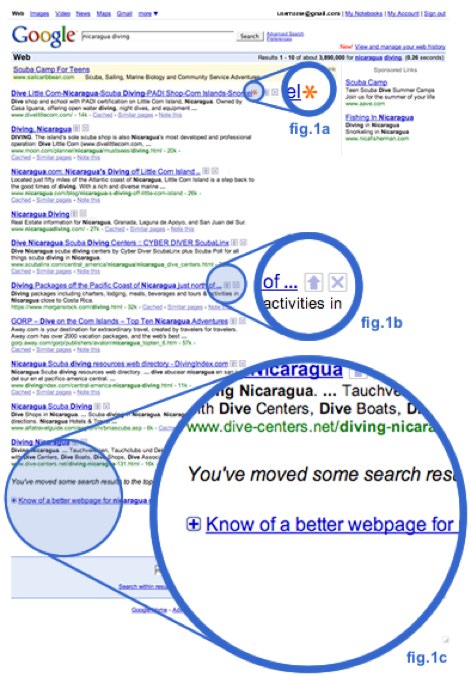
googledigg.jpg

(via Googlified/ Paris Lemon)

  • Sphere It

Trackbacks/Pings (Trackback URL)

  1. VisualBlog - das VisualOrgasm-Weblog
  2. O'Flaherty
  3. Kid Mercury's Blog
  4. Dekut.com
  5. Marlex Systems
  6. Bratku
  7. Support this story on Stirrdup

  8. Metah Blog
  9. Internet Headlines for November 29, 2007 « Dmartel’s Weblog
  10. Mark Evans » Blog Archive » Google’s New Search Wrinkle
  11. Bits and Bobs Round Up | Tech Erin
  12. Removing All Doubt
  13. (EMP) E-Marketing Performance » : » Google Experiments With Digg-Like Voting On SERPS
  14. vBulletin SEO Forums
  15. مدونة موقعي » Google تقدم خدمة البحث بطريقة Digg
  16. Schnellschuss-Links am 29.11.2007 | Werbeblogger - Weblog über Marketing, Werbung und PR » Blog Archiv » Schnellschuss-Links am 29.11.2007
  17. Giga Promoters Blog
  18. Aviran's Place
  19. » New Google Experiment Allows Users To Vote Search Engine Optimization Journal
  20. Digg Style Voting On Search Results - BevyHost Forum
  21. Top 15 Monday Morning Stars of the Week, Dec 3 | Scott Fillmer
  22. Google Experimenting With Digg Style Voting On Search Results « Ikatlah Ilmu dengan Ngeblog

Comments

RSS feed for comments on this post.

  1. Kelli

    I think this would fit in great with iGoogle. There are times when I want to search for something a few times within a couple of weeks or a month and the ability to filter out certain, non-related pages would be useful.

    I think Google deserves praise for this because they have been given a hard time for branching out into non-internet advertising and alternative energy. This shows that Google is committed to their core product.

  2. drew olanoff

    i like this move for a lot of reasons. i find this way more interesting than the whole open social movement. google learns from me WITH my input rather than pouring through my freakin emails.

  3. Mathilda

    It’s likely that their algorithms have already implemented something similar to this through bounce rates, for example, but with non-individual results customization.

    The toolbar app also has a good/bad voting system that nobody uses, although that one does not bury or dig results.

  4. Dan Frommer

    Sorry, but how is this either Digg-style or social? Digg has nothing to do with inventing a yes/no setting. And if my preference is only stored in my account, invisible to other users, and not impacting their engine, what’s social about it? Sounds like they’re just letting people give them feedback to the accuracy of their search results.

  5. William

    In some ways, this strikes me as a pretty logical extension of what Google already does. In this talk:

    http://www.baychi.org/calendar/20061212/#2

    Daniel Russell of Google made it pretty clear that they use user behavior to affect search results. Effectively, that’s using implicit voting, rather than explicit voting.

    The personalization based on user interest isn’t new, either:

    http://blog.searchenginewatch......628-073541

    I think the main difference is the extent to which this is all in the user’s face. Given that a lot of people love Google for the magic simplicity, I’m not sure that’s a step forward.

  6. RBA

    Somehow I agree with Dan. This seems to be a feature so a single user can taylor his/her own search experience when doing future searches. I don’t see the social element anywhere. Yes it could be extended to make it more open, but as it stands this is not a “social” feature.

    As for associating anything that has to do with voting to Digg, well, that’s another story :-)

  7. Muhammad

    I completely agree with Dan’s comment; It’s neither Digg-style nor social, but it’s a nice experiment nonetheless.

  8. Searcher07

    My money is that digg will open their APIs to allowing embedding of Digg technology around other types of data. It’s only a matter of time before you will be able to digg anything.

  9. Duncan Riley

    Dan
    vote up or bury. Sounds like voting to me, which is what I did last time I was on Digg, or even Reddit and other Digg-style sites.

  10. Rob

    I would take Google over Digg any time of the day.

  11. Joe

    The big challenge will be for Google to prevent people from gaming the results. This opens up a lot of possibilities for someone in control of a bot net.

  12. Fred

    I actually had an idea for a search engine a year ago that included social elements and more, drafted up the business plan and everything, but pulling together a team can be tough. I’ve got a number of friends in the Silicon Valley, but they can be lazy and very negative if the idea doesn’t come out of their uncreative, ‘rational / logical’ and boring minds.

  13. Stefan

    Simply a clone of the http://www.sproose.com concept.
    So the large prize goes to the sproose.com guys, they saw that coming 2 years ago.

  14. Santu

    If using digg, how about SEO?

  15. Kuldeep

    I think this must be a most useless feature offered by Google, ever!

    I’d kill my self if it ever comes out into mainstream search.

  16. kyle

    @duncan: yes, digg and reddit have up and down, but the key is the social. when you hit the up arrow, you are promoting that story for all the other users to see. your post specifically states that google is not doing this (”will only be stored per user and not applied to the general search index”) so i fail to see how this is digg-style or social. it doesn’t sound like social voting at all, it sounds like the google equivalent of a highlighting your notes.

  17. Subvert and Profit

    Hmm, if this got opened out, Digg-style, it looks like something Subvert and Profit (or someone similar) would jump on to try and game for SEO benefits…

  18. Axel

    I heard hotornot is adding a digg-like feature, but with a voting “scale” rather than just binary options. I can’t wait. But why did they need to “copy” digg?

  19. Rajeev

    Cool now Online Debris can be avoided. Hope they use decisions of influential people collectively and make them available to common people.

    http://tekno-world.blogspot.com

  20. Federico Pistono

    I’ve always wanted Vi-like style shortcuts on Google, I already use them extensively on Google Reader and GMail, I was wondering when would they start enabling them on Google search as well.

  21. InformationPile

    This is a nice little thing from Google. Sometimes the search results contain crap or porn which is not intended. All those tricky MFA websites and cloaked websites can now be “buried” for good.

    I don’t really hope to see the feature any time soon. I don’t know many people who are logged in to their iGoogle while surfing. Most are just trying to find something from the toolbar.

    Lets wait and watch…

  22. Darren Stuart

    Its a good idea but I don’t think it can work without being gamed. Wouldn’t be to hard for the bot commanders out there to game it. I suppose it would only be an extra field on their page rank calc and thats up to well over 120 odd.

  23. jamie

    Our organization has been working on a similar but more advanced concept for months. Our approach works with all of the major search engines and does provide a far more sophisticated mode of operation rather that just ‘like / don’t like’ and ‘bury’.

  24. Parul Bindra

    I think it will just affect your own results. However if a site gets hundreds of buries they would probably flag the site and the search results page for a manual review. Does this mean for all Google users? So if a page maybe gets 100 thumbs down then Google remove it? Not sure??

    Parul
    http://www.bhopu.com

  25. Wayne Smallman

    “If you saw this one coming, give yourself a very large prize.”

    What do I get? A cuddly toy?

    I talked about Google taking on Social Media smarts some time ago.

    So for me, it’s about time Google finally ‘got’ Social Media…

  26. simon jones

    I totally agree with Subvert and Profit , very easy to manipulate for SEO purposes.. I mean what is it with you diggers, some of you seriously think you own the internet.. there is nothing more than diggers love than talking about digg… get in the real world , google is doing this so it can improve its results… as already said above I would take Google over the sexually frustrated users of Digg any day.

  27. Jonathan George

    About two years ago I predicted that this would be the future of search. It makes sense when you sit back and think about it. Google’s algorithm is supposed to work by measuring the number of links pointing at a site. This is essentially a vote. Their algorithms try to predict the votes which are a better representation of quality by building connected graphs of “quality” web sites. There are two other ways to determine votes of quality. The first is to measure the time a user stays on a page. This could be determined by 1. tracking when a user leaves Google and when a user returns, 2. by measuring page stay through Google ad server requests, or 3. by buying up large pipes and monitoring traffic. All of these methods seem rather big brotherish. They may be used but it would be best to do so out of the scrutiny of the public. The other method is to allow a person to actively vote for the sites he or she likes and/or downgrade the others. I will now give myself a large prize…(a.k.a. grande coffee before work.)

  28. Rick

    I hope Google clarifies if the dig/bury system is for relevancy or for ethics because if people think it’s for relevancy and start burying quality web sites that aren’t elevant for their particular search, a lot of good sites may be added to the black list.

  29. Marc Nathan

    http://www.irazoo.com has implemented this Social Search feature early this summer, but they’re using to to refine all of the searches for that topic based on human-powered relevancy - without relying strictly on algorithms.

  30. kcore

    I’m so curious about how people will go on spamming the searchresults. Personally I think black hat seo will concentrate even more on small niches so there won’t be to many people who rate the sites bad.

  31. Richard

    WooT! I can finally get rid of the *.about.com links! I love it! :)

    Later…
    Richard

  32. Brad

    Finally we can all remove Experts Exchange from our search results!

  33. Dave

    At the moment the results of the program will only be stored per user and not applied to the general search index, so that sites buried (”I don’t like”) will not appear in future results for the user, where as sites voted up will stay up.

    In other words this will be applied at the personal level, and have no impact on anyone elses search results for the same search text. Therefore it is not a social implementation, but a method to control what you personally see in the results.

    Its only going to work for search results that return the same sites - otherwise it would be a pointless exercise. It appears to me to be a way of getting rid of sites that you dislike from appearing. I can’t believe this would have any impact long term on the search results presented across the board, otherwise everyone would vote down the competition.

  34. John

    To bad theres no way to promote a google cache result to punish but still use the pages that show the spider a different page. A heat map in the background of a link would be the obvious choice.

  35. amorson

    Isn’t the best voting is simply following what users click? Obviously some clicks do not supply the best answer or information, but it should give some idea of whats useful and whats not.

    How many people will go back to the search results page to vote after they already found the information they needed?

  36. Rytis Sileika

    I believe it has to be tightly integrated into existing social networks. Ideally, search results should not be influenced by the whole internet community, but only by the preferences of the close friends group.

  37. Ed

    I would say this is a better fit for Mahalo. It could help the editors there in a big way.

  38. CCNA Exploration

    Good move. But could be abused.

  39. rajanmr

    This will enhance spamming of serp. People will vote on their own sites like digg

  40. elegance

    God is on the war path, I suspect the agrodated data of something like this will be around and developed for a long time to come. God has long since recognized that their algorithms are game-able and they surely could improve the results with a large flux of data gathered from the wisdom of crowds.

    This might be timely :
    http://startupcrunch.org/who_w.....extlinkads

  41. mmouse

    what about searching only sites that appear on digg reddit like http://www.50matches.com does?

  42. Chris R.

    Good for them. It’s interesting to see them making major changes in the way pages are ranked.

  43. RONLG

    This could be a great thing. To touch no the topic of SEO, this would be interesting to see what happens.

    The chances of you being able to manipulate results in an non-ethical manner aren’t likely since you have to be logged in to use the voting system. I see it working to an advantage because it gives the chance for logged in users to weed out the junk and bring the goods to the top. In return, this should drive positive traffic to your website and that would effect the general populations search results (users who aren’t logged in)… Right?

    Now, I haven’t gone through and read up on more details regarding the experiment, but wouldn’t it be awesome if it had an “A.I.” that naturally returned sites based off of your voting habits? If this happens; please mark my words and give me credit as needed.

    HA!

    -ronlg

  44. reddogg

    Off hand I dislike this change, if feels like a pure popularity contest. On the other hand I will gleefully mark down required registration sites like “Experts Exchange” or “NYTimes” and useless sites like “BizRate”.

  45. Thom

    Vertical search engines, and one in particular — Wazap have had this feature for over a year, AND it’s social, AND it effects the overall index weighting of the result.

  46. Bernd

    First there was Web History: Google stores your search terms in private
    Now there is Google Labs: Voting on search results in private
    What will be next: Making both social? I think so! In my point of view the integration of search and social networking could make sense…: to improve search fulfilment and to improve networking…

  47. HMTKSteve

    All hail the Google Bury Brigade!

  48. VW

    Ohh finnaly i get to take out the stupid search results i dont like :)

  49. Robert MacEwan

    We’re missing the point that folks, especially bloggers, are not going to hang out on Google to promote stories. I see this as Google testing the waters - maybe to purchase a Digg site in the next 3 years. sssh, don’t tell anyone.

  50. NextInstinct

    Thank You Duncan. I’ll take one large prize thank you.

    Perhaps Google is in fact experimenting to see the ‘how’ and ‘what’ users do, to better write their next custom search algo.

    Gord Hotchkiss discussed this in August; http://ask.enquiro.com/2007/go.....ted-world/

    As a search user, I would hope Google doesn’t take a tiny sample (”a few weeks”), and apply those standards to general results.

    I get it that user input can’t be wrong. But it can when the user eventually doesn’t even know what other choices could have been available.

    And then there’s the risk of a gamed system if it is applied to general results.
    A couple thousand thumbs up for your link for $50, from a third world spam farm anyone? (Let alone the blackhat automated software programs that will be attempted).
    I’m sure Google is aware of all this.

  51. JAlpino

    I’ve been doing this with Google search results for a while now on my site mp3Salad.com. I use their Search API to find search results that point to mp3s, but when I run across an advertising honey pot returned in the results, I label it as an onion and hide it from the user. The end result is that users only find quality pages that contain real links to mp3s. Unfortunately I’ve had to alter the way that the results come back to the user to be compliant with G’s TOS. They gave my site the boot from their index because (I think) I was not displaying all of the results their API was delivering to me.

  52. Permeate

    Duncan, you are an idiot. This is not social voting because there is no “social” aspect to this. All it’s doing is allowing the user to sort the search results to their liking. It’s not applied to the general index, but only stored locally. How is this social?

  53. vaspers aka steven e. streight

    User ranked SERPs is something Swicki/Eurekster has offered for years. Google is just now catching up?

    What I want is the ability to order results by Recency, for the freshest info.

    http://twitter.com/vaspers

  54. vaspers aka steven e. streight

    Permeate: you’re a webless troll idiot.

    You have no right to post comments here or anywhere, if you’re too cowardly to display your URL or too un-geeky to have a web presence.

    This is social, but you’re too stupid to get it.

  55. Permeate

    Ok Vaspers, then why don’t you explain to me why it is social, because I did pose the question, didn’t I? Let’s hear it smartass.

  56. vaspers aka steven e. streight

    Permeate: Nope. Not until you reveal what your blog or website URL is. If you don’t have one, then you have no right to comment.

    Why? Because if you post an abusive comment on a blog, we have no way to return the favor.

  57. Wil

    Hey, it’s a cool feature. There are a lot of inconsistent search results out there. Cheers to google.

  58. Permeate

    I do have a right to comment actually. See, website is not a required field! Why don’t you ask Michael why he allows anonymous posts? There is a perfectly good reason for it, but you’re too stupid to get it. Good day sir.

  59. Steve Ballmer

    They totally stole our idea! Windows Live Digg was going rules the internets!

  60. vaspers aka steven e. streight

    Permeate: There is no reason for allowing cowardly webless trolls to post comments. I don’t run TechCrunch, so I can’t enforce this policy of disallowing you twerps to post comments.

    But webless anonymous trolls merely decrease the value of a blog.

  61. Ian

    Back in 2003 I built an experimental front-end to Google called “WhittleBit”, there is a good third-party description here: http://www.rankforsales.com/n-.....4-03.html. It never really went anywhere though (the implementation was pretty flakey as it was just a prototype).

    The concept was that you search for something, and you can vote yes or no on each search result. It will then automatically refine your search by adding or removing terms from it based on your feedback.

    As for crediting Digg with the concept of selecting content based on community voting, they definitely weren’t the first. The earliest implementation of this I’m aware of is Kuro5hin.org (see http://en.wikipedia.org/wiki/Kuro5hin), which was founded back in 1999.

  62. vaspers aka steven e. streight

    BTW, the “Steve Ballmer” comment is spam, for the URL mentions “milfriders” thus it’s another troll.

  63. Permeate

    Vaspers,

    First, all I wanted was to fire Duncan up and get a straight answer from him, but he knows he is wrong so I doubt I will get one. You also failed to provide me with an answer to my original question.

    Second, I own 3 e-commerce sites, so I don’t know how I am webless. Which URL would you like me to display?

    Third, trolls post comments unrelated to the topic to get a rise out of people.

  64. Dan

    This will be interesting feature for local searches in perticular.

  65. Al Gore

    I’m honestly completely sick of Digg and the rest of you aholes out there (aka TechCrunch, scoble, etc.)… sooooooooooo tired of hearing your endless babble. This isn’t a digg style voting system. It’s a voting system.

    Kevin and Alex are SUPER annoying these days gloating and drinking on their unfunny podcast. It was fun for awhile, but now it is freaking DULL.

    We need a brand new, clean slate… and hopefully you guys will have an earthquake so that can happen.

    Peace,

    Al Gore

  66. Finally

    Finally, I can remove military dictatorship, and famous villain people. This planet have some sick people. I want to ban them from being famous.

  67. theLiveWeb

    Cool idea! It seems they are trying to use Wikipedia like model to use the intelligences of masses to make the search more intelligent.

  68. Dave

    Permeate: you’re a webless troll idiot.

    You have no right to post comments here or anywhere, if you’re too cowardly to display your URL or too un-geeky to have a web presence.

    This is social, but you’re too stupid to get it.

    I must be stupid too then, because I don’t understand how changing the results google presents to me, for my benefit, that no one else can see/feel/touch/appreciate and love can be in any way social.

    Can you explain it for the uninitiated please………

  69. Randy

    “Digg Style”?

    Doesn’t look anything like Digg’s style.

    Unless you are referring to voting?

    I hope you’re not, because “www.Digg.com” did not invent this concept. They merely got enough kids and groupies together to make their site’s version popular.

  70. Will

    It is amazing how myopic we have become. Do any CS guys read this site anymore, or is it all biz dev people?

    As others have pointed out, this isn’t social like Digg. In Information Retrieval parlance, this is called “relevance feedback”. In fact, this feature was the main differentiator for excite.com back in the web 1.0 days. The main reason this didn’t work out for them is that very few people would actually click on the feedback links/buttons. Another problem is that negative feedback (saying you don’t like something/not relevant) isn’t all that useful to the search engine, since there are a billion other pages that matched your query.

    Excite actually *would* take user feedback into account for its result rankings for other users, so in a way Excite was more Digg-like even back then. This is a bit of a different play by Google, so perhaps they can get more people to use it. But please, let’s not pretend like this is new!

  71. buy penny stock online

    Black hatters beware.

  72. mark

    Seems like an interesting experiment.

  73. Niko Bellic

    They should make sure that this never influences the current results page - just limit this to each user’s own page. It shouldn’t contribute or take away from the current results - otherwise you end up with massive SEO scamming and spamming.

  74. Jozef Jarosciak

    I sent an email to Google in October 2006, pointing to this blog post I’ve made.
    It’s almost exactly what we see described in this blog post above.

    If someone wants to read my original idea, here is the page:
    Solution for improving Google’s search result relevancy!
    http://www.joe0.com/2006/10/28.....relevancy/

    Anyhow, I don’t claim to be the first one to come up with the idea, but the email I sent them was never answered and year later we see something similar in a testing phase :)

    Joe

  75. Mark

    How can we use this? Its not listed on the Experimental Labs search page?

  76. Robert

    Sproose.com has already deployed this funtionality and even..in a more community based social way.

    http://www.sproose.com

  77. Dave

    I have been working on a social search site like that for a while now.

    It is still in closed beta but I’m building a search index to work hand in hand with search engines like Google and Yahoo to increase search relevancy - particularly enhancing subjective search topics that are the major weakness of traditional keyword searching.

    *shameless plug*
    http://luzul.com/about_us

  78. Tony

    Nice idea, but I don’t see the point in doing it if it’s only for myself

    Most of the time when I search in google, I’m looking for something completly new. Thus I’d only get benefit if I saw the votes of other people.

  79. Velioncho

    The key is to “only for myself”.
    Else, flood gates are open for spammers.

  80. Matt Ellsworth

    interesting idea. I think that google already knows if someone liked something by whether or not they hit the back button immediately.

  81. Steve Ballmer

    One thing you should never accept on the internet, democracy!

    http://fakesteveballmer.blogspot.com

  82. exapted

    @78, Matt,
    That might be one reason there is no way to open search results in a new tab or window using keyboard shortcuts under “Experimental”.

  83. Sebhelyesfarku

    vaspers aka steven e. streight you retard, stop spamming techcrunch with your sorry ass blog

  84. Andy Schweig

    vaspers — i have to agree with permeate. you’re comments are pretty much moronic. hmm - could it be that you are actually Duncan’s alter, slightly more intelligent ego?

    this is NOT social - yet. and like one user acknowledged, will be a great feature for users to take out BAD sites from their index. in fact, i think this is the biggest use of this feature. imagine being able to take out about.com, random search engines, etc. from your results for good? very valuable!

  85. ajcates

    I like the idea of a digg system, if it was used correctly by everyone, it could really help out sreach. Also parental ratings of pages I think would be cool as well.

  86. atomic1fire

    so basically aftervote.com without the multiple search engines

  87. tketch

    Interesting. I came up with this EXACT idea just over a year ago but never had the resources to make it happen. It really makes sense to have human input mixed with relativity connecting algorithms. Good job Google, lets see this one out of Labs.

  88. Burgo

    @71,
    Even if Google says this will never influence general results, you’d have to think they’d be stupid to NOT be looking at these stats in that context…

  89. Chris R.

    @51 @83 - I was actually really enjoying the comment thread until you had to pollute it with your self indulgent bullshit. Please find another blog to masturbate over you trolling idiots.

  90. IdeaTagger

    Taken from a blog post I wrote back in June:

    “… a social search engine where users could own search phrases by being one of the first to rate results generated for them and then share in any advertising revenues resulting from those phrases.”

  91. Shahar Nechmad

    Although it sounds really cool at start, think about it - How many sites you really don’t want to see in search results? How many exact searches you do again and again if you don’t like the top 3 results?
    The only good thing here will be if Google will use it to better search results of everyone. But of course this will be almost impossible thing to do without getting into hell of SEO problems.

    Shahar Nechmad
    CEO, NuConomy
    http://www.nechmads.com

  92. clem

    I did see it coming actually…
    I emailed Google some time ago offering my services and suggested this to them, amongst other things. Never heard back from them.

    Where’s my very large prize?

  93. supaswag

    The last thing Google will do, is to include a “vox populi” that’s easy to subvert into their search algorithms. It’s [at the moment] just a personal feature to attract “The Digg Crowd”. Otherwise you’ll have thousands of badly paid computer monkeys, typing in keyphrases and then giving company’s direct competitor’s listings bad ratings. Google is doing a very good job at the moment to make it as challenging as possible to influence search engine results. And they’ll do everything to keep it like that.

    http://supaswag.blogspot.com/

  94. Salvo

    I did not predict this specifically would happen, but am not surprised. They have been testing it out with Google CO-Op haven’t they? When I started getting better results by searching in Del.icio.us as opposed to Google, I did have an idea that Google would need to start adding a human element to keep up with the others.

  95. MG

    This technology has been implemented earlier in the Russian search engine Google: http://wiki2.ru

  96. Tom

    I’m not a big fan of this concept. If it ever went mainstream, I can only imagine everyone wanting to pay a big group of people to up their rank and downgrade their competitors.

    I think this will only work well with each person’s personal results.

  97. Steven Marder

    As mentioned in one of the earlier comments, Eurekster launched its community-powered social search platform “swicki” close to 3 years ago, and explicit voting functionality in 2006. To date, over 100,000 swickis have been built, each serving a community of users passionate about a specific topic. Each swicki comes with a customizable widget that contains the searchbox and the “buzzcloud” widget, making it easy for swickis to be added to a topical site or blog and shared among the community. A recognized innovator and leader in social search, Eurekster processes over 25,000,000 searches a month. The key to Eurekster’s success in improving relevancy here has been leveraging the explicit (and implicit) user behavior though at the group or community level, not individual or general. Check out http://www.eurekster.com.

  98. Indus

    Did you notice the URL of the experiment? The last part “a840e102″ decodes as ‘a double dose of cannabis produces a 100 times better search engine!’ More analysis on my post at http://www.khaitan.org/mt/archives/000194.html

  99. seopat

    to improve results for yourself it’s ok, but how about influence of a one’s choice to natural lists

  100. Joy

    hmmm…sounds interesting..^^

  101. Alfred Saforo

    i would like to brand Google as the biggest copy cat ever. They have taken on paypal , skype, youtube and now digg. What will this monster do next? Google Air?

  102. Mo Raja

    I am owner of
    Official Football Credit Cards
    and I believe this system wont work well for. In fact sites football wallpapers and graphics of star players would probably get “digged” or “dug” and sales sites would be burried. If I type in ‘football’ and come across “American Football” sites, I would burrie every single one. It doesnt necessarily mean these websites are rubbish. It just means… thats wasn’t what I was searching for ‘on this occasion’. I think a youtube style voting system would be better. At least you will have organic results.

  103. Cezanne Huq

    I think it’s worth testing but part of me thinks the democratization of “relevance” could hurt search but then the other half says this is the step in search development.

    dunno but good to see that this type of experimenting is public and open…

  104. berto_s

    This move fits in perfectly with the data collection that Google was already doing for popular votes (stars), where they have been tallied up and used to determine whether sites should be ranked higher.

    In addition, with the recent influx of locally targeted results and local search tools, this seems to be a perfect fit. Google can now pick up on local search trend data and display results in the same area for that area. This can then be used to give higher rank to the little sites that may only be in one city. It can also be used to prevent click-fraud by simply not reflecting clicks from that hot spot or other country that may be ranking one site higher than is typical.

    If you want to see another use of user input changing the Google result, check out Google maps and look on the left side where they have “Add or Edit your business: Learn more »”. Now on the maps, you can move the pinpoint of a location. And they do have safeguards to prevent malicious changes.

  105. Perry_T

    AS long as this improves my own search results, then I am all for it.