 Silicon Valley based Ning and Los Angeles based Flux are “networks of networks” that allow communities to build feature rich social networks with a few clicks.
Ning, which launched in 2005, has raised over $44 million in capital and has 130,000 social networks on its platform. Ning was founded by CEO Gina Bianchini and Marc Andreessen, pictured to the right.
Flux, which launched in September, is a joint venture between Viacom and Social Project (formerly Tagworld). They are pre-launch, but power a number of social networks around Viacom properties (including MTV) and third party sites.
The two companies are on a collision course. Both platforms share users, meaning once someone has signed up for one social network on the platform, joining another one requires just a single click. Ning has built its community from the bottom up, and has benefited from backlash against the big, sometimes impersonal social networks. Flux, the newcomer, carries the weight of Viacom’s hundreds of brands behind it and will soon open up to any third party that wants to join.
But something about Flux doesn’t sit well with Bianchini, who sent us a long analysis of their business model. She goes into detail on Viacom’s history with partners, their tendency towards litigation, and conflicts between Flux’s marketing materials and terms of service. Flux undoubtedly will respond. For now they have no comment.
The analysis, written by Gina Bianchini, is below. I’m staying neutral on this for now until Flux fully launches and they’ve had time to respond to this. But I’ll say this – it is refreshing to see a company be willing to mix it up and say exactly why they think they are the better service. Too often, PR-speak gets in the way of clear communication. That certainly didn’t happen here.
Update: Social Project has asked us to point out that the sections of the “Terms of Service” excerpted in the post below are from the Social Project Terms of Use (for end users) and a third party Privacy Policy (also for end users). The information does not come from Flux’s third-party partner agreement. Third-party partners on Flux retain rights to their data and users. Social Project is an independent company with no controlling investor.
Flux: A Point-By-Point Analysis
Executive Summary
Flux is a new service from Viacom that enables companies to theoretically create branded social networks.
With Flux, artists, music labels, and soon individuals are handing over their rights and ownership in the social networks they create to Viacom, a litigious company with a single, rigid social networking application that can’t be customized nor virally distributed.
With 130,000 social networks – 100,000 of which have been created in the past nine months alone – Ning is the hands down leader in branded social networks.
With Ning, the artist or individual controls their network, their content, their brand, and their destiny with an infinitely flexible platform offered by a well-funded independent company with a track record of innovation.
The Facts
- Ning is the largest provider of branded social networks on the Internet today.
- Social networks on Flux aren’t viral.
- Flux’s social networks have extremely limited control and customization options. You can’t make it yours.
- On Flux, Viacom owns everything. On Ning, you do. 50 Cent created his own social network on Ning despite his label creating one for him on Flux. Why? Because he owns his network on Ning, on Flux Viacom does.
- On Flux, Viacom has the exclusive right to make money – or control who does. On Ning, you do.
- Viacom has a history of unsuccessful online initiatives.
- Viacom has a history of suing partners.
- In software, platforms like Ning win. Single applications like Flux don’t. And single applications that seek to control people on rights issues while ignoring viral distribution are death.
Fact: Ning is the largest provider of branded social networks on the Internet today.
With over 130,000 social networks – 100,000 of which have been created in the past nine months alone – Ning is the hands down leader in branded social networks.
Flux is reincarnated application from Tagworld, a MySpace clone from 2004, which Viacom purchased quietly this year.
Fact: Social networks on Flux aren’t viral.
Flux relies exclusively on external video services like YouTube or Brightcove for videos. Here’s an example of a video on Interscope’s 50 Cent website:
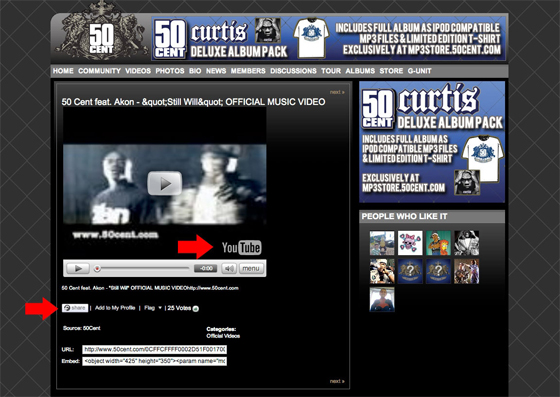
As you can see, there is no option for 50 Cent to have his own watermarked video player, photo slideshow, or music player on Flux. (Editors note: see Bianchini’s blog post on the need for control over video players for more on this).
Furthermore, Flux’s new fShare feature demonstrates that as a large, traditional media company, they do not understand viral distribution. fShare simply enables a user to add a YouTube or Brightcove video from Flux to another service like MySpace with a click. That’s great, but it’s still a YouTube or Brightcove video that actually sends someone back to YouTube or Brightcove, not the network itself. This dramatically limits the virality of the social networks on Flux and ensures the continued success of YouTube and Brightcove at the expense of the new network.
In contrast, viral distribution is built into every branded social network on the Ning Platform. Invitations. Sharing. Easy integration with Facebook and MySpace. Viral video players, photo slideshows, music players, and badges are all uniquely branded for each social network. All enable massive distribution at zero cost. And – unlike Flux – they are yours.
Here’s an example of Powder Church, a social network on Ning for skiers:
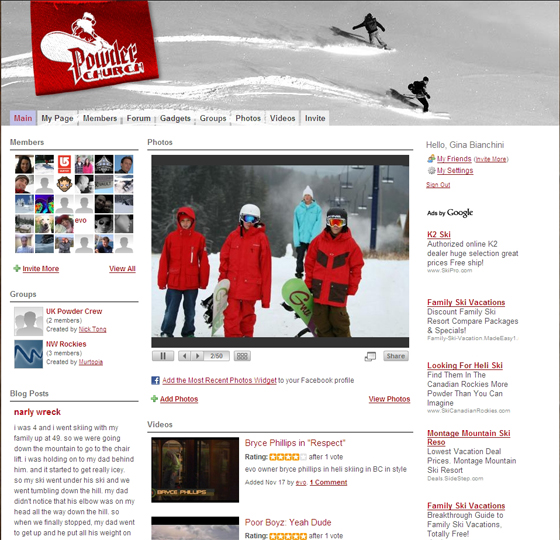
And here’s Powder Church’s embeddable branded photo slideshow widget that comes automatically with any social network on Ning:
http://www.powderchurch.com/xn_resources/widgets/photo/slideshowplayer/slideshowplayer.swf
Find more photos like this on Powder ChurchAs you can see, the widget watermark is uniquely branded for Powder Church and, if you click on it, you’re sent back to Powder Church. While the members of your network can pull in videos from around the web into your social network on Ning, the primary widgets are all uniquely branded for your social network. Not YouTube. Not Brightcove. Not DailyMotion.
Fact: Flux’s social networks have extremely limited control and customization options. You can’t make it yours.
The ability to customize Flux’s social networking features is limited.
Here are the questions on 50Cent.com, powered by Flux:
- About Me
- Occupation
- Favorite Music
- Favorite Shows & Movies
- Interested in
- Looking for
- Relationship Status
- Interests
And here are the questions on pcdmusic.com, powered by Flux:
- About Me
- Occupation
- Favorite Music
- Things That Make me Laugh
- Tagline
- Interested in
- Relationship Status
It’s a different ordering of the same generic questions. Nothing specific to either artist. Limited customization.
In contrast, profile questions on your social network on Ning are created by you, making them unique to your branded social network. For example, take Wakefirst, a social network for wakeboarders on Ning:
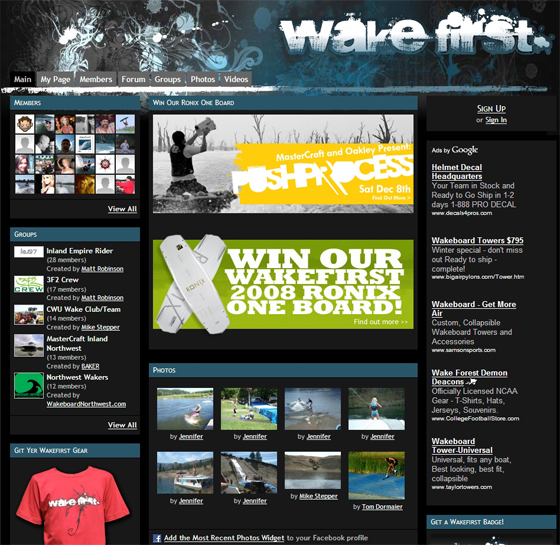
Here are the profile questions on Wakefirst:
- Male or Female
- Where are you from (City, State)
- When did you start wakeboarding?
- Favorite Lakes
- Do you own a boat or ride with friends?
- What do you ride?
- What’s pulling you?
Membership in Wakefirst is about the passion for wakeboarding. Plus, these questions are then used for highly targeted advertising and sponsorships by wakeboarding equipment companies.
Fact: On Flux, Viacom owns everything. On Ning, you do.
According to Flux’s Terms of Service, Viacom owns everything on any social network created on Flux. This is at direct odds with their marketing splash page for Flux:
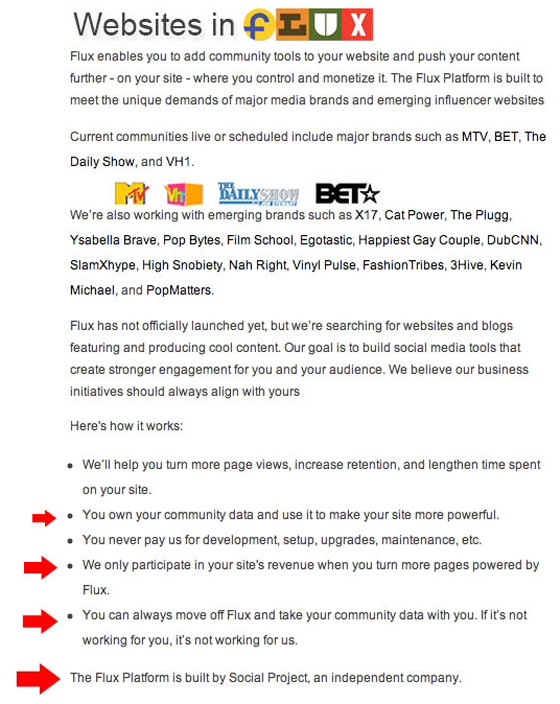
So, that’s what’s they’re marketing. Now let’s look at Flux’s Terms of Service:
On ownership of the social network on Flux
From the Flux Terms of Service: “The past, present, and future content of the SP Service, including, without limitation, all applicable software in any format, organization, designs … and all other materials related to the SP Service and the SP Service itself …and other intellectual property (individually and collectively, “Material”) are protected by applicable copyrights and other proprietary (including, but not limited to, intellectual property) rights and are, as between SP and you, the property of SP.”
In plain English, even partners such as music labels don’t own the networks on Flux. Viacom does.
In contrast, you own your network on Ning. From the Ning Terms of Service: “Ning does not claim any ownership rights in the Content or the Code you provide. You, as the Network Creator, own the Code you develop (“your Code”). You also own the Content you create and upload (“your Content”). After posting your Content or your Code, you continue to retain all ownership rights in such Content or Code, and you continue to have the right to use and license your Content and your Code in any way you choose.”
On ownership of the social network’s content
From the Flux Terms of Service: “You grant to SP the unqualified, unrestricted, unconditional, unlimited, worldwide, irrevocable, perpetual, and royalty-free right, license, authorization, and permission, in any form or format, on or through any media or medium and with any technology or devices now known or hereafter developed or discovered, in whole or in part, to host, cache, store, maintain, use, reproduce, distribute, display, exhibit, perform, publish, broadcast, transmit, modify, reformat, or translate, all or any portion of your User Content on the SP Service and any other channels, services, and other distribution platforms, whether currently existing or existing or developed in the future, of SP(collectively, the “Channels”), for any purpose whatsoever (including, without limitation, for any promotional purposes) without accounting, notification, credit, or other obligation to you, and the right to license and sub-license and authorize others to exercise any of the rights granted hereunder to SP in our sole discretion. These rights include without limitation, the right to distribute and synchronize all or any portion of your User Content in timed relation to any other visual elements; to web cast, pod cast, re-publish, re-broadcast, re-platform, port, syndicate, route, and link to and from all or any portion of your User Content; to encrypt, encode and decode, and compress and decompress all or any portion of your User Content; to edit, mix, combine, merge, distort, superimpose, create or add special effects, illusions, and/or other material to or of all or any portion of your User Content;; and to excerpt and/or extract portions of your User Content in order to host, store, index, categorize, and display your User Content on or through the Channels.”
In plain English, every single member of the network – including the artist and network creator – just handed over the keys to Viacom.
In contrast, you own your content on Ning. From the Ning Terms of Service: “Your Content remains yours. We claim no ownership interest in the Content you provide on Networks running on the Ning Platform.”
On ownership of member data
Flux says on their marketing page, “Data collected is your data.” Analyzing the Terms of Service, this is simply not true.
From the Flux Terms of Service: “By visiting these sites, you affirmatively consent to our collection, use and distribution of your data. We may share your information with other third parties with whom we have business relationships and, in some cases, we cannot control or know their privacy practices. By visiting our sites, you affirmatively consent to our collection, use, and distribution of your data.”
Beyond this, the only reference in the Flux Terms of Service that may conceivably address member data ownership is: “Except for the licenses, authorizations, consents, and rights granted hereunder and described in this Agreement, SP acquires no title or ownership rights in or to any User Content you submit and nothing in this Agreement conveys to us any ownership rights in your User Content. SP is acting only as a host, bulletin board, or conduit for submitted User Content, with all of the specific rights granted by you hereunder.”
The problem with this is that it’s gutted by the content license above which enables Flux to do anything they want with your content.
In contrast, on Ning you control your members and their data. From the Ning Terms of Service: “If you, as a User of a Network, agree to a Network’s privacy policy, you agree that any dispute you have with a Network Creator is between you and that Network Creator (and not Ning).”
Saying Social Project is an independent company is insincere
Viacom owns a significant stake in Social Project (aka the company formerly known as Tagworld aka a MySpace clone from 2004) which is doing nothing other than providing Flux on behalf of Viacom. There is no other service of the company.
To argue that Social Project is an independent company is the equivalent of saying that Enron’s shell corporations in the Cayman Islands were independent. In theory, perhaps. In reality, no way.
In contrast, Ning is well-funded, independent company with a track record of innovation and Terms of Service that have consistently been pro-Network Creator from the start. We believe there is a compelling way to profitably grow the Ning Platform explicitly because we are pro-Network Creator.
Fact: On Flux, Viacom has the exclusive right to make money – or control who does. On Ning, you do.
From the Flux Terms of Service: “The SP Service is to be used solely for your noncommercial, non-exclusive, and limited personal use and for no other purposes without the express prior written consent of SP…SP reserves the sole and exclusive right to sell advertising and otherwise exploit, benefit from, and/or realize revenue from the conduct of its business and operating the SP Service, the User Content Submission Features or other Channels, and any and all arrangements made with respect thereto, without accounting, obligation, or liability to you, notwithstanding that your User Content may be displayed on or otherwise used by or in connection with the SP Service, the User Content Submission Features, or other Channels.”
From the Ning Terms of Service: “Ning offers fee-based premium services on the Ning Platform. If you choose to sign up for a premium service, you agree to pay the applicable fees and abide by any additional requirements or rules associated with that premium service.”
In plain English, you pay us $19.95 per month; you can run your own ads and you keep 100% of whatever advertising revenue you generate from your social network. If you want to sell a subscription or goods on your network, go for it. It’s your network. It’s your choice. You control it.
Fact: Viacom has a history of unsuccessful online initiatives.
Not to throw stones, but Viacom does not have the best track record of successful online initiatives. From Valleywag and Computerworld August 22, 2007, here’s the history:
- November 1996 Yahoo and MTV announce the creation of UnfURLed, “the ultimate guide to music on the Web.” The site is promised to launch in January 1997.
- January 1997 UnfURLed does not launch.
July 1997 UnfURLed launches, six months late. The site later disappears, forgotten. - February 1999 Viacom acquires Imagine Radio, a service which lets users listen to preprogrammed music channels, or create their own. (If that sounds a lot like Last.fm or Pandora, that’s because it was a lot like those sites.)
- May 1999 Viacom acquires SonicNet, an online music-news and information site.
- August 1999 Amid Internet fervor, Viacom creates the MTVi Group as a rollup of its Internet websites, hoping to take it public to cash in on the market for Internet stocks.
- August 2000 With an IPO off the boards, Viacom reorganizes MTVi, giving control over websites like MTV.com and VH1.com back to their respective cable channels.
- 2001-2004 MTV does nothing interesting with Internet music for five years or so, as best we can tell.
- April 2005 MTV launches Overdrive, a broadband “channel.” MTV later brags about how many “video streams” Overdrive serves, not noticing the complete apathy with which music fans greet it.
- July 2005 News Corp. swoops in and inks a deal to buy the parent company of MySpace. Viacom is widely reported to have been interested in buying MySpace, which gained popularity by embracing music on user profiles and getting bands to use the site to communicate with fans.
- January 2006 Microsoft and MTV launch Urge, an online music store.
- August 2006 Google and MTV announce an experimental deal to distribute videos over Google’s AdSense network. The experiment, apparently a failure, dissolves quietly.
- September 2006 Viacom CEO Tom Freston, a longtime MTV exec, is fired, reportedly for missing the chance to buy MySpace. Later that month, Microsoft knifes MTV in the back by announcing its Zune player and companion store, rendering Urge pointless.
- August 2007 MTV merges Urge into RealNetworks’ also-struggling Rhapsody music service.
Is it fair to ask what’s going to be different with Flux?
Fact: Viacom has a history of suing partners.
From The Boston Globe March 12, 2004:
“Satellite provider EchoStar Communications Corp. resumed broadcasting Viacom Inc.’s CBS and cable channels yesterday on its Dish Network after resolving a contract dispute that left millions of viewers without Nickelodeon, MTV, and Comedy Central.”
From the New York Times August 7, 2006
“Google has struck a deal to allow Web site owners to put video clips from Viacom, including “SpongeBob SquarePants” and MTV’s “Laguna Beach: The Real Orange County,” on their pages. The clips will be accompanied by advertising, with Viacom, Google and the site owners dividing the ad revenue.”
From the New York Times March 14, 2007
“Viacom, the parent company of MTV, Nickelodeon and Comedy Central, filed a wide-ranging lawsuit against Google on Tuesday, accusing it of “massive copyright infringement.” Viacom said it was seeking more than $1 billion in damages and an injunction prohibiting Google and YouTube from committing further infringement.”
From the Wall Street Journal July 20, 2007:
“The Law Blog has a special place in its heart for Viacom, and it’s not because the company has created some of our daughter’s favorite TV shows. It’s just that the media giant and its boss Sumner Redstone (Harvard Law LLB) provided us with so much rich material.”
Viacom is a big fish. A big fish whose partnerships – especially with other media and technology companies – tend to end badly.
Fact: In software, platforms like Ning win. Single applications like Flux don’t. And single applications that seek to control people on rights issues while ignoring viral distribution are death.
Flux is a single social networking application that only internal developers can touch. Flux isn’t a platform. There is nothing about Flux that would make it a platform. You can’t program it. You can’t add features to it. And you don’t own the application.
On Ning, you can and you do. Ning is an infinitely flexible platform for creating branded social networks. Viral distribution is built into every branded social network on Ning.
Solid, independent engineering-driven companies are uniquely able to create platforms. Why? Because it’s hard to do. And they have consistently dominated the Internet since its inception. Single applications created by large, traditional media companies – especially ones that treat the rights of artists and individuals as something to dominate – have not.
As an artist or individual, it’s incredibly important to pay attention to the fine print. In the final analysis of the fine print, Ning provides a superior, infinitely flexible social network that is uniquely yours in every way that matters.
Kent Nichols of Ask a Ninja sums it up nicely:
“With Ning, you get an instant social network and you get to own it. Flux is just another big media play to screw over individual artists. Who are you going to trust? The guy that gave us the web browser and the magic of the Internet, or the guys who gave us The Hills and Jackass?”
We couldn’t have said it better ourselves.