Apple: What Could Go Wrong
by Erick Schonfeld on November 27, 2007

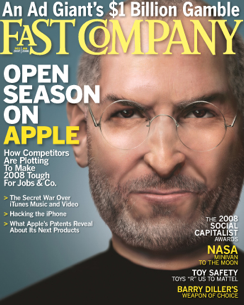
fc-apple-cover.png“Merry Christmas, Steve. Enjoy it while it lasts.” That is the sentiment of Fast Company’s December cover story about Apple, written by Adam Penenberg. (I got my hands on the cover at right, which is a computer-generated image of a sour-faced Jobs by Alex Ostroy). He argues that it is a “dangerous moment for Apple.” The stock is near an all-time high, with a P/E ratio about the same as Google’s. Everyone from Nokia to Amazon to Microsoft to Vivendi Universal to NBC is gunning for it, and its ability to sell 10 million iPhones next year—the famous third leg that is propping the stock up—is yet to be proven. Writes Penenberg:


But when you get down to it, the Apple phenomenon is as much about fashion as it is about technology. You might say that Steve Jobs is the Marc Jacobs of computers (minus the heroin), betting the house his products will be, season after season, cooler than anyone else’s. Yet fashion is, by definition, fickle. Lose the buzz, and you’ve got trouble. And for the first time in years, there are signs that Apple is not infallible and that Jobs’s reservoir of goodwill with his followers is not bottomless.

I’m not so sure I buy the arguments that Apple has to worry about the cell phone industry getting its act together, or the music industry, or the movie industry, for that matter. We still have not seen much evidence of this, although there’s been plenty of grumbling from all corners. The notion, for instance, that iTunes has anything to worry about from subscription music services is laughable. Rhapsody? Please. It is a great service, but hardly a business threat to the iPod/iTunes juggernaut. Apple should be more worried about free advertising-supported music services that are popping up.

I do agree, however, that the “iPod-iTunes pairing was the product of a historical moment that may never be reproduced.” AppleTV is certainly a bust, and Hollywood bosses will not be the easy marks that the desperate music executives were when iTunes first got started. Penenberg’s strongest argument is that in an era of increasing openness, Apple’s insistence on closed perfection might no longer fly:


What does Steve Jobs know that Albert Einstein didn’t? Einstein posited that a closed system would become stagnant over time. . . . Jobs may have to accept that Apple’s next wave of growth–or energy, as Einstein might have put it–depends on syncing up his products and platforms with those of his competitors.

In an age of convergence and simplification, customers are ever more insistent that computers, phones, TV, and music systems work together. For them, being “open” isn’t about sharing patent information or computer code but about compatibility and seamlessness, from the phones in their pockets to the movies playing on their flat screens. . . . Winning outright is a very tall order, of course. It means coming up with a self-contained system so beautifully functional that a critical mass of consumers are willing to enter that world and never leave

It all sounds good. Except that, it has been exactly this closed-world strategy that has worked perfectly for Apple so far. The digital device industry needs a control freak like Jobs to show the rest of us what is possible when everything works as it should. Open systems are great because of their inherent flexibility, but they can also be more chaotic and difficult to manage. The question is whether everyone else can learn from Apple, catch up, and surpass it. And if they do, whether Steve Jobs won’t simply join their parade (at the front, shouting loudly about his new-found open religion) just as it begins to pass by.

Advertisement

Comments rss icon

  • I think on the iPhone a closed strategy is best. Since there are not that many applications that can really work with the small screen etc.

    I would not bet against Steve Jobs. He has been in the industry since the 70’s and seen his share of ups and downs.

    Jobs has done it again and again with Pixar, iPod and now the iPhone so I have no concerns about the future of Apple.

  • Apple has a solid niche. They shouldn’t go after it. They should build their own shtick and brand instead. If they are too lame, then they should quit their jobs period.

  • Maybe the danger will come in the fall of 2008, when the iPhone craze will begin to slow down. At least in Europe it has just begun, so we’re far from going downhill, yet.
    And judging from the wet eyes of my colleague who just received it, caresses it and whispers love words in its ear buds, I think this model will go on, at least for a little.
    Key in Jobs’ strategy for the next few years will be to embody the dreams and hopes of millions of users. To deliver them something palpable, to make them feel special enough to pay a lot for less.
    At least for the rest of us, who remain only slighty touched by the iPhone craze, that will be interesting to watch…

  • Third leg propping the stock price up? iPhone is gravy for the bottom line. How about the fact that Apple is growing its market share in the computing market, and still has, oh, about 90% of the computing market available yet? That’s what I call “room for growth.”

    Then you add iPods, iPhones, AppleTVs (wait for the revamp — remember, Jobs admitted it’s nothing more than a “hobby” product for them right now… emphasis on RIGHT NOW). What else do they have up their sleeves? Rumors are car user interfaces, tablets, sub-compact notebooks, GPS devices or user interfaces. All gravy.

    MGZ

  • its funny how you laud Apple for having a closed system and call Microsoft evil for following the same strategy…..

    the other thing that they teach you in overpriced b-schools is that history can be a partial indicator of the future, but is never perfectly replicated….so saying stuff like “we haven’t seen any indication of this” is actually pretty stupid…..if there was an indication, we won’t be coming here to read about it, we’ll already know….

  • There is a possibility that Apple may become a victim of the brand extension trap. But if we really look at it, Apple hasn’t become the victim of it at least yet. Owning a Mac is cool…and really iPod and iTunes have helped them grow their PC business as well. I think Apple has its game figured out and this time Steve Jobs is being smart by not bringing some exec from a big company who as good at selling carbonated sugar water. We may think that Apple has peaked. But I think that iPhone will be “the computer” for a common person who buys a PC only to browse the web.

  • Reminds me of this story from 2001:

    http://www.busi...21/b3733059.htm

    saying how bad the apple stores will do!

  • @Andrew,

    I was just thinking about the same story and remember it well. Sounds like they are trying to sell magazines by being nay-sayers once again

  • Apple could sell more if they wanted. Sell an unlocked iPhone through the Apple store for 399 EUR. Provide an Apple TV with hard disk recording, satellite tuner and massive storage – I’d pay 700 EUR for such a device.

  • “The notion, for instance, that iTunes has anything to worry about from subscription music services is laughable. Rhapsody? Please. It is a great service, but hardly a business threat to the iPod/iTunes juggernaut.”

    The reason Apple doesn’t need to worry about competing with subscription music services is that they don’t give a shit if ITMS makes any money. Since Apple makes obscene margins on iPods the fact that they make nearly zero margins on media doesn’t matter.

    That makes life really suck for other media retailers.

  • Stating that Apple is all fashion is not correct; the company has plenty of real technology to its credit.

    There is one ‘ace in the hole’, that APPL has not played, and I guess they are holding it in reserve: Releasing a commercial version of OS X to a limited number of large OEM”s – Dell, HP, Asus, Lenovo.

    They may not care to sell a general commercial version for all PC brands, grey and black, but if a real close alliance could be established with say, three of the top commercial and business OEM’s, it would be a 2-3 billion coup.

  • Those guys are just pissed that apple has kicked their butt yet again, time after time, apple pisses over the “competition”.

    buy stocks in apple and retire a wealthy man…

    anyone say the word “CULT” recently?

  • Apple is the king of the of the ill-informed, pseudo counter-culture. How long will it be before the majority of consumers opens their eyes and see how disgusting it is behind Apple’s glossy walls? Soon, I hope.

  • As a Rhapsody subscriber for 3 years, if they switched to MP3s for downloads then they would be iPod compatible and I personally think could put a dent in iTunes. It’s EXTREMELY liberating to be able listen to whole CDs of any artist you like and their influences, followers, comtemporaries without having to pay for each one. Then, when you actually decide you want a song enough to want a copy outside of Rhapsody you pay 90cents and download it.

    They’ve already started the switch to MP3.

  • Is it me or does Steve Jobs look like Salm Rushdie’s long-lost twin brother in that picture?

  • That should read Salman Rushdie, of course, not Salm Rushdie. :-)

  • These types of stories have been published every couple months for the last few years. Apple is the company pundits love to hate, cause hating Apple sells magazines. Note that I’ve invested in Apple fairly heavily for the past 7 years or so, so you may take my opinions with the requisite grain of salt:

    1) Apple’s core upside potential is not tied to the iphone. Their core upside is their operating sytem / computer business. OS X is an amazing consumer operating system and is getting better and better year after year. Their consistent increase in market share is a testament to this. Also their prices keep going down but their margins keep getting fatter. This is good for the company.

    Furthermore, apple gives away it’s development tools for free and integrates open source products into their operating system. (the kernel of which is open-souce itself) This gives them a large advantage over companies like MS who are responsible for all development work on their core daemons. (IIS vs Apache for instance)

    If the quality of the OS continues along it’s current trajectory and Microsoft’s offering does the same, Apple will grow this share of their business by leaps and bounds over the next 10 years – and they own the hardware side of their business as well.

    2) The iphone will sell boatloads, but the key thing to remember is that apple is the only company out there that continuously releases new compelling products in the consumer computing space that consumers actually go out and purchase. The iphone is not the last new, cool product that apple will ever release. Good products paired with good marketing make rich companies. So long as everyone else playing catch-up to apple, they will be in a good spot.

    AAPL is a volitle stock, where it will be 3 months from now is anybody’s guess, but the picture gets a lot more clear when you take a long term view of the company. Anyone who honestly believes that 5 years from now apple will not be making a boat-load more money than it is today needs to have their head examined.

    Furthermore one of the core premises of this article, that Apple desires and needs to keep the music side of it’s business ‘locked in’, is baseless. Job’s wrote an open letter, published in the WSJ last year, stating that the music industry should ditch it’s mandate for DRM on all downloads. Mr. Jobs recognizes this would be better for competition and the consumer, and apple as a whole – it doesn’t seem to me a shrewd businessman like Jobs would beg for his greatest fear to become realized. Apple doesn’t make much money selling songs, they make a bunch of money selling ipods, laptops and phones.

  • Off-topic: TC paid subs - November 27th, 2007 at 12:38 pm PST

    Can we pay for techcrunch subs so that we can:

    1) edit our comments
    2) get RSS with comments (implementation howev you can)
    3) ignore certain comments
    4) filter posts by author

    Please?

  • On this:
    “Apple should be more worried about free advertising-supported music services that are popping up.”

    That’s obviously the future of music, free advertised supported music, the TV figured out that long ago, and companies like Joost and Hulu already understand that.

    Hopefully the lawsuit-trigger-against-your-own-customers-mafia (a.k.a RIAA) will eventually get it. In the meantime, apple I don’t has nothing to worry about.

    How many songs bought in iTunes do you really have on your ipod?

    iTunes might make decent money but its not what make Apple breathe, its more of a front to make it look legal. Most people rip their own CDs, get music from their friends or listen to shitload of podcasts.

    Today’s generation of kids is not into buying CDs, and they won’t be anytime soon.

    Music should be free and sponsored by companies, music is a great mass media channel and people want it for no direct cost.

  • The Einstein excerpt isn’t quite right. The iPod/iTunes system isn’t entirely closed. It gets an influx of new content to sell on a regular basis. The artists are not in the system.

    …or maybe I just don’t understand physics, business, or economics : )

  • @Apple:
    Keep on doing what your doing with hardware. That coming from someone who typically desires openness. For Apple it’s in-house built system has been their competitive advantage, it’s helped them maintain a more seamless system. If they do end up becoming more open, they should remain closed as far as hardware.

    As far as iTunes, that business was built to destruct if they do not get rid of DRM protections. I think it might be in Apples best interest to get involved with acquisitions; Pandora.com would be a nice fit. Also, various partnerships such as Facebook (not likely), Google (cloud computing) and Amazon (cloud computing). All of which would provide synergies for both companies.

    As for the stock, I think AAPL will soon plateau (nearly)… It’s still a solid long term investment, I just don’t think we’ll be seeing the same level of growth while the economy is leveling off.

  • Chad@13:
    Apple is the king of the of the ill-informed, pseudo counter-culture.

    How perfect is it that Fast Company is the king of the ill-informed, pseudo business-culture? I’m guessing the article is some kind of Zune ad.

  • What has made Apple incredibly successful in recent years is what makes most successful companies so: execution. Only 10% of any business is creative genius, while 90% is execution. They streamlined a ridiculously bloated product lineup, simplified their messaging and branding, drastically improved their inventory management capabilities and results (virtually eliminated a chronic inability to meet demand on some products and significantly reduced inventories for others), partnered more aggressively with partners (like Portal Player, FoxConn, etc.), moved to more standard electronics and computer components, etc.

    Some companies are successful without the creative genius. Few are without execution. Apple has not only continued but enhanced its reputation for good design, and in fact blows through the 10% barrier for creative genius. But would their stock fly so high, or the company be held in such esteem today, or be subject to such scrutiny, if they hadn’t performed operationally? Absolutely not. Sales are a small part of this picture. Jobs (and to a lesser extent Ive) get all the credit, but what Jobs has done best is nurture an executive team (Schiller, Ive, Cook, Joswiak) who have been together for a while and learned how to run a well-oiled machine. In many ways, Apple core competency is now product development. They know how to conceive, design, market, deliver and support a range of mostly related products.

    By far the biggest danger to Apple, particularly from a capital markets standpoint, is succession. They do not have a charismatic leader to replace Jobs, and they don’t do enough to tout the operations successes they’ve achieved. If Jobs becomes incapacitated for any reason, they will take a major hit in valuation, limiting their operational flexibility and wiping the sexy glow off their products. They must continue to fire on all cylinders, better promote their executive team and operational successes, and establish a multi-option succession plan, or their recent performance could become a shooting star story.

  • I think they can have it both – a closed platform, with compatibility towards open standards and open platforms. I think soon we will see iPhone running Java ME (if this hasn’t already happened), and that will offer another way of doing iPhone apps (in a more core level), except doing apps for Safari

  • apple has one major advantage it will continue to have until late 2009 – VISTA

    when the competition is this lame, taking marketshare is easy-pickings

  • Another clueless idiot
    Another baseless article

    Next….

  • I am inside your silicon reading all your sources.

  • Apple’s big success, the iPod, isn’t really closed. Aren’t most songs on most people’s iPods in MP3 format, which *can* move to a computer, cell phone, etc? They offer a closed-format option through the iTunes store, but I don’t think they’ve sold enough tunes to fill more than a tiny fraction of each iPod out there.

    That’s a lesson people might be missing.

  • DRM protection are imperfectly secure. You can only transfer to a set amount of computers before your license is maxed out. However, if you burn to a cd that DRM protection is lost and therefore the music becomes open. As far as the iPod itself being open, to my knowledge the iPod “Classic” is not explicitly programmable and therefore remains a closed system.

  • The iPhone and iPod Touch are not closed. I’d argue that with Safari, WebKit, Wi-Fi, and hundreds of web apps, they are radically open compared to any mainstream handset on the market.

  • Think it’s not that hard to follow the arguments. The mobile industry is a healthy one and a much bigger competitor than the few mp3 player companies (or even record companies) back in the days.

    Also the iphone product is not that convincing, e.x. there’s nothing of a hype surrounding the iphone in Germany and this is one of the key mobile markets. It’s not a success story yet. People don’t like that touchpad initiative and the device is far to large for mainstream usage.

    I don’t think that Apple will crash but it’s hard to believe that Apple can repeat the ipod story in Germany.

    just my 2 cents

  • Good point about Apple’s success thus far with closed systems. Though I do think Apple is hitting a PR turning point, that it either has to overcome or become unfashionable.

  • I just wrote an article on what i think will solve apples problems by paying off developers – http://www.mrga...obs-and-itunes/

  • So the iphone is another “closed system” that will get run down by the openEverything juggernaut. Apple is obviously blind to Google’s mobile ambitions; if Stevie J had a clue, he’d work on integrating some of Google’s most popular applications – say, gmail or google maps – into the product line. Hey wait a sec…

  • One “bad Apple” and everything could go wrong.

  • iPhone is apparently off to a slow start in the UK. That could put a dampener on the plans to ship 10 million during 2008.

    The problem may be that Apple / Steve understands the US market perfectly… But has imperfect understanding of markets outside.

    I see the problems with iPhone deployment in Europe as being:

    1) The high cost of the unit in addition to (and most of all because of) the high cost of a fixed length contract is a serious financial commitment.

    2) The lack of availability of an unlocked phone, in order to give choice of either provider or option to use pre-paid SIMs, shows a serious lack of understanding of the European market.

    3) The premium price is not justified by the lack of development since the June release – the phone is still very much 1st generation, for the following and other reasons:

    - The lack of 3G for such a high-priced (cost + contract) phone is intolerable.
    - At the very least, a 16GB model should have been presented as an enticement.
    - The software, while adapted to international formats (essential for release), has not had much other development, eg, the lack of MMS, notes syncing, other apps, etc.
    - Apple seems to have spent more time revising its security lockdowns to prevent illicit unlocking – a fool’s errand that simply demonstrates how greedy they are for network revenue.

    While the UI of the iPhone is superb and still state of the art, the slow pace of sales in the UK vs the US market demonstrates that Apple should not rest on those laurels alone.

  • Sounds like there’s a lot of worried companies out there. :)

  • Dumbass Maczealots would buy even a turd with the Apple logo, so until the RDF generator works well and the “A-list” Mactard bloggers hype enough, there will be some market for Apple.

  • Every now and then somebody tries to bet Apple out of the game like this story from Business Week in 2001:

    Sorry, Steve: Here’s Why Apple Stores Won’t Work
    http://www.busi...htm?chan=search

    I wish I would have bought their stock back then. Hey, maybe you’re given me another chance!

  • I dont think the article is considering a number of things:
    1. Leopard can put a good dent in future vista sales.
    2. The iphone sdk is coming out in jan, and there will be some cool apps written for it, there might even be apps where the touch screen interface is the ideal interface.
    3. Competition is good, it forces people to innovate — when apple innovates it comes up with very nice products.

  • Love to see the apple drones come out in force when trouble articles go to print.

    They come out almost as strong as they do when a novice apple suer posts a article on the apple forum about an issue with a apple product and then 10 minutes later sees that the post has been removed.

    “grin”

  • I am glad to agree with you, Erick and its beautiful argument have have put in the last para, thats really intuitive.

    You are right, Apple/Jobs has shown world that, what is possible when everything works as it should and its takes a real visionary to achieve that. But, at the same time its also very difficult to maintain that.

  • I love the idea of the mobile companies “getting their act together”. The iphone is nice. That is, it has a nice user interface and it’s new and well done. BUT – to make any dent in the global mobile phone space it would need to be as Jobs said it was – five years ahead of the competition. It isn’t. Within 6 months (and recall most people in Europe can’t even get an iphone yet), Nokia will release a similar phone, but it will be cheaper, it will have a responsive touchpad, it will have a better camera and it will be open. I’ll eat my shorts if Apple get more than 5% of the smartphone market outside the US.

  • Some points in the article are well-put. Some things are pointless to keep closed. Safari, for instance, should have been dumped… it’s not bad, but it’s a waste of Apple’s attention and resources. “.mac” is also pathetic compared to Google’s offerings.

    Like the walkman, the iPod will only last for some years. People need to carry less than 25 gizmos around. Hence the iPhone, the “convergent” device. But it should have VOIP (iChat; which nobody in the planet uses; skype would be great–It will hopefully have after the SDK).

    The article basically assumes that the iPhone won’t evolve at Jobs pace. But it most likely will. Five years ago an iPod had 4GB, today it has 160Gb… if it continues at that pace, it will reach a terabyte soon (for HD video?). But storage isn’t the point. In four years, the iPhone should have a 10+megapixel camera, capable of capturing video, it will certainly have over 100Gb of memory, an included GPS, it could become a gaming platform, blah blah yadda yadda.

    It has the potential to become the “convergent” device. Whether or not it will is in the hands of history. Jobs should be concerned with Android–a project certain to be a mess at start, but to rapidly catch up with the iPhone.

    Apple might also launch a tiny iPod-nano-style phone, with a list of contacts to call, at a low price point. It is easier to fill new space (as the iPod did with mp3 players), than to capture space that’s been conquered (as the mac and the iPhone are trying to do).

  • This Century only the Edsel was a big mistake the Auto Industry is still making Edsel’s with other names ! Steve Jobs is in a position to make mistakes, the rest of the cell phone industry are taking swimming lesson’s from a drowning men!

  • Let’s not forget that if FastCompany wrote a 100% friendly, P.R., “everything is and will be perfect for Apple for a long time to come” article, no one would buy that issue on the news stands and in the bookstores or waiting for a flight in an airport.

    If the cover reads or hints at something like “Apple could have a tough 2008 because competitors are gunning to topple it – and here’s how they will do it,” it will definitely get more of you to pick up a copy.

    FastCompany is in the business of selling issues. An “everything’s not perfect for Apple” article does that.

    With subscriptions down and single issue sales down as well for most mags, you can expect more articles with slight shock value in order to keep sales propped up.

    What are the chances the article was written from the reporter’s Mac Book Pro with the occasional break to buy a new tune from iTunes or to take an incoming call on his / her iPhone from his / her editor on how the story is coming?

Leave Comment

Commenting Options

Enter your personal information to the left, or sign in with your Facebook account by clicking the button below.

Alternatively, you can create an avatar that will appear whenever you leave a comment on a Gravatar-enabled blog.

Trackback URL
bugbugbugbug
Techcrunch on Facebook