
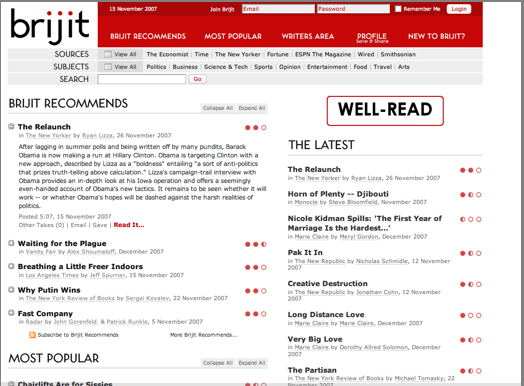
Can’t keep up with all those magazines piling up in your mailbox, especially the high-brow ones you thought would make you smarter but never have time to read? Well, cancel those subscriptions and head on over to Brijit, a self-styled “Thinking Man’s Digg.”
There you will find 100-word abstracts on the latest articles from magazines such as The New Yorker, The Atlantic Monthly, The Economist, Fortune, Harper’s, Vanity Fair, and Wired, with links to most of them. The site also covers video from 60 Minutes, Charlie Rose, The Colbert Report, and The Daily Show. Readers vote the best stories up or down, so you can keep up on the ones most likely to come up during a dinner party. You can even get paid to write abstracts, $5 apiece if your submissions are accepted.
Brijit is designed to be a filter for the smart set. But it oddly defines smart only as what’s in print. Where are the blogs? Other than Salon and Slate, very little online-only media is represented. Perhaps that is because Brijit is focussed on long-form narrative, and there is not much of that online. But it makes you wonder whether sifting through the dead-tree titles will be enough to keep readers coming back to this site, or whether they will prefer a broader view of the world.
Brijit has raised $1 million from angel investors, including former Time Inc. editor-in-chief Norman Pearlstine.
(Disclosure: I worked at Time Inc. when Pearlstine was the editorial boss there).


Unlike you hipsters, I’ve been dying for an alternative to Digg. Digg mostly caters to 16 year olds these days; their comment section is approximating 4th grade levels. And Reddit, gotta be the ugliest web2.0 site I’ve ever seen. Going to brijit right now.
I wish you guys would link to the website on screenshots that you provide, instead of linking to the exact same sized image provided in the article.
Yeah, this is sweet. I can tell I’m going to like it. The one thing though is that part of what I like most about magazines is that they *are* in print, so I’m not sure I’ll want to switch to reading them online. (I.e., I rarely read Economist.com since I have a subscription.) But we’ll see…
Ok, I’m back. The site’s biggest flaw is that it’s inefficient. There’s a huge article on Barry Bonds being indicted in the NYTimes. The turnaround time for this to appear on Brijit is likely 1 day – one of their editors has to enter the story, someone has to write an abstract, the abstract has to be posted. What ’s great (or was great) about Digg is that it can function as your news resource. Also Brijit’s adstracts (ads that closely resemble articles) are annoying. But there’s alot to like about the site, especially the $5 bounty for abstracts.
Haha, @4, I just visited the site after commenting here and now I’m back. I still think it’s cool, but the ads _are_ pretty annoying, and a lot of the links either didn’t work, not taking you directly to the article, or took me to pages asking for subscription information which I don’t have (like to Harper’s). And I don’t like how they have editors review comments; if the articles are heavy then smart people will read them and respond; their current policy is very undemocratic.
I think it would be great to view abstracts and rate them.. I love to read articles and books but its killing to find the really good ones.. but on this site it would be easy to find some good ones by viewing the number of votes..
We appreciate you sharing Brijit with your readers, Erick. We hope that by combining editorial judgment with a passionate, knowledgeable user base, we can provide a better service for busy people.
For what it’s worth, we believe long-form content is alive and well; it just doesn’t fit neatly into the way people engage with content in an increasingly Web-, mobile-, RSS-driven world. Brijit’s 100-word abstracts help bridge that gap. We’re print-heavy at the moment because, well, so much of the great long-form stuff out there is print-native. But we’re completely agnostic on where our sources originate, so long as (a) the content is high-quality, and (b) our abstracts add value for time-strapped readers. Look for more broadcast- and Web-native sources, as well as site enhancements, in the coming weeks and months. And our own Brijit Blog launches next week.
Best,
Jeremy Brosowsky, founder & CEO, Brijit
http://www.brijit.com
i agree #1
@4 I don’t see the lag time being much of a problem. If I want up to the second news there are hundreds of outlets available, I don’t need another digg clone to do the same thing. What Brijit seems to be offering is a different kind of content that can be accessed quicker, easier, and cheaper than in its current state – various newspapers and magazines. Hopefully the few sites that are charging subscription fees will rethink their models if the Wall Street Journal does indeed become free online and the service will become even better
Seems like a great idea to me. Though $5 isn’t enough for me to start writing abstracts, unless payment is guaranteed.
I can understand why it is US-centric, but it would be of much more use to me if it had a broader base of world publications.
More global sources are coming, Bloobeard. If you or anybody else has any suggestions for specific titles, please email Brijit at feedback – at – brijit – dot – com. We’d love your input.
Thanks,
Jeremy from Brijit
http://www.brijit.com
I have just been to the site and there is a lot of variety there. However, its too US to be worthy another visit from me and you only have to look at the Sports section to see why.
Full Disclosure: I’m friends with one of the editors, but I’m in no way officially connected. My opinions are my own.
Having read and written for Brijit I can address a couple things
1. Turn around time
I actively seek out long form articles that are obviously going to interest me and I do this as soon as they are available. It’s those important long form articles I might ignore that Brijit so succinctly directs me toward. And as a corollary to this:
2. Getting paid
When I’m interested in an article enough to have a subscription to the magazine (e.g. SciAm) and read it the day the new issue comes out, I find taking the time to write a summary both prepares me to share how cool this article is with RL friends, and can get me a few dollars for a few minutes extra work. And while there are writers who devote huge amounts of time to Brijit it excites me to know that passionate readers can contribute on specialized areas occasionally and get compensated for that.
-Ian
I like this site a lot. I should subscribe to some feeds but I’d like to return to the site regularly – we’ll see if that happens. Love the idea though.
Very interesting – especially the $5 payment…but has anyone seen http://www.Newser.com ? It also covers the coverage, providing original summaries of news events, together with other links and media…I think this is the new news – covering those out in the field covering.
I might consider buying this crap! nice!
http://fakestev...er.blogspot.com
ehh… seems ok, i’d rather check out digg or newser.
I love their design tho, very nice.
I mean, idk… i bookmarked it… maybe it’ll grow on me (as tuaw.com did)
Digg for Apps http://www.onsoftlabs.com
I think digg should also implement similar strategy.
I like this new wave of short – bit size – information. Too much out there to consume everything. Pictures and video make consuming even easier (picture is worth a thousand words…) – on that note, while Brijit gets a thumbs up from me – I prefer http://www.newser.com since I can get in and out faster – with an understanding of the top news at that time.
I’m not convinced that short attentions spans are the reason people don’t read all the mainstream news that’s out there. I think its the lack of engaging content or the inability of some (not all) mainstream news organizations to provide content that is really relevant to their readers. While people are on the go, and have a plethora of choices, I reall think that great content that is credible, well-articulated, and relevant will capture the reader’s attention for a lot longer than we think.
Shafqat
blog.newscred.com
My first thought…what do the f’ing circles mean?
No explanation anywhere. Not even in the FAQ AFAIK. Makes me wonder if any usability testing was done. Certainly that would have come up given how prominent they are on the site.
Otherwise it’s a cool idea…
something similar we started 3 years ago is http://newfocus.hu/
check the pictorial seed at http://newfocus.soup.io/