
November 13, 2007

What’s the Point?

Erick Schonfeld

36 comments »

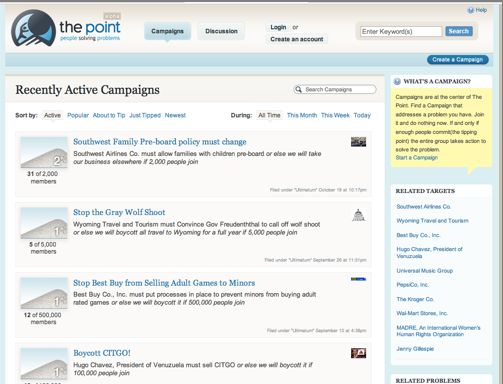
thepoint-logo.pngIf you find yourself asking that question a lot, here is a new Website for you. The Point is a social and consumer activism site that just launched yesterday. It brings a new twist to online grassroots campaigns. Anyone can create a campaign—to raise money for a political candidate or cause, to lobby a corporation to change its ways, or to organize neighbors to fix up a park.

But here’s the twist: participants pledge to take action only when enough other people have pledged to do the same thing. That is, when support for the cause reaches a tipping point (hence the name). In this way, the site attempts to address one of the biggest obstacles to people signing up for a cause even if they believe in it—the fear that they will be wasting their time or money on something that will never result in change. On the Point, you only agree to take action if a cause can attract a critical mass of like-minded people.

Some of the campaigns on the site include trying to get Aquafina to switch to bio-degradable bottles (50,000 participants needed), Universal Music to sell DRM-free songs (1,000,000 participants needed), or CNN.com to separate trivial human interest stories from actual news (1,000,000 participants needed—good luck). If the tipping point is reached, members agree to boycott a product, donate money to the cause, or take some form of civil action.

This seems like a really smart way to tap into the culture of participation on the Web and channel it towards political, consumer, or local causes. The Point has raised $2.5 million from angel investors and will soon try to raise more in a VC round.
the-point-screen-shot.png

  • Sphere It

Trackbacks/Pings (Trackback URL)

  1. What?s the Point?  »TechAddress
  2. What's The Point? » Things Are Good: good news
  3. Cookthink: Andrew Mason wants to make you a sandwich
  4. The Point Organizes a $4.8 Million Series A For Itself
  5. advance cash cheap day pay pay day cash advance advance cash day in loan pay uk
  6. ThePoint.com People Solving Problems | yahoo web hosting

Comments

RSS feed for comments on this post.

  1. Morgan

    Gotta get a campaign to get the Aquafina campaigners to try maybe not buying water out of a bottle. The bottle could be made of mud, it’s still getting trucked in, they should try fixing themselves before fixing Aquafina. What’s new.

    I guarantee this will be in my top 1 annoying websites of the year. But it is a decent way to harness the total non-commitment of people that join causes just for the social aspects.

  2. yau

    isn’t this like pledgebank which has been going for a long time but is ugly.

  3. Voices.com CEO

    Despite it’s noble effort, people, particularly savvy Internet users will trivialize the cause and rally people around such unnecessary causes like “CNN.com to separate trivial human interest stories from actual news”. People, and companies should be thinking about leaving a legacy and asking themselves how they can make the world a better place.

  4. Soren G

    Great. I love to see TC posting on things like this — a cool website that i did not know about. I personally tire of reading about the million dollar deals and acquisitions and any little thing Google does.

    Show me what small groups of innovative people do that I do not have the time to track. This is that. Thanks!

  5. Tony Wright

    Great job, guys!

    It’s nice to see a startup that is actually trying to make the world a better place.

    It’s also nice to see coverage on a young startup out of the Valley (these guys are in Chicago).

  6. fastcart11

    that cnn one is funny. anybody ever look at search volume for celebrities? it’s MASSIVE. cnn wouldn’t put that celeb stuff up there if it wasn’t what the majority of people actually wanted. im not interested in that stuff & prefer real news too. but it’s a market. and they are just giving the masses what they actually want imo.

    -just sayin.

  7. Donate Car Portland

    Interesting concept. Now if we can get a grassroots effort going towards causes that really matter and that people truly care about…

  8. mark slater

    so please someone explain how once a point is reached, you actually get all of those people to pony up on their point? surely this is the paradigm that needs solving and has real network effects. I mean i agree with most good causes right - and am happy to sign up to stop grey wolf hunting or whatever, but its about ensuring action that leads to real consequences that generates change that matters - solve that aspect of the business and its a winner - in the meantime no more shooting grey wolfs for me but i will still probably end up in wyoming over the next year having forgot my point. what is my point?

  9. Hot Potato

    Can we have a Duncan Riley post please? I love reading badly written stories on major sites.

    Thanks.

  10. nw

    Great idea, but i won’t use it unless it is a facebook app. Maybe i should start a campaign for that.

  11. mrpete

    I totally agree with Soren G

    Thank you very TC

  12. børge

    Yes, this is exactly (as far as I can see) like PledgeBank. PB is even open source, so you can create your own “The Point” if you want (like Amnesty International Norway has done with a site called Domino)

  13. jh

    What’s up with that logo? looks like an angry, toothy pac-man.
    Going to the website I see it is a stick man pushing a rock over the hill.

    I think the beauty of this site is that if enough people sign up and then take an action as a ‘group’ at the same point in time - the impact can be seen (by the company) directly, without question.

    Most of the campaigns have too low of a threshold to make much of an impact.

    We’ll see if the site itself reaches its own tipping point. Cool idea - hope it works.

  14. John

    So what’s to stop scammers from signing up with multiple accounts, take the money and run?

  15. Len

    Erick,

    You didn’t report on “WHO” sets the ‘point’. (Or did I miss it?)

    Is it the person that starts the campaign?
    Is it the web site management?

    Also, what relevance does the number have with respect to the cause.

    Its all nice and dandy to set a point of say 50,000 - but if the number has little chance of making an impact - what’s the point? (pun intended)

    If you need an example, how about Proctor and Gamble and all of the disposable products they make and we consumers consume. I doubt even 1 Million people signing up to boycott one of their products would make them change their practices.

    One could make a case that if it isn’t disposable, consumable, and bad for the environment - P&G doesn’t make it. AND they continue to be one of the biggest companies out there without a sign of slowing down.

  16. appetite

    Wow. A lot of people on this comment thread wouldn’t get the point if it poked them in the ass.

  17. Whatever

    @appetite, then why don’t you enlighten us if you are so damn smart. More likely than not, you are affiliated with the startup.

  18. Marc Miles

    And is there a “Point” for “The Point” as to how it makes money to fund its operations?

  19. Craig Klein

    Good question Marc! Sounds dangerously like a typical “altruistic” model - if you build it they will come, and so will the money, hopefully…

  20. Andrew Mason

    Hi guys,

    My name is Andrew, I’m the founder of The Point. Thanks for the feedback; just a few things to contribute:

    First, as a company, The Point doesn’t have a social agenda. We made it because it’s such an obvious way to use the Web to bypass many of the problems groups experience when trying to make things happen. Our goal is to give this “tipping action” model of group problem solving a fair shake with the public, and then to let the chips fall.

    Pledgebank is a great site and shares the same basic “I’ll do something, but only if others cooperate” model, but beyond that, there are more differences than similarities. First, The Point is largely focused on “do this, or else” campaigns — ultimatums targeted at a third party that are designed to, once they tip, quickly force a change by creating an unendurable financial stress. For many campaigns on The Point, the tipping point is something that can be quantified — it’s the point where the cost to a target of the group action becomes greater than the benefits of not changing. The tipping point of a campaign on The Point shouldn’t be determined by a prediction of how many people are likely to join, rather, a calculation of how many people are needed to force change. On The Point, it’s less important that a campaign tip than it is for people to have the sense that they will only be asked to take action when the conditions exist for a combined action to solve their shared problem. We also have an awesome feature called conditional anonymity — your identity isn’t revealed until the campaign tips — that makes The Point a singularly powerful tool for forming issue-specific workplace unions.

    @morgan: I think there are a lot of people (including me) who are overwhelmed by the number of big problems out there. We need a way to figure out where our time adds the most value. We can’t boycott every product that offends us — we’d be naked or broke. The Point is a tool for people to manage all that noise, and only take action when the public has demonstrated that the demand for change has reached the tipping point that will actually make it happen.

    @mark slater: When a campaign tips, credit cards are automatically charged on the fundraiser campaigns(the CC info is taken and securely stored when you first join the campaign). For ultimatums, i.e. campaigns where people agree to take some collective action designed to force change, participants are notified via e-mail that the action has begun, and then campaign organizers keep them abreast of further developments. Eventually, the organizers make a decision whether the campaign was successful or a failure, and close it as such.

    Obviously, the percentage of people that comply is going to vary with the cost to the individual of taking action, the magnitude of the tipping point, and the relationship between the participants. We’ll regularly be tweaking the platform to make that percentage as high as possible. However, we think the knowledge that there is a group relying on your participation, and with it you can solve the problem, will induce a far higher turnout than traditional attempts. That’s the power of only acting when you reach a tipping point. Think of it like an election that’s predicted to go 50/50 — many more people will show up because they sense that their vote will actually matter.

    @nw: You’ll be glad to know that we’re working on Facebook / OpenSocial integration.

    @jh: The logo is a play off of the Sisyphus myth, the greek that was punished to an eternity of trying to roll a rock over a hill that would always escape him at the last minute and roll back to the bottom. Our logo we’re showing him finally overcoming that hurdle, a reference not only to the “tipping point” idea, but also the fact that we’re using the Web to overcome the traditional hurdles to collective action, and thereby making it easier for policy to reflect the sum of individual preferences.

    @Len: users create campaigns and set the tipping point. For users who aren’t sure what the appropriate tipping point is, there’s a “Problems” section under the Discussion area where people can collaborate on a shared problem and use their combined resources to quantify an effective action and tipping point. If a campaign has a tipping point that seems to low, I don’t think people will join. You can have multiple campaigns linked by the problem they aim to solve — people will gravitate to the campaigns that appear likely to have an impact. In other words, I think the most compelling content will rise to the top.

    @Marc Miles: Some day, we’ll make money through targeted ads. We have a few ideas up our sleeves to make advertising more useful and profitable than it is on most social networks.

  21. Daniel Gibbons

    How does that work, taking the credit card and then charging it (presumably) much later on? You can’t hold an authorization for more than a couple of days. Isn’t there a risk of massive chargebacks? I’d be curious to know how you deal with that issue.

  22. Andrew Mason

    Hey Daniel -

    Yeah, the authorization is only good for a couple of days, so there’s a small risk that the funds won’t be available whenever a campaign finally tips. If unavailable funds end up causing more trouble than we’re anticipating, there are other options, e.g. running monthly authorizations.

    To minimize chargebacks, we send people who have made contingent pledges regular updates, reminding them of their commitment. It’s easy to withdraw a pledge any time before a campaign tips.

    Thanks for the questions — it’s a situation we’ll be monitoring closely.

  23. www.CARversation.com

    this could go somewhere.

  24. Joe Keehnast

    Man, if only this existed during the labor strikes of the 1800s. Take the Writer’s Guild strike and add 20 more in the next year. This site is going to turn the US into France.

    Ok, a bit dramatic, I think it’s a pretty cool idea.

  25. Ailsa

    Vive l’egalite!

  26. appetite

    It’s a good idea. It could work. If it does, it would be great. Definitely worth the attempt. I think the people missing ‘the point’ are trying to mask a sad lack of imagination as astute skepticism.

  27. cory

    This has a lot of really interesting possibilities for education It will be fun to see what types of campaigns interest my HS students.

  28. mark slater

    and thanks for the response Andrew - you helped me understand it better. I still think that the notion of where someones opinion becomes actual action is the cingular most challenging aspect of the model. and i think that the time between my statement and my action (delta of my opinion and the TP) will see you experience erosion of supporting group - as time is the enemy of you getting me to opine and then getting me to act.

    I’d also believe that there is an intangible PR value to the very existence of a campaign that will have those companies wanting it to go away regardless of how many are lining up to support - not sure how you quantify that though - might be a question for the ad agencies.

    best of luck - its not without its challenges - but find me a start-up that isn’t.

  29. Joe

    As a casual observer residing in Chicago, I think you all are on-point about the point behind The Point. It’s important to point out that many of your points point to the notion of social finger-pointing and culpability relative to “big” business (oil, walmart, et al). Ok what I just said was pointless.

    Seriously though, great concept in theory. I’m rooting for The Point. Home town team running with the west coast boys, saweeeet. I’m a visual dude, I like good user experience and IA wrapped in effortless aesthetic. I kinda wish the homepage focused more on “most popular” or “latest” campaigns… i.e., a rolled up version of what you see when you click on “browse campaigns.” Me no likey the clicky.

    So I went ahead and created an account. Easy, good. I even joined the Walmart campaign. I was hoping to see some indication of this new campaign I’ve just joined on the homepage (bottom or right sidebar perhaps, a little “my” section?) Gotta click on “Me” though. Nothing major, but again, the clickly. I guess what I’m getting at is I like the campaigns homepage as THE homepage a little better, but I understand the current homepage’s purpose, edumacate peoples.

    I was also surprised not to see (and forgive me If I’ve just missed it) an option to “watch” a campaign. Like save it and watch it without joining. (see ebay auction watch). If I find a campaign 10 pages in and I’m not necessarily ready to comitt to joining, what do I do?

    That’s all I have gang. Rock on The Point!!

  30. Rachel

    Wow I actually really love this site. It can be used for both trivial and serious matters. Which is good. And it’s all user-generated. Even better!