I recently had the opportunity to see a demo of a product coming out in early 2008 called Blist (pronounced like “bliss” with a “t” at the end) that will take on DabbleDB and Trackvia by giving users the tools to easily create and manage databases online.
Blist’s initial target demographic will be Excel users who need more functionality and are trying to make their spreadsheets act like databases, but who don’t have the skills or tolerance to even use Access. Blist will not require users to know any SQL, the language commonly used for interacting with databases (in contrast, recently reviewed Zoho DB does require knowledge of SQL). The company behind Blist seeks to eventually replace traditional databases completely by making its product robust and appealing enough for database application developers as well. The end result: no more databases behind the firewall, since they all end up existing in the cloud.
Blist’s plans are obviously ambitious. They are not only designing a better user interface for manipulating databases, they are also building a sophisticated database architecture that will allow them to replicate data geographically, thereby preventing data loss from natural disasters. Their entirely SaaS-based database solution will also provide an API so you can link your applications up with it. If Blist ever has a chance of replacing traditional database servers, its API will need to be very capable indeed so that applications can run all of the same queries they run now. Blist’s CEO Kevin Merritt says that the API will eventually allow for a large range of operations, but the initial API will be fairly simple and will rely on XML.
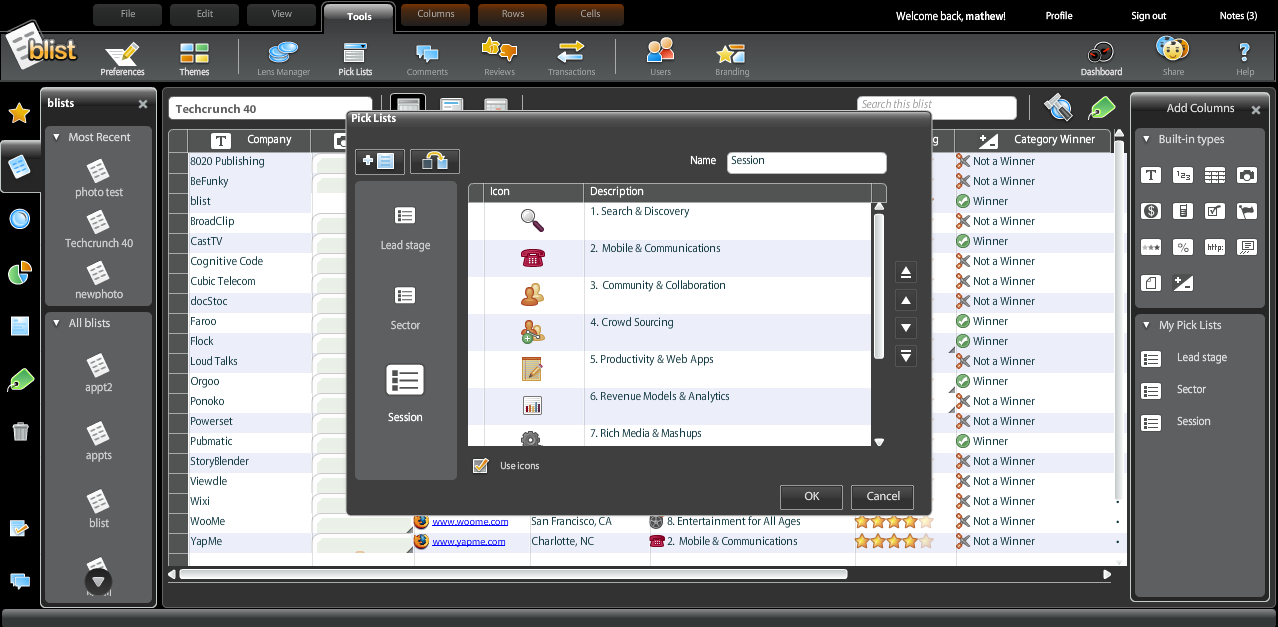
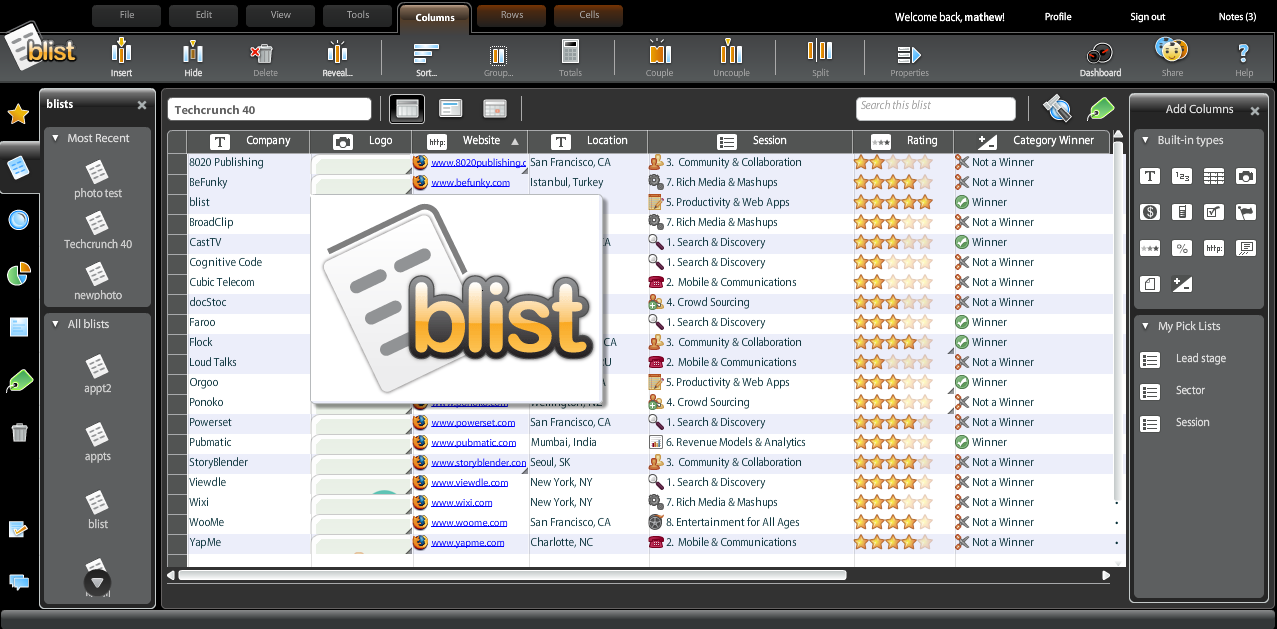
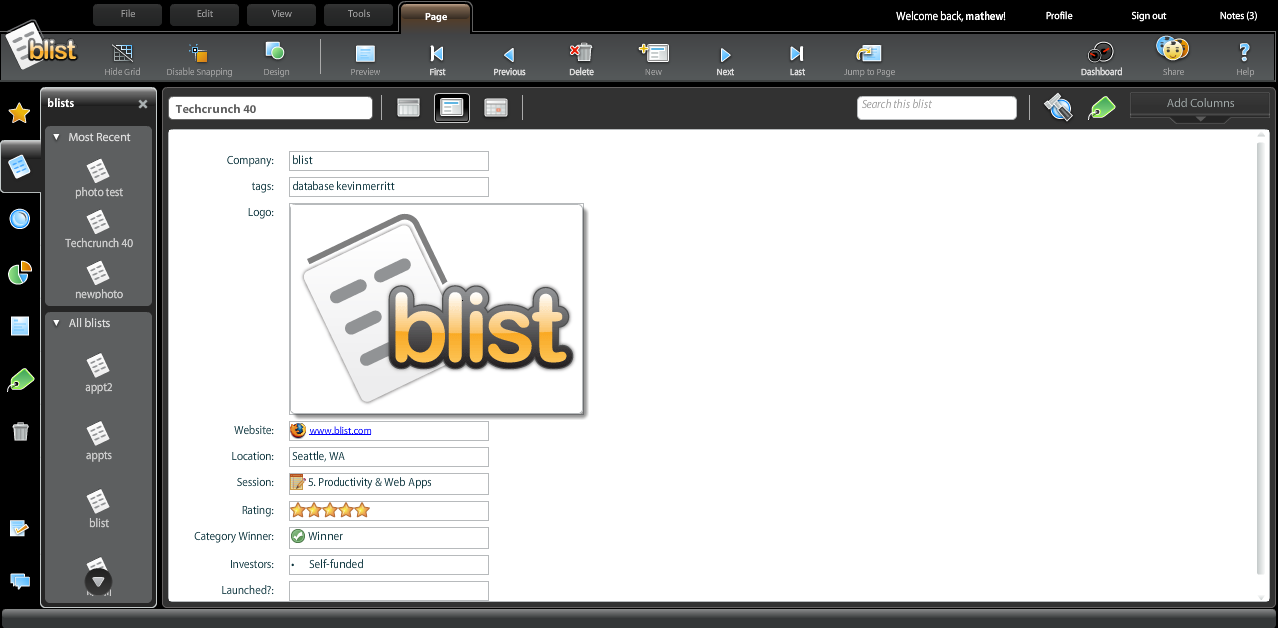
Since Blist won’t be ready to convert database administrators right off the bat, the quality of its user interface will determine its initial success. Either Blist will come across as intuitive and succeed, or non-technical users will go right back to using Excel. From the brief demonstration I saw, Blist does look impressively easy to use and very functional, too. As you might be able to tell from the screenshots – which show how Blist could have been used to organize our candidate data for the TechCrunch40 conference – the program looks and feels more like a full-fledged desktop application than DabbleDB. It currently supports fourteen data types, with more coming soon. Data can be viewed in table mode (as in Excel), page view (so you can edit entries using a form), or calendar view (so you can see entries with associated dates in a calendar layout).
What really makes Blist a database application is the ability to apply various “lenses”, or views, to the data. These lenses are like queries since they allow you to view the data by particular criteria. But you won’t need to know any syntax: just change the fields in a form to construct your query. Right now, lenses can only be used to view data in different ways. Blist will become much more useful, in my mind, when users can also implement lenses to manipulate data. Once that is possible, it will closely match the functionality of GUI database tools like MySQL Query Browser.
Since Blist is an online application, the company has taken care to integrate features that distribute and share data. Databases in Blist can be easily shared with other Blist users through the standard interface. They can also be spread over the internet via widgets that pull out samples of data from particular databases. If you are a blogger who wants to publish some of the raw data you have used for analysis, you’ll be able to drop a Blist widget into your post that will highlight some of the main data points and allow users to gain access to the original data set. For example, I wouldn’t have to make unwieldy charts like this one for white label social networking solutions, because I could just drop in a Blist widget with all the data and viewing capabilities instead. These widgets, like most, can also be embedded on other webpages across the net.
While Blist is gunning for the $15 billion relational database market, they have not yet figured out pricing (although they do intend to charge both casual consumers and business users). The company will start by focusing on the North American market and will move to other regions from there. Blist has not accepted any external funding yet but will be looking to raise some soon.


Clearly there is a very large market for these type of products.
You would be amazed to see how many people use visual basic to make excel act like a database.
Marketing to business users is not easy though. I am sure they can build a nice product, but can they build it into a company?
Looks like they are hoping to be acquired.
A lot depends on their marketing model and pricing model .. I would say go for niches …So create ready made products for different niches because it makes it easier to market and identify your customers ..
This looks like a very nice niche. This is the second site I found and used today on this site. Thanks Techcrunch.
I don’t think an experienced SQL developer would really need this… but it is a great tool for excell users
It looks like this product doesn’t have the indexing features for the larger business segments, so they will have to target SMB.
One pricing option would be to employ a two-part tariff: charge a license fee for each user-month and add an additional charge for the amount of space used. Hopefully this would fairly compensate blist for CPU time and storage costs.
CRM SaaS applications (salesforce.com) use a per-user-month pricing strategy which would not fit blist since a single user could be consuming much more resources in the blist database than a CRM app.
“The company behind Blist seeks to eventually replace traditional databases completely by making its product robust and appealing enough for database application developers as well”
They are doomed for failure. It just seems like the company trying to do too much. There’s already an MS access and there seem to a lot of security implications not mentionned.
“The end result: no more databases behind the firewall, since they all end up existing in the cloud.”
Yea right. Do they think that companies are going to give out sensitive databases for a 3rd party to control? Please.
“The company behind Blist seeks to eventually replace traditional databases completely by making its product robust and appealing enough for database application developers as well. The end result: no more databases behind the firewall, since they all end up existing in the cloud.”
The reason the databases are behind a firewall isn’t because they are hard to use, but because they contain sensitive data. Reducing a barrier to entry on database access doesn’t make the data less sensitive and have the ability to be “in the cloud”.
thats a might big ambition these guys have, good luck to them!
can make a lot of money
I think this is a great untapped market – room for lots of people to tackle different aspects of the space. We already have Google Documents for straight spreadsheet-like applications; so the opportunity here is to get the multi-table (relationships) part of the problem solved in an intuitive way. DabbleDB has done some really clever work here in allowing “refactoring” of flat tables to eliminate duplicate data entry and build relationships on the fly.
Hopefully, Blist will incorporate that as well as building on a more scalable architecture than DabbleDB uses (rumored to be an all in-memory database backend).
Great idea! Any non-developer who has struggled with Access, FileMaker or PHP will immediately see the value in blist.
Putting sensitive data outside the firewall is de rigeur for most SME’s. Your bank is already outside the firewall! The majority of SME credit card processing is outsourced to third party vendors who store their data outside the firewall, not to mention the growth of outsourcing in critical applications like email (Google Apps) and CRM (Salesforce.com). It’s a non-issue for 90% of SME databases.
One note of clarification on ZohoDB – it does have a fully graphical mode for database creation & report manipulation (pivot tables, grouping etc) without knowledge of SQL. In addition, it permits SQL capability to directly manipulate the data for those with the intent, intended for power users.
We take the same approach in Zoho Creator: a GUI based form building capability with a script mode for power users.
In a nutshell the design philosophy is the time-tested one of “Make simple things easy, and difficult things possible”.
if you like blist give yadashare.com a try
There are lots of other tools aimed at helping non-developers build web-based applications. LongJump is another one.
Hmmmmm ….
Investment capital bait?
http://fakestev...er.blogspot.com
I was interested to know if anyone has done some *real* work using any of these applications (or Zoho Db/ DabbleDb).
Has anyone created an important report/document/spreadsheet using these toys for a serious assignment (and shown it to the boss)?
Many web-based Office competitors are “sexy” for tech journalism (yeah! here they come to crush Office and take over the world).
I have tried using some of these applications but had to switch to the good old MS Office to save my ass while trying to meet a deadline. Maybe I don’t know how to use such bleeding edge technologies!
Evergreen, Zoho Creator is used for serious purposes. Take a look at the user created blog http://landofzohocreator.com which documents some of the real world uses. Please note that this site is done by independent third parties and is not affiliated with Zoho.
Jason – it’s not an english word, and lots of people have the instinct to call it “Bee List.” I assume that’s why Mark called out the proper pronunciation.
Let’s get odds on an over-under for max db size.
Not sure it will be popular. You can do access app also without sql/vba knowledge. And if you need web app – you can consider sharepoint
@Alex
I clicked through to your blog about Access. Scanning the first six posts (none of which would be intelligible to the people Blist is clearly aiming at) I can safely say you are not in the target market.
I’ve had the misfortune to use Sharepoint at two companies now. It’s fine if you are 100% invested in the Microsoft ecosystem, but again, it’s complete overkill for a non-technical person seeking to create a simple database. Sharepoint also sucks if you are a Firefox/Mac/Linux shop.
I don’t know how many Microsoft only sites you have in Russia, but in many US companies (and most startups) if you decreed a Microsoft only policy you would have a riot on your hands.
TechCrunch is so FAIL.
I arrived here just to see that this is not exactly what I am looking for…
I administrate a large number of Oracle databases for my company.
Some DBs are easily structured and the staff responsible for keeping them updated are able to use an Oracle client (SQirreL, PLSQL/Developer, or even MS Access as a client) to directly access Oracle and update their tables (without messing around with integrity etc).
Other DBs are too complex in their structure or the staff responsible for data updating are not able to handle with SQL and have no skills in working directly on DB objects…
For the later case I wish I could offer them a foolprof’ed, user-friendly web-based tool for updating data (enter new data; update existing data; delete data).
I dream of a generic DB-management application:
- configure your application by naming the tables, the relations between them, the constrains, etc, and you get on the fly an application that enables you to browse from master to slave table, to move from record to record and from column to column and edit/delete/insert data in/from/into them.
- perform checks (data type, domain constrains, etc) using the info from the data dictionary.
- perform pre-defined plausibility checks.
- supports data capture helps like drop-down-lists for foreign keys, check or radio buttons for flag-columns.
- etc etc etc.
This is something I would love to develop myself… if I only had the time!
I wonder that (at least as far as I have been able to google around) there is nothing like this on the market!
Best regards from Bonn, Julian
Out of the database apps listed in this article, Zoho is the only one that is free (and not the 30 day trial crap either). Zoho.com keeps making themselves the better option every day in my book!
thanks For you , Blist Grete