
San Diego based Digital Telepathy has changed direction from strategy-public relations to services, with a new model that will appeal to anyone who has ever wanted or needed a hand at getting their startup ideas off the ground.
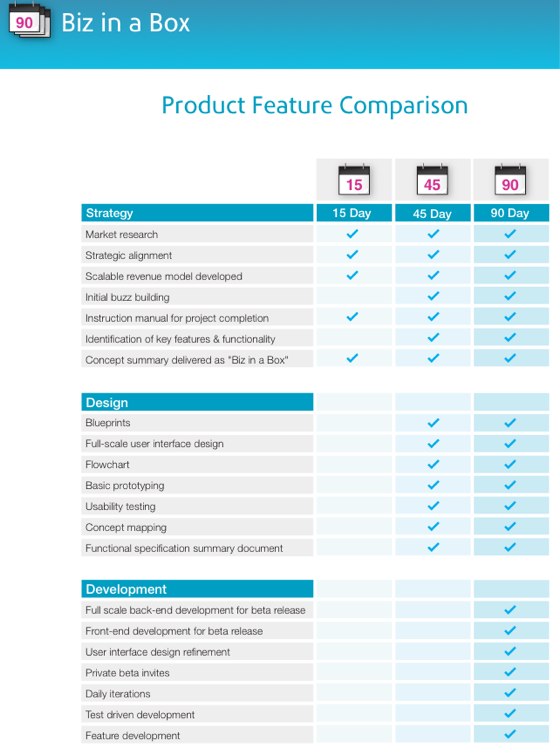
The concept is simple: Digital Telepathy offers three design my business options with varying service levels based on the length of each plan. The 15 day plan provides a wannabe startup with market research, strategic alignment, scalable revenue model, instruction manual for project completion and a concept summary delivered as a “Biz in a Box”. The 45 day plan offers (in addition to the 15 day plan) “initial buzz building,” and a range of design services including basic prototyping, usability testing, blueprints, concept mapping and other design services. The 90 day plan adds development services including full scale back-end development for beta release, front end development, private beta invites, feature development and more.
The Biz in a Box service isn’t for those already in the industry, or those with a lot of experience, although Digital Telepathy also offers services for existing startups looking for advice on taking their business to the next level. I know when I was previously involved in a startup it was difficult to know where to start, and who to get advice from. Even when you do find someone it’s often not a cheap experience either, the consultant I dealt with previously charged 6 figures to basically guide us in the right direction, without providing any development services.
Digital Telepathy is passionate in helping startups they believe in. DT’s Sarah Carr described the change of direction to me as follows: “It’s pretty cool because we are basically saying to our clients, to the Internet/social space, and to the entire WORLD that we are going to actually DO what we love to do and just get rid of all the crap that bores us to death.” I asked CEO Chuck Longanecker about the cost and he responded “the most important thing for us (dt) is to work on projects that we are passionate about and enjoy doing. The second most important thing is to eventually get paid for what we do, so that we can keep doing it.”
Prices range from $15,000 through to $250,000, although each project is calculated on a per startup basis. It may sound like a lot of money, but it’s a lot of service for your buck, and it is competitive. See the full list of options below.


This has the potential to be a life saver for so many newbies.
There have been several instances of visiting a Start-Up’s Website after getting excited about service review in a popular blog – only to find the site down or the service extremely slow.
Imagine blowing an opportunity like that – especially if the site is TechCrunch, Mashable, Engadget or LifeHacker
bill will be perfect at this.. i wish they had time for my new one..
is it me or shouldn’t you be able to everything except development on your own as a start up founder?
I just don’t see this working – a startup is about creativity and production. If the founders need the help of dt, something is wrong and as an investor I would look elseware.
Interesting attempt at productizing what is a widely needed service among startups.
What I find interesting is the wide range of potential costs ($15,000-$250,000!). I’m curious as to how this is that different from a startup advisory/consulting firm that would provide a similar subset of services.
The value of a product (vs. a service) is that it “scales”. Customers benefit by lower prices (since cost of delivery is lower) and the company benefits because the margins are better.
I concur with #3 [Andrew], though I’d think you should also be able to do development.
Just the line item “scalable revenue model developed” is more than most web2.0 companies have even started to think through.
Nick/ Andrew
not everyone has the skills to do everything in a startup. not every one is a coder for example.
George
The VC’s I spoke to when I went through the process were glad that we were getting help: there’s far too much junk around with ppl who don’t know what they are doing. It’s not unwise for a startup to get some help along the way…a smart startup knows that it cant possibly know everything and knows to get help when required. Having said that as I said in the post it’s not for everyone…if you’ve got experience you’ll probably know what you’re doing, but if you’ve never run a startup before or need some help along the way I think this is a great idea…and it’s certainly a lot cheaper that startup coaches
Duncan thats why I left development out of my list. Not everyone is a programmer.
But everything else is pretty common sense and if you are passionate about your idea, you probably already figured out everything, + it helps to do the actual design/mock up yourself…because you are bound to get a whole bunch of new ideas that you just didn’t think off, when figuring out the concept.
From the looks of it, its a glorified web development & SEO company that will tell you “Hey…you can add adsense and make BILLIONS!”
Andrew
true…but to you and me. I’ve seen some pretty bad business plans in my time; not everyone has the benefit of education etc to write a killer business plan. Some people can code but couldn’t articulate a business plan, do the market research etc. In my case I’d think I could write the business plan, but market research (done properly) isn’t my thing.
I’d say though don’t be so cynical: I knew this company from when it was pitching startups to TC and they are switched on, they are serious about helping build businesses. It’s not for everyone, but it is for some. Heck, I’m rusty at building a startup from scratch, I might even use their services…it would be nice to have a helping hand along the way
This is really interesting. Good job Duncan.
Gilded age.
I’m a 1st-time startup founder and this is something I would consider exploring, especially if comp could be a mix of cash and stock, both for cash flow purposes and incentive purposes. Get in touch if you want to chat, guys. Cheers.
I’m in the camp with those who think the vast majority of this stuff should be learned by the founders through reading and meeting with people.
If you outsource engineering, $15k can launch a pretty decent prototype. The money would be better spent on a product than on consultants imo.
This is indeed great news. Often in a startup many face the problem of unable to find the right founding members or lacking in a specific area of skill. Nonetheless, the real problem for first time entrepreneurs is that they don’t know how to bring it to the market and create the buzz.
The site is dead.
Step 1 – You cut a hole in the box.
I’m interested in the item ‘Initial Buzz Building.’ This could make or break a startup and I’m wondering what they could offer. Not much details on their website unfortunately, but I imagine its all about the contacts they have. Pitching to TC and getting a client on the front page is probably worth a significant amount of money. I agree with Duncan that its probably helpful to some, but I think it just takes some of the joy and satisfaction out of the startup process.
Shafqat
Great post and brilliant idea on Digital Telepathy’s part. I’m a PR guy who works with a lot of startups and often times I wish there was more that I could do to help them build their company and get the word out beyond PR, marketing and communications. More PR firms are moving into services these days and I think that’s a good thing. Smart move, DT!
The most important thing you need for your web 2.0 startup is to be partnered with Microsoft!
http://fakestev...er.blogspot.com
I agree with Fred, that money can be used towards building a decent prototype first. As a founder you should be able to do everything else – but more importantly are you building something that people will want to use? It would be better to spend $15k on a prototype with a 10/20/30 business plan vs the whole shebang, and if you’ve got a few PAYING CUSTOMERS then you can focus on full scale strategy and design. Too many startups launch with the whole nine yards but if you can’t make any money what’s the point in spending that $15k – $250k? Just take a look at techcrunch’s deadpool …
If I were a newbee today, I’d hook this up along with Sun Microsystem’s Startup Essentials Program — the resources some companies are aggregating for you to just turn the key are amazing! Vrroom Vrroomm..
just what i wanted..hope my vc signs the bill
so does TC now cover local services firms too? this is a ridiculous post…but if this is where you’re headed, i hear that a few dry cleaners are moving into the home pickup service, and there’s a gas station in boston that still does full serve and 10 point diagnostics – any chance you could cover them too, or do you need to owe a favor first? any chance you could include your auto insurance provider too – they must be doing something ‘totally cutting edge’ too!
If you write a check to these people, you deserve what you get, which is to waste 100% of that money.
Bear in mind that Tech Crunch is not a real publication, so don’t count on them to do basic fact checking for you. (Hence the credulous, as in gullible, positive review of this firm).
#1 : “Digital Telepathy” is in San Diego, not a locus of the tech industry. So what are the odds that the people there actually know the trade? Pretty low. Reason to be skeptical. It could be worse. They’re not in Boca Raton or Great Neck.
#2 : Check the Careers section. Smells of “get press first, then hire people if customers show up”. They’re hiring everyone from a “web developer” to an “executive administrative assistant”. Try clicking through for more details on an open position, doesn’t work.
#3 : They are asking for a lot of money for little value, and have every incentive to tell startups what they want to hear. No objective way to measure performance or value delivered. They may be nice people, or they may be shyster douchebags looking to cash in off you.
My point here is not to trash Digital Telepathy, they may simply be decent people with a mediocre idea that most entrepreneurs would be well advised to avoid. It’s mainly to point out that Tech Crunch should not be running stories like this, or should be approaching them with the appropriate level of skepticism, which in this case is a lot.
If you’re in need of startup or web s/w news, there are plenty of other places you can find it. If you think you need to spend tens of thousands of dollars to design your business plan, DON’T QUIT YOUR DAY JOB.
I provide similar strategic (market intelligence, differential analysis) for startups, but I omit the UI work. Even some of the big boys use me to punch holes in new plans they have for Web Applications and B2B pre-launch. So if a humble man like myself, transplanted from Boston and struggling to make a name in the valley, can be useful to some, I guess they can too.
I’m cheaper. I find that agencies touting strategies, (and who also charge tens of K), are sometimes want to subtly endorse whatever the client is leading into, rather than give candid opinions that might be unwelcome. I don’t sugar coat.
In general, pre-launch product sector analysis can be a good ‘vote’ in the decision matrix when steering or making fine adjustments. It’s a lot cheaper, no matter who you use; I’ve been retained by a couple of institutional investors that occasionally make direct placements.
My, point (rambling)…..hiring an outside ’strategic sector analyst as one who will say exactly what they find, good or bad, is a precious service:
1) We are only there for a closed ended engagement, no career axe
2) We are generally fixed cost
3) We, I, usually specialize in sectors that we continually cultivate, and have an ear to the ground.
4) As freelancers, if an unpopular adjudication is crystallized in our reporting, it can be ignored, and the truth will out.
It’s getting crowded out here in the valley, it was easier in Boston, somewhat, but it’s a legit service for new and mature companies that are contemplating entering a new sector or competitive quadrant with only the advice of an internal manager, and employee.
It’s a vote with hopefully reasoned advice. Good luck to ‘em.
In order to reasonably judge the value of what you’re paying for, a service like this is actually best used by someone who already has a few start-ups under their belt.
If it’s your first time with a website idea, chances are you can get it built for $1K-$2K via outsourced freelance programmers. Better to save money and actually get some experience first. Once you have a feel for what you’re doing, THEN perhaps make a bigger investments with a company like this.
Hey all, thanks for your open and honest comments. Duncan, thanks for the coverage!
Andrew and George are right that founders need to be creative and have a clear vision for their business/app. The last thing that we want to do is hand holding as it’s nearly impossible to create an authentically inspired 2.0 app without the driving force of an entrepreneur. We always recommend that people bootstrap their startup if they have the skills and capacity to do so. However, if you’ve got a great idea and want to get to market as fast as possible we have the process to enable you to do so. We chose this direction because this is what we are passionate about…who wouldn’t want to work on creating new and exciting businesses every day?
In regards to costs, we tried to create a scaled system so that most people would be able to work with us in some capacity. At the same time, we have to maintain the integrity of our process, so strategy needs to come before design…etc. Most of the costs of the strategy, research, design and prototyping range from $15k-$75k. Add on development and it kicks us up to $175k – $225k. We recommend having some type of outside funding for the full enchilada.
We are open to working partially for equity, however we are very selective of the projects we partner on. We have also formed an app management company called REBEL where we will be creating our own apps. We hope to partner with business rebels to create David-like apps to take on the Goliaths. Feel free to hit us up with ideas. http://www.re3el.com
Please keep the comments coming. We aren’t perfect and its always great to get feedback. At the same time, it’s nice to know that we are on to something!
@25: Good post. Perhaps TechCrunch should move it to the top of the page and move the advertorial down to the 25th comment.
It is a founder’s responsibility to do most of this work. Offshoring entirely is a big mistake, however if used as a “second set of eyes” I like it.
Chuck Longanecker:
I’ve been developing web applications, on a consulting basis, for a long time – I wrote my first one in 94 (actually I wrote my first internet application in 89 but that’s a different story). I primarily specialize in helping start-ups develop a strategy for development and deployment, and then, not surprisingly, develop and deploy their application. If the project is interesting I actually do a lot of the development myself and if I need additional help use only on-shore talent (here in the Bay Area).
Over the years I’ve developed just about every type of application you could think of. Most recently it’s been social networks, of one type or another.
I must say I’m a little stunned at your development costs as outlined in your comment. According to that, development of any system costs $150,000. I find this number surprising for a number of reasons.
1. Development costs should depend on the complexity of the system; it should never be a straight cost.
2. $150,000 buys a LOT of complexity – even at the high end of contracting rates we see for developers in San Francisco, say around $150 per hour, that’s 1000 hours, or looking at it another way, 25 man weeks of work. That’s 2 high end, senior, exceptionally competent developers working for 3 solid months. Considering that I know some great developers that charge $75 per hour, we’re now talking about a years worth of development time. Like I said that’s a LOT of complexity.
Admittedly, the above does not include your markup, or project management time, but we’re still talking about a lot of development dollars here. As an example, we just finished building a fairly involved ratings site (kind of like Digg, but for anything), with a full public API, for under $35K
3. Given the availability of development environments that are ideally suited to start-ups and can provide complex feature sets with minimal development effort (Ruby on Rails, Django, etc.) this number becomes even more difficult to understand.
Yes, I understand the scalability arguments around Rails and the like, but that’s not a problem for a start-up, it’s a problem for an established company.
To be honest I’m actually curious about your development strategy and I seriously think that you could easily reduce your development costs, and hence provide a much less expensive experience to your clients, and perhaps provide service to even more clients, since as we all know, cost is always a factor. If you’re interested in talking, drop me a line at info at dalecook dot us.
I think there are some service separation issues here:
1) Steering for prototype and scale to application development assistance (very crucial when the founders are not experts both in the sector and the technology)
2) Sector / Product intel and strategy. Knowing who you are butting heads with and how they are positioned, countering strategies, surveys, real metrics of an immature market that may not be well reported on.
3) Get to market strategies, alternative channels (OEM, partners, licensing)
Just some thoughts on what I have run into when working with some folks. Product managers in the sense of mid-boost phase companies can use help, as they are overworked; a consultant can keep them on top of the sector issues and cater to their particular needs.
This could only be considered a good idea in the intelligence starved air of “Web 2.0″ and Silicon Valley.
If you need this much help getting your idea of the frickin’ ground then you are screwed. Go back to work in the cube. Self employment isn’t for you.
Here’s some advice and it won’t cost you $15K-$150K: The world doesn’t need another bloated, poorly written social networking site. The 325,254,981 that already exists are working just fine at lowering the national IQ.
And another: Your “Web 2.0″ idea should involve revenue. That means people pay you money. (I feel the need to dumb it down so that the Web 2.0 entrepreneurs can understand it.) Further, the revenue should be more than your expenses. I know this is an advanced topic. Email me for my consulting rates. I can explain subtraction to even someone in Silicon Valley.
Finally: If you plan on having a startup that is built around software and you can’t write code then you are screwed. You can’t outsource your competitive advantage. People like Chuck will say you can. But is he wrong.
All that notwithstanding…I’m certain that there will be at least a few people who think they can be the next “Web 2.0 ” zillionaire if they just pay enough money to people like Chuck. And they are all, and I mean all, destined to absolute failure. Except Chuck…He’ll be laughing all the way to the proverbial bank.
Sounds very interesting. I’ll be bookmarking this one.
We used DT for help with our company’s product: http://beta.razoo.com. They rock! They’ve been really helpful. Go DT or go home!!!!!
Ryan,
What product? Social network for change? That’s not a product. It might be a worthy cause, but it’s not a marketable product.
If you’re running non-profit or a hobbyist site and you can swing DT’s fee, then more power to ya. But that’s entirely different than trying to monetize a web site and paying someone else to figure out all the hard stuff.
this is how we know there is a bubble -> companies 900 miles away “changing direction” to make money off the frenzy of people and investors chasing web 2.0 millions.
“biz in a box”? come on, sounds like “pie in the sky” to me.
this is classic snake oil salesmen: charge a lot of money, tell someone 15/45/90 days, and it’s so easy they can put it in a box
it’s much tougher than that here in the real world
who are their customers? i’ve never heard of them.
where are their testimonials saying how invaluable they are?
never believe what a company says about itself. be skeptical
i guess they should make hay while the sun’s shining, maybe move here to the valley and make a killing before it bursts again, but they’re just chasing.
so is techcrunch, michael used to be good and “hard hitting”, now we get this flowery junk.
Here’s the hidden value for a guy like me:
I have 4 major projects going on right now. One is web-based and the others involve a merger, new product development and existing business expansion. I’m stretched! If I can take my great web idea and pay someone to do all the stuff that I don’t have time to do but will put me in a position to go raise some serious cash, sign me up. We’ve already done a ton of research and as much development that we are capable of otherwise, I wouldn’t even think of spending the money for a Digital Telepathy.
Sure it cost $15k-$150k but how much did I save in lost opportunity costs because I’m having time management issues?
It\’s an interesting concept and I begin to wonder how the VC and Angel world will take to this as the investment comes down to the team, but there isn\’t really any information on their website about who is behind their team. If you\’re going to take on a large expense like this I hope there are qualified people behind this biz in a box product. I too am interested in the testimonial part and execution, maybe a free webinar? Walk the talk.
There is no way I would invest in a startup without a team. This model just like offshore development DOES NOT work for webapps.
I noticed a lot of comments about the absence of a solid revenue model behind most apps. A huge fault of our industry is that some people believe, if you build it, they will come and if they come, you will get acquired. Every new business should be able to stand on its own without any consideration of acquisition or dependency on member count or traffic based advertising revenue. So we develop creative strategies and multiple revenue models that do not discount the user’s experience yet still provide value to website partners.
I disagree with the comparisons to offshoring. We focus specifically on expanding our clients’ ideas and building revenue models around them. Our process works because everything is linked and created from the perspective of an entrepreneur. The strategy is conceived from the founder’s idea, the UI and functionality reflects the strategy and the development brings everything together. We tried offshoring many times over the years. It works for spec work and spec work only. It’s rare that an offshore team will add value to your product or offer creative solutions to your problems along the way.
Great point about the testimonials. We’ve put in a request to the clients listed in the project section on our website and will update it as soon as we have permission from those clients. We’ve also added some of the previous reviews of our projects.
Hey “Whatever” – what kind of person comments like a covetous teenager without even leaving a name or link. Must you lurk in the shadows? I’m curious to see what kind of apps you’ve created…
Chuck can you provide some links to startups who used your biz in a box plan that are known to be successful? Show us some sites that have mass adoption or a scalable revenue model that is working in the real world…..
I’ve worked with Chuck and the DT team for a while now and these guys are extremely innovative, creative and seriously smart. Hiring DT can save you 10’s if not 100’s of hours in recruiting top talent to your team. They have the knowledge, experience, and the passion. Not only are they really good at what they do but they are also a pleasure to work with.
In the early stages of a start up outsourcing is critical; Outsourcing to DT will increase your chances of success and make life at your startup a little easier.
I feel fortunate to have met Chuck and the DT team. I’m a serial entrepreneur and when you find people like those at DT who share your expertise and passion it’s truly refreshing and energizing.
Glad to see these guys get coverage here on TC. I have worked with Chuck @ DT and his team on several occasions and they have always delivered outstanding results.
I was not aware of their new offering and I can see were it could be very valuable to new startups. Chuck is right in saying that they take on projects that they are passionate about. These guys have always impressed me with their passion, intelligence, vision & execution. He has built a great team, which is no easy task.
As a side note; I really dig their new office space. Totally Hip!
Cheers!
Rodney Rumford
Editor: http://www.FaceReviews.com
As a point of reference, after funding two VC backed companies I created a Boston-based strategic-design consultancy in 2005, Propel Consulting which provides a similar service for entrepeneurs. Over the past two years we have worked with over 30 seed and VC backed companies in the Boston area.
We work with Series A companies on an equity basis to:
- Crystallize the opportunity into a practical product
- Rapidly visualize the product so it can be validated and help close investors, customers and partners
- Identify high level product plan
- Build Beta version
We partner with the leading VC firms (General Catalyst, IDG Ventures, Softbank, North Bridge, Kodiak, Venrock etc.) to both help them on the deals they ‘hatch’ and also bring them deals we help cultivate. Our services extend to Series A and Series B companies, as it is not just about what you can create/define in the first 90 days, but an evolving and refined ongoing strategy that will make the company sustainable in the long run. We work with funded companies on a fixed price/fixed deliverable basis with a cash + equity model.
We work with experienced investors and entrepeneurs and this is what they say the ROI of our service is:
“Getting it right the first time”
“Accelerated development by 50%…at a fraction of the cost”
“Reduced product execution risk”
“Instrumental in helping communicate the vision”
“Focused our team and closed our key partnerships”
“Lifted my valuation”
Samples of clients include Sermo, Bungee Labs, Enpocket (acquired by Nokia), Systinet (Acquired by Mercury), Pragmatech, ScanScout, Awareness Networks.
On the comment about geography, I couldn’t agree more. Being in Boston gives us proximity to the entrepeneurs and investor community. We are able to make the connections and introductions between entrepeneurs, investors and increasingly more difficult to find resources. I believe it is critical for a consulting firm to be able to sit face to face with the client and be plugged into the local community.
That said, I am from San Diego originally and wish you guys the best of luck. It will be interesting to see how your model grows and I agree with you 100%, there’s no better job I could think of that helping entrepeneurs start successful companies.
Hey Alexis,
Thanks for your comments. You have definitely built an impressive business and seem to have a solid understanding of the entire life cycle(s) of growing a business.
To clarify The 90 Day Web App – this is just the tip of the iceberg with the creation of the basics for a new online business. It’s by no means a finished product. It is meant to jump start an concept and take it to market. Our Cultivate process is designed help continue the innovation management and provide insights for organic growth of the product. Our goal to help inspire innovation within our clients, not define it for them.
I would be interested in talking with you more offline.
from a distance this looks like a “add water” strategy. usecase: create a startup, get funding, exit early. it´s like a robot factory for dumb ideas. smells like 1999.
Glad to spend some time chatting Chuck. You can ping me at alexis at propelconsulting dot com.
Biz in a Box? $250k? I can do the same thing, and I guarantee it would be a whole lot less expensive.