Live from the RealTime CrunchUp »
The Facebook Ad Backlash Begins
by Erick Schonfeld on November 7, 2007

facebooklogo7.gifWithin hours of Facebook’s announcement of its social advertising plans, the backlash began. What about privacy? What about relevance? (I know everyone is sick of hearing about Facebook, but there are some important business issues at stake here, so bear with me). As far as privacy goes, there is none on Facebook, in that any information you share is fair game for targeting by advertisers. So get used to it. You don’t want to be targeted, don’t share information on Facebook. Perhaps the more important question, though, is around the relevance of the ads themselves.

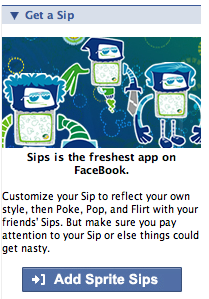
Already, there’s been some insightful critiques on this front. Nick Carr started things off with his tart summary: “The medium is the message from our sponsor.” He goes on to point out that becoming a fan of a animated Sprite can is not exactly a revolution in advertising:
sprite-sips.png

It’s a nifty system: First you get your users to entrust their personal data to you, and then you not only sell that data to advertisers but you get the users to be the vector for the ads. And what do the users get in return? An animated Sprite Sips character to interact with.

Henry Blodget asks, not unreasonably: Will advertisers pay people to recommend their products to friends? (That would be a bad idea, but you never know what Madison Avenue will try to do next).

And Umair Haque warns of adverse selection with Facebook ads that are presented as updates to people’s feeds (aka Beacons). Excerpt:

Yes, we all know referrals are powerful. But real referrals aren’t what Facebook’s offering. Real referrals aren’t broadcasting preferences; they are matching preferences. See the difference?

Beacon is essentially a biased market mechanism. That is, advertisers have control – but connected consumers (despite Facebook’s hype) don’t.

The synthetic relevance Facebook is pushing is a drug for the strung-out advertisers of the world: they desperately need a hit of something to make them believe they matter again.

As advertisers buy into Facebook – no one will be better off – except Facebook.

Marketers and firms won’t gain true connection with consumers.

And, crucially, consumers will be trapped into not just receiving crappy ads – but sending them as well.

These are all valid points. The best referrals come from people who know you have a particular need or are looking for something. They usually come out of a conversation. “Have you seen any good movies lately?” “Oh yeah, just last week we rented . . .” I only want referrals when I need them. If all my friends and casual acquaintances start bombarding me with referrals that are not matched to what I need, that could very quickly just become another source of noise I need to filter out.

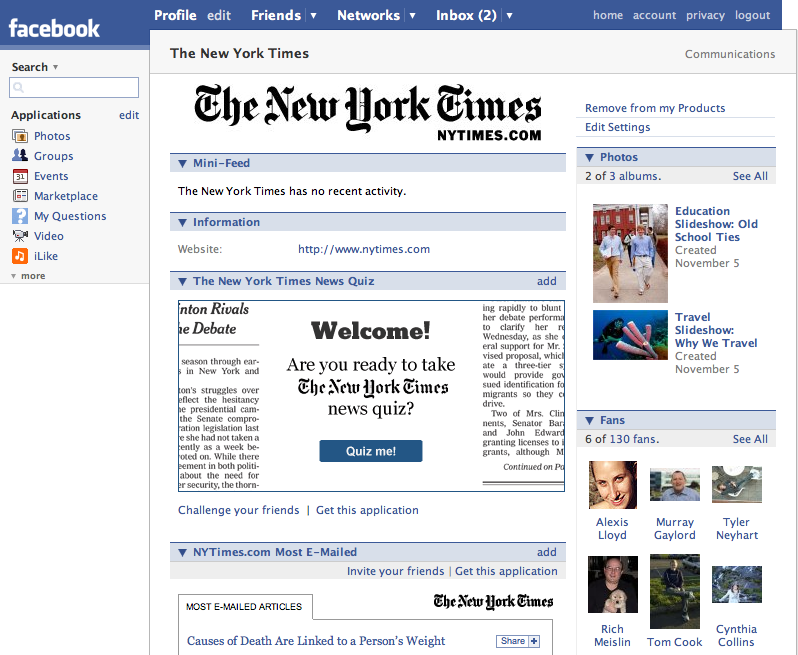
And yet, it is just too soon to tell where all this will go. Granted, many of the advertising partners that have jumped on board this bandwagon are faceless consumer products companies. I am not sure I want to be a fan of Sprite or Chase or Verizon (and I am a customer of all of these brands). But some of the partnerships do make sense. I don’t mind identifying myself as a fan of the New York Times.
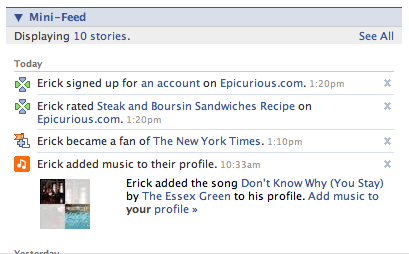
beacon-ads.pngThe social ads that will work will tend to be niche or high-end brands that people really like to show off because it says something about who they are. They will also work for other media sites where people already interact in a social way.

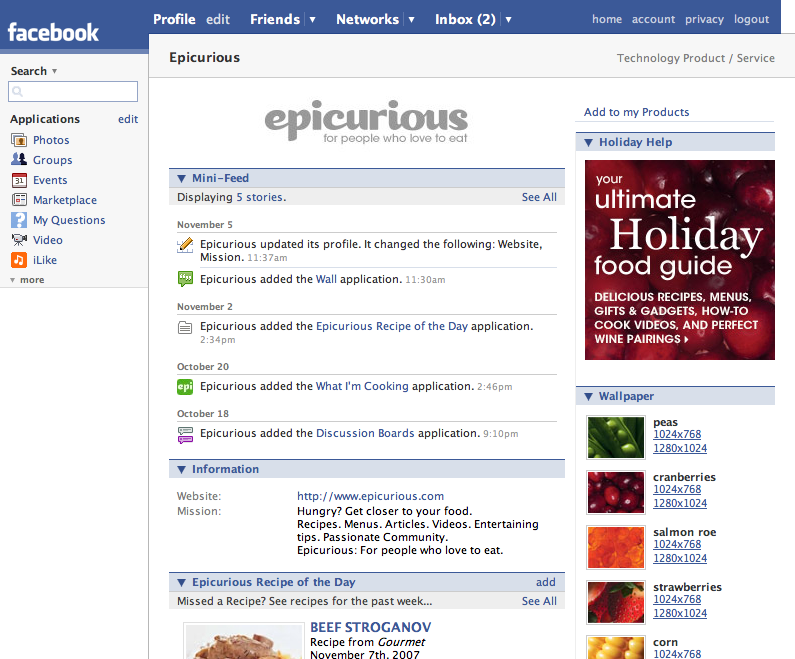
For instance, Epicurious now knows if you are a Facebook member and broadcasts any recipe you rate or save on the site to all your friends on Facebook (via their feeds). You can opt out if you don’t want to share this information, but it seems to me to be very similar to what people are already seeing in their feeds. “I like this recipe, check it out.” The New York Times will be doing something similar for travel ratings, movie ratings and reviews, and articles you save or e-mail (except, in that case, you will have to opt in to share the information and it won’t say who you are emailing it to). That too seems to me to be in keeping with the spirit of the Mini feed. “Here’s an article you should read.”

But those are not product endorsements. They are more akin to other Facebook applications, except that they are surfacing activity from a different site. Which is why I think that for this to work advertisers need to think more like developers. Help people do something useful, informative, or fun, and they will gladly broadcast that experience to the world. If people see these as ads, they will revolt. If they see them as indistinguishable from the stream of Facebook chatter already in their feeds (which is often inane, but addictive nonetheless), the messages will have a better chance of getting through.

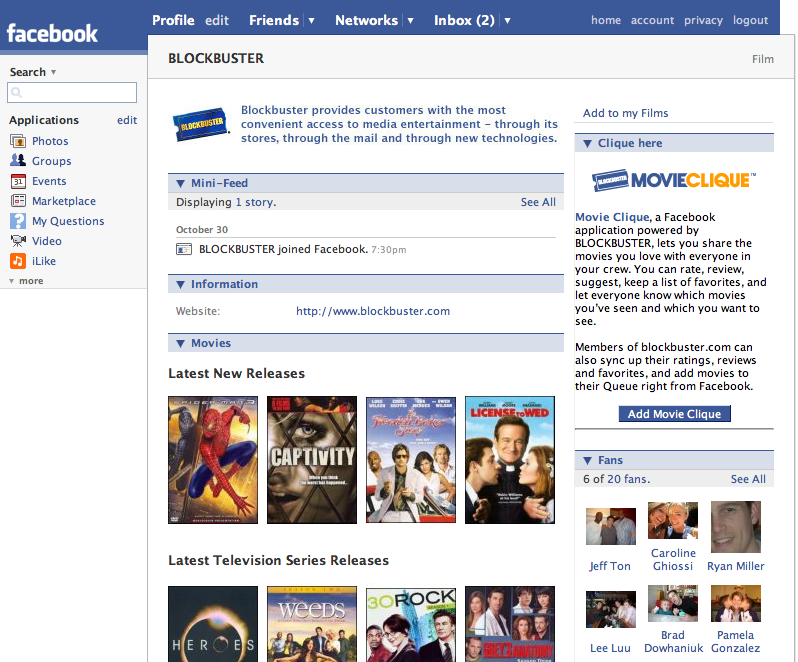
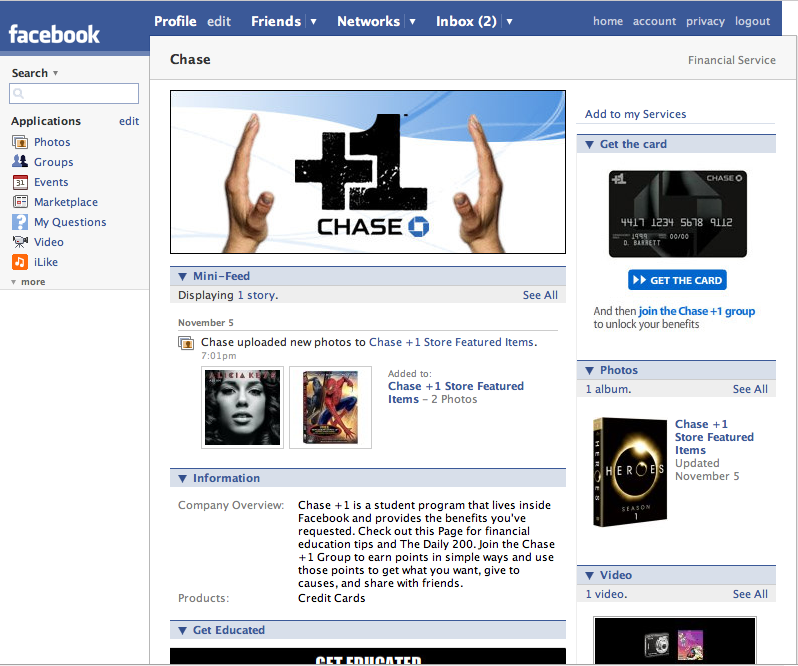
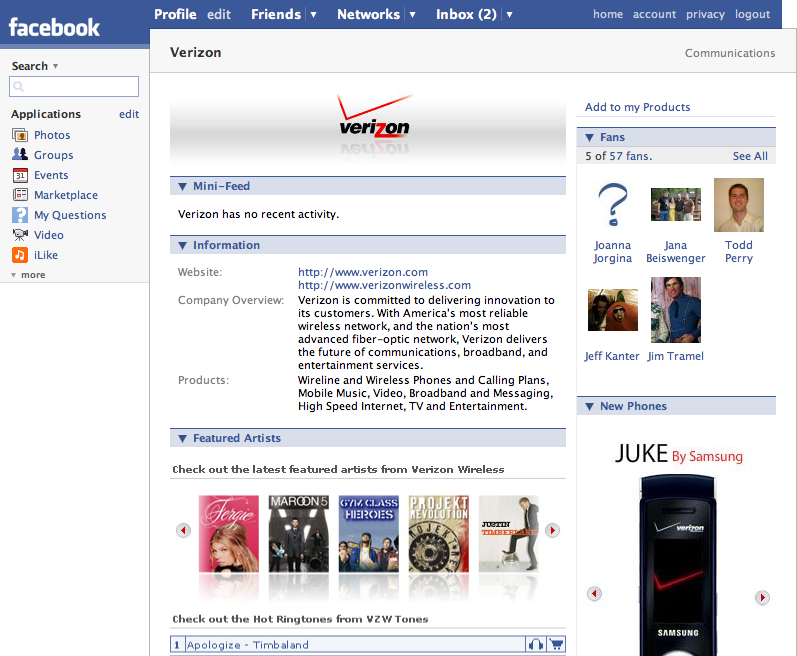
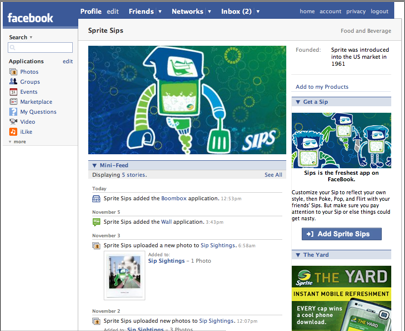
Here are some screen shots of brand pages on Facebook (for thumbnails, click to enlarge):
sprite-sips-fb.png
blockbuster-fb.pngchase-fb.pngverizon-fb.pngverizon-fb.pngnytimes-fb.pngepicurious-fb.png

Advertisement

Responses

Comments rss icon

  • This post is very bold…let us see how it goes.

    :-)

  • Advertisers will pay people to endorse products (probably not directly though), just take a look at payperpost and subvertandprofit. This will just be another medium people will try to take advantage of for monetary gain.

  • Eric,
    Thank you for acknowledging the Facebook overcoverage! It’s reassuring to know that you realize it’s an issue.

    Very interesting post. Thanks again.

  • What’s really troubling is that Facebook appears to be spending most of its development time on making the site a haven for advertisers. Meanwhile, there’s very little new user functionality added. It’s as if Zuckerberg and friends think ads and widgets like vampires are the end all of social networks.

    It seems like they are starting to get Friendster delusions of grandeur disease.

  • “It seems like they are starting to get Friendster delusions of grandeur disease.”

    Very insightful statement…

  • So true Erick:

    “The best referrals come from people who know you have a particular need or are looking for something. They usually come out of a conversation.”

    Also, ads are a company telling you how great they are. Customers telling other people how great the company is — as anyone knows who markets for a living — is worth way more to any company that isn’t selling image (and I suggest that’s everyone that isn’t in the clothes, food, and car business).

  • Hmm, what’s worse, Google reading our email within gmail and serving us ads or Facebook advertisers looking at our profile information? At first I was opposed to having google target ads from my email but I’ve gotten used to it. Most likely it’ll be the same with facebook ads.

  • Please start a new blog called FacebookCrunch and move this content there

  • interesting post, and I agree: let’s wait and see where it goes…

  • I think it was Clay Shirky who defined social networks as anything that eventually attracts spammers. Looks like Facebook is trying to make a business model out of it.

  • From an advertisers perspective, I’m hesitant to invest in a system that takes at least 48 hours to let me know that my ads are live, and another 48 hours for activity to show up. Businesses make decisions based upon real-time data, not data from 4 days ago.

  • Advertising agencies – have for their existence – been about interrupting the conversations of people to get their message out.

    With the advent of Social Media, the new trend is to try and be “….part of the conversation…” as Erick put in his liveblogging post at the FaceBook announcement (the time was 2:46pm I believe).

    Trying to be “part of the conversation” is still about interrupting people or groups as they communicate and will still fail miserably.

    It’s the truly special companies/brands that understand/know the secret to success is “to be the conversation” – not to join one.

    Of course Facebook will make dumptrucks full of money while agencies throw everything they can at the wall to see what sticks.

  • I’m a big fan of facebook, but should it turn into the marketing beast that myspace is I’ll ditch it for something else.

    Maybe I’ll join lonerbook?
    http://www.star...ial-networking/

  • I remember a similar uproar last fall when Facebook introduced News Feeds, and people were so upset about their privacy…

    Interestingly enough, a month passed and everyone loved the feeds. Perhaps this angst is also much ado about nothing.

  • The biggest reason why asking a friend an opinion on a product is useful – is because a fair amount of time they say said product was a bad one, and advise you not to buy it, not to see that movie, not to read the book etc.

    If Facebook were really interested in enabling truly valuable friend to friend product endorsements – I’d find more value in something like Yelp. But no – this is all about giving advertisers more ways to shill their products because Facebook needs a business model to justify their valuation.

  • The press is definitely feeling some of that Facebook hangover, where you were all excited to go out, had a great time when it happened, and then said to all your friends the next day, “I’m never doing that again.”

  • I agree with #4, does FB even have a Community Evangelist? At the end of the day this is only going to work if users are willing to make it work. FB gets all the money and users get nothing and become FB cheap whores for advertisers.

    Turn off all data to FB and share nothing.

    Google ads’ don’t bother be cause they often more times them now show me something related to what I was searching for.

    Join my FB group “No Ads in my Feed”
    http://www.face...2472&ref=mf

  • PublicBroadcastChannel - November 7th, 2007 at 1:32 pm PST

    My initial response is that the advertisement addition to facebook thing feels a bit like a 5th wheel slapped on to a car, and all the ensuing aesthetic and technical hinderance that ensues. And then I realize that it is because the advertising model hasn’t changed much, like Len says, it is about interrupting conversation, of “trying” to be a part of the conversation, which all in all, still becomes a signal to noise ratio that an increasing amount of people are sensitive to. This is a real big duh, but they should really look at trying to change the role of advertisement in the “big conversation”. Do something engaging. That would be so great if an add didn’t talk at me, but instead offered me a legitimate service of some kind, maybe not even having to do with said product (gasp!). I know you ad folks out there are like “this kid has no idea about what models work, blah blah, statistics, blah blah apple ipod web 2.0″ my question to you (or whoever) is how come all the ads on the internet still feel like aesthetic relatives of banners and javascript pop-ups from 1996? Was all the ad groundwork laid out already? I hope not…

  • Get over it people. If Facebook is doing news worth activities then they should be covered here.

  • Privacy on the Internet does not exist and this will be forgotten within 7 days. I am also sick of FB coverage.

  • 99.9% of the people on Facebook probably won’t even notice the ads, which is Facebook’s bigger problem.

  • With all due respect, I am starting to suspect that Michael Arrington may be quietly holding a not-insignificant amount of equity in Facebook. All signs point in this direction. Arrington has gone on the record about his sense of freedom to invest and cover companies at his own discretion as a blogger, and such a deal would be very smart on Zuckerberg’s part, to gift a wack of shares to the most prominent web 2.0 influencer online today. This thesis comes in the wake of a number of TC posts, including many which may feign critique of FB in some way or another, but which seem to, under their surface, perpetuate the overwhelming and often seemingly baseless hype around the website.

    I will be the first to admit that Facebook is entitled to kudos for its impressive product design, growth metrics, feature development etc. But as a technology platform, it comes nowhere close to being “revolutionary,” and the fact that Arrington is so consistently singing its praises or discussing it in any light, for that matter, smells funny.

  • Wouldn’t it be funny if there is a huge uproar / revolt by FB users over this being imposed on them and resulted in them leaving FB for other sites? Nothing would shrink Mark Suckerberg’s head and FB valuation faster.

  • Facebook has gone too far with how they use the user’s information.

    I think it’s time to switch. Any suggestion??

  • I tend to agree with the sentiment that all this is similar to gmail with ads. Time will tell if this not the case. I have advertised on Facebook and found that the number of clicks is way higher than what I get from Google Adwords. It is early still to talk about conversion rates (I am talking about Facebook Flyers on not the Ads released today).

    Btw, I could not figure out how to get to the brand pages on Facebook?

  • @23, Jason: Perhaps you didn’t notice, but Eric wrote this post (and most of the others), not Michael. Further, it would NOT be “very smart” considering all of us that read this blog need no introduction to FB. Please get a clue.

  • @23, Stu: Perhaps you didn’t notice, but Rupert Murdoch doesn’t write or read the editorial content featured in every fox news segment, nor in the other segments featured in other channels owned/operated by Newscorp. This does not undermine its ability to set rigid, extremely defined editorial guidelines – such as what stories/subjects should be covered and in what light – in order to to further high level strategic objectives (many of which are monetary).

    Further, this has nothing to do with “introducing” anyone to facebook. Making an introduction and creating the perception of market dominance through continual coverage, particularly when such coverage is consistently stylized and non-essential, are very different concepts.

  • This is a horrible move by Facebook. Leveraging people’s personal data to shlep products no matter how its disguised is something they are going to pay dearly for.

    A cool widget that can entertain or inform is an even exchange for a branded message. But the new system is far too entangled in people’s personal connections. They will lose a ton of their end users as people get pissed off at all the nonsense and head for the exits.

  • @jughead — I agree wholeheartedly. I’ll be the first out the door. This being said, there’s no accounting for the willingness of young people to tolerate some level of commercial exploitation…I’ve done a lot of consumer marketing and I often find it baffling.

  • Erick,

    How is facebook not like the claria/zango’s of the past? In one swoop- facebook has managed to reduce their image to the like.

    Facebook- can you let us opt out. then at least I won’t feel like I’ve sold out (even though you have) just by using facebook.

    can someone write an ode to icarus on behalf of the fb mgmt…

  • hey guys, does anyone know how I can find/be-friend the new york times page? i can’t seem to find it anywhere???

  • nobody cares for privacy anymore. i do agree with #27 though about arrington having some shares or even potentially some nice free advertising deal with fb later on to increase viewership.

  • @Leon, i’ve been looking around for the “pages” too – all i can find is “coca-cola” if i do a search, i haven’t found anything else… a search for “n.y. times” yeilds some misc. bar, but searching for “new york times” or variants yeilds no “pages”. Of course, i could be wrong, but the fb blog post indicates that they should show up as pages… seems rather silly to launch this service, tell us all about it, but not give us an easy way to play around with it (mabye thats the point, who knows).

    If someone knows of a good way to see what ad’s/products/services exist on fb, i’d like to know.

  • TechFaceCrunchBook - November 7th, 2007 at 5:46 pm PST

    eric i thought this post was well done. however you could have shortened to say just this:

    “If you have over 50 facebook friends, you’re now f*cked”

  • Don T. Havbizmodel - November 7th, 2007 at 5:59 pm PST

    Webmattica is right – in order to justify absurd valuations, Facebook had to offer up the only thing of value it has – personal tastes of its membership to marketers. what other value is there in 1000s of gimmicky applications that no one is willing to pay for directly? i used to love playing soccer, hockey and kungfu fighting in that little email game, but i would not have paid for it. and now it does not exist. see the pattern? are you willing to spend $ to take and share with your friends a likeness quiz?

    now linkedin actually has some subscription models that generate revenue. and my guess is the average income of a linkedin user is 5X that of a facebook user.

    so tell me which is more valuable?

    and while we are at it – hulu and other efforts will also kill gootube. in 5 years that thing will just be folded into google at large. again – no business model.

    the social networks of today are the portals of 1999.

  • I already use Facebook apps that utilize my profile information, and publish stories for all of my friends to see. Also, the apps actively work to get me to evangelize to my friends.

    Why would an advertiser pay Facebook when they can currently do it for free. Can one of the guys familiar with the system answer that?

  • here’s a question for all of you:

    i think generally facebook’s moves are examples of smart folks doing the best they can with a medium (their social network) that typically fails to deliver against advertisers. it’s tough monetizing a social network – nobody clicks on ads, and frequency is mindblowingly high – so you’ve got to get creative about ways to monetize, and i think the theory is good, at least. as to whether it moves the needle for advertisers, well, we’ll see.

    all that said, i question one thing – in yesterday’s blog post at http://blog.fac...ook.com/?ref=nf , Facebook states (and i quote): “Facebook will never sell any of your information.”

    Isn’t that exactly what they’re doing? I say I’m male and 24 years old, and they promptly “sell” (or is it “give” or “use”) that information to let advertisers come find you? regardless of how you slice it, you’re handing personal information to facebook, who in turn is connecting advertising to it. no?

    i applaud the company for the smart thinking, and i think they’re showing a determination to squeeze revenue out of what has been mostly a social (not profitable) phenomenon…i think you need to call a spade a spade, however.

  • i should also note that i personally don’t have much of an issue making that information available to others. there are far greater violations of privacy already happening elsewhere. (can someone say “Equifax?”)

    as for the comments above re: Facebook getting too big for their britches or overly cocky, i’d say this is exactly the opposite. they’re trying to move the company into a profitable place as soon as possible to live up to the lofty expectations that are out there. page views don’t equal a solid company, as Friendster illustrates…Facebook is pursuing the path of becoming an independent, profitable business. Don’t shoot them for trying.

  • Beacon sounds useful even for non-commercial content. Imagine browsing Wikipedia and clicking a “SocialShare” button to show your friends/associates what you are reading or doing. Or any website, for that matter.

    If Facebook charges for Beacon, think of all of the missed opportunity. If it were free, all sorts of websites, organizations and individuals would get into it and it would increase pageviews dramatically. Ads could be displayed when users click into (free) Beacon events, and such advertisements could be more expensive because they are more highly targeted.

    I bet Google will implement a similar standard for OpenSocial, and they will start with some of the same partners that Facebook has.

  • Eventually there should be a much broader standard by which to integrate web content into social networking applications. Facebook better start competing with del.i.cious (or whatever), Google toolbar, etc.

    Google is probably already working on a very broad standard by which to integrate web data into one’s online identity and application suite. They better be, because such standards could be a part of the search experience in search engines 5 years in the future.

  • @38

    That’s interesting. Twitter can update my Facebook profile when I do something. They didn’t pay Facebook.

    Now that I think of it, this is just a way for companies to pay Facebook to invade the Facebook userspace without getting users to actually install anything or give permission. Yuck.

    And this may drive developers to OpenSocial.

  • This is a classic “if you build it they will come” assumption. Why exactly won’t the 50 million users of Facebook just ignore this entirely. People are conditioned to ignore ads all together except for that .0x% of the time when they do click. So do we think that this .0x% will then turn around and push this to their friends? Sorry but in my view this dog won’t hunt.

  • I couldn’t agree more that Facebook is being very aggressive with this new approach. The power of a “Social Ad” has great potential to virally rip through user profiles, but it must be done with at least a little self-respect. I blogged about it here: http://tekmix.b...out-of-bag.html

  • “In order to form an immaculate member of a flock of sheep one must, above all, be a sheep”

    Albert Einstein

  • backlash? granted it’s only been a day, but so far I’ve become a “fan” of a few businesses (New York Times, FaceReviews), and created a “page” for my site, FacebookEconomy.com:
    http://www.face...p?id=8431870131

    If these things start to bug me, they haven’t thus far, I quit them. What’s the big deal, where’s the drama?!

  • Good article, Erick.

    Favorite Quote #1
    This the the quote: If you “don’t want to be targeted, don’t share information on Facebook.”

    Favorite Quote #2
    “If all my friends and casual acquaintances start bombarding me with referrals that are not matched to what I need, that could very quickly just become another source of noise I need to filter out.”

  • @Mark Mayhew … how did you find the new york times page/profile? a few of us here have had no luck finding it ?

  • Facebook should have done this on a strictly hush-hush basis and not announced it to the world AT ALL. They should have offered this service initially via inside sales to exclusive media buyers at a massive premium for early placement, and not told the world anything about it.

    Instead, Zuckerberg screams out “hey we’re selling all of you to SONY and FRITO-LAY !!!” on stage. They could have gotten away with stealth for a long time, and the first advertisers would have been that much more likely to succeed, thus establishing this scheme in ad-buying circles as a good solid high-ROI bet. Nope. Making money over the long term apparently is not as important as grabbing yet another headline for young Facebook.

    FB’s PR people have committed a “rookie error”. All news, when you’re running a good-time site like Facebook, should be directed towards the furtherance of good times (e.g. more user value), not how the party’s promoters are making a killing by inviting Verizon and Chase to DJ. That’s a story for AdWeek, not for the general tech press. A business model like this isn’t even tech news, that’s the irony – it’s “yet another spammy corporate monetization scheme” supercharged by news feed & user generated content – it’s only news because Facebook is news.

    it remains to be seen if Facebook’s audience is in sync with the tech blogosphere’s revulsion. maybe sprite sips will nudge the sales needle for KO regardless?

    -s

Leave Comment

Commenting Options

Enter your personal information to the left, or sign in with your Facebook account by clicking the button below.

Alternatively, you can create an avatar that will appear whenever you leave a comment on a Gravatar-enabled blog.

Trackback URL

RealTime CrunchUp Sponsors:

bugbugbugbug
Techcrunch on Facebook