
What do you get when you cross iTunes with a web browser? You get Songbird, an application built on top of Mozilla Firefox’s core technology that serves as a platform for media websites that want to integrate tightly with a desktop media player.
We last wrote about Songbird over a year and a half ago when version 0.1 was released. Tonight, Songbird releases version 0.3, which the company considers its equivalent to Firefox 1.0.
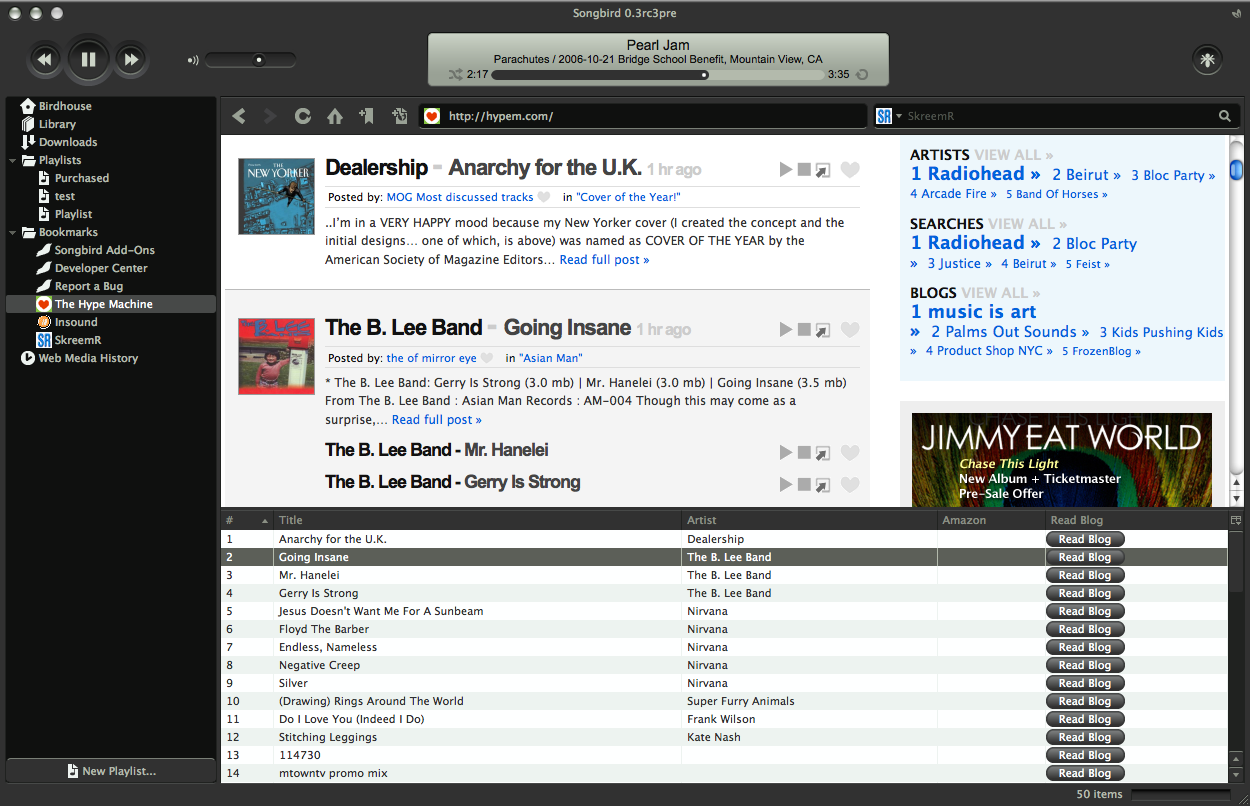
Perhaps the best way to explain Songbird is to compare it what Apple has done with iTunes. While iTunes is a traditional desktop application that must be downloaded and installed, the iTunes Store within iTunes is actually a website that meshes so seamlessly (and exclusively) with iTunes that you don’t really realize that you are browsing a website when looking for music to buy. Click to purchase some music and the iTunes Store website communicates with the iTunes desktop client to trigger certain functionality, like a user prompt and then a file download. Apple is able to contain the entire shopping experience within its media player, making the consumption of new music very convenient.
Now suppose you’re a media company that wants to set up shop within users’ media players the way Apple has set up shop within iTunes. You could try to hack together a plugin for iTunes, but you won’t get the same results and you’ll be subject to the whims of proprietary software. With Songbird, you have access not only to a fully-equipped desktop media player but also a set of open APIs with which you can easily mesh your existing website with Songbird (see developer center). For the most part, developers just need to program their websites to take advantage of a Songbird DOM object in JavaScript. You can also build themes and plugins for Songbird as you might for Firefox, since the application’s architecture is fundamentally the same.
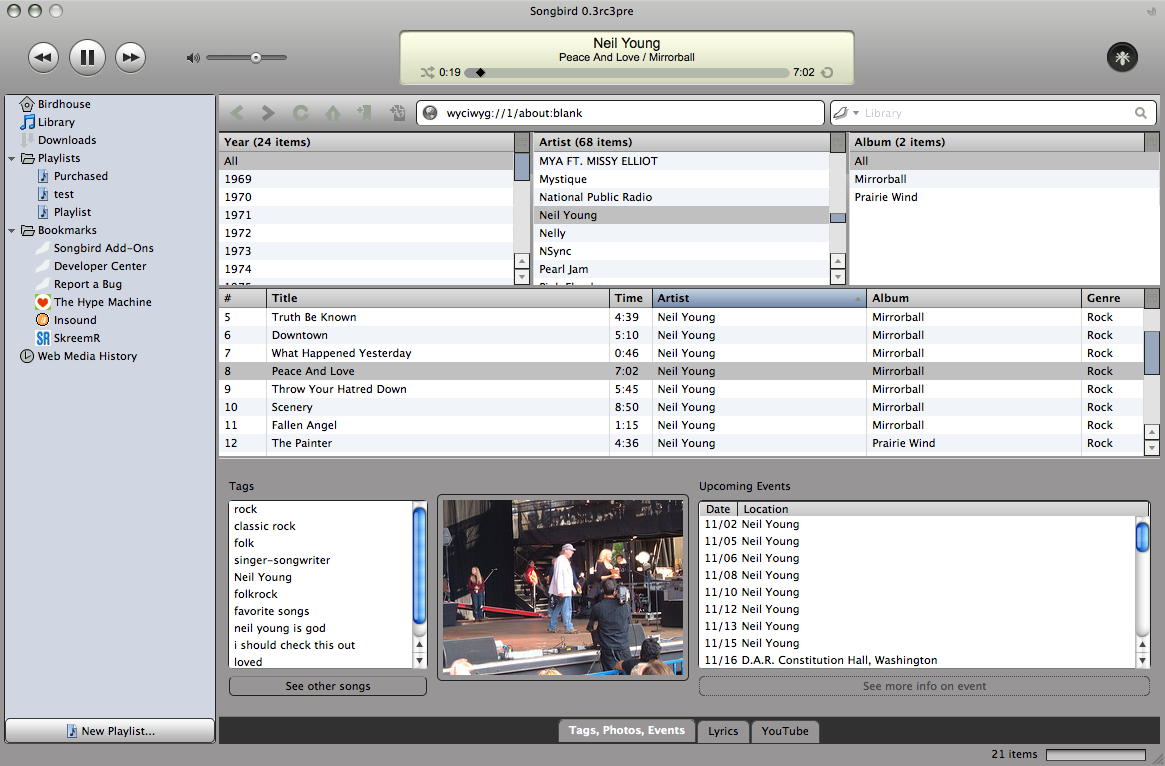
Songbird turned to Mozilla technology for its product because it wanted operating system agnosticism. Also, other possible web-to-desktop platforms, like AIR, were not created with an open source philosophy nor designed well enough for large-scale projects. Songbird envisions its platform being used not only for track download services, but for services based around any type of media such as video.
The Hype Machine, Insound, and SkreemR have programmed their websites for Songbird and are packaged with the latest release. A screenshot of the player I saw on their website also suggests that an iLike integration is in the works.
Songbird closed $8 million in funding from Sequoia Capital and Atlas Venture in December 2006. The software has been downloaded around one million times so far. And the company’s developers previously worked on Winamp and the Yahoo Music Engine.


See all


Mark, thanks for the words of praise, but I’m not sure we’re quite a FF 1.0 just yet. We certainly invite both Web developers and FF developers to come and see our new API’s.
This just makes sense and I like it. It seems those companies that survive on walled-garden business models are not having a good day. Are the discussions with Amazon complete or ongoing :)?
the SkreemR link goes to insound
correct link is http://skreemr.com
“…iTunes that you don’t really realize that you are browsing a website when looking for music to buy.”
Right. Except for the massive load times, the timeouts, the error messages. It’s atrocious and slow. Not to mention, lately, you have to download/update the entire app monthly.
This is why music services should run in the browser like Amazon - and Songbird. Kudos to them for sticking with this idea.
“Also, other possible web-to-desktop platforms, like AIR, were not created with an open source philosophy nor designed well enough for large-scale projects.”
Good grief. Why would you say such a thing? The runtime isn’t open source (yet), but development is and you can build large-scale projects *easily*.
Finally? An update? Ah great! Now I have to wait the rest of the week to update it back home XD
Songbird looks great. Device-makers that aren’t Apple or Microsoft should pay attention to this one.
Good job, Ian & team.
I’ve long feared, that one day - my sins would catchup with me…and the price, is more than I can bare to pay.
It’s so cool to see a company doing some awesome work with XUL, it’s such an underutilized technology now that everybody is bracing for Air.
One of the more interesting aspects of using the Mozilla code is that Songbird now supports Greasemonkey scripts:
http://www.p2p-blog.com/item-398.html
This is probably the most exciting application that’s come out in a while. I’d really like to see someone do something like this for A/V chat. Yes, there is Pidgin, but I’d like to see the extensibility engine of Mozilla come into play.
I’m very excited about Songbird, and it’s extensibility.
“Songbird turned to Mozilla technology for its product … other possible web-to-desktop platforms, like AIR, were not created with an open source philosophy nor designed well enough for large-scale projects.”
Wasn’t Songbird developing it’s product long before AIR/Apollo was even known about? Not saying that Mozilla wouldn’t have been the best choice for them anyway.
I agree XULRunner/Mozilla is an awesome technology to target multiple OSs, and has been my first choice for desktop apps for awhile. But now that Adobe AIR is about to reach 1.0, and Mozilla 2.0 is just getting ready to shake things up, I will be leaning more towards AIR as a solution. I see no reason why it can’t handle large-scale projects.
@11 AIR has several things missing from it. One reason why I don’t consider it for some my projects is due to synchronous DB (SQLite) calls. It’s a hack to implement business logic through lots of asynchronous calls to a persistence layer.
11 - Very true, they were developing Songbird before AIR. But when I asked them whether they considered switching over to AIR, they said they preferred Mozilla’s open source nature and ease with which to build larger, more complex, projects.
iTunes is a browser, a dedicated one (it only retrieves data from one place). I suspect we’re going to see a web-based version of iTunes in the very near future which, if it happens, kills this project.
As a non-technical person I don’t want what AIR offers- I want all my apps to be online and don’t care about desktop apps. To me the desktop is looking more and more like a backup solution rather than a workspace.
Walled gardens can only be walled if what’s within those walls is darn good. What the music industry has been trying so far is to do stuff that actually makes what’s inside those walls inferior by introducing limitations to the products and even Spyware (shame on you Sony).
What IS better than iTunes AND better than songbird would in my opinion be Spotify. Here we’re talking blazing fast searches (faster than local iTunes searches on my machine), quality metadata, great sound quality and what seems to be a very compact and well written piece of software.
#7 — And your point is what? Nothing. Don’t be a coward on TechCrunch.
12 - AIR Beta 2 has a synchronous database API:
http://labs.adobe.com/wiki/ind....._Beta_2.3F
13 - “whether they considered switching over to AIR, they said they preferred Mozilla’s open source nature and ease with which to build larger, more complex, projects”
Yeah, add to that an existing codebase and a large number of hours already invested with Mozilla technologies. I would think that would be a horrible idea to switch to a different technology too, no matter what it was. (Unless there were some do-or-die emergency)
So maybe just stating that as a standalone opinion, not as part of a decision made to intentionally avoid AIR.
Integrating content into media players this way provides a great user experience. And it’s also a business: we have been doing this at zSlide with our White Label solution “Omega Media Player” :
http://www.omegamediaplayer.com/
It’s been successfully used for music and VOD for 2 years, our biggest client being Orange, the European giant telco.