October 12, 2007

Supply Side Economics Fail Music Industry Again

Duncan Riley

72 comments »

economics.jpg

The latest brainwave from the besieged music industry is the proposal to offer free music to end users via the Total Music brand. Spawned by Universal Music, Total Music looks likely to sign the big four record labels and a range of smaller firms as well, with Sony BMG on board and Warner Music looking as it will be as well.

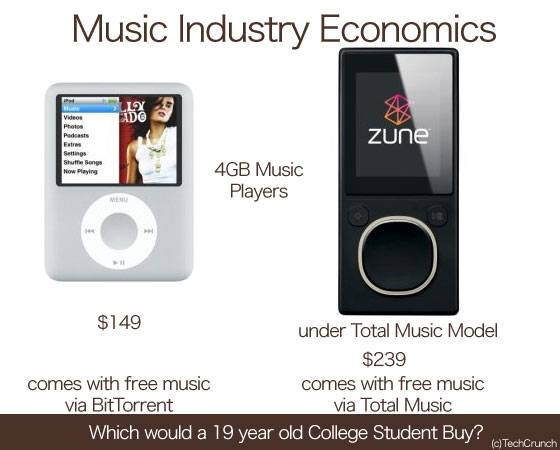
Free is the ultimate selling point in market side economics, because ultimately you can’t beat the opportunity cost of zero. But here’s the catch: Total Music may market itself as offering free unlimited music, but it’s not really free, the cost is just hidden. That cost: $90 per device for access to Total Music, based on $5 per month over 18 months (the figures Universal are using). In our above example Microsoft has decided not to absorb the $90 Total Music charge but has instead added it to the price on the 4gb Zune, taking the total price to $239. Which would you buy?

In the Zune example Microsoft may embrace the Total Music model and subsidize the subscription costs. Say that Microsoft split the difference and the Zune went from $149 to only $194, it’s a better figure but it’s still $45 more that the iPod. Could Microsoft absorb the whole price? Unlikely; after all why would it willfully hand over $90 of a $149 product, which we presume would certainly destroy Microsoft’s product margin on the Zune, and could even make each sale a loss.

I’ve used Microsoft as an example but it could be any company with a music player that isn’t Apple. Universal is looking at targeting anything that plays music, so aside from MP3 players you could be seeing this hidden cost built into mobile phones, media streaming devices and perhaps even computers.

I should note that some people like their music legal and will pay a premium, but given a $90 price difference this is unlikely to be a majority of buyers, particularly when the iPod offers legal options as well, options that are a choice and not an imposed upfront cost to the buyer.

The music industry may talk about free music, but all it is doing with Total Music is shifting the point in which the consumer pays to one that isn’t nearly as transparent as iTunes.

More details at CrunchGear.

  • Sphere It

Trackbacks/Pings (Trackback URL)

  1. Blog Feeds about Music » Archive » Comment on Supply Side Economics Fail Music Industry Again by Pete
  2. More on Major Music Labels « Changing Way
  3. Blog Feeds about Music » Archive » Comment on Supply Side Economics Fail Music Industry Again by Joe
  4. Blog Feeds about Music » Archive » Comment on Supply Side Economics Fail Music Industry Again by Rajeev
  5. Blog Feeds about Music » Archive » Comment on Supply Side Economics Fail Music Industry Again by Blog …
  6. Abhishek Tiwari
  7. DOJ Launches Anti-Trust Probe Over Total Music | tips tech blog

Comments

RSS feed for comments on this post.

  1. bc

    And not to mention the fact that for that extra money, you don’t own anything more in the end. In the old CD model, you owned a CD that could be traded with friends, family, sold on ebay, etc. I have to wonder if this is the market the industry would rather kill than file swapping. How many new sales are lost to the used music industry (either actual sales or someone giving a friend or family member a disc that they don’t listen to anymore). I am just guessing, but it seams like this would be a bigger strike to new music sales than “file swapping”? Perhaps this is what the industry is really trying to kill? Can you sell your itunes or Urge music that you no longer listen to?

  2. KirkH

    I have this crazy theory that if you have to pay for something it’s not really free.

    A quick google search turns up:
    “In the UK alone, the music industry employs over 130000 people in these various sectors”

    “The music industry employs over 600000 people across the European Unio”

    “The music industry employs 28000 Californians, according to the Hollywood Reporter. ”

    Between this and the extinction of realtors/mortgage brokers there aren’t many jobs being created outside of tech. Maybe lawsuits will fill the income void.

  3. Steve Ballmer

    Nothing Like a Zune in the Morning!
    I love the new zunes! Our friends at ZuneScene (yeah baby) are doing a great grassroots job of promoting them too. The iPud has nothing close to ZS, you see, nobody feels passionately about their iPud. The Zoonies have zune body art, Zune haircuts, they name their children Zune, Zunette, Zunisha, Zubert, … The Zune is a lifestyle, a mindset. They even name their trailers after the Zune. I got my Z-tat last week, I can’t post a picture of it because of it’s location, but let me just say it’s beautiful!
    My favorite new Z-colors are the Military Avacodo and the ManPink (pink for real men)! What’s yours?

    http://fakestevsballmer.blogspot.com

  4. liquidboy

    The question on my mind is, will this music be drm free? Most likely not!

    Untill it is DRM free i will not buy!

  5. Jon

    I think Microsoft has to decide if it’s serious or not - it looses money on every XBox just to gain market penetration, it needs to do the same for the Zune or just get out of the marketplace.

    Jon

  6. Steve Ballmer

    Zune has a Squircle!

  7. Fabian Schonholz

    Yes … powerful economics … but forget about them.. which one is the cooler device? Put back economics but in the socio-economic sense … $90 is nothing. But … the iPod still the cooler device.

  8. Sammy

    Ok, it isn’t that bad a deal. Let’s give credit where credit is due, Duncan.

    The extra $90 gives me as much music as I want over the life of the device. That is 90 legit songs from iTunes. Or about 9 CDs. If I buy more than 9 CDs in the lifetime of the device, I am ahead. And if I am given a free pass, you bet I will try more music than if I had to pay for it. Probably 3 CDs a month on average? That makes it 54 CDs over 18 months - makes me come out 6x.

    And not everyone uses BitTorrent - surely not the average user. So what if this skips the college kids - big deal. Music players are used by a lot of other people who would pay for the convenience, and maybe the ethical high ground as well.

    I for one am happy to see the music industry stretching and waking up. Nice move.

  9. Fake Richard

    Hoping for this music to go drm free, until then I will just wait and not buy.

    http://vidsonly.blogspot.com

  10. Duncan Riley

    Sammy
    it’s why I noted some people will like the deal, but given an upfront price difference of $90 where you can get can free on either unit (legalities aside) which would the majority pick? And I didn’t even go near the argument where the iPod is actually the most desirable product design wise as well (I dont hate the Zune like Erick, I’m just looking at sales popularity). So the market leader will be $90 cheaper than the competition, who are already less desirable: it’s a terrible marketing strategy for Microsoft and others, but on the other hand I’d bet Steve Jobs is thinking bring it on :-)

    Fake Richard
    I’m not sure on the DRM side, it sounds an awful lot like a Rhapsody style subscription service to me, where you get to play as much music as you want but only for the lifetime of the subscription, or in this case the device from which you’ve secretly paid a subscription fee on. Short form: DRM is highly likely.

  11. Boyle Heights

    @Sammy

    That is 54 CDs which is about 90 songs that you actually like. After 18 months you dont own anything. With the ipod you own 90 songs.

    It used to be that you got a CD that had all good songs. Now if they have 4-5 good songs you are amazed.

  12. ChrisD

    Given a “pre-paid” subscription, I wonder how Universal would figure out how to divvy up those revenues to the artists. Would it still be on a per-download basis. If an end-user consumes far and above that royalty basis, will Universal take a loss?

    I’d like to hear more on the details. It seems like it would be hard for the artists to get behind this initiative. Or maybe they don’t have a say in the matter.

    Given Radiohead’s experiment in direct-to-consumer selling, I think all of this will be moot soon - or at least for new music as opposed to back-catalog, which will still be under the control of the labels.

  13. Alex H

    I love the little ‘(c) TechCrunch’ you have placed there Duncan.

    Considering TechCrunch’s stance on the rewards and incentives of intellectual property (ala music) I find it pretty contradicting that you would place something like that there.

  14. Colin Dowling

    The record industry needs to get out of the music distribution business and in to the music promotion business. The cost of getting a new band, hyping them, recording a record, promoting it, and navigating everything else is super costly. Instead of trying to protect narrow margins of such high risk, the music biz shoulf see that there is a very long tail of quality artists who may never make millions, but can certainly make thousands and thousands.

  15. addys

    The Microsoft-bashing on TechCrunch (and Apple worship) is truly shameful. You guys are about as fair and balanced as Fox News.

    The topic is an incredibly stupid move by the music industry. Yet the entire article (except for two sentences midway in) makes it sound like Microsoft and the Zune team are the ones making the mistake, when in fact the author “used Microsoft as an example but it could be any company with a music player”.

    Next time someone needs to be the scapegoat , how about a big iPod picture instead of a Zune? Yeah, didn’t think so.

  16. PookieBadMuffin

    Right.

    College students with a couple hundred bucks to burn.

    Brilliant example.

  17. Mitch Reisendorf

    They always end up leaving out how the artist will be paid out of all of this. I guess we can assume they will get the short end as always as the big cheeses try to rake in the last pennies while they can but ignore the fact that their ability to push out the next generation of superstars with legitimate talent. The real issue is not competing with Apple but figuring out a way to use online technology to bring back the lost art of Artist Development. Without that all the DRM-Free/Subscription/MP3 player talk means nothing in the long term.

  18. Dave

    Alex - I agree about the (c) - I find it hilarious after the copyright rant yesterday…and the fact that who ever created this beautiful, techcrunch copyrighted graphic most likely used apple and ms copyrighted images as the center piece.

    Also - is it hard to use the actual © symbol?

  19. John

    Actually I don’t think this is a bad idea. It could be better but it’s pretty fair and a good start at least. I bet if Apple were to offer this option with their ipod/itunes a lot of customers would opt for it.

  20. Ryan W.

    You guys are crazy if you think that the average user wouldn’t see value in something like this. It’s not a perfect model, but I would much rather pay an extra $90 for unlimited access to tons of music for the lifetime of the device. As someone pointed out above, that’s 9 cds on itunes. If apple announced a $90 subscription option that would allow unlimited music on your ipod (even without DRM), you would all be shouting their praises from the rooftops. But because it’s big evil microsoft, it must be a rip-off. Please.

    Also, this has nothing to do with supply-side economics.

  21. Ryan W.

    ^ meant to say “even WITH drm”

  22. mitch

    Bittorrent has always been a poor resource for pirating music since someone actually has to be seeding the music you want. Good luck finding anything older than a few months that isn’t a huge seller. It’s nothing like the good old days of Napster, Kazaa, eDonkey, etc.

    Add that to the fact that the big torrent sites are becoming pretty unaccessible to U.S. citizens and I think the $45-$90 delta is pretty trivial - even for a college student.

  23. Pete

    Sounds like the perfect gift, the gift that keeps giving. I think a lot of average consumers will find value in it. For me I think it sounds like a decent deal, as I don’t download via BitTorrent.

    It’s kinda funny to compare this to BitTorrent, Total Music is LEGAL. Anything compared to BitTorrent is going to be more expensive.

    Maybe you should ask the Minnesota woman that, for now, must pay the RIAA $220,000, $90 sounds like a pretty good deal compared to that.

    I would like to see a (c)TechCrunch graphic of an iPod + free BitTorrent music $220,000 vs Zune + Total Music for $239.

  24. Boomer

    mitch>>

    You obviously aren’t using the right BitTorrent trackers.

    Why does Microsoft insist on pricing equivalent to the iPod? There have got to be a lot of people out there who would switch to Zune for a $50 saving.

  25. MarcosV

    Seeing the teaser and the example of Apple vs. Zune and *then* reading the content of the article, it does come across that the author is biased with a pro Apple/anti-Microsoft slant.

    The article is about the merits of the proposed Universal’s Total Music. The thing is, where does it say that the only way you’re going to get a Zune is by paying the extra $90? If you opt out of the proposal, you have the same advantages as the iPod: pirate music you want for free or pay for what you want legitimately.

    The all you can rent model is interesting to those who want to sample music on demand without worrying about getting busted doing the P2P thing. There’s a restriction on what’s easily available on BitTorrent, which makes instant on-demand interesting to some listeners. The all you can rent model exists right now on Rhapsody and other services at around $12 to $15 per month (albeit for multiple machines, including PCs and portables that support DRM).

    The problem with the Universal model is that it doesn’t fit Microsoft very well. Microsoft wants to sell hardware and music/other content — same as Apple. Why would Microsoft want Universal in the mix taking the media profit? Other companies that sold hardware and used Play for Sure or some other media service can benefit here. Especially if they do subsidize some of that $90. hence using Microsoft as an example makes less sense.

  26. aspir8or

    I find it incredible that the powers that be in the music industry are incapable of understanding the shift in consumer attitudes towards buying music. Cd sales are down, there’s as much file sharing going on now as before Jammy went to court, bloggers and pundits the world over try to explain the paradigm shift in music industry economics, and the industry just keeps it’s heads buried in the sand while trying every method they can think of to prop up a failing model, and most of those methods work under the assumption that the consumers are plain stupid and/or gullible. The music industry employs a lot of people. Simple statistics state that there must be some people at a high enough level who are bright enough to understand what’s happening. Are they being deliberately muzzled, or are they just too scared to speak out?

  27. Tcruncher2

    $90 == 90 Songs on Itunes vs $90 for Unlimited Songs

    Fk the supply side economics ….. thats unreal!

  28. Johnathan

    What’s next? a picture of Bill Gates dressed as a borg? I’m getting tired of this constant bashing of microsoft from you guys. Total Music is a good deal, i’m paying $90 for unlimited music, that’s a no brainer in my opinion.

    If I’m an ISP promoting my broadband service my tag line would be.

    “Free internet access for £18 a month” or would you prefer if I said “6p a day for internet access.” Same reason you buy stuff for £2.99 instead of £3.00, it looks and sounds cheaper.

    Get your head round it, total music would pay for itself.

  29. Steve Jobs

    As I read the posts, its funny to watch as the music industry marketers hear about this post on TC and come out of the woodwork to try to sway public opionion with nonsense arguments.

    Duncan is spot on — if only for the fact that the Zune is quite a bit more expensive than the iPod. Period. End of story.

  30. micah616

    Sorry, Duncan, but I think you’re missing the bigger picture. It’s not a terrible marketing strategy. The record companies involved so far (Universal, Sony-BMG, and Warner, aka the major parts of the RIAA) are in control of 70% of retail music. The back catalogues have just about everything that just about anyone could want. Apple owns no music and controls no music. Apple Computers can’t even get into the business of making music, as they are legally bound by Apple music to never do so.

    Few of the major media companies who deal with Apple actually like to deal with Apple. Apple, to them, is an unnecessary middleman that is eating away at their profits. Once the record companies collude and decide upon a course of de-facto consolidation, Apple will no longer be a major player.

    If the record companies say “To hell with Apple,” then to hell Apple goes, along with the iPod. That’s one of the fringe benefits of having a monopoly.
    Before you start talking about “alienating the consumer,” please remember that the RIAA doesn’t give a rat’s ass about the consumer. They have the products that people want, people will buy or pirate. If the RIAA decides that this is the way to go, piracy will be the only option left to non-Total Music devices, including the iPod. How long would it be until the RIAA targets Apple on some b.s. piracy assistance charges, or some other nonsense? So unless Apple plays ball, they could find themselves steamrolled in a protracted legal battle that will leave the iPod and iTunes in legal limbo, a limbo that will last long enough to effectively kill the product.
    With Microsoft aiding and abetting, Apple has zero chance of winning out in the medium or long run. So mock them if you wish, but let me know in 5 years about how well the Zunes are working out for you.

  31. met

    It would have made sense to argue on this article if the ipod and zunes were reversed. Would someone pay extra for the supposed coolness of the ipods with unlimited music or would someone pay less for the zune :)

  32. fog city dave

    Nobody has said this, but if you think they’re actually going to let you have unlimited music “for the life of the device”, then you’re nuts. If Universal says that they think you’re going to keep your Total Music device for 18 months, then that is when your Total Music for that device will expire. I’d bet my life on it.

    If this thing ever comes to fruition, it will require a whole new DRM scheme (they can’t use existing schemes like PlaysForSure, or people wouldn’t have to buy the more expensive new players), and whatever that future DRM platform will be, I can guarantee you it will be Draconian, and its rules and limitations will make your head spin. At the very least, your music will surely be locked to that device alone. The devil is in the details my friends. Let’s wait and see what the fine print looks like.

  33. Heelo

    The problem with the argument presented in the article is that if you follow the logic further down to its core, you basically end up with the idea that people will never pay anything for music (why pay if you can steal it for free?). But if that is true then how is it that iTunes continues to sell millions of songs per day?

    In my view, it’s not the kids in their teens and 20’s that have established the iPod as the defacto MP3 player in America, it’s the older adults and media establishment. High school and college students for the most part are plugged into the latest trends, and they’ll ditch the iPod in a second the moment it becomes uncool or the technological lead is usurped by another gadget. But older adults and other people with real responsibilities beyond trendwatching will continue to just buy iPods because it’s familiar and easy.

    But if those same people could pay a small price for free music on that player for the life of the machine that would change the dynamics quite quickly. And when parents are buying players for their children for Xmas I imagine that a large number of them will buy an all-you-can-eat player as protection against an outrageous lawsuit by the RIAA.

    Subscription-based music distribution is the only logical solution to the current mess the music industry finds itself in. Revenue will be allocated to the recording artists (who will then pay out to their producers and labels according to their contracts) according to what percent of total downloads their music represents. The devil will surely be in the details (how will we define download units? by running time or tracks? if by running time, will people attempt to scam the system by adding in long-winded intros and dead space at the end of their tracks? if by number of tracks, will DJs turn their 60-minute mix into 600 ten-second tracks?), but it will eventually work itself out. And since it seems like cell phones and music players will completely converge at some point, I imagine that at some point your Rhapsody subscription will end up as part of your monthly bill, just like the $5 you pay for unlimited text-messaging.

    It seems to me that in the end history will repeat itself and Apple will sink itself under the weight of its bunker mentality. Just as “IBM Clones” eventually became “PCs” as their technology became commoditized and Windows became the killer app, all of these “iPod clones” and “iPhone clones” will become “media players” and “media phones” when, as is inevitable, someone other than Apple produces the next HW or SW killer app.

    I’m embarrassed for the tech wonks who pimp themselves out as experts and yet are apparently oblivious to this inevitability, pooh-poohing every evolutionary step by the competition as woefully inadequate when what’s really happening is they’re adopting Apple’s core competencies piecemeal, which is a sound strategy that’s likely to put pressure on Apple to take greater risks in an attempt to maintain differentiation [the form factor of the Nano Fatty is likely just the first of these risks to backfire. there’s no way that Steve Jobs could ever pull that thing out of the coin pocket of his jeans as he did to unveil the original Nano, and you can’t bet your ass that the latest Nano would be thin with a long vertical screen if that form factor hadn’t already been adopted by numerous players from Sony, Samsung and Microsoft].

    If Sony, Samsung, Microsoft and the others followed the advice of these tech wonks and tried to produce fully differentiated products with next-generation features and functionality they would be setting themselves up for failure for two reasons. First, they would be ceding Apples core competencies to Apple and thereby failing to compete on the features that are obviously important to the general public that has made the iPod the MP3 player of choice. Second, they would almost certainly end up releasing a buggy product that came up short in terms of technology and usability.

    I applaud the measured and conservative approach that Microsoft is taking in developing it’s Zunes, and I applaud Universal for putting together a creative alternative to the unnecessarily expensive and inflexible approach of the current music marketplaces. Both of these steps are necessary if the business and technology of music is to advance as fast as possible.

  34. Peter Benjamin

    Make better music and maybe the buyers will buy it. The music industry needs a wake up call. The music out nowadays sucks. Show me a Celine Dion show me a Michael Jackson, A new Garth Brooks. These are superstars who will continue to sell records. When Paris Hilton gets a record deal ( I love her by the way) I think it says alot about the standard for the industry. If you close your eyes Jay LO is terrible. Should she have a deal? Yes because she is a star. However when you look at the American Idol phenomenon and other copy cats you realize how much talent the world has. Like any other industry, if you make an inferior product people will go for the bootleg because then the quality won’t matter. Its time for new music that is great not just Good.

  35. Dan Grossman

    @ Steve Jobs .. the Zune is not more expensive than the iPod, it’s priced exactly the same. Duncan completely made up the $239 price to use in his example. The flash Zune is the same $149 that iPod nano is.

  36. Tan The Man

    And the sad thing is that they’re both pretty ugly.

  37. GB

    The music industry never fail to behave like the slowest kid in the class ,shouting eurkea! when the train already left the station and getting the wrong side of it too…SO, LET’S DO IT SLOWWWLY, - YOUR INDUSTRY IS ABOUT THE CONTENT , NOT DEVICES. SELLING “SUBSCRIPTION” IS JUST LIKE THE “BUCKETS” OF THE CELLULAR, DO YOU WANT TO BE A UTILITY? NO DEVICE MAKER? HELL NO. A HINT - YOU NEED TO ATTACH VALUE TO THE CONTENT.

  38. Tom Dogg

    The USD 90.– are not a serious problem for the consumer - as long as some sort of serious quality added value comes with the offer. “Total Music” cannot simply be the legal version of a common BitTorrent (or whatever) service. It must go further:

    By “added value” I mean something like this:
    - get a web based access to all the music you like
    - be able to stream your music to any Internet enabled device (no need to sync all your files to all your devices all the time)
    - have a very sophisticated recommendation engine (must be better than Pandora) chose automatically your music and stream it to you.

  39. Todd

    Hooray! The “cut-my-nose-off-in-spite-of-my-face” music industry wants to push more people into pirating music ( who would have preferred to get it legally for a dollar or two ). This CNN/Money survey sums it up:

    “…When asked about buying habits of MP3 players and online music, 82 percent of the students who own an MP3 player indicated that they also own some form of an iPod, which is up from 79 percent in fall 2006. Purchasing online music is becoming more mainstream as 64 percent of the students surveyed indicated they download music illegally.”

    source: http://money.cnn.com/news/news.....2007-1.htm

    One last chance for you record label executives: music is now a commodity. You cannot wish it away, “shell game” the same old business model into music players, or sue some mother of two into bankruptcy - EVOLVE OR DIE!

  40. Joe

    So, Microsoft offers the 30Gb Zune now with unlimited music downloads for $14.95/mo. What makes it better than iPod + BT? I have immediate access to millions of tracks, don’t have to share my collection on a peer network, and be a eclectic as I want.

    Granted, they don’t do videos, but you can sync PodCasts. I sometimes think people want the Microsofties to fail, rather than giving them credit for at least sticking in the game and offering an alternative.

  41. pickupjojo

    I’m a 19 y.o. student, I’ve got an iPod and I buy all my music on the iTunes Store.
    What’s the problem?

  42. me

    This is stupid. If I own 4 players in my family then i have to pay for free music for each of them? Under the current model from iTunes, I pay for the music once and share on all of my devices for free.

  43. Rajeev

    In fact you can offer earning through ADVETs and networking to users.

  44. Steve

    Until a plan gets put forth that makes sense, I’ll probably continue to buy CDs and rip them to MP3 format. I do download music but it’s generally hard-to-find mixes and artists that the brick-and-mortar stores don’t carry.

    And in response to the person who’s lambasted you guys for copyrighting the image you created for this article: how else are you to get any credit for the image or traffic to your site when the image is posted (over and over) to other message boards discussing this issue? That would be stupid. Someone show me a Van Gogh or Rembrandt (besides a sketch) that doesn’t have that artist’s name on it and I’ll show you a fake.

  45. Andrew

    Economics? Really. IF it is DRM free and you can have it after you MP3 player dies then its a good deal for a certain segment of consumers. If it doesn’t work then I give the industry credit for trying it.

    The point on music companies getting more about promotion and branding artist is bang on. So welcome madison avenue the new record giants. The add industry is a good model as to what to expect.

    On another topic, why does everyone assume college kids are poor. It has surprisingly similar demographics as, well, our nation.

    that is all.

  46. dweezel

    @Heelo (33) - I wholeheartedly agree with you. The tech industry hasn’t quite realized that when you get comfortable with your market share (Apple, Google) you leave yourself open for attack by competitors. What has worked in the past != working in the future.

    IMHO, Amiestreet coupled with their “Fantasy Record Label” application on Facebook, will become the iTunes replacement. This is why I like it:
    - DRM free
    - Songs start at free and increase to $0.98 as they become more popular / downloaded
    - 70% share of proceeds to artists
    - “social network” features that reward you for good reviews with free music
    - Fantasy Record Label is ADDICTING (think stock portfolio but with music)

    As more artists move to this platform, the balance of power will shift away from iTunes.

  47. Michael

    Once, again Music gurus - we want to own our music. Not only does iTunes allow us to do that, it allows us to do it simply. And it ushers us to MORE music, and other bands we may have not known about. And we don’t want to buy music somewhere else (see your Google, Walmart Bestbuy download deals), so that we have to port it over into an application that already allows us to download and sync effortlessly. Which other portable music devices has been even remotely successful? Are you happy with that market share?
    Figure out a way to make your deal less terrible, and stop wasting our time. What will this amount to? 6 months of no Sony BMG or Universal downloads on iTunes and a few hundred million down the tubes on your failed experiment, and a few hundred more in sales lost during that time. We don’t care about your deals, we care about getting what we want. Maybe if you put the users and buyers of the world first, and work from there, your industry wouldnt be in the crapper. So now you go out and alienate the end user even more, and add even more red to your terrible bottom line.
    Guess I’ll be listening to indie tunes for a while.

  48. sunkistd

    Total music will be drm’d. There’s a time estimate of 18 months sohow can one even entertain the possibility of non drm’d music? And i liked the point about having to possibly pay for ‘each’ dap that you own- where you can share on unlimited iPods and five computers with iTunes.
    Question: would you also be able to play these songs on your computer or other media player? How would you obtain the music? And when with the 18 month countdown begin?

    Question: if the countdown begins when you purchase and register the player, what happens to music you buy the day before your time expires? Good for only a day?

    Observation: presumably- as is currently the case with subscription plans now, not all artists would be available through the plan. You’d probably then still find your self paying out if pocket for some music. But I guess you’d be able to keep that music after the 18th month?

  49. Bruce Warila

    I have written extensively on subscription models. There are two problems:

    1) The cost of purchasing a track is only part of the cost-equation for consumers. The TOTAL TOTAL cost of a track = TRACT RETAIL COST + TIME TO FIND TRACK COST. The reason people are “afraid” of subscription services is that they have a nagging fear that they will never recover the TIME TO FIND portion of the cost of acquiring their music library upon terminating a subscription arrangement.

    2) I have trouble believing subscription services - even at 50% penetration will be able to financially support the community that makes music - given the cost of living in the US, Canada and the UK.

    Here’s my latest advice “Elephant Piss Saves Labels”
    http://www.unsprungartists.com.....abels.html
    I thought I would have some fun with this…

    #34 - my favorite comment on this post. It is about the music!

  50. Simon Foster

    When Napster and Gnutella ruled the range (approx 7 years ago). I met with many label decision makers (including Ted Cohen at EMI who had previously been CEO of Napster) about a controversial but logical business model for the music industry. Funnily enough they were considering it but it never really took off due the RIAA’s vanquishing efforts to punish all free music distribution.

    My model was simple and incredibly effective as a business model and it’s not that different to what the TV networks are currently experimenting on with their online strategys today - the basic idea is ‘tagging ads to freely distributed content’. Back then I was tagging five second audio ads to the top and tail of hundreds of thousands of mp3s, and freely distributed them on P2P networks like Napster and Guntella etc. The model didn’t just stop with ads. I had also begun experimenting with music videos (as I was a music video producer at the time). I was tagging .mov’s with a personality (usually a actor/VJ), an ‘video advertisement’ and then the ‘video’ itself. These were essentially downloadable ‘micro-TV shows’. This was a breakthrough in video distribution. These clips had the necessary components of the TV revenue model but used them in a micro freely distributed format. They were getting popular back then before online video took off, imagine how popular they would be with label support today!!

    I set up a bunch of host nodes on high bandwidth DSL/Cable lines. I hosted tens of thousands of MP3s. My ad tagged MP3s created massive reach. As songs were released weekly (as they have done in Europe for decades)- I would simply tag these tracks with the latest ads. The reach was partially measurable by searching for these specially coded tracks over these networks.

    My experiments then generated a lot of VC interest and I had VC lined up. My funding hinged on the Napster court trial with the RIAA. Had the RIAA lost against Napster the Labels (Majors) could have easily and successfully moved forward with this model, that I was creating. Instead Napster lost and my experiment became one of the many targets in the RIAA’s cross hairs. My ideas became the negatively viewed and my efforts to help the music industry, essentially turned me into a criminal.

    If Napster had one that landmark trial, recording artists and labels would probably now be earning critical revenues from advertising proportionate to distribution and an mp3’s popularity. My model worked and its a pity the Labels were too slow to realize what was good for them. The current BitTorrent model is stripping the ‘business’ from the music business isn’t healthy in the long term and it’s time they figured out how to put it back in with something we want to pay for. Maybe my early advertising experiments are right for this time? Anyone have any thoughts on this?

  51. dweezel

    @Simon Foster - Things have changed in seven years…

    People don’t want advertising on their music, especially if they can pay a little more to get indie music, that is just as good (if not better), and support their artists directly.

  52. Nicolas Schriver

    In France the Internet suppliers propose some packages including free music downloads for the regular price. Record companies have to totally change their business plans.

  53. Simon Foster

    @ dweezel

    I agree with you that things have changed. But there needs to be a scalable economic model here. I think the solution to the music industrys economic dilemma is to launch numerous label-approved solutions, this being just one.

    My thinking is that you might be right about the ‘MP3 unit’. However video today is more pervasive ever and MTV and other networks that fueled the promotion machine behind the music industry have dwindled. This, to my thinking, is an incredible opportunity that the labels may have missed. Namely, taking back the entertainment platfrom, that MTV shrudly monopolized over the last 20 or so years. The labels can do this by producing TV content around music videos, like the ‘micro-shows’ I was creating 7 years ago.

    In todays world 7 years is a lifetime. However, the industrial elements that created the online cloud over media ecosystem then, are still in place today. The broadest base of music fans don’t like to pay for content and the music industry are equally loathe to seeing the brokerage of there ecominc model fall to Apple and Amazon. The TV industry are are abandoning iTunes based on these same principles. They are now exploring this micro-econimc unit that I’m suggesting. Again, I’m not saying this is the ONLY solution, mearly a ‘additional’ and ‘healthy’ revenue driver that gives music fans more than just the audio component (MP3), which as we know, has become impossibly defensible.

  54. Simon Foster

    @ dweezel

    One other thing about your comment on Amie Street’s model. These are great guys and have a very cool model. It may well prove to have it’s day in the sun. The online music industry has a brief history, maybe 10 years or so. In that time there has been two broadly adopted trends ’sharing’ (Natpster, Gnutella, BitTorrent) and ‘device/platform integration’ (iTunes).

    Both trends were widely adopted massively and rapidly. This, I think, is the litmus to logical distribution models. It’s my belief that if just one label bgan offering free videos files online (that included a presenter a music video followed by a hip TV ad) you would see massive adoption. People would download these units to their devices in huge numbers.

    The music industry MUST take back more control the distribution system or it’s dead. Unless they imporve their product they will recreate the MTV disaster in iTunes, Amazon et al. There is room for iTunes, Amazon, AmieStreet and label produced micro entertainment. These are symbiotic services and it’s a no brainer!

  55. mint question

    “I’m a 19 y.o. student, I’ve got an iPod and I buy all my music on the iTunes Store.
    What’s the problem?”

    Are you a student at refrigerator college? Because you seem to have completely missed the point of this article and the debate in the comments…

  56. The Grinch

    All this article demonstrates is that the apple fanboys are pissed that the new zunes are superior to the Ipod. There is a great video on youtube showing the new zune interface and it is far better than the ipod interface. These new zunes are going to take a huge bite out of apple.

  57. Israel L'Heureux

    Duncan, you messed your example and undermined your point.

    You should have shown a chinavasion.com mp4 player with bit torrent–it’s even cheaper.

    By using an ipod, you’ve instead shown that PRICE isn’t the most important metric. Convenience, usability, guarantees, etc. are all valuable, hence the massive premium price apple is able to charge for their products.

    Likewise, iTunes isn’t as cheap as legally-impaired torrents. But 3 billion times, people chose convenience.

    I’m no iTunes lover, mind you. In fact, I think it’s bloated and the licensing sucks. But it just like the premium price that is attached to the iPod, it just goes to show that convenience is highly valued.

    Now, if the pricing and distribution, etc. on music were more flexible, and it was coupled with a more-convenient-than-iTunes interface, then we’d really have something. And it wouldn’t have to be free. It could, in fact, be Better than Free.

    Imagine that.

  58. adam

    So hardware would absorb the cost of a $5 PER month fee?
    So a Zune would cost me $5 x avg lifespan of unit, say 24 months?
    OK I can see that would be okay to some.

    BUT…..

    This fee gets added to my cell phone bill too since it has an MP3 player that I dont use? Oh and my PSP has had it tacked on too? And there is no way to opt out since i pay upfront?

    Screw that!! No way in hell would this work for me if there isn’t a way to be paid back for a service I don’t use on all my devices that “can” play MP3s.

  59. Cursal

    “Screw that!! No way in hell would this work for me if there isn’t a way to be paid back for a service I don’t use on all my devices that “can” play MP3s.”

    that sound about right

  60. rezo

    I’m sure somewhare that it states reacuring fees after 18 mounths…. bammm….

  61. Marc

    Duncs,

    I don’t think ms did themselves any fovors by modelling the zune form factor on my nokia phone from 1999.

  62. Don

    The fundamental assumption of this article seems to be that college students can’t do math.

  63. Master Guru

    This article is the biggest LIE so far this year online. Why? If the music model price goes up for the Zune or any other player it goes up for the iPod.
    TechCrunch goes in the garbage now.

    BTW, seeing as Apple will not be able to license Windows Media, they can fu** off. No good songs for you looooooosers with iPods this year. I do hope you all went and dumped the stock today. Again, MS wins. Go cry now.

  64. Harry Wolf

    150 million iPods - 1 million zunes.
    iTunes 3.5 Billion tracks sold - Zunes - ? Any at all?

    Music Biz - dying industry - times have changed, songs are available so MANY different places; example: many old CD’s and record collections are freely copied by friends and relatives.

    All things must pass - one day the music biz will be gone (soon), one day Microsoft and Apple will be gone, your Ford Mustang WILL eventually go the dump.

    Be happy, play the songs, ignore this idiotic VAPOURWARE announcement/rumor by desperate Universal execs.

    And, sorry, but the new zunes are frickin horrible, just like the old ones, and the iPod is still the leader. Yawn.

    Its just so simple and easy to play ANYTHING on the iPod - its just a PAIN to use a zune. Thats all there is to it folks - dream on Microsfty fanbois, you are like the Hitler youth, only its the Gates/Ballmer Youth. Puke.

  65. david

    If this deal were in canada i’d jump in a heartbeat even tough many “claim” p2P is legal in canada for audio for personal use (down not up)