Google: 99.999 Percent Reliable, in Brazil
by Erick Schonfeld on September 27, 2007

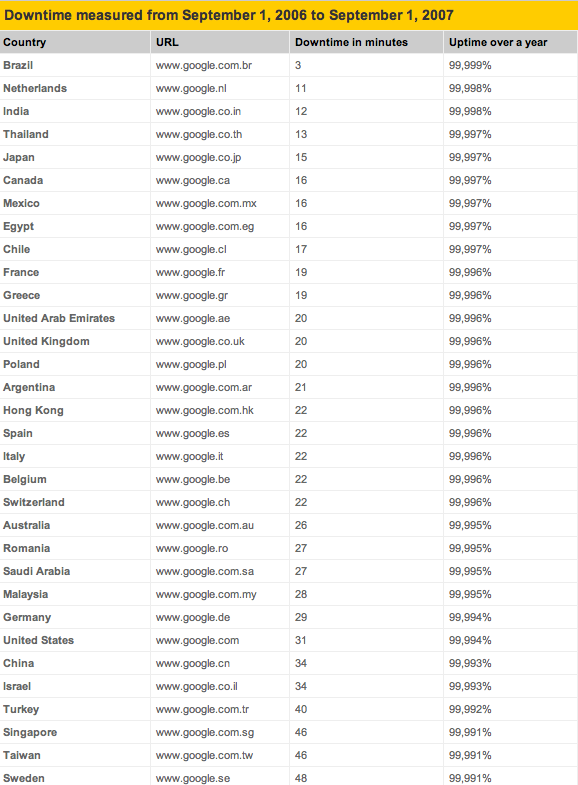
The folks at Pingdom measure the uptime of Google in different countries around the world. Google users in Brazil encounter the fewest hiccups.  Google’s Brazil site was down only three minutes in an entire year, giving it five 9s reliability.  The U.S. search site was down ten times as much, giving it only 99.994 percent reliability.  I think I can live with that.  (Sweden came in last, with 48 minutes of downtime over the past year).  Here are the stats:
picture-99.png

Advertisement

Comments rss icon

  • Do the folks in Brazil win some kind of Google trophy?

  • 48 minutes of downtime for a engine that is so popular and has to keep up with all that traffic is not bad at all.

  • The folks At GOOGLE should win a trophy.

    Google has done a great job of being there when we need them.
    This poll show that they are highly reliable worldwide. It is no
    surprise that they became so successful so fast.

  • even in the worst case they’ve still got four 9s… great job, Google.

  • I’d love to see which hours of which days there was downtime. 48 minutes out of a possible 525,600 minutes per year. (yes, I did Google that)

    Pollutants remark ‘miraculous’ nails it.

    But does this cover Gmail as well? Or just the search page. Not like it matters, its always there when I need it.

    Also what is the average time any given user uses Google in a day? That would be interesting to see the odds of a user experiencing downtime.

  • What was the total spread? In other words, how are the minutes distributed? Also, what was the perceived downtime from a user experience point of view? If a tree falls in the woods and there is no body there, did it make noise?

  • C’mon Google, get with the program. I’d like somebody to do some calculating on how much that .006 loses Google? I’m sure it’s not a small number.

  • I find it interesting that Brazil, Chile and Argentina all had better performance than the more highly regarded (technologically-wise) USA and Germany.

    And no, it’s not a matter of traffic… if the lower performance of USA and Germany is attributed to the high traffic load, do you think Japan and India have any lower load ?

    In fact these countries I mentioned, all together have many times the traffic load of USA and Germany combined, and their average uptime is still higher than that of USA and Germany.

    And excuse me, but 48 minutes downtime is AN AWFUL LOT, if you take account of the thousands of page impressions and CTR missed… it’s a lot of money Google loses. (especially since it’s been demostrated they can do better)

    It’d be interesting to find out wot’s uh, the deal ?

  • Google still number one, today i say……..

  • They are measuring the wrong thing. It’s not important to me if google is responding to ICMP requests but that gmail let’s me login and use it. The uptime measurement should always including actual usability analysis.

  • I fully agree with Jason. It needs a web application test software like iMacros to confirm that a website is REALLY working, not just “up”.

  • I’m guessing this is google.com only (and the national variants). Either way, there was a 1 hour outage earlier this year for google.ca, that isn’t reflected here.

    Still 3 9’s, which is still remarkable.

  • Any of you that have worked in network/systems for a “real” dot.com know how difficult this kind of uptime is. Pretty darned impressive, I say!

    Of course, some layer 7 testing definitely would have been nicer (and more accurate).

  • These three minutes happened when orkut went down for maintenance and people start to search “how to login in orkut during a maintenance” in google, causing a server crash.

    No, seriously.

  • @10

    The downtime to 5 places can be attributed to the vagaries of technology. It has nothing to do with technological “superiority”.

    A load balancer goes kaput and it takes the system a couple minutes to adjust. Meanwhile, the system is still getting hammered by requests it can no longer handle and starts disregarding some.

    As others have said, the real-world up-time information would be more telling. It would also be interesting to see number of instances of prolong outages. Are these hundreds of instances of a few seconds or tens of instances of a few minutes?

  • And for the fun of it. Some page load times for some sites I visit regularly.

    Full page test:

    Wired – 1.9 sec
    Betanews – 2.0 sec
    Techcrunch – 2.4 sec
    Gizmodo – 2.7 sec
    Engadget – 4.6 sec
    Pingdom – 5.6 sec

    Might have to contact Engadget. If they could drop that to the 2 second range that would save me minutes a month.

  • BR Google Sup. Eng. - September 27th, 2007 at 7:26 pm PDT

    Hi,

    We’ve won a bonus last year because we’ve cut Operations budget by half. I think I’m going to ask for some more because of our uptime! :)

  • goog should become a brazilian corp rather then continuing as a US company

  • You know what I think? Three nines is three freggin’ nines.

  • During the earthquake in south taipei late 2006 the only running mail composer was gmail. I don’t know if they directed the traffic through a rented fiber glass through India or they mirrored the server backups in south asia as it was the only service running of the top ten web properties.

    As I attended a conference in the province of Guangdong and the event details were on a western server, my only viable solution was to write an email to my peers in Europe to get immediate response about date&place of the conference.

    Thanks awesome Gmail, everything turned out happily. I remember a discussing going on here: http://resource...from_China_.htm

Leave Comment

Commenting Options

Enter your personal information to the left, or sign in with your Facebook account by clicking the button below.

Alternatively, you can create an avatar that will appear whenever you leave a comment on a Gravatar-enabled blog.

Trackback URL
bugbugbug