Yesterday a select group of fifteen or so industry luminaries attended a highly confidential meeting at Google’s headquarters in Mountain View to discuss the company’s upcoming plans to address the “Facebook issue.”
The meeting was so secret that all attendees had to sign confidentiality and non-disclosure agreements strictly forbidding them from discussing what was shown to them at the meeting. Notwithstanding that NDA, I’ve now spoken with three of the attendees off record to get an understanding of what Google is planning. Google’s goal - to fight Facebook by being even more open than the Facebook Platform. If Facebook is 98% open, Google wants to be 100%.
The short version: Google will announce a new set of APIs on November 5 that will allow developers to leverage Google’s social graph data. They’ll start with Orkut and iGoogle (Google’s personalized home page), and expand from there to include Gmail, Google Talk and other Google services over time.
On November 5 we’ll likely see third party iGoogle gadgets that leverage Orkut’s social graph information - the most basic implementation of what Google is planning. From there we may see a lot more - such as the ability to pull Orkut data outside of Google and into third party applications via the APIs. And Google is also considering allowing third parties to join the party at the other end of the platform - meaning other social networks (think Bebo, Friendster, Twitter, Digg and thousands of others) to give access to their user data to developers through those same APIs.
And that is a potentially killer strategy. Facebook has a platform to allow third parties to build applications on Facebook itself. But what Google may be planning is significantly more open - allowing third parties to both push and pull data, into and out of Google and non-Google applications.
In the long run, Google seems to be planning to add a social layer on top of the entire suite of Google services, with Orkut as their initial main source of social graph information and, as I said above, possibly adding third party networks to the back end as well. Social networks would have little choice but to participate to get additional distribution and attention.
Google has a number of heavy hitters engaged in the project. Amar Gandhi, who apparently wasn’t at the meeting and whose title is the rather unassuming “Product Manager, Orkut,” was previously at Microsoft where he unsuccessfully tried to integrate social networking features into Vista. Brad Fitzpatrick, the chief architect of Six Apart until he joined Google in August, is leading the charge to make the Google project as open as possible. Patrick Chanezon, Google Evangelist, is herding the cats.
Lots of people noticed Fitzpatrick’s social graph post (linked in paragraph above), connected the dots to his new job at Google, and speculated that Google’s has been working on something really, really big in this area. This is now confirmed and, unless Google changes the launch date, we’ll be seeing the beginning of it on November 5.


Should be a fun battle to watch!
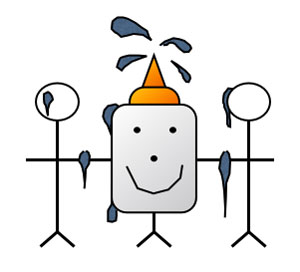
But what on Earth is that graphic supposed to represent?
the image is taken from Brad Fitzpatrich’s post on an open social graph. I’ll add a direct link.
What the hell is that image? Is that Google in the middle with a happy face, ejaculating all over their partners?
this is bad news for google. they shouldn’t be so worried about playing defense and they’re just going to get themselves into a mess. this is just a big dead-end distraction, imho
they need to stay on offense and put all those phd’s to work on the next big thing!! (and not a ripoff of facebook)
also, what the hell is that a picture of?
i just hope google comes out with an api that lets people read my email - that would be awesome - maybe let 3rd parties ‘parse’ my emails to show me ads or something.
so much for secrecy within google
Or maybe they deliberately wanted you to break this news Michael….
I knew it’s coming. We shall be able to leverage on that!
@4 why would you think Facebook would do that? Their latest history shows that they do exactly that rehash something thats successful or buy it.
Facebook applications are annoying
1. Google lacks lock-in of its users, which is why it should be afraid.
2. Google employees have no clue about user-generated content, which is another reason they should be afraid.
Michael:
I think there may be lurking but large privacy issues here? Maybe you can write your next article addressing this? I never login to Google EXCEPT for gmail. I’ve already been somewhat worried about email and privacy and now i’m really concerned
Man I hate the phrase ’social graph’ almost as much as ’semantic web’. I’m 34 and I feel like I’m 80 all of a sudden, time to just go back to using stamps and letters for me. I can’t possibly leverage all of this effectively.
this is the era of “social sites” i am a 29 year old young entrepreneur that never been to myspace(or any other social site) for that matter, i had to scratch all my prior ideas and come up with a social site concept so i can keep up with what people want.
its what people want my friend.. we just have to give it to them
I hope the google social graph has more categories than just ‘friends’. Then it might be truly useful.
From my blog:
How Google could beat Facebook at its own game
http://mindrosity.blogspot.com.....t-its.html
I am happy that google would go open soon, I think at least it is a defensive move they can do to stay on par with facebook for now. Before it has got all the developers locked in..
but google sure needs to be open enough for people to move to them. Looking forward to see more info on this~
Stupid question: Has anybody made any money from openness yet?
It only takes ONE to lead successfully and innovatively - and the rest will follow.
It wasn’t too long ago that GOOGLE was the one being imitated. With all of their PHDs and brilliant Engineers - it proves that no one can think of every innovation no matter how high the quality of their staff is.
Spelling mistake “Amar Ghandi” It is “Amar Gandhi”
i repeat: open isn’t better… BETTER is better.
if Google does cool stuff, it will be better on the merits… not because it’s “open”.
that said, Google is one of the companies that could actually give Facebook a run for its money.
and… vice versa
- dave mcclure
http://GraphingSocial.com/
Orkut? Who uses Orkut? Google should shut down this dead network and focus on connecting already existing ones. That’s the only part of this plan that make sense.
The difference between Facebook and Google is tht Facebook has all of my friends already actively using the website… How’s Google going to get people to switch?
Interesting move on Google’s part. Not surprising, given how they’re quietly taking over more and more of our web user experience (search, gmail, analytics, docs, spreadsheets, etc.)
Should be very interesting to see how they implement this.
We’ll work for whatever side contracts us, and shun the other side. We’ll do it with a smile. As always.
David - Orkut ain’t dead. Quite the opposite.
http://www.techcrunch.com/2007.....-says-yes/
Ryan,
If I was Google, I wouldn’t try to get people to switch. Instead, I’d become part of the experience, regardless of what site or app they’re on. From Michael’s article, that’s what it seems they’re headed toward.
I guess Google will have to get some social graph data first. God, I hate that term. But let’s roll with it.
Like no one uses Orkut. No one, not in the US. There’s some data there, but not heaps and loads — nowhere near what Facebook has.
iGoogle social graph data? Um, um — where? I have no iGoogle friends. I have no social graph on iGoogle. Maybe (seriously) I missed some way folks are connected on iGoogle, but I don’t think so. Connection really happens through personalization — if we have similar tabs, we might share similar things, but I’m not actually socially connected to people through iGoogle.
Google Talk? OK, now you’ve got me connected with some people. And we do what shared activities on Google Talk? Like nothing. I mean, we talk.
Gmail? What, you’re going to just open up people I email? OK, going to use my address book. Personally, I never put an address book in Gmail. But if I did, what are you going to do — tell me what others are emailing to each other? That’ll be fun.
I’d love to know more about what you were told, Mike — but it really sounds like Google’s going to try and invent a social graph of its own from scratch, perhaps by pushing Orkut somehow into iGoogle which gets a hell of a lot more usage that Orkut does. But there’s no real social graph to tap into right now at Google that I can see, regardless of Brad being hired and the fun of talking about it.
Ugh, so hate that term. What, we can’t just say social data? Social network? Social connections?
OMFG on the graphic
google can easily create social graph of users by analyzing gmail usage…combine that with orkut, all other things we are addicted to use on google….it is not too late to enter the social game
only problem is, if it is too ambitious like google base, it may not go anywhere!!
Good news for FaceBook again
“if facebook is 98% open” ha! Facebook is more like 30% open if that. All that really matters is the social graph and they qont wxpose that
Good for already popular Orkut. It is a hugely active social network which, despite of so many short comings, is doing great. Yes now people will say, it is popular in Brazil n India. Mike’s comment with the link, says it all. Traffic is what matters. Opening the platform is a good move by Google.
Why do some companies like this think that they have to do what everyone else is doing? Why can’t they simply do what they do best? (whatever that is) These type people make me sick!
http://fakesteveballmer.blogspot.com
Inspite of being a huge company now, google is very nimble and have been moving fast on to all possible big new things, be it videos or social networking leveraging their search/mail/docs/orkut power. google might do to facebook what softy did to netscape. wait for 2 years and see where facebook will be. I agree with # 9, most of facebook applications are annoying. I would rather use those applications stand-alone rather than be inside facebook with all those limitations.
Is any of this related to Socialstream? From the Web site:
Socialstream is the result of a Google-sponsored capstone project in the Master’s program at Carnegie Mellon University’s Human-Computer Interaction Institute. This project was guided by three goals that built upon each other:
Initial Task: Rethink and reinvent online social networking
Refined Focus: Discover the user needs related to social networking and explore how a unified social network service can enhance their experience.
Prototype Goal: Create a system for users to seamlessly share, view, and respond to many types of social content across multiple networks.
Directed to help improve the online community orkut, the project’s scope was not to simply redesign the interface.
Re: Graphic
It’s obviously an Elmer’s Glue bottle representing open standards that are able to glue together the open social web. duh!
RE: “Facebook has a platform to allow third parties to build applications on Facebook itself. But what Google may be planning is significantly more open - allowing third parties to both push and pull data, into and out of Google and non-Google applications.”
Facebook’s API does that as well. You can build apps for inside facebook, your own web app, or desktop apps. Sounds like what you just said Google wants to do that is “more open”. Sounds to me like that’s the same thing?
What everyone still seems to not understand is that Facebook is becoming the new Internet. Consider the general trends:
1. Nerds create web to share info with one another
2. Businesses create content to attract non-nerds
3. Penetration and adoption rates skyrocket; web becomes messy
Right now, the web is over-run. It’s just simply ugly and the value of each additional bit of content is constantly decreasing as is the chance that that bit of content (or application) will be able to attract a user’s attention.
4. Social networks pop up, offer walled experiences
5. Users rely on aliases to articulate identity, interact
6. Social networks not sticky; offer limited data to businesses
So at this point a user has multiple online homes and also touches multiple vendors through separate accounts. They are still going outwards to businesses and outwards to find information (on this increasingly ugly web).
7. Sites like Mahalo spring up to re-organize the web
8. Facebook stays closed, but allows the outside web to come in
9. Users must selectively choose which elements of the outside web they let in to facebook.
Ultimately it appears that Facebook is simply building out a cleansed version of the Internet. And yes, many of the applications are annoying and wonky, but look a bit more down the road –> they have the guys who were going to launch Parakey and eventually they’ll likely have a majority of the web-savvy world on their application, which doesn’t look kindly on aliases and fights spam with a really big sword.
So all of this said, I’m not sure that what Google is coming up with can beat this unless
a) they give each person/user an individual public and private web presence (think google people pages…we can’t assume wink, peekyou, spock will make it) or
b) they let people interact with different levels of a “cleansed” web.
One can only assume that whatever move they make will ultimately be to the benefit of Ad partners, as well, by giving more targeted info.
So either way, exciting times it seems like. Just wish Google would acquire facebook and make the world an easier place to interact with.
This is good news for those of us tired of using and building social networks. Every site is/has a social element because everybody realizes how drastically important it is for the future of the web. The problem is right now it’s totally fractured across a thousand different sites. It needs to be one seamless layer sitting on top of the web that everyone can build from and have access to equally. Facebook, Google, and I would guess Six Apart are making a decent play to build that layer. If it’s truly open though, no one can really claim ownership of it. It’s like saying I own XHTML. We just get to enjoy the benefits of it in the future.
This is the battle of the online operating systems. It was to be expected. I am not at all surprised. Besides, Google has had open apis to integrate into websites through mashing. This is just the next step.
thats bullsh_t, facebook is not facebook because it opened a platform, i some extend all that app crap made it worse place and facebook itself is slower now.
only to geeky crowd this social graphs and apis have any meaning.
I think the story here is that multiple luminaries that Google trusted with this information would turn around and violate the confidentiality agreements they just signed hours before. Where are their ethics? Should we think twice about holding those involved in this story in high moral regard?
Hi danny sullivan,
ate you certain google doesn’t have more info for a “social graph”?
Kidding, right?
Google reader- what you read
Gmail/gtalk who you talk to (connections)
anything you share on their platform
orkut, not popular here but elsewhere (orkut is obvioudly something they have access to and is FIRST for a reason; other SNs possible
calendar, um what you are doing when and how (maybe not all, but)
need i go on? dont make that drivel commentary that seems clueless
thanks
Great move by Google, nice to see they are still pretty nimble. I already have more confidence in the stability of Google API development than Facebook API development.
Google took the first step toward open social network data Wednesday when they announced GData JavaScript Client Library for Calendar. This library allows AJAX read-write access to Google Calendar without an intermediate server.
What does this mean? As I wrote yesterday on my blog:
“What this means is that any web application can read an event from Upcoming, let’s say, and (with your AuthSub authrorization), create a Google Calendar event for you. A little Javascript to read Upcoming’s REST API, a little jQuery drag-and-drop onto a Calendar AJAX object, and Wam Bam, you’ve dragged data from Yahoo and dropped it onto Google. All without any round trips to the originating server.”
“Think FaceBook applications. Then think about them interacting with one another — without them bogging down on some developer’s rented web host.”
@tomas
Nope, wasn’t kidding. But since you think I’m clueless, I’ll go through it again for you.
Google Reader — what you read is social? Because Google crawled in your brain and figured out who your friends are? It COULD be social, just ain’t right now. You can one way share with others, but Google doesn’t know who those others are. Maybe it does if they subscribe to you through Google’s own systems — but you didn’t give Google any permission for it then to start pulling you socially into someone else’s life (such as with Facebook’s news feed) based on that.
Gmail — Again, connections based on who you email? Heck, where’s my Outlook social graph, then? Yes, Google can see who you are emailing. You really think they’re going to start harvesting that now? I mean, you recall the freakout when Google wanted to show just ads next to your email. Folks are going to sit still for Gmail to making associations and flow what, your Gmail activity? You tell me more of exactly how you think Gmail’s going to be a social app. Gmail, mind you, not your contact book.
Google Talk — Aside from it still not being that widely used (for example, I just asked a pretty wired friend for her IM, and she sent me Yahoo, AIM and MSN — but no Google Talk/Gmail address), again, what social? Facebook has a social graph because you’ve not only explicitly connected with people but you’ve also selected a ton of things you do on Facebook that can be shared with them. What are you doing on Google Talk? Oh, you’re talking. Like now. So you’re going to what, start sharing that you’re talking with — right, you’re already talking. Well, maybe you’ll make it possible that Google has some master social feed of all you do at Google, so then if you’re talking with someone, you can flow that out onto the feed (I’d assume because you explicitly chose to do that). OK, kind of cool. But right now, there is no master Google Talk social connection in place, no graph. You connect with your friends, but Google is not currently showing you how those friends are connected with others. Long story short — sure, opportunity here, but let’s not make it out like this is primetime at all.
Anything you share on their platform? Sure. And again, just as soon as Google puts the infrastructure in place to get all that sharing into a social graph and then figures out where it’s going to flow. That’s not happening by November, not by a long shot. There is no master social graph for them to export. Geez, if they had that, you’d be seeing it in Orkut. Right now, you want Orkut, you have to sign up for it specifically (and have you? Or are you with Facebook? I actually have an Orkut account, a mature one from before the thing even opened to the public. It’s a graveyard compared to Facebook).
From what Mike’s describing, it sounds like they’re going to open Orkut up in the way they already have iGoogle opened up (and funded in part through the gadget grants). Get some cool social things pulling from Orkut into the very popular iGoogle pages, plus let Orkut flow anywhere and tout how “open” it is, and maybe more people will start going into Orkut.
Aside from that, let Gmail and Talk be open not for the social aspect (they don’t have that really, as explained above), but just so that you can say Gmail and Talk can be embedded in apps anywhere. Facebook apps get embedded in, yep — only Facebook. So saying you let your apps go anywhere again makes you sound open and also maybe gives you an edge in being on pages across the web (which, you know, already have all your ads — which now also, conveniently, are being even more promoted inside of apps/gadgets).
Finally, as Mike says, since you’re being all open sounding, that gives you leverage to say other social networks should be open, so that their data can flow into you. That’s handy if you’re Google and freaking out that Facebook seems to have a huge graph in your major market (the US), where you are now behind. Plus, it’s handy when people are feeling kind of all social overloaded and you think there might be a groundswell of support that Facebook should open up.
Heck, if I were Facebook, I’d be sitting over there saying we’ll open up our social graph as soon as you open up your web graph/index. Then you’ll see how open Google is.
When the new social Goog goes live, there will follow a fresh, new batch of venture capital-backed 2.0′ers trying to make a business out of the new API…
This move fits into the broader context of the industry taking steps to ensure the “social web” is no less open than the web itself. Facebook uses the term “open” very liberally to describe its strategy to become the proprietary OS for the social web. If you are interested in this topic, you might want to check of the recently drafted “Bill of Rights for Users of the Social Web,” co-authored by Joseph Smarr of Plaxo, Marc Canter, Robert Scoble, and Michael Arrington. It’s at http://opensocialweb.org.
I signed in my orkut account today morning and was thinking the same thing. Why don’t they open it somewhat so that we can build something on top of it. and now this news came. It would be just great if it happens.
Does anyone else get an Animal Farm feeling off this post? Everyone is Equal, but some are more equal than others (open vs more open).
The post linked to makes it critical that the fabric of social net is open-source not for profit. Would Google sponsor this effort simply to make facebook irrelevant as a competitor? And why can’t facebook simply use its own internal graph and page views for selling its own inventory (they have a lot)?
I just started using facebook, but I have never clicked on an Ad, and don’t see how the social graph will really anticipate my needs BETTER than search or even content based ads (and therefore be more valuable to advertisers). If someone can give me a real life example?