Google Books: Embed Book Clips Into Websites
Michael Arrington
27 comments »

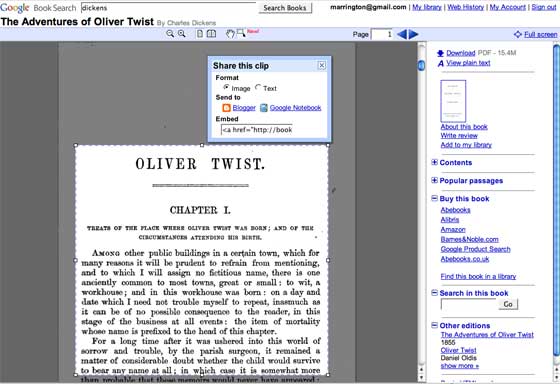
Google Books released a useful new tool this morning - the ability to embed parts of public domain books directly into other websites and/or Google Notebook.
The clip from the image above is embedded below. You can choose an image or text embed (both are below). It’s useful for bloggers who want to discuss a certain passage of a book, although taking a screen shot and uploading it does exactly the same thing. The image embed lacks a link back to the original source material for some reason. The text embed has a link but the formatting isn’t so wonderful.
The Adventures of Oliver Twist By Charles Dickens OLIVER TWIST CHAPTER I TREATS OP THE PLACE WHERE OLIVER TWIST WAS BORN AND OF THE CIRCUMSTANCES ATTENDING HIS BIRTH AMOXG other public buildings in a certain town which for many reasons it will be prudent to refrain from mentioning and to which I will assign no fictitious name there is one anciently common to most towns great or small to wit a workhouse and in this workhouse was born on a day and date which I need not trouble myself to repeat inasmuch as it can be of no possible consequence to the reader in this stage of the business at all events the item of mortality whose name is prefixed to the head of this chapter For a long time after it was ushered into this world of sorrow and trouble by the parish surgeon it remained a matter of considerable doubt whether the child would survive to bear name at all in which case it is somewhat more


I’m a student and I can see it to be useful in the academic field.
I ‘ll try this new tool with my blog
Its a great tool, but I think it needs some work yet, probably upcoming versions will be really useful
does the quoted material copy into the blog sans-punctuation, like it does here, Cormac McCarthy style?
I’m not sure of the utility. While Google has been, and most likely will remain, pretty stable, if for some reason this service was off-line or discontinued, all the remote references to passages you’re quoting would disappear. This is different than doo-dad, gee-whiz widgets which are “extra” content rather than the main content. There’s also a risk that the WRONG sub-content could be served up, thereby making what you’re quoting and the context to be different. It would be much safer and future-proof to just cut-and-paste the content into your document/web-page where the entire thing would then be self contained. If students and academics find this useful, they should be concerned about part of their content being dependent on someone else. And you’re allowed to do that anyway with public domain works. Of course, embedding from services like Scribd and youtube have the same issue; Scribd more so because things can more easily be edited and go through different revisions, what you’re “quoting” of the work could be changed out from under you; youtube less so because it’s been more of an “archive” rather than works in progress, the video is either there or it isn’t.
anyone who wants to be embedding book clips into their websites can use my site as well… (”embedding book clips” is also known as “copy/paste” for the uninitiated.)
it’s too hard to read a photo of a deteriorated printed page - project gutenberg takes the approach of typing up the books digitally…you still run into problems when there’s images, or the typist decides to add their own dedication, or they decide to correct things that don’t need correcting, etc, but it’s still nice to have the books in text format.
unfortunately it’s a lot harder to get people to read a book on a computer than, say, watch a video of a cat flushing a toilet.
Stick with the image version or your own screenshot since the OCR still misses quite a bit.
Google’s OCR is /awesome/! “TREATS OP THE PLACE” and “BIRTH AMOXG other” and such.
This will be a great resource for bloggers.
It is amazing the amount of free content available for
FREE online. Sharing is great and web 2.0 rocks.
Thank you GOOGLE.
My only real problem is that google books isn’t a very viable option for people who have published outside the mainstream publishing industry, with ISBN and all.
This is a great tool for all! Thanx for providing this info the very day it was introduced.
worknplay.net
It’s a great tool. I can see an extensive use of this google book reference feature in research and citations. Would be much better if Google fixes the image link to source issue.
Rajesh Shakya
http://www.rajeshshakya.com
Helping technopreneurs to excel and lead their life!
Not being able to copy-paste the text makes this Google tool less useful, for me.
Doesn’t Google have OCR scanners?
Maybe that’s for “version 2.0″ ; )
The main limitation of this service, IMHO, isn’t technical, but legal: you can use it with “any public domain book” in Google Books. That excludes the last several decades of books. Blogging does not appear to be fair use. And copyright, as has been argued many times before, is way too long.
Interesting took from Google
I love how it looks like a page from a book. Very . . . “real” looking
V
reminds me of scripd.com
Dear Michael,
Reading the reactions more than the original post, for some reason I can feel that Google is not the “so cool tool,” it used to be.
I you remain private you can still enjoy some of the reputation you work hard many years to have. Once you go public, then it does not matter what you do, will be “corporate America.”
Little unfair, such is life!
Mario Ruiz
http://www.oursheet.com
yes I agree. There was so much hype initially when google books/print started. but at the end, if this is the outcome, then it is bad.
Yeah, terrible OCR…
This entire scan & digitize project seems to be heading to a deadend. So much for the librarian’s dream.