
Movable Type is releasing the final version of their 4.0 platform tonight. We covered the beta, their turn towards open source, and new feature set previously. The new release, no doubt, comes under pressure from the success Wordpress has had as an open source platform. Unfortunately, we’ll still have to wait until later in the year for Movable Types’ open sourced version.
The finalized version includes 50 new features, a component based architecture, a new plugin directory, and some new launch partners. It looks like a solid release that comes with a lot of the functionality Wordpress MU is aiming for. Notably, Boing Boing will be upgrading soon.
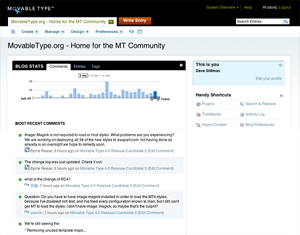
We covered the upgraded features in depth before. They included a new installation and upgrade wizard, easier and more powerful template management tools that speed site development, all new default templates and themes, and a completely redesigned user interface focused on streamlining common tasks. You can see a full list here.
However, the release also includes a shift to a component based architecture running on top of a single MT 4 code base. Components will be paid extensions of the platform meant to provide greater functionality out of the box. The first example component will be their enterprise version. Instead running as a separate installation, the enterprise version of the software will run on top of the basic MT 4 code base. It will feature the original enterprise feature set, including LDAP and Oracle support.
They have also released a new community component that beefs up the basic community features. The component adds a ratings system and deeper user profiles. The ratings system consists of post specific user ratings and a buzz feature that tracks the highest rated content. The new profile pages consist of a blog, their latest comments, and recommendations on your site. The infrastructure for these enhancements exist in the basic version, but buying the community component provides them out of the box and comes with support. They plan on releasing more components in the future.
Accompanying the release, Movable Type is launching a new plugin directory. They’ll also have some partners throwing their own plugins into the mix. Partners developing supporting applications and tools for MT4 include HP, Amazon, Sphere, Technorati, Snap, Feedblitz, NewsGator, SimplyHired, SocialText, Fliqz, Box.net, Mpire, Vizu, SodaHead, and Oodle.


See all


This is too little too late! I ran Movabletype a few years ago, and I’ll never go back. Wordpress can do pretty much anything.
Nick, thanks for the post. All of us on the Movable Type team are excited to show off what we’ve been able to do thanks to the efforts of our community. Anybody who’s never looked at MT before might want to check out movabletype.com, but most TechCrunch readers who are already familiar with MT and with blogging in general, will probably be most interested in joining the community at movabletype.org. We can’t wait to hear what people think.
The idea of paid extensions doesn’t appeal to me at all. Yes, very hard to draw people who are already using other platforms like WordPress.
Thats lookslike a good plataforms alternativives.
Barcia
To be fair, the paid components are aimed at enterprises. Plugins may be able to offer similar functionality to for the basic version.
They are going to have a hard time keeping up with Wordpress, thats for sure.
Glad to see competition though. Keeps things moving, although may not be as important once things move to an open source model.
Tim McCormack
iRent2u.com - the Online Rental Marketplace
wordpress rocks! btw Techcrunch runs on wordpress. nuff said.
I’ve been using both Movable Type (3.x) and WordPress (2.x) for awhile now, and to be fair, MT was already doing a decent job of “keeping up” to WP. True, the development cycle slowed down for awhile, but the plug-in developers did a good job of providing new functionality in the mean time.
If you didn’t have a chance to download the MT4 beta, it’s really pretty impressive. It’s now a lightweight CMS instead of just a blogging engine. Pretty much all of the functionality is available out of the box to create a complex website with multiple blogs. That is, if you’re willing to invest some time learning the architecture.
If that’s not what you’re looking for though, and you don’t do much with WordPress besides download themes and plugins, sure, there’s probably not much here to excite you. But if you need a great blogging engine and a respectable CMS, this might be exactly what you’re looking for.
Does anybody know if there will be a similar update to Typepad as well?
As far as I know it is based on MT.
I intend to move about a dozen blogs from Wordpress over to Movable Type over the next few weeks.
Wordpress does not scale as well as MT and probably never will.
In the past 18 months I’ve lost track of the number of security issues that Wordpress has had, while I think I’ve only had to install one minor security update for MT 3.*
I think the article may have confused people regarding extensions and plugins. You can extend MT without paying for stuff, though there will be paid extensions available as well - the same is true with a lot of OSS software.
Regards from Ireland
Michele
I suppose it depends on what you consider important. They all have issues with spam and security. which to me is one of the largest issues.
Here’s an example Russian sleaze marketing illegal Viagra and phishing scams on techcrunch.com .
http://www.techcrunch.com/2007.....-mash-ups/
or
http://search.yahoo.com/search.....fr=sexp-rd
#9 Michele -
It is true that MT does scale well due to it’s static HTML output, whereas Wordpress continues to hit the database multiple times for every page view because the content is dynamic.
The bug comparison doesn’t really hold too much water though, as any open source software is going to have seemingly more “bugs”. It’s the nature of the beast. When you put the source code out there for anyone to grab, more bugs get reported quicker, and there are continual patches. That’s not even mentioning anything about the user base being magnitudes larger so there are more eyes on the source code and more sites running it for attackers to target. There are bound to be more security flaws discovered for that reason alone. I guess we’ll see what happens when MT moves to open source.
Actually, WordPress scales incredibly well. It’s interop with memcache and such allows it to cache both images, pages and objects within pages. I’ve seen WP installs doing 250-400 MILLION pages per month, with tens of thousands of posts.
Scalability of WordPress is only an issue when you aren’t using the proper setup/plugins/caching - which is true of any software (including MT).
We’ve backed up our files and will be upgrading our network of blogs and podcasts to MT4 this fall. Thanks for the tip and overview of what to expect.
Maybe Adobe/Macromedia can buy them and offer a “blog design” WYSIWYG, that would grab more of the WP crowd’s attention I think, because HTML/CSS/PHP tweaking is painful.
If you install wp-cache for wordpress there are no scaling issues.
Yes you can optimise WP, but average Joe user does not know how and thinks that they can keep dropping in more plugins etc., without having an impact on performance.
The bugs analogy is rubbish - Apache is open source and has far fewer security bugs.
#10 Czaries
> “The bug comparison doesn’t really hold too much water though, as any open source software is going to have seemingly more “bugs”. It’s the nature of the beast. When you put the source code out there for anyone to grab, more bugs get reported quicker, and there are continual patches.”
The bug comparison absolutely holds water. MT’s code is as open (as in readable and auditible by anyone) as WordPress. Bugs are found in the MT code over time by the community, but not at the frequency or severity of what Michele is referring to that constant releases are that necessary. From my experience this is the result of a fairly extensive unit testing framework[1] and having a full-time QA staff doing testing in addition to the testing of the community before any final release. Yes, there are bugs like any software package (nothing would ever ship otherwise), but they are normally manageable fringe cases that are generally known before shipping.
[1] Does WordPress do unit tests? I can’t find any information on this and support threads like one leads me to believe that there isn’t: http://wordpress.org/support/topic/123418
Michelle, wordpress doesn’t scale??? hmmm…. techcrunch is on wordpress and probably has more traffic than all your blogs combined. nuff said
B S meter
I don’t doubt that it gets more traffic than I do, but I would guess that it’s running on more than one machine and that the system has been heavily optimised using multiple techniques.
Regards
Michele
I don’t get why everyone is so hung up on the WordPress vs. Movable Type angle. If you talk to anyone from Six Apart, they’ll tell you their goal is to expand the use of blogs and blogging in general, not to replace WordPress.
WP is great for managing a single blog. At the same time, MT is a very attractive option to businesses looking to integrate it with their existing infrastructure (LDAP, etc.) or wanting to manage multiple blogs through a single interface (WordPress MU seems to handle this in a different, more complex way).
WordPress is great at what it does - but so is Movable Type. There’s room for both.
Jason–you’re absolutely right. I work at Six Apart and I like WordPress just fine. There are certainly use cases where WordPress is a better alternative, just like there are people who would find Drupal more amenable, or even, God forbid, Microsoft Sharepoint. Or Apple’s iWeb.
I find all of this fanboy rivalry to be a fun distraction, when it’s conducted in the spirit of good fun, but when it gets nasty, at which point it’s merely tiresome, and even, as Hamlet wondered about Gertrude, if “they doth protest too much.”
Competition is good. I’m sure anyone who’s had to endure life using software that’s produced in a space that’s not competitive would agree. As Anil Dash has pointed much more eloquently than I could, when a market is growing like blogging and social media, it’s not a zero sum game. Both Automattic and Six Apart could build very successful, lucrative businesses.
Makes sense that Fliqz is one of their development partners. That’s a great video tool for bloggers.
Michelle.
with all due respects I don’t think you are informed. the only optimization you need is wp cache. this will give you the biggest bang for your buck and is what wordpress.com uses on their blogs.
Wordpress scales very well and is the best blogging platform there is. I wish you luck with movable type.
B S Meter
With all due respects we’ll have to agree to disagree.
Regards
Michele
I remember my days of using MT …but rebuilt times were an absolute nightmare.
This looks promising, but hardly enough to beat Wordpress (or ExpressionEngine which is arguably better than both of these)…
I use wordpress for my band’s site. I’ve tried the new MT beta but I don’t have time to sit there and tell it what to do and set permissions.
Wordpress works out of the box for me. Thats my two.
An impressive player in the multiblog market is http://expressionengine.com/ with its new Multiple Site Manager feature — this might be what MT4 is competing with, on an enterprise level.
I’m using WordPress now but will have to keep an eye on MT’s move to open source.
This has been my experience to date with MT4.
Over the years I have used various blogging platforms, and never found one I was completely happy with, even ones I designed myself. I always felt ’something was missing.” It was as if I was being forced to use a Windows based platform when I knew there was something better out there — my Mac.
Having used MT3 on a visit to a colleagues office, I was immediately smitten.Maybe this is THE blogging platform I have been looking for.
I had a major no-commercial project in the pipeline which would involve a need for numerous blogs on our own servers so I decided to wait until MT4 was available before I switched over to it.
I read all the reviews, followed all the pre launch beta testing comments and marketing hype with anticipation, and finally took the plunge and downloaded MT4 this week.
I am no whiz at the technical side of server management, but I would consider myself a bit more technically savvy than the average man/woman who would wish to use MT4.
Here are the results to date of my attempts to get up and running with MT4 out of the box.
Ran MT system check on server. Server returned as having all the necessary requirements and being OK for running an installation of MT4.
Set up a MySQL database (DBD::mysql & DBI.pm perl modules ) for MT use.
I uploaded Movable type via FTP to the server using my Mac ftp client. (Fetch)
MT4 setup wizard said that as server will not allow it to run from cgi_bin. directory it had to go in other directory. I moved it.
I then had to change all the necessary permissions on .cgi files to 755 so they executed.
This got the MT installer wizard to start. The wizard then told me that one of the MT Folders ( mt-static) had to be put outside the main MT folder so it could be on accessible webpath to run.
However, no matter where I put it, the wizard could not find it, even though the web path address to it is correct. ( I can find it by putting webpath url in browser and get “mt-static OK” message )
I then tried editing the mt-config.cgi file. This did not work either.
I have a much better than the average server hosting account with one of the top providers in Europe. ( Unlimited number of domains/unlimited domain size/unlimited data transfer with full access and control)
The current thought — according to a Server support engineer — as to why MT4 will not install properly was that.
“MT was trying to connect to server through Port 80 which is dis-allowed”.
End result? I still do not have MT4 to use. But I am not — yet — fully disheartened. I have now ordered a “paid for” installation from MT4.
This will make it an expensive “free” solution, but if my expectations are realised it will be worth it. Watch this space