34 More Ways to Build Your Own Social Network
by Mark Hendrickson on August 14, 2007

A few weeks ago we posted 9 Ways to Build Your Own Social Network, a review of several hosted, do-it-yourself white label social networking solutions. Conspicuously missing from that round-up were many additional companies that specialize in the creation of social networks. These companies were intentionally overlooked in the first post because we wanted to focus on self-service websites. In this second post, we cover these remaining companies, all of which offer either made-to-order solutions or downloadable software.
When reviewing Ning, KickApps, et al., I was able to test the products first-hand by creating social networks from scratch and for free using online wizards and tools. Testing this second post’s solutions was more difficult because they all require the formation of business relationships and/or local installation and configuration. But we were able to test many of the launched social networks that actually use these solutions, and we also interviewed several of the companies.

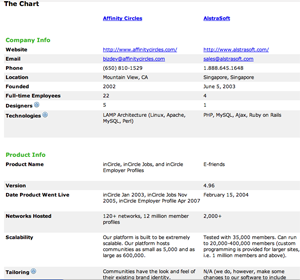
Detailed information about the companies is presented in the interactive chart to the right, which features additional information in popups and the ability to select only particular companies for comparison.

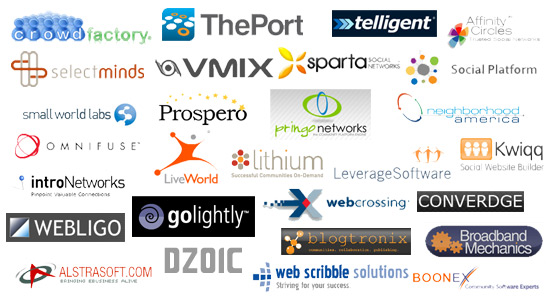
The following companies are included in the chart: Affinity Circles, AlstraSoft, Blogtronix, Boonex, Broadband Mechanics, Converdge, Crowd Factory, DZOIC, GoLightly, introNetworks, Kwiqq, Leverage, Lithium, LiveWorld, Neighborhood America, Omnifuse, Pringo, Prospero, SelectMinds, Small World Labs, Social Platform, Sparta Social Networks, Telligent, ThePort, VMIX Media, Web Crossing, Web Scribble Solutions, and Webligo.

(Update: Awareness has been added to the chart, raising the total to 35)

Not included are Dave Networks, Five Across (absorbed by Cisco), PHPizabi, Pluck, and Village Engine because they did not respond to our inquiries. phpFox responded but opted not to fill out our questionnaire.

Your initial reaction may be “wow, this market sure looks overcrowded.” In the longer run, competitive pricing may force many of these companies to drop out of the business. However, I was surprised to hear several of them say that current demand for social networking services is overwhelmingly high. One of the representatives I spoke with half-kiddingly said that he did not actually want TechCrunch coverage of his company because he already has to turn down multiple project requests per week. It will be interesting to see over the next few years whether this demand further intensifies as potential customers realize the value of niche social networks, or whether it slackens as people get over the hype surrounding this aspect of Web 2.0.

Many of these companies are targeting large, well-established organizations with deep pockets. Scan the chart and you will see big-name media companies, educational institutions, and corporations such as Reuters, Campbells Soup, Harvard Business School, Citrix, Oracle, HP, Microsoft, Fortune, Cingular, Comcast, Land Rover, American Express, ABC News, ESPN, and HotMomsClub.com (okay, so they’re not all big names).

The companies in this round-up have some advantages over those in the first round-up when it comes to providing for well-established organizations. First, these companies can protect and enhance their clients’ brands by delivering highly-tailored social network components that integrate seamlessly into existing websites. This is especially true for the subset of social networking companies that provide made-to-order solutions rather than downloadable packages. However, even downloadable software can (at least theoretically) be retooled by the clients’ developers to match an existing look and feel.

Secondly, many of these companies provide greater ownership of social network data and/or software. While a groupie running a Smashing Pumpkins fan network on Ning does not care that the network’s data is locked up in Ning’s system, Wells Fargo and Ernst & Young prefer to keep their communication systems much closer to the vest. Corporations often need to know that their data is safe and trackable for both dependability and legal reasons. Social network ownership is often ensured by putting the software and data management entirely on the client’s servers, or as is the case with Blogtronix, delivering the hardware and software together as an appliance, if demanded. However, even the hosted solutions among these companies eagerly emphasize that they respect their clients’ ultimate ownership of data on their servers.

Thirdly, several of these companies claim to develop closer, longer-lasting relationships with their clients. They provide information sessions at the beginning of their relationships, collaborate during the design process, and may even help market the social networks and provide ongoing content moderation support.

Fourthly, these companies can be very flexible when it comes to how much of the work their clients want to take on themselves. While they all provide complete social networking packages, many also support the widgetization of their features so clients can embed social networking functionality in regular pages. Some, such as Crowd Factory, also allow for the client to take complete responsibility for front-end programming and use an API to plug into a full-service back-end.

While all of these companies provide social networking functionality, they differentiate themselves in several ways. AlstraSoft, Blogtronix, Boonex, Broadband Mechanics, DZOIC, phpFox, PHPizabi, Telligent, Web Scribble Solutions, and Webligo form the minority that provide non-hosted solutions (although Blogtronix and Broadband Mechanics provide software as a service, or SaaS, solutions as well, and others might be willing to locally install their traditionally hosted platforms).

Some of them, such as Crowd Factory, Prospero, and Neighborhood America mostly concentrate on serving media companies. Affinity Circles provides job-oriented social networking solutions for alumni networks and trade associations. SelectMinds exclusively builds private networks for the employees of corporations. And Kwiqq aims to become a long-standing technology partner with the companies it serves.

A few provide unique features not found in your average social network. Leverage and introNetworks both have strikingly similar visualization features that enable network members to easily locate other members who share their backgrounds and interests. DZOIC’s Handshakes Professional product allows members to save their searches and get notified when new members match search criteria. ThePort, which has been around since 1999 and focuses on creating niche communities, differentiates itself by integrating its social networks with its own news aggregation and start page services.

Speaking of older companies, the players in this market also vary significantly in age (at least when considered in light of other Web 2.0 companies). The oldest of the group, Web Crossing, was founded in 1986, and others were originally born as Web 1.0 companies: LiveWorld in 1996, and Neighborhood America and Sparta Social Networks in 1999, for example. As representatives for Prospero (founded in 2000) attest, these older companies have needed to changed their focus in the last couple of years to accommodate a new preference for “me” technologies over “we” technologies. However, these companies also claim that their experience, business relationships, and internal structure have prepared them well for this transition and equipped them to deliver mature products.

Check out the chart for more detailed information about these companies. If you have personally dealt with any of these companies, please share your experience in the comments below.

Advertisement

Responses

Comments rss icon

  • yes, great summary thanks Mark

  • I couldn’t understand some parts of this article o.us poetry, but I guess I just need to check some more resources regarding this, because it sounds interesting.

  • Excellent summary. Thanks!

  • Curiously omitted is Elgg, the open source social networking platform, which is powering over 1200 networks including what was the world’s first institutional social network to be released to every member of a university and rugby fan sites. It’s been used by a number of very large companies, including both Vodafone and France Telecom, it’s translated into over thirty languages, has been featured on wired.com and has a spread in the current issue of .net, and you can pick it up for free.

  • Matt, most of the links point to CrunchBase, which also belongs to TC. No link-love here…

    The only 5-6 links that point to outside sites are justified IMO, so we can take a look at these Hot Moms… I mean… Social Networks!

  • Nice summary, thanks for doing this! :D

  • You forgot Active Data Online Discussion Board (http://www.acti...ssionboard.html), another .NET based solution.

  • Mark,
    Great job. Thanks.
    Vassil

  • @ RBA – #6

    CrunchBase provides plenty of link love. :D

  • Ben Werdmuller,

    Is elgg.org still live? I am getting a page cannot be displayed message.

    Mark,

    The coverage here rocks. I was just browsing at different social networking tools when you posted this one. Cool! Thanks!

  • Good summary. I have spoken with several of the companies mentioned here for setup and hosting solutions. They have all been very enthusiastic and have very quick and detailed follow ups. I found Group Members International (GMI) to be by far the most knowledgeable since they have several ex-myspace people in their team. They have very sound fundamentals but come with a steep (premium) price tag. Other companies like Sparta, Kwiqq and Small World labs are more affordable in my opinion and are more or less priced at par with reference to providing an enterprise level solution. The fine print is that though several claim to be able to have a community up and running in a week – its all hype! The reality is that it takes at least 1-3 months (safe estimate) to have the community up and running after various levels of testing – especially if the client is offshore or separated by geography and a different time zone e.g. USA and India.

    My advice to readers is this – read the fine print and do a deep dive on hosting, site maintenance, page views serving, number of members supported, cost of added components like video upload and streaming, etc. before selecting a technology partner. What may at first seem like a bargain may be costlier than what you first saw as being expensive.

    All the best.

    Interactive Visionary

  • Hi Mark,

    Is the market too crowded for social networks? No at all. You point out a corporation market for enhancing developments with corporate culture embedded. Big corporations have their own set of values and promote them. What a best way to do it than its Intranet, not reconverted to social network with data privacy and its own widgetization of their features. I WOULDNOT LIKE TO BE A PART OF THE IMPLEMENTATION TEAM. AFTER ERP PROJECTS WITH VERY RIGID SPECS AND BATTLING WITH THE CUSTOMER FOR EVERY CHANGE, I FORESEE, IT WILL TAKE FOREVER OPEN PROJECT LIKE THESE.

    This is just one of the specializations for these applications: We soon are going to have, the homo network, the lesbian, the blue collar, wall street, family, Christians, so on and so forth. Lets not be blind the today´s networks belongs to the high school kids, excepted for Linkedin. There is a lot of room for everyone.

    Mario Ruiz,
    http://www.oursheet.com

  • @ Techticles, 11: yep, we’re still very much up and running. Also see the parent company, Curverider.

  • Have you seen the growth of Websense? That looks bad news especially when big corporations block all these social networks in websense. They would more would they care less on having a social network in the enterprise. Afterall, they wouldn’t want people to be that close for employee Union organizations.

  • Altrasoft is a scam! Just Google Altrasoft nightmares and you will find many review, their customer service hotline is dead, 2checkout.com banned them and they are run by 2 guys who have scammed so many people!

    John Ross is the guy, before sales service is super good and after you have bought their product they mysteriously disappear. E-friends is full of bugs and it is reported that they have stolen some of the software, rebranded it under their own brand.

    http://www.site...d.php?p=3491708

    This is just one of the many horror stories, you will find, Google them more and you will find many others….

  • @16: The enquiries we’ve received suggest otherwise. Also, if a company cares more about squashing unions than helping their employees find colleagues with relevant interests and skills, and therefore making their operations more efficient, I’d suggest that they aren’t going to last very long …

  • Laurent Emolument - August 14th, 2007 at 3:09 am PDT

    Is the market too crowded for social networks? Absolutely.

    I have enough trouble keeping up with Facebook. I need a real good incentive to sign up for another one. Free tins of campbells soup or glossy pics of Land Rovers just isn’t enough

  • Today’s youth can’t get enough of these social networks (e.g., my brother in high school belongs to at least 4) and as young people grow up they’ll be very comfortable using these types of networks–at their future jobs in corporations or for keeping in touch with other alumni from their colleges. The growth and market potential for social networks such as those featured here looks quite good.

  • Superb summary! This will be very helpful to many people. If there’s any way you can continue to update the chart as these platforms evolve, this will be a must read for many media execs.

  • Ah, I wish I had had time to let you know about neighborring.org
    http://www.neighborring.org been – it’s been around for a couple of years now helping small nonprofits create branded local social networks. However it’s completely off-the-radar since it’s hidden from all search engines to make it more private. The site can be configured as free or per-signup fee and donates 100% of any signup proceeds back to the nonprofit. Here’s an example: http://www.fath...odcoalition.org (see resource net link)

    Functionally, I think it is the first site to facilitate sharing of skills, experience, and possessions between friends. Shareable items can be listed as private (between friends) or public. Organizations are special group types that treat all members as friends for sharing.
    Resources can be merged between individuals or organizations…

    The idea is that if you put this on your site instead of a simple Donate button you are giving your members something in return: the ability to share for mutual benefit.
    It has had a yahoo-maps mashup component since before people were calling that ‘web 2.0′. It does need some GUI updates…

    NR was developed with input from nationally recognized community-builders using a time-tested technique of neighborhood development and has the backing (fiscal sponsorship) of a very well established nonprofit, timebanks USA, and yes there is a bunch of nonprofits including YMCAs waiting to be set up on NR. Contact me if you’d like to get involved as an investor or partner. thanks.

  • good write up, I am sure this helps the remain people looking to start up in this space find where the competion is at.

  • Ouch =). I like to think we provide something more valuable than link lists when doing these round-ups.

  • I wrote this piece ( http://hjalli.com/?p=169 ) in 2004 about the need for a meta-social networking tool (comparing it to Trillian, which was the meta-IM of choice at the time).

    I believe this need is even more real today, but still haven’t seen anything that comes close to a good implementation.

  • Okey, Thanks for the summary, Excellent!!

  • Mark

    great job with this Analysis!

  • NIce analysis; best article in weeks around here. :)

  • http://onmycity.com should have gotten a mention. We provide social networking for schools, churches and other organizations as well as businesses.

  • Hi Mark,

    Thanks for the summary. And thanks for including Prospero in the comparison chart. I wanted to correct one item that you attributed to our conversation: I noted that Prospero’s business has historically been focused on services as message boards, chat, polls, ratings and other applications that are about bringing together a community in the context of “we”. For example, fans of the Red Sox on MLB.com or expectant mothers on BabyCenter.com. Social networks are more about people meeting other people with similar interests and publishing information about themselves, or what I called the “me” perspective. So we’ve been transitioning our business to mesh the “we” communities with the ability to learn more about the people who participate in them using “me” techniques such as friending, personal journals, and private messaging. (You said that we’re trying to transition from “me” to “we”).

    It may seem like a minor point, but it’s a significant shift that is driven primarily by the success of MySpace, Facebook and LinkedIn.

    Thanks again.

    Rusty Williams
    Prospero Technologies

  • Rusty: Thanks for the correction; I’ve fixed the post. I probably should have elaborated on that point anyway, but you’ve done a nice job doing that for me.

  • #25, Mark, thats why i say, stay far away from making that lists:) otherwise term ‘get techcrunched’ will loose its value:)

  • I would take some of the chart responses with a grain of salt, for anyone seriously considering some of these products.

    As part of my job I had to evaluate several off-the-shelf social network solutions for my employer. We wanted a jump-start solution to bridge the gap between launch and our custom solution.

    I reviewed a few of the products in the chart (and one not on the chart), and I had similar experiences with all of them.

    One example is Handshakes by DZOIC. My experience with that product does not quite stack up to the chart. They claim to have an API, but that is really not true. They have a WYSIWYG editor (that only works in IE-Windows) for creating and editing HTML pages.

    They use code-generated configuration files that replicate configuration details in multiple places (sometimes up to 5 different files in different folders for the SAME information).

    User homepage templates are physically duplicated and copied into folders along with images and CSS information. Want to change a user template or update an image? Good luck, unless you write a script that crawls all the user folders and updates each and every image. They claim 500,000 users in the database but their system would be a horrible nightmare to manage with only 5,000 users.

    There is also no real developer documentation and the entire codebase is a procedural PHP 4.x spaghetti-code mess, with objects only used as containers, and all the code split into linear modules. I don’t know how they can claim to provide an API.

    Anyways, that was a bit of a rant, but Handshakes was really the worst of the bunch that I looked at.

    All I can suggest is that if you are looking for a very custom solution, be weary of off-the-shelf, but if you can live with the built-in features, you might be ok.

    There is a reason that big successful websites don’t run on off-the-shelf products.

    • I agree. I purchased this software. The code is spaghetti and next to impossible for a developer to work with. I’ll give him credit, he was there to answer questions, but I seemed to know more about the programming than he did. Millions of folders, millions of files, poor framework. I was initially attracted by the price and gamut of features but in the end I had to purchase another software as well. I don’t recommend Handshakes.

  • I’ve recently explored several downloadable solutions to base a social networking site off of. I find that most provide functionality I don’t need, while at the same time miss critical parts I *do* need.

    My gut feeling was that we’d need to “roll our own” – not a good option when you have a tight deadline. We need a head-start.

    In the end, I feel in love with Drupal (www.drupal.org). The core install provides a bare minimum feature-set. You can choose from hundreds of plugins/modules to add the social networking functionality you need (friends, blogging, media sharing, etc). For custom features, write your own modules – there is a huge development community, and even books in print to guide your through it.

    Even IBM chose to develop with it:
    “Using open source software to design, develop, and deploy a collaborative Web site”
    http://www-128....ex.html?ca=drs-

    An excellent writeup Mark. You’ve mentioned several options I hadn’t heard of.

  • mark,

    first…great job with the chart. lots of important info on there.

    the platform info is a huge one because consultants need to be able to inform their clients what solutions are available based on the platform their company supports.

    I noticed everything was either asp.net or php. I didn’t see any rails, django, and I don’t think there was any java on there either.

    I found that interesting.

    cheers.

  • The chart is fantastic. Thank you. I’d visit CrunchBase a lot more if these grids were added for each product category.

  • Mark,

    This is very well done, thank you!

    We are presently working with Small World Labs to implement an unusual twist on social networks. We selected SWL on the basis of their ability to delivery a highly customized solution, and couldn’t be happier with the enthusiasm and professionalism they’ve brought to their approach.

    Because the project is still in stealth mode, I can’t disclose more information on the specific customization they are providing, but I can say that, of all the companies we interviewed, they were the only ones who not only understood what we were doing, but partnered with us to make it happen on time and on budget.

    We’ll be launching in September and I’ll be sure to set aside some Crunch invites for the beta ;)

  • Good summary, missing CommonGate though.

  • Hey Mark,

    Thanks for including Small World Labs in your comparison chart.

    You mention that “several of these companies claim to develop closer, longer-lasting relationships with their clients” and I just wanted to add that we are very committed to community planning and feel that a focus on people as well as the technology is key to creating a thriving online community.

    Thanks again,
    Miles Sims
    http://www.smallworldlabs.com

  • On niche social networks that you don’t need much differentiation with the average Joe, then these off the shelf packages are sufficient. I still believe that for true projects that you want to take to another level, you gotta have your own codes.

  • Great work, Mark. Lotta stuff here. I’ve personally worked with Dolpin & Handshakes & both have their ups & downs. There’s definitely more opportunities nowadays for white label SNS. :)

  • I must say, it’s refreshing to see an article about businesses other than those with paid advertisements on the right side bar, or that ‘ perhaps’ have no ties with the VC in crowd of Mike( I said perhaps). YIPPPEEEEEEEEEE, it isn’t about Facebook.

  • Mark, this is quite and impressive and valuable piece of work for companies looking to add some social media zip to their sites. Having done similar research for a major media client in the past year, I know firsthand how much work had to have gone into this – so thanks!
    To echo your post, I also had an experience with another vendor not listed here who started my introductory call with her by telling me that she was too busy to do anything with my client for 4-5 months. Needless to say, that sales pitch didn’t go anywhere, but it does indicate that if these guys start sales calls like that, they may actually have too much business.
    The trick will be to find the right niche or provide enough flexibility where one’s solutions provide the right fit and value to prospective customers. Also, I found that price points and pricing models varied quite a bit but most were flexible.

  • So I just read that Classmates.com is going to be the first “social network” to go public. Their business model — a way for classmates to reconnect, has been improved and offered for free from Facebook and Myspace. Add this to rapid sales growth which won’t be sustainable, and we will see it sink.

    http://mediabiz...oney_topstories

  • Not a one of these things are useful. No Web site is going to help you build a social network beyond your existing socialness. Adding people’s names to a list of links isn’t going to help you get a job or whatever a social network could provide you. These sites are all sort of a lie in that they seem to advertise themselves as a way to meet people. But the only way to meet people, website or otherwise, is to have social skills and to fit into a social group. These websites just give people the feeling that they know a lot of people or have a lot of connections, or give them a way to organize and catalog the connections they have. So what if I’m linked in three degrees to the CEO of Ubercorp? It won’t do me a damn bit of good on its own. Unless you already know a lot of people, get along with them real well, and associate with them freely, you’re not going to have a meaningful social network. Did we learn nothing from Friendster?

  • I just checked the elgg.org site and it’s working just fine.

    http://www.elgg.org

  • Not sure if you guys read that Kickapps, one of the social network providers reviewed in the earlier article, has just closed its latest round of funding:

    http://www.kick....com/blog/?p=71

  • does anyone know any SEO impacts of using any of these forums based services vs. using a standard forum software such as vbulletin which does have some powerful features and is very SEO friendly?

  • the two open source solutions to build your own social networks are not included in the list.

    1. mugshot supported by redhat. 2. elgg a solution for educational networks.

  • Social Networking space is surely crowded already. Most of those are copy cats and resembles in one way or the other. It’s now high time that people come up with innovative attractions.

    Rajesh Shakya
    http://www.rajeshshakya.com
    helping technopreneurs to excel and lead their life!

Leave Comment

Commenting Options

Enter your personal information to the left, or sign in with your Facebook account by clicking the button below.

Alternatively, you can create an avatar that will appear whenever you leave a comment on a Gravatar-enabled blog.

Trackback URL
bugbugbug